Taxation & Customs · 2026-10-06
The FCC upheld super tax in January 2026, and the Finance Act 2026 changed the rates. What was decided, and what is still worth contesting.
Read more →
Taxation & Customs · 2026-10-06
A reference is won or lost on how the questions of law are framed. The 90-day limit, what can be argued, and recovery while it is pending.
Read more →
Taxation & Customs · 2026-10-06
Leave to appeal under Article 185(3), the 60-day limit, where tax cases are heard, and when the Federal Constitutional Court is the right forum.
Read more →
Inheritance & Succession · 2026-02-02
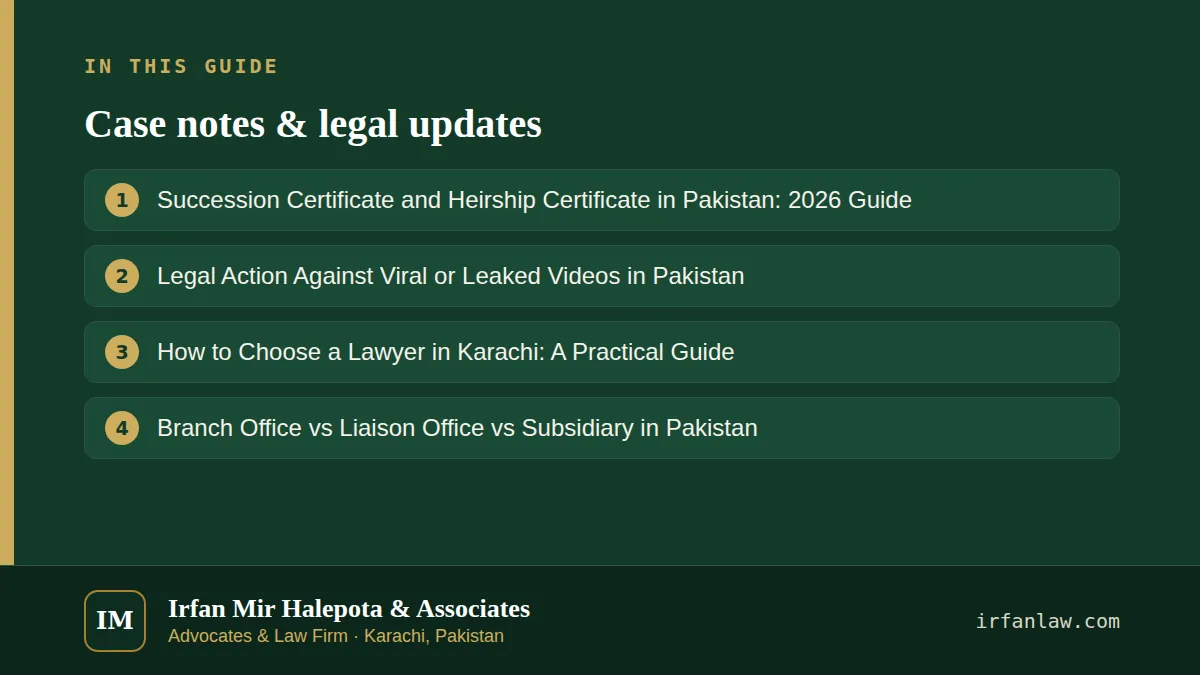
A succession certificate covers movable assets; letters of administration cover immovable property. NADRA now issues both for uncontested estates.
Read more →
Criminal Litigation · 2026-02-04
How to preserve evidence, which PECA offence applies, where to complain now the NCCIA has replaced the FIA, and how to get content removed.
Read more →
General · 2026-02-06
Which forum your matter belongs to, how to verify Bar Council enrolment, what to ask about fees, and the warning signs.
Read more →
International Trade · 2026-02-14
Neither a branch nor a liaison office may trade in Pakistan — only a subsidiary can. How the three structures differ on approvals, liability, tax and repatriation.
Read more →
Intellectual Property · 2026-07-12
Germany (DPMA) and Austria are covered by an EUTM; Switzerland (IPI) is outside the EU entirely.
Read more →
Intellectual Property · 2026-07-10
France has INPI; Belgium, Netherlands and Luxembourg share the BOIP with no national offices.
Read more →
Intellectual Property · 2026-07-14
Denmark, Sweden and Finland are EU-covered; Norway and Iceland are EEA but not EU.
Read more →
Intellectual Property · 2026-07-18
Italy, Spain, Portugal, Greece, Malta and Cyprus — all EU members covered by one EUTM.
Read more →
Intellectual Property · 2026-07-02
Poland, Czechia, Slovakia, Hungary and Slovenia — EU-covered with active national registers.
Read more →
Intellectual Property · 2026-06-30
Estonia, Latvia and Lithuania keep three separate registers, all covered by one EUTM.
Read more →
Intellectual Property · 2026-06-28
Croatia, Romania and Bulgaria are EU-covered; the Western Balkans are not.
Read more →
Intellectual Property · 2026-07-20
Ireland stays inside the EUTM; the UK left it at Brexit.
Read more →
Intellectual Property · 2026-07-06
Turkey, Ukraine, Moldova, Belarus and Russia all sit outside the EU trademark system.
Read more →
Intellectual Property · 2026-07-08
Europe is not 44 separate trademark systems. One EU Trade Mark filing covers 27 countries — here is which route covers which country, and how to file from Pakistan.
Read more →
Intellectual Property · 2026-03-28
How an EU Trade Mark works — one EUIPO application covering 27 member states, and the all-or-nothing opposition risk.
Read more →
Intellectual Property · 2026-07-24
Since Brexit, an EU Trade Mark gives no protection in the United Kingdom. What Pakistani exporters selling into Britain need to file separately.
Read more →
Intellectual Property · 2026-02-12
There is no such thing as a Belgium-only trademark — the BOIP handles all three countries together.
Read more →
Intellectual Property · 2026-05-11
An EU Trade Mark leaves much of Europe uncovered. How to protect a brand in Switzerland, Norway, Turkey, Ukraine and the Western Balkans.
Read more →
General · 2026-04-23
Plain-English definitions of the Pakistani legal terms clients ask about most — Khula, Vakalatnama, FIR, stay order, and more.
Read more →
Intellectual Property · 2026-07-04
What a trademark filing actually costs in Pakistan — government fees, agent fees, and what changes the timeline.
Read more →
Intellectual Property · 2026-05-05
Which countries a Pakistani business can actually designate under Madrid, and how the fee structure works.
Read more →
Intellectual Property · 2026-04-15
Trademark filing is the floor, not the whole plan, for multinationals entering the Pakistani market.
Read more →
Intellectual Property · 2026-03-14
.pk disputes run through PKNIC's amended UDRP policy and the DNDRC — not the standard providers.
Read more →
Intellectual Property · 2026-02-08
A Pakistani-only trademark usually will not unlock Amazon Brand Registry on its own.
Read more →
Intellectual Property · 2026-05-17
DRAP approval and IPO trademark registration are separate processes that don't protect each other.
Read more →
Intellectual Property · 2026-04-05
For multinationals that already hold trademarks abroad, extending protection into Pakistan.
Read more →
Intellectual Property · 2026-05-09
The recurring, avoidable trademark mistakes we see multinationals make in Pakistan.
Read more →
Intellectual Property · 2026-07-22
Defensive registration and monitoring steps that prevent a dispute before it starts.
Read more →
Intellectual Property · 2026-05-03
Pakistan has been a Madrid Protocol member since 2021, with full domestic legislative backing since 2023 — advice on outbound filings from Pakistan and inbound designations of Pakistan.
Read more →
Intellectual Property · 2026-04-11
Two routes exist for international trademark protection touching Pakistan — direct national filing, or the Madrid Protocol. How each works, and which to choose.
Read more →
Intellectual Property · 2026-05-01
The outbound Madrid Protocol process for Pakistani trademark holders, step by step — from the basic Pakistani application through to examination in each designated country.
Read more →
Intellectual Property · 2026-04-03
How a Madrid Protocol designation of Pakistan is examined, what a provisional refusal means, and how it compares to filing directly with IPO-Pakistan.
Read more →
International Trade · 2026-03-24
Foreign judgments aren't automatically enforceable in Pakistan — how the reciprocating-territory execution route and the fresh-suit route work, and how this differs from enforcing an arbitral award.
Read more →
Family Law · 2026-03-02
A plain walk-through of how court marriage registration works in Karachi — documents, the Nikah Nama, and the mistakes that cause delays.
Read more →
Civil Service · 2026-06-02
Government employees challenging a termination or disciplinary order go through the Sindh or Federal Service Tribunal, not the ordinary civil courts. Here's how that process actually works.
Read more →
Intellectual Property · 2026-07-16
Most trademark refusals in Pakistan trace back to a handful of recurring issues. Knowing them before you file saves months of opposition proceedings.
Read more →
Civil Litigation · 2026-05-25
A realistic look at how long a money recovery suit takes in Karachi's civil courts, and the moves that actually shorten it.
Read more →
Civil Litigation · 2026-04-09
Courts apply a consistent three-part test before granting an injunction. Knowing it changes how you should draft the application.
Read more →
Criminal Litigation · 2026-05-19
Pre-arrest bail exists to protect against malicious prosecution — but courts scrutinise it closely. Here's what actually gets it granted.
Read more →
Criminal Litigation · 2026-03-06
Online harassment, blackmail and impersonation are prosecuted under the Prevention of Electronic Crimes Act. Here's what filing — or defending — a complaint involves.
Read more →
Criminal Litigation · 2026-07-28
An FIR is the start of the process, not the end of it. Here's what the stages between registration and trial actually look like.
Read more →
Corporate & Commercial · 2026-05-31
A practical walk-through of registering a private limited company with SECP — structure choices, documentation, and where founders usually get stuck.
Read more →
Corporate & Commercial · 2026-06-04
Most shareholder disputes we see trace back to a founding document that never addressed the situation that eventually happened.
Read more →
Corporate & Commercial · 2026-03-20
The legal due diligence items buyers most often skip — and the ones that cause the most expensive surprises after closing.
Read more →
Family Law · 2026-08-01
Khulla gives a wife a route to end a marriage without her husband's consent. Here's how the process actually runs in Family Court.
Read more →
Family Law · 2026-02-22
Custody decisions turn on the welfare of the child, not a fixed rule favouring either parent. Here's what Guardian Courts actually weigh.
Read more →
Family Law · 2026-05-23
Dower is a legal debt, not a gesture — and it's recoverable through the Family Court even years after marriage.
Read more →
Intellectual Property · 2026-02-26
Copyright arises automatically on creation — but registration still matters more than most creators assume.
Read more →
Intellectual Property · 2026-05-29
An opposition notice isn't automatically fatal to your application — but the response deadline and evidence requirements are unforgiving.
Read more →
Taxation & Customs · 2026-03-30
A show-cause notice sets a short clock running and shapes every appeal that follows. Here's how to approach the response.
Read more →
Taxation & Customs · 2026-06-20
Tax appeals in Pakistan follow a defined chain, and each stage narrows what arguments remain available. Here's the route, stage by stage.
Read more →
Taxation & Customs · 2026-03-04
A held shipment is usually about valuation or classification, not a random check. Here's how those disputes are resolved.
Read more →
Civil Service · 2026-03-08
Government employees who go straight to the Tribunal without exhausting departmental appeal often lose on a technicality, not the merits.
Read more →
Civil Service · 2026-05-15
Pension disputes — withheld, delayed, or miscalculated benefits — go through their own process, distinct from active-service disciplinary appeals.
Read more →
Property & Real Estate · 2026-05-21
Forged documents, impersonation, and fraudulent powers of attorney are more common in Karachi property disputes than buyers expect.
Read more →
Property & Real Estate · 2026-06-10
When a seller backs out after receiving payment, specific performance — not just a refund — is often the stronger remedy.
Read more →
Banking & Finance · 2026-04-27
Being sued by a bank isn't automatically a losing position — but the response window and available defences are narrower than in ordinary civil suits.
Read more →
Banking & Finance · 2026-02-10
Banking Courts exist because ordinary civil procedure was too slow for finance recovery. Here's what's actually different about them.
Read more →
International Trade · 2026-04-01
Foreign investors can wholly own a company in most sectors of Pakistan's economy. Here's the practical sequence of steps.
Read more →
International Trade · 2026-03-22
Pakistan recognises foreign arbitral awards under the New York Convention — but enforcement still requires navigating a specific court process.
Read more →
Environmental Law · 2026-03-26
Not every project needs a full Environmental Impact Assessment — but getting the threshold wrong can stop construction mid-way.
Read more →
Environmental Law · 2026-05-27
A closure notice stops operations immediately. Here's how to respond, and what the appeal route to the Environmental Tribunal looks like.
Read more →
Arbitration & ADR · 2026-03-16
A poorly drafted arbitration clause causes more disputes than it prevents. Here's what a working clause actually needs.
Read more →
Arbitration & ADR · 2026-02-20
Courts don't re-examine the merits of an arbitral award — challenges succeed only on narrow, specific grounds. Here's what those actually are.
Read more →
Firm News · 2026-04-13
We're accepting applications for our current internship intake. Here's what interns work on, and how to apply.
Read more →
Inheritance & Succession · 2026-06-10
A widow's inheritance share is fixed by law — but disputes over how it's calculated and enforced are among the most common family conflicts we see.
Read more →
Landlord & Tenant · 2026-06-24
Eviction in Karachi isn't a matter of a landlord's say-so — it runs through a defined legal process with limited grounds. Here's what tenants should know.
Read more →
Constitutional Law · 2026-06-14
Pakistan's apex judiciary was split in two by recent constitutional amendments. Here's what that means for where an appeal actually belongs.
Read more →
Family Law · 2026-04-25
Maintenance, custody and even basic communication become harder when a husband lives overseas. Here's what's actually available under Pakistani law.
Read more →
Civil Service · 2026-06-16
A landmark 2025 ruling held that giving government jobs to a deceased employee's widow or child without open competition violates constitutional equality guarantees.
Read more →
Constitutional Law · 2026-06-12
A look back at the constitutional petitions that led to the announcement of Pakistan's February 2024 general election date, and what the case shows about the limits of judicial power.
Read more →
Divorce & Khula · 2026-06-18
A talaq isn't legally effective the moment it's pronounced — Pakistani law requires a specific notice and waiting process under the Muslim Family Laws Ordinance, 1961.
Read more →
Divorce & Khula · 2026-04-19
Filing for khula is the easy part — knowing what happens at each hearing afterward is what actually determines how smoothly the case moves.
Read more →
Divorce & Khula · 2026-03-12
Missing or inconsistent documentation is one of the most common causes of delay in a khula case. Here's what to gather before filing.
Read more →
Divorce & Khula · 2026-04-21
Three distinct legal routes end a Muslim marriage in Pakistan, each with different initiators, procedures and financial consequences.
Read more →
Divorce & Khula · 2026-03-10
A talaq notice or khula decree isn't the final step — registration with the Union Council is what makes the divorce official on the record.
Read more →
Divorce & Khula · 2026-02-24
A husband's opposition doesn't stop a khula case — but it does change how the case unfolds, and what evidence ends up mattering.
Read more →
Divorce & Khula · 2026-05-13
Living outside Pakistan doesn't put divorce or khula out of reach — but it does add a few extra procedural steps worth understanding upfront.
Read more →
Divorce & Khula · 2026-04-17
Timelines and costs for khula vary case to case — here's what actually drives that variation, so you can judge your own situation realistically.
Read more →
What this page covers: Case notes & legal updates.