Khula vs Talaq vs Mubarat: Comparing the Three Routes to End a Marriage in Pakistan
Three distinct legal routes end a Muslim marriage in Pakistan, each with different initiators, procedures and financial consequences.
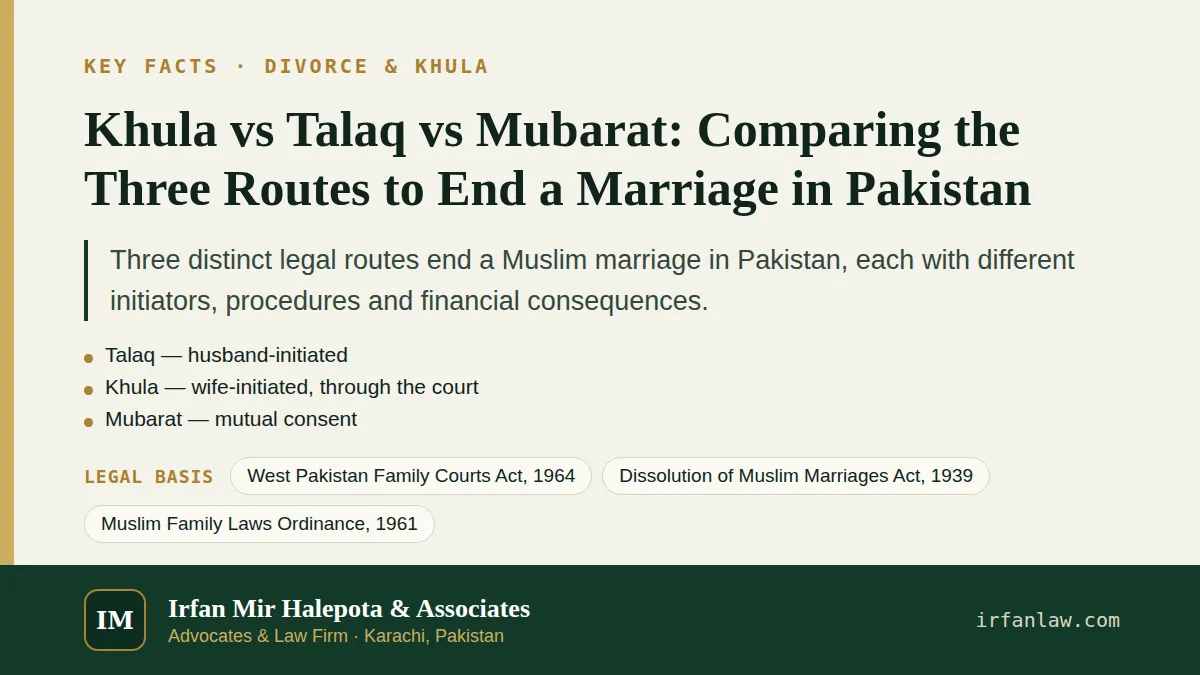
Clients often use "divorce" and "khula" interchangeably, but Pakistani law recognises several distinct routes to end a Muslim marriage, and the differences aren't just terminology — they change who initiates the process, what procedure applies, and what happens to dower. Before hiring the best divorce lawyer in Karachi, it helps to know that these three routes are not interchangeable — each carries different consequences.
Talaq — husband-initiated
Talaq is pronounced by the husband and becomes legally effective only after the Section 7 MFLO notice-and-reconciliation process runs its course, typically over ninety days. It doesn't require the wife's consent, but it does require the husband to follow the statutory procedure for it to have clear legal effect.
Khula — wife-initiated, through the court
Khula is a wife's route to dissolve the marriage through the Family Court where the husband doesn't consent to release her. It proceeds as a suit, generally centred on her sworn statement that the marriage cannot continue within the limits prescribed by Allah, and commonly involves returning some or all of the dower she received.
Mubarat — mutual consent
Mubarat is dissolution by mutual agreement — both spouses want to separate and consent to the terms, which can make it the most efficient route where both sides are genuinely aligned. Financial terms, including dower, are typically settled by agreement rather than contested, though the dissolution still needs to be formally registered to have full legal effect.
Why the distinction matters practically
The correct route depends entirely on the actual situation — whether the husband is willing to pronounce talaq, whether he consents to release the wife, and whether dower terms can be agreed rather than litigated. We assess this at the first meeting, since pursuing the wrong route can cost months that a better-fitted one wouldn't have.
What stays the same across all three
Regardless of route, registration with the Union Council, the running of the iddat period, and its effect on matters like custody and maintenance follow broadly similar principles — the difference is almost entirely in how the marriage gets to that end point.
Follow us on Google
If these guides are useful, add this site as a preferred source. Google will then show it more prominently to you in Search, Discover and AI results.
Official sources
Common questions
What is the legal difference in outcome between khula and dissolution on a fault ground?
The financial consequence. Khula is dissolution in exchange for consideration: in Sindh, the proviso to section 10(4) of the West Pakistan Family Courts Act, 1964 requires the Family Court to restore to the husband the dower the wife received at the time of marriage. Dissolution granted on a ground under Section 2 of the Dissolution of Muslim Marriages Act, 1939 does not carry that consequence. The Supreme Court criticised courts for blurring the two in Civil Petition No. 3268/2024.
Does a talaq take effect as soon as it is pronounced?
No. Section 7 of the Muslim Family Laws Ordinance, 1961 requires the husband to give written notice of the talaq to the Chairman of the Union Council, with a copy to the wife. The Chairman constitutes an arbitration council to attempt reconciliation, and the talaq does not take effect until ninety days have elapsed from the date the notice was delivered, unless revoked earlier. The marriage subsists during that period.
Is khula available if my husband simply refuses?
Yes. Khula is a judicial dissolution granted by the Family Court and does not depend on the husband's consent. His non-appearance or refusal delays the proceedings; it does not defeat them. Under the proviso to section 10(4) of the Family Courts Act, 1964, the court is to pass the decree forthwith once reconciliation has failed.
This article is general information about Pakistani law and procedure, not legal advice for any specific matter. If this touches on something you're currently facing, get in touch and we'll advise on your facts directly.