Contested Khula Cases: What Happens When the Husband Opposes
A husband's opposition doesn't stop a khula case — but it does change how the case unfolds, and what evidence ends up mattering.
Many wives hesitate to file for khula out of concern that a husband's opposition will drag the case out indefinitely or even prevent it succeeding. In practice, opposition changes how the case is conducted, but Pakistani courts have been fairly consistent on the underlying principle: his consent is not required for khula to be granted. Women searching for the best family lawyer in Karachi for a contested khula need to know that opposition delays a case — it does not defeat it.
What a husband typically argues in opposition
Common defences include disputing the grounds asserted, contesting the dower terms proposed for return, or arguing that reconciliation is still possible. Some opposition is genuine; some is aimed simply at prolonging the process, and courts are generally attentive to which is which.
Why the wife's statement carries significant weight
Higher courts in Pakistan have repeatedly affirmed that where a wife firmly and consistently states, on oath, that the marriage cannot continue within the limits prescribed by Allah, that alone is generally treated as sufficient — the husband's opposition doesn't require the court to force the marriage to continue against her stated position.
Where opposition actually has more impact
Contested khula cases tend to be fought hardest over the financial terms — how much dower is returned, and disputes over property or assets — rather than over whether the khula itself will be granted. Being prepared for that fight, with documentation on dower and any relevant assets organised in advance, matters more than trying to overcome opposition to the divorce in principle.
Delay tactics and how courts respond
Repeated non-appearance, adjournment requests, or procedural objections are common delay tactics in contested matters. Family Courts have case-management tools to keep proceedings moving, and persistent, well-documented follow-up from the wife's side is usually what keeps a contested case from stalling indefinitely.
Follow us on Google
If these guides are useful, add this site as a preferred source. Google will then show it more prominently to you in Search, Discover and AI results.
Official sources
Common questions
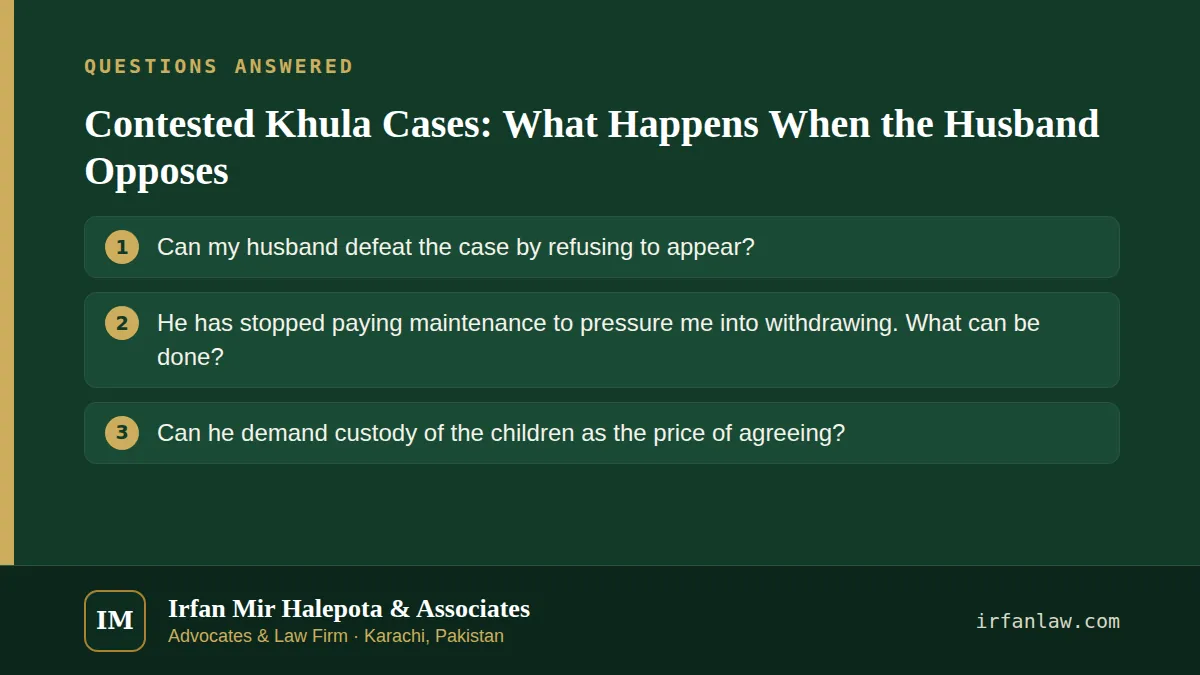
Can my husband defeat the case by refusing to appear?
No. Khula is a judicial dissolution and does not depend on the husband's consent. Non-appearance delays proceedings rather than defeating them, and Under the proviso to section 10(4) of the Family Courts Act, 1964, the court is to pass the decree forthwith once reconciliation has failed.
He has stopped paying maintenance to pressure me into withdrawing. What can be done?
Section 17-A is designed for exactly this. Where interim maintenance has been fixed and the defendant fails to pay by the fourteenth day of each month, the statute provides that his defence shall stand struck off and the Family Court shall decree the suit on the averments in the plaint. In 2024 SCMR 1292 the Supreme Court confirmed the Family Court's authority to strike off the defence of a father who failed to comply, and imposed costs for the delay.
Can he demand custody of the children as the price of agreeing?
No. In Civil Petition No. 4129/2019 the Supreme Court held that khula does not contemplate surrendering a child's custody to secure it, and that custody cannot constitute valid consideration for khula. Such a condition in a khula agreement is contrary to law.
This article is general information about Pakistani law and procedure, not legal advice for any specific matter. If this touches on something you're currently facing, get in touch and we'll advise on your facts directly.