Free Legal Advice in Karachi: Sadqa and Zakat Consultations for People Who Cannot Afford a Lawyer
Irfan Mir Halepota & Associates gives free legal advice, as sadqa and zakat, to people who cannot afford a lawyer, especially women facing divorce, khula, maintenance or custody problems, widows and sisters denied inheritance, and women facing harassment or blackmail. Call or WhatsApp +92 321 2057582, or book a time at the office at Glass Tower, Teen Talwar, Clifton. The advice is free; court representation is not promised, and where you need a lawyer you cannot pay for, we will point you to the free legal aid routes under the Pakistan Bar Council Free Legal Aid Rules, 1999 and the District Legal Empowerment Committee (Constitution and Functions) Rules, 2011.
A woman whose husband has stopped paying for the children, or a sister told she has no share in her father's house, rarely needs a long engagement on day one. She needs an honest answer to three questions: what are my rights, which office or court deals with this, and what should I do this week. Many people search for the best family lawyer in Karachi when what they first need is exactly that answer, given free and without pressure to sign anything. That is what this page offers, and it explains the limits plainly so that no one is misled.
Who the free advice is for, and what it covers
The firm gives this advice as sadqa and zakat, as charity, to people who cannot afford to pay a lawyer. It is meant especially for:
- women facing divorce, khula, unpaid maintenance or a custody dispute;
- widows, and sisters and daughters, who have been denied their share of inheritance;
- women facing harassment, threats or blackmail, including online and through misuse of private pictures or videos.
In a consultation we will listen to what has happened, read the documents you have, explain your rights in plain language, tell you which forum deals with the problem (Family Court, Guardian Court, Union Council, police, a complaint body), and tell you what the first step is and what papers to collect.
What it is not. Free advice is not a promise of free court representation. Preparing and arguing a case takes months of work, and we will not suggest otherwise. What we promise is an honest view of your options, including the ones that cost nothing, and, where you need a lawyer in court but cannot pay for one, directions to the free legal aid routes described below.
How to ask for free advice
- Phone or WhatsApp +92 321 2057582. A short message is enough to begin: who you are, the problem in two or three lines, and any date that is coming up, such as a hearing or a Union Council meeting.
- Send photographs of key papers if it is safe to do so, for example the Nikah Nama, a talaq notice or a court summons. Clear photographs of each page are fine.
- Come to the office if you prefer, by appointment, at Glass Tower, Teen Talwar, Clifton, Karachi. A family member may come with you.
Your safety comes first. If someone checks your phone, tell us the safest time and way to reply, or ask a trusted relative to make contact for you. What you tell us is kept confidential. If you are in immediate danger, call the police on 15 first and contact us afterwards.
A relative can make the first call on your behalf, but on matters such as khula or custody we will usually need to hear from you directly before giving firm advice, because the facts and the decision are yours.
Free legal advice as sadqa and zakat
The firm gives this free advice as sadqa and zakat: time and professional knowledge given for the sake of Allah to people who cannot afford a lawyer. Priority goes to those most in need: women facing divorce, khula, maintenance or custody problems, widows and sisters kept out of their inheritance, and women facing harassment or blackmail.
No fee is charged for the advice.
Can a donor use zakat to pay a deserving litigant's court costs or fees?
This is a different question, and a common one from families who want to help a relative. Scholars' answers turn on the principle of ownership (tamlik):
- Giving the money to the litigant. If the litigant is eligible for zakat, the donor can give the zakat to her, and she, as owner, may then use it for court fees, copying charges or a lawyer. This is the clearest route.
- Paying a third party on her behalf. Hanafi authorities generally hold that paying a bill directly, without the recipient first owning the money, does not discharge zakat. Some allow it where the recipient authorises the payment: a fatwa of Darulfiqh (Mufti Faraz Adam) treats a payment to a poor debtor's creditor as valid zakat if the debtor acknowledges it, the creditor then acting as the debtor's agent; without that acknowledgement it is only a gift. Darul Ifta Birmingham similarly allows the eligible person to appoint a representative who receives the zakat for her and then pays the fees.
- Eligibility still matters. The recipient must be someone entitled to zakat; a litigant who owns surplus wealth at the nisab level beyond her basic needs is not, however expensive her case.
Views differ in the detail between schools of thought and between individual scholars, and these short fatwas are not a substitute for a ruling on your own facts. Before using zakat this way, consult a qualified mufti or the dar ul ifta you trust. We can advise on the law and the court costs involved; we do not give fatwas.
Free legal aid routes in Karachi when you need a lawyer in court
If you need representation and cannot pay, these are the formal routes that exist, with what we have been able to verify about each:
- Bar Council free legal aid committees. Providing free legal aid is one of the functions of the Pakistan Bar Council under section 13(1)(la) of the Legal Practitioners and Bar Councils Act, 1973. The Pakistan Bar Council Free Legal Aid Rules, 1999 set up a central committee, provincial committees at the seat and benches of the High Court of Sindh, and district committees. They are meant for poor and deserving litigants, including widows and in family matters. The application asks for your CNIC, income, assets and a description of the case, and you must state that the information is true. Ask at the office of the Bar Association at your district court.
- District Legal Empowerment Committees. Under the District Legal Empowerment Committee (Constitution and Functions) Rules, 2011, each district has a committee chaired by the District and Sessions Judge, with the Deputy Commissioner, the jail superintendent, the President of the District Bar Association and a civil society member. It can pay a deserving litigant's lawyer's fee, court fee, copying charges and process fee. You apply in writing, on plain paper, to the Chairperson with a copy of your CNIC; a court can also refer a pending case. If you are refused and your finances worsen, you may apply again. In 2025 the Law and Justice Commission of Pakistan announced an expanded state-funded scheme paid through these committees.
- Suing as a pauper in civil cases. For a civil suit, such as a partition suit over inherited property, Order XXXIII of the Code of Civil Procedure, 1908 allows a person without sufficient means to pay the court fee to apply for permission to sue as a pauper.
For women in distress, the Women Development Department, Government of Sindh lists helpline 1094 for complaints, women's complaint cells at district headquarters and Darul Aman shelters, including in Karachi; check the number on its website, as helplines change. Women and Children Police Stations and women and child protection cells of the Sindh Police can help register a complaint. The Sindh Commission on the Status of Women, set up under the Sindh Commission on the Status of Women Act, 2015, monitors how complaints of violations of women's rights are redressed, but it is not a court and does not decide individual cases. Abuses by the police or other public bodies are covered on our human rights page.
What to bring to a free consultation
Bring what you have; do not delay because something is missing. Originals stay with you, and photocopies or clear phone photographs are enough for advice.
- Everyone: your CNIC, and one page in your own words listing what happened, with dates, in order.
- Divorce, khula, maintenance, custody: the Nikah Nama; any talaq notice, khulanama or Union Council letter; children's B-forms or birth certificates and school fee receipts; anything showing the husband's income, such as a salary slip, business card or property details; the list of dowry articles if one was made; and any court papers, including the next hearing date. Our guide to khula in the Family Court explains why each matters.
- Inheritance: the death certificate, NADRA Family Registration Certificate, any succession or heirship certificate, and whatever property papers you can obtain: lease, transfer letter, mutation entry, utility bills. Widows can read our guide to the widow's share first.
- Harassment or blackmail: screenshots showing the date, time, profile name and link; the phone numbers used; and any complaint or FIR already lodged. Do not delete messages or confront the person before you have preserved them. See cyber harassment complaints under PECA.
Three common situations, and the first step in each
Your husband has stopped paying for you or the children. Maintenance is claimed in the Family Court, and a claim for the children can run with your own. Start now by keeping a written record of what was last paid and when, and collect anything that shows his income. Do not wait for him to return or for the family to settle it; arrears you never claimed are harder to prove.
Your brothers want you to sign a paper about your father's property. Do not sign any release, gift deed or “no objection” until you have had it read to you and understood what share you are giving up. A daughter's share is fixed by Islamic law; a signature obtained under family pressure can take years to undo.
Someone is threatening to post your pictures. Do not pay, do not delete the messages and do not block the account until the evidence is saved. Take screenshots showing the profile and dates, then a complaint can be made to the National Cyber Crime Investigation Agency under the Prevention of Electronic Crimes Act, 2016.
What happens after the consultation
You will leave with a clear next step. Often it is something you can do yourself: sending a notice to the Union Council, collecting a certificate from NADRA, or writing a complaint to the right office. Sometimes it is a free legal aid application, and we will tell you which one fits. If you later decide to engage a lawyer, the firm's terms are discussed privately and you are under no obligation to us.
We will also tell you when time is short. A maintenance claim, a custody application or a harassment complaint all go better when they are started promptly, and evidence such as messages or witnesses can be lost if you wait. Advice given at a consultation is general guidance on the facts you give us; it is not a substitute for a lawyer acting for you in court.
Official sources
- Pakistan Bar Council: Free Legal Aid application (Free Legal Aid Rules, 1999)
- District Legal Empowerment Committee (Constitution and Functions) Rules, 2011
- Sindh Human Rights Commission: Mapping of Legal Aid Mechanisms in Sindh (2023)
- Women Development Department, Government of Sindh
- Darul Ifta Birmingham: tamlik in zakat
- Darulfiqh: paying zakat to a creditor on a debtor's behalf
Common questions
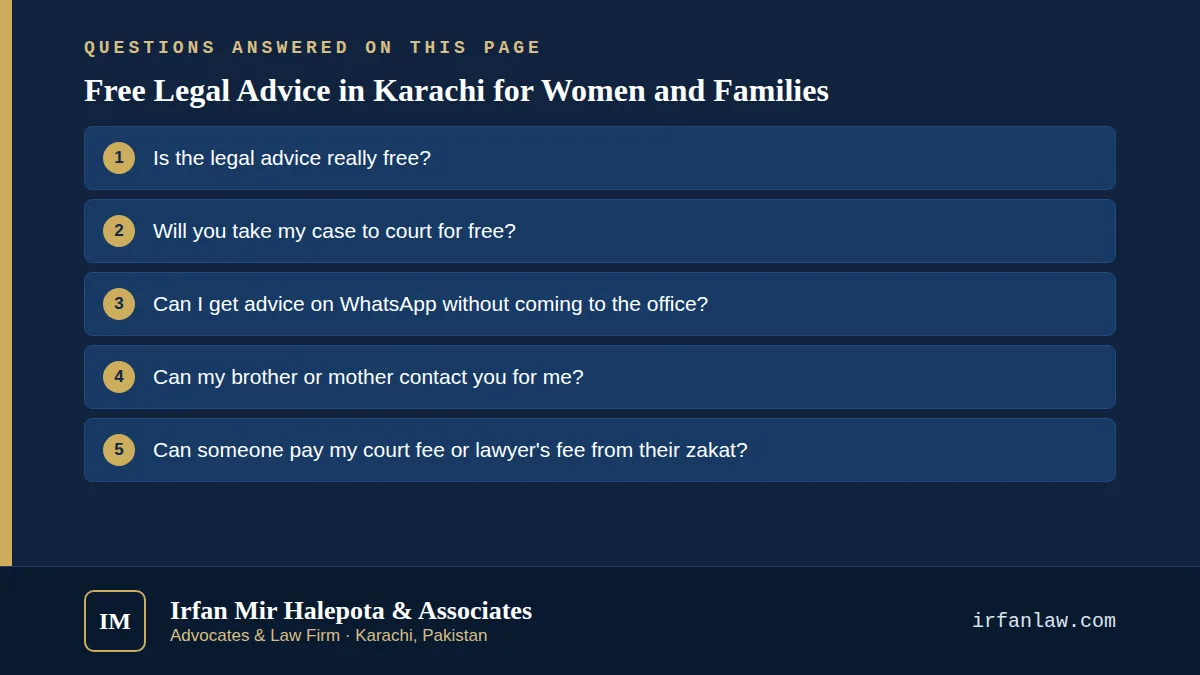
Is the legal advice really free?
Yes. The firm gives this advice as sadqa and zakat to people who cannot afford a lawyer, and there is no charge for the consultation and no obligation afterwards. If you later choose to engage a lawyer for court work, terms are discussed privately at that stage.
Will you take my case to court for free?
We do not promise free court representation. We will advise you honestly on your options, and where you need a lawyer in court but cannot pay, we will direct you to the Bar Council free legal aid committees or the District Legal Empowerment Committee, which can pay a deserving litigant's lawyer's fee and court costs.
Can I get advice on WhatsApp without coming to the office?
Yes. Send a short message to +92 321 2057582 describing the problem and any upcoming date, with photographs of key papers if it is safe. If your situation needs a longer discussion, we can arrange a call or an appointment at the Clifton office.
Can my brother or mother contact you for me?
A relative can make the first contact, which is often safer for a woman whose phone is watched. For decisions such as filing for khula or custody, we will usually need to speak to you directly, because the facts and the choice are yours.
Can someone pay my court fee or lawyer's fee from their zakat?
Many scholars say this is possible if you are eligible for zakat and the money is given to you, so that you own it and then pay the fee yourself, or if you authorise someone to receive it for you and pay. Paying the court or lawyer directly without your knowledge is generally treated as a gift, not zakat. Views differ in detail, so the donor should ask a qualified mufti.
Do I need to bring original documents?
No. Photocopies or clear phone photographs are enough for advice, and your originals should stay with you. Bring your CNIC and a one-page note of what happened, with dates, and whatever papers you already have.
This article is general information about Pakistani law and procedure, not legal advice for any specific matter. If this touches on something you're currently facing, get in touch and we'll advise on your facts directly.