Human Rights Lawyer in Karachi
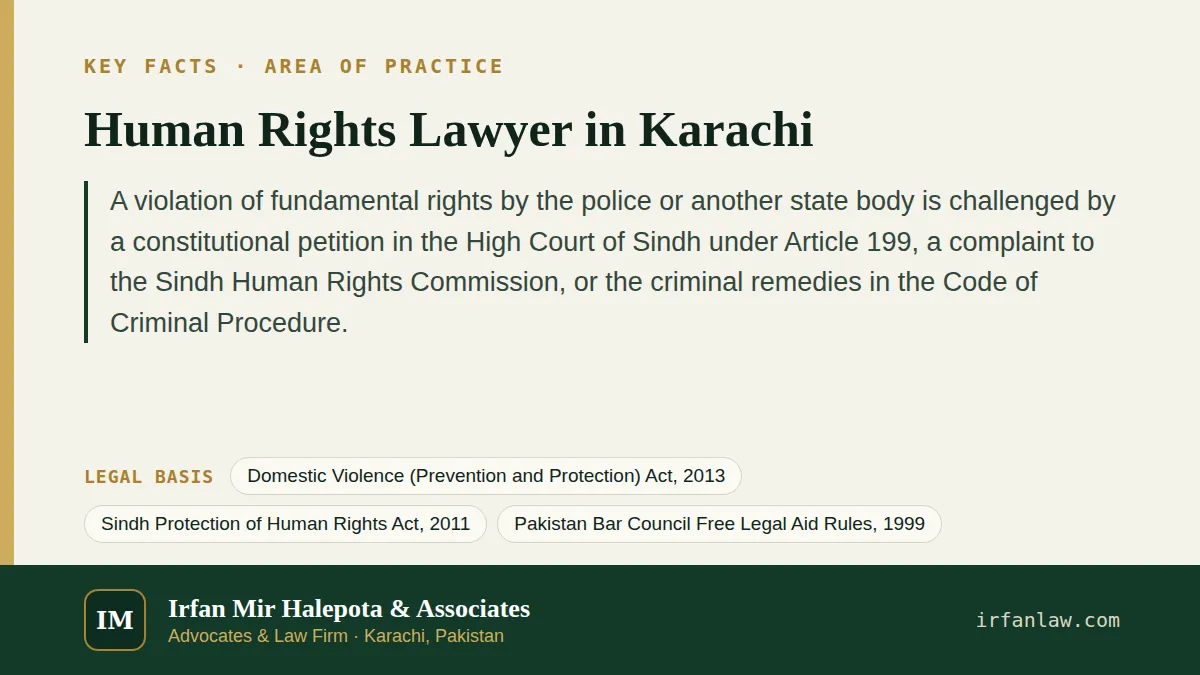
A violation of fundamental rights by the police or another state body is challenged by a constitutional petition in the High Court of Sindh under Article 199, a complaint to the Sindh Human Rights Commission, or the criminal remedies in the Code of Criminal Procedure. If you cannot afford a lawyer, free legal aid is available through Bar Council free legal aid committees and District Legal Empowerment Committees.
Free legal advice is provided as Sadqa. If you cannot afford a lawyer, read our page on free legal advice in Karachi or call or WhatsApp +92 321 2057582.
Many people searching for a free human rights lawyer in Karachi are in the middle of an emergency: a relative taken into custody without explanation, a complaint the police will not register, violence at home. The first useful answer in that situation is which remedy works fastest, not who charges least. Our women's rights and human rights work is led by Advocate Nusrat Irfan, and constitutional petitions are handled with Irfan Mir Halepota, Advocate of the Supreme Court of Pakistan.
What this covers
- Illegal or unacknowledged detention (habeas corpus)
- Police refusal to register an FIR, and police harassment
- Domestic violence protection
- Harassment and online abuse of women
- Women's inheritance and property rights
- Fundamental-rights petitions against state bodies
Where we appear
- High Court of Sindh (constitutional jurisdiction)
- Sessions Courts, Karachi (Ex-Officio Justice of the Peace)
- Family Courts and Magistrates, Karachi
- Supreme Court of Pakistan and Federal Constitutional Court
In detention and violence cases the first 24 hours matter most. Call before you go to the police station.
Official sources
When a family member is detained
Where someone is held by the police or another agency without being produced before a Magistrate, the High Court of Sindh can order the person to be brought before it, either under its constitutional jurisdiction in Article 199(1)(b)(i) of the Constitution or under Section 491 CrPC, which gives the High Court power to issue directions of the nature of habeas corpus. Once an arrest is formally recorded, continued custody must be justified before a Magistrate under Section 167 CrPC, and the route becomes a bail application. See criminal and bail representation.
When the police will not act
If an SHO refuses to register an FIR for a cognizable offence, a petition to the Ex-Officio Justice of the Peace under Sections 22-A and 22-B CrPC can lead to a direction to register it. The petition is much stronger with written proof that you approached the SHO and then the SP first. Our criminal litigation page explains the steps.
Domestic violence and harassment
Sindh was the first province to legislate on domestic violence: the Domestic Violence (Prevention and Protection) Act, 2013 (Sindh Act No. XX of 2013) allows a court to grant protection orders for victims of domestic violence. Online harassment, blackmail with private images and impersonation fall under the Prevention of Electronic Crimes Act, 2016. See cyber harassment complaints under PECA. Where the abuse sits inside a marriage, the family law remedies of maintenance, custody and khula often need to run alongside.
The Sindh Human Rights Commission
Under Section 4 of the Sindh Protection of Human Rights Act, 2011, the Sindh Human Rights Commission can inquire into a complaint of a human rights violation, or of negligence in preventing one, by a public servant. It can act on its own initiative or on a petition by the victim or any person on the victim's behalf. It makes recommendations to the Government of Sindh rather than deciding cases, so it works best alongside a court remedy rather than instead of one.
Fundamental-rights petitions
Petitions to enforce fundamental rights against a state body are filed in the High Court of Sindh under Article 199. After the 27th Amendment, appeals from those judgments generally go to the Federal Constitutional Court, except in rent and family matters. Our Supreme Court and constitutional practice page explains the current split.
Free legal aid in Karachi: where to apply
If you cannot afford a private advocate, these are the formal routes:
- Bar Council free legal aid committees under the Pakistan Bar Council Free Legal Aid Rules, 1999, which operate at central, provincial and district level and maintain panels of advocates.
- District Legal Empowerment Committees under the District Legal Empowerment Committee (Constitution and Functions) Rules, 2011, which can pay an eligible litigant's lawyer's fees, court fees and process fees from the Access to Justice Development Fund.
This firm is a private practice. There is no charge for our first assessment of which forum and remedy fits your situation, and if one of the free routes above suits you better, we will tell you.
Free legal advice from the firm, given as sadqa and zakat
Alongside the formal legal aid routes above, Irfan Mir Halepota & Associates gives free legal advice, as sadqa and zakat, to people who cannot afford a lawyer. It is meant especially for women facing divorce, khula, maintenance or custody problems, widows and sisters denied their inheritance, and women facing harassment or blackmail.
Advice is given by phone or WhatsApp on +92 321 2057582, or at the office at Glass Tower, Teen Talwar, Clifton, by appointment. We will read your papers, explain your rights and the right forum, and tell you the first step. The advice is free; court representation is not promised. Where you need a lawyer in court but cannot pay, we will tell you honestly which free legal aid route fits.
For women in immediate need, the Women Development Department of the Government of Sindh lists helpline 1094 for complaints, women's complaint cells at district headquarters and Darul Aman shelters, including in Karachi; check the current number on its website. Women and Children Police Stations can also help a woman register a complaint. In an emergency, call the police on 15 first.
Our page on free legal advice in Karachi explains who it is for, what to bring to the consultation, and the question many families ask: whether zakat can be used to pay a deserving litigant's court costs.
Common questions
Can I get a free human rights lawyer in Karachi?
Yes, through two formal routes: the free legal aid committees set up under the Pakistan Bar Council Free Legal Aid Rules, 1999, and the District Legal Empowerment Committees, which can pay an eligible litigant's lawyer's fees and court fees. This firm is a private practice, but there is no charge for our first assessment of which remedy fits your case.
What can I do if a family member has been detained illegally in Karachi?
Where the person has not been produced before a Magistrate, the High Court of Sindh can order them to be brought before it, under Article 199(1)(b)(i) of the Constitution or Section 491 CrPC. If the arrest has been formally recorded, the route is a bail application. Act quickly, and keep a written record of when and where the person was taken.
How do I complain to the Sindh Human Rights Commission?
The Commission accepts a petition from the victim or from any person on the victim's behalf about a human rights violation, or negligence in preventing one, by a public servant (Section 4, Sindh Protection of Human Rights Act, 2011). It inquires and makes recommendations to the government, so a court remedy may still be needed for binding relief.
Is there a law against domestic violence in Sindh?
Yes. The Domestic Violence (Prevention and Protection) Act, 2013 (Sindh Act No. XX of 2013) allows a court to grant protection orders to victims of domestic violence. Criminal offences under the Pakistan Penal Code, and family law remedies such as maintenance and khula, can be pursued alongside it.
Who handles women's rights cases at the firm?
Advocate Nusrat Irfan leads the firm's women's rights, human rights and family law practice, including custody disputes, domestic violence, harassment, and women's inheritance and property rights. Constitutional petitions are handled with Irfan Mir Halepota, Advocate of the Supreme Court of Pakistan.
Is the firm's free advice the same as free legal aid?
No. Free advice is a consultation on your rights and options, given by the firm as sadqa and zakat, and it does not include free court representation. Free legal aid, through the Bar Council free legal aid committees or a District Legal Empowerment Committee, can pay for a lawyer and court costs in an actual case. We will tell you whether you should apply for it.
Related areas of practice
Speak with an advocate about a human rights matter
Tell us what has happened and when. We will tell you which remedy fits, and whether a free legal aid route suits you better.