Share of Widow in Property and Inheritance Rights of a Widow
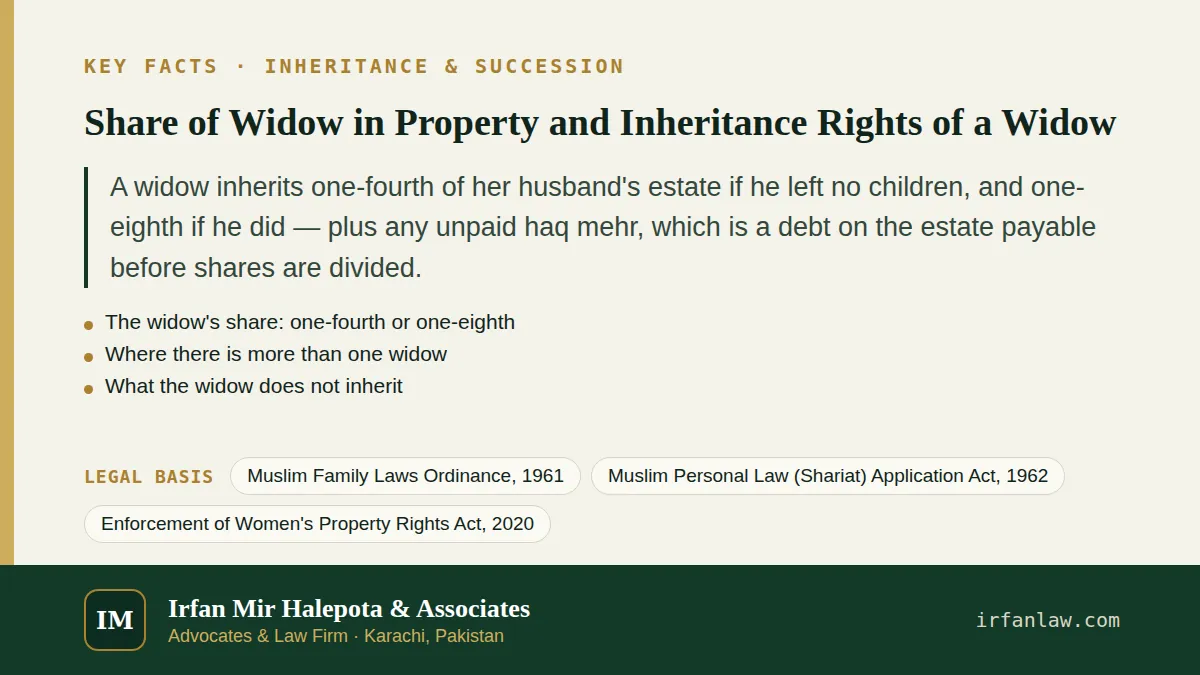
A widow inherits one-fourth of her husband's estate if he left no children, and one-eighth if he did — plus any unpaid haq mehr, which is a debt on the estate payable before shares are divided.
Free tool: Calculate each heir's share for a spouse, children and parents under Sunni (Hanafi) rules.
When a husband dies, his widow's right to inherit is not a matter of family goodwill, negotiation, or what relatives decide is fair. It is a fixed share set by law. Yet in practice widows are routinely pressured to "waive" their entitlement, told incorrectly that they have none, or simply left out of the paperwork by relatives who control the process.
The widow's share: one-fourth or one-eighth
Under Muslim personal law as applied in Pakistan, the share is determined by one question — whether the deceased left children:
- No children: the widow inherits one-fourth (1/4) of the estate.
- Children surviving: the widow inherits one-eighth (1/8).
This derives directly from Surah An-Nisa (4:12). "Children" here includes children from a previous marriage of the deceased, and includes grandchildren through a son in the relevant circumstances — not only children of this marriage.
A correction worth stating plainly, because the opposite appears in circulation and causes real loss: the one-fourth share applies where there are no children, and one-eighth where there are. It is not the other way round. A widow told she is limited to one-eighth when her husband died childless is being deprived of half of what she is owed.
Where there is more than one widow
If the deceased left more than one widow, they do not each receive a full share. The 1/4 or 1/8 portion is divided equally between them. Two widows of a man who died childless take one-eighth each; three take one-twelfth each.
What the widow does not inherit
A widow inherits from her husband's estate. She does not inherit, in her own right, from the property of her father-in-law, mother-in-law, or any other blood relative of her husband — regardless of how long the marriage lasted, whether she has children, or whether she later remarries.
Where a husband predeceased his own father, the position becomes more complex, and Section 4 of the Muslim Family Laws Ordinance, 1961 becomes relevant: it provides for the children of a predeceased son or daughter to receive the share their parent would have taken. This is one of the most frequently misunderstood provisions in Pakistani succession, and it is worth advice on the specific family tree rather than assumption.
Haq mehr is a debt, not part of the inheritance
This is the point that most often costs widows money, because the two entitlements are treated as one.
Before any estate is distributed among heirs, the law requires that funeral expenses and the debts of the deceased be discharged. Unpaid dower (haq mehr) is a debt owed by the husband to his wife. It is therefore payable out of the estate before the remaining property is divided into shares.
The practical consequence: a widow with unpaid deferred dower is entitled to recover that dower in full as a creditor of the estate, and then additionally receive her 1/4 or 1/8 share of what remains. These are two separate entitlements. Treating them as one — "you already got your mehr, so that is your share" — is wrong, and it is a common feature of family settlements that later require unwinding. See our guide to recovering haq mehr.
Sunni and Shia law differ
The distribution rules are not identical across schools. Which applies depends on the sect of the deceased — Sunni (Hanafi) inheritance principles differ from Shia (Ja'fari) principles in how residue is allocated among remaining heirs. The widow's fractional share is broadly consistent, but the wider distribution can produce materially different outcomes. Establishing which law governs is a first step, not a detail.
How the share is actually claimed
- Establish the estate. Identify all property — immovable, bank accounts, shares, vehicles, provident fund and gratuity, and any business interest.
- Obtain a succession certificate. For movable assets — bank balances, securities, dues — a succession certificate is the instrument banks and institutions require. NADRA now issues succession certificates through its centres for uncontested cases, which is considerably faster than the traditional court route. In Sindh, the Sindh Letters of Administration and Succession Certificates Act, 2021 lets NADRA issue certificates for both movable and immovable property where no heir objects; where any heir objects or the matter is contested, the court route remains necessary.
- Letters of administration may be required where there is a will or a more complex estate.
- Mutation of immovable property in the revenue records, so the widow's share is entered in her name rather than left in the deceased's or transferred wholly to others.
When relatives refuse to give her share
This is the situation that brings most widows to a lawyer, and there are real remedies:
- Suit for declaration and partition in the civil court, establishing the entitlement and dividing the property.
- Cancellation of fraudulent transfers — where property was transferred out of the estate, or a gift or sale deed was manufactured after death or during the deceased's final illness. See property fraud and fraudulent transfers.
- Interim injunction restraining further alienation while the case proceeds — usually urgent, because property that has been sold onward to a purchaser without notice is far harder to recover.
- The Enforcement of Women's Property Rights Act, 2020, which created an Ombudsman route allowing a woman deprived of ownership or possession of property to complain without full civil litigation. It applies only in the Islamabad Capital Territory; Punjab and Khyber Pakhtunkhwa have their own laws, and we are not aware of an equivalent Sindh statute in force, so in Karachi the civil and criminal routes remain the main remedies.
A "waiver" signed under pressure is not automatically binding. Relinquishment of an inheritance share must be free, informed and genuine. Where a widow was told she had no choice, given no independent advice, or did not understand what she was signing, that document can be challenged.
Time limits
Inheritance claims are subject to limitation, and delay makes recovery harder in practical terms as well as legal ones — property gets sold on, records get altered, and witnesses become unavailable. Where a widow has been out of possession for years, the position is still often recoverable, but it should be assessed rather than assumed lost.
Legal assistance for widows
This firm has long assisted widows in recovering their lawful share, and continues to take on such matters for women who cannot meet professional fees at the outset. Where a widow is unable to pay, we will file her case and settle fees at her convenience, or without fee where circumstances require it. If you are a widow being denied your share, contact us and say so directly — the inability to pay should not be the reason a woman never claims what the law already gives her.
When her husband's brothers occupy the house or ask her to sign
A common pattern after a husband's death in Karachi: his brothers or parents remain in the family house, the widow is told she may stay only on their terms, and within weeks a stamp paper appears for her to sign giving up her claim, or a 'family settlement' giving the house to the sons. Three points help her hold her position.
Leaving the house does not end her share. Her one-fourth or one-eighth vested on her husband's death. If she moves to her parents' home for safety, she remains a co-owner and can later sue for partition, possession and a share of any rent the others have collected (mesne profits, which the court can inquire into under Order XX, Rule 12 of the Code of Civil Procedure, 1908). Where she is being pushed out or the house is about to be sold, a suit can be filed with an application for a temporary injunction under Order XXXIX, Rules 1 and 2 CPC.
She does not have to sign anything quickly. In Mst. Bibi Amina v. Shamsullah (C.P.L.A. No. 143-Q of 2025, decided 4 June 2026) the Federal Constitutional Court held that a woman cannot be deprived of her inheritance on the strength of a relinquishment, compromise or gift unless it is proved to have been voluntary and fully understood, and that the person who benefits carries a heavy burden where she is vulnerable. A widow who is grieving, dependent on the family and unadvised is exactly the case the Court had in mind. Asking for time and a copy of the paper to show a lawyer is reasonable and should not be treated as hostility.
Keep a record. Note who holds the original title documents, the society or KDA file, the keys and any rent. Keep messages in which her share is denied. These details later decide both the remedy and the limitation period. The tactics, and the case law on them, are the same as those used against daughters; see our guide on what to do when brothers refuse a sister's inheritance share.
Which routes actually apply to a widow in Karachi
Three routes are often mentioned to widows. Their position in Sindh is more specific than general guides suggest.
NADRA succession certificates cover property of every kind in Sindh. Under the Sindh Letters of Administration and Succession Certificates Act, 2021 (Sindh Act No. VII of 2021), NADRA's Succession Facilitation Units can issue succession certificates and letters of administration for both movable and immovable property (section 3). The catch is consent: every heir is verified biometrically and a public notice invites objections, and if any heir objects or a factual dispute arises NADRA declines and the matter goes to court under the Succession Act, 1925 (section 5). Since a 2025 amendment, where the widow's children are minors the certificate takes effect only once a guardianship certificate is issued under the Guardians and Wards Act, 1890, which she may need to obtain from the Guardian Court first.
The Ombudsperson route under the 2020 Act is not available for Karachi property. The Enforcement of Women's Property Rights Act, 2020 extends, by section 1, only to the Islamabad Capital Territory. Punjab and Khyber Pakhtunkhwa have their own laws. We are not aware of an equivalent Sindh statute in force, so a widow in Karachi should not wait on an Ombudsperson complaint.
Criminal law is available. Section 498A of the Pakistan Penal Code, added by the Criminal Law (Third Amendment) Act, 2011, punishes anyone who by deceitful or illegal means deprives a woman of inheriting property, with imprisonment of five to ten years, or fine, or both. It protects a widow as much as a daughter. A complaint does not return the property by itself, so it is normally pursued alongside a civil suit for declaration, cancellation of documents and partition.
Common questions
How much of my husband's property am I entitled to as a widow?
One-fourth (1/4) of the estate if your husband left no children, and one-eighth (1/8) if he did. Children from a previous marriage count for this purpose. If there is more than one widow, that portion is divided equally between them.
Can I claim my haq mehr as well as my inheritance share?
Yes. Unpaid dower is a debt owed by your husband, and debts are discharged from the estate before it is distributed among heirs. You are entitled to recover unpaid dower in full as a creditor of the estate, and then separately receive your 1/4 or 1/8 share of what remains. They are two distinct entitlements.
Do I inherit anything from my father-in-law's property?
Not in your own right. A widow inherits from her husband's estate, not from his blood relatives. Where your husband died before his own father, Section 4 of the Muslim Family Laws Ordinance, 1961 may entitle your children to the share their father would have taken — a position that depends on the specific family circumstances.
I was made to sign a paper giving up my share. Is that final?
Not necessarily. Relinquishment of an inheritance share must be free, informed and genuine. Where it was obtained under pressure, without independent advice, or without you understanding what you signed, that document can be challenged in court.
Does remarrying mean I lose my share?
No. Your entitlement to inherit from your deceased husband's estate crystallised on his death. Remarrying afterwards does not remove it.
Where does the widow's one-fourth and one-eighth share come from?
Surah An-Nisa (4:12), which fixes the surviving wife's share at one-fourth of the estate where the deceased left no child, and one-eighth where he did. Pakistani courts apply this through the Muslim Personal Law (Shariat) Application Act, 1962, which makes Muslim Personal Law (Shariat) the rule of decision in questions of succession for Muslims.
Do my late husband's debts come out before my share is calculated?
Yes. Funeral expenses and the debts of the deceased are discharged from the estate before the residue is distributed among heirs. Unpaid dower is a debt owed by the husband to his wife, so a widow recovers unpaid dower as a creditor of the estate in addition to her inheritance share.
My husband died before his father. Do my children inherit from their grandfather?
Section 4 of the Muslim Family Laws Ordinance, 1961 introduced representational succession: the children of a predeceased son or daughter receive the share their parent would have taken had the parent survived the propositus. This is one of the most litigated provisions in Pakistani succession law — the Federal Shariat Court addressed its Islamicity in Allah Rakha v. Federation of Pakistan (2000), and the superior courts have construed it in different ways over several decades. It remains on the statute book, and how it applies to a given family requires advice on the specific facts and dates.
Does the section apply if my father-in-law died before 1961?
The provision is generally treated as applying prospectively, so that where the grandparent died after the promulgation of the Ordinance the orphaned grandchildren may claim its benefit. Courts have in some circumstances applied it to earlier deaths by reading the Ordinance together with the Muslim Personal Law (Shariat) Application Act, 1962 — particularly where a widow's limited estate was involved and succession opened only on its termination. The date of death matters and should be established at the outset.
Is a waiver of my inheritance share binding if I signed under pressure?
Relinquishment must be free, informed and genuine. Where a document was obtained under coercion, without independent advice, or without the signatory understanding its effect, it is open to challenge. Reported authority on gifts is instructive by analogy: benefits given to a wife have been held to be her absolute property which cannot be taken from her (PLD 2006 Karachi 272; PLD 2012 Lahore 43).
My husband's brothers want me to leave the house. Do I lose my share if I go?
No. Your share passed to you on your husband's death and does not depend on living in the house. You can later sue for partition and possession, and for a share of any rent the others have received. If you are being forced out or the house may be sold, ask the court for a temporary injunction when the suit is filed.
Can I complain to the women's property rights Ombudsperson about property in Karachi?
Not under the Enforcement of Women's Property Rights Act, 2020, which extends only to the Islamabad Capital Territory. Punjab and Khyber Pakhtunkhwa have separate provincial laws. For Karachi property the practical routes are the civil court, NADRA where all heirs agree, and a criminal complaint under section 498A PPC.
Can NADRA issue a succession certificate for my husband's house, or only for bank accounts?
In Sindh, NADRA can issue certificates for both movable and immovable property under the Sindh Letters of Administration and Succession Certificates Act, 2021, provided all heirs cooperate and no dispute arises. If your children are minors, a guardianship certificate is needed before the NADRA certificate takes effect.
Follow us on Google
If these guides are useful, add this site as a preferred source. Google will then show it more prominently to you in Search, Discover and AI results.
Official sources
This article is general information about Pakistani law and procedure, not legal advice for any specific matter. If this touches on something you're currently facing, get in touch and we'll advise on your facts directly.