Supreme Court & Constitutional Lawyers in Karachi
Appeals and petitions before the Supreme Court of Pakistan and the newly established Federal Constitutional Court. Irfan Mir Halepota & Associates represents clients in this area before the relevant Karachi courts and tribunals.
Pakistan's apex judiciary was significantly restructured by the 26th and 27th Constitutional Amendments, culminating in the establishment of the Federal Constitutional Court (FCC) in November 2025. The FCC now holds jurisdiction over constitutional interpretation, fundamental-rights matters at the apex level, and disputes between federal and provincial governments — matters that previously sat with the Supreme Court of Pakistan, which continues as the apex court for ordinary civil and criminal appeals. This is a genuinely new and still-developing area of practice, and we advise clients on which forum a matter now belongs in before anything else.
What this covers
- Civil and criminal appeals before the Supreme Court of Pakistan
- Constitutional petitions and fundamental rights matters before the Federal Constitutional Court
- Appeals from High Court constitutional benches to the Federal Constitutional Court
- Federal-provincial and inter-governmental disputes
- Leave to appeal petitions
- Review and curative petitions
Where we appear
- Supreme Court of Pakistan (civil & criminal appellate jurisdiction)
- Federal Constitutional Court of Pakistan (constitutional interpretation & fundamental rights)
- High Court of Sindh (Constitutional Bench, first instance)
Forum selection and limitation periods are often decided in the first conversation about a matter — the earlier we're involved, the more options remain open.
Official sources
The Supreme Court has now clarified the jurisdictional split
The relationship between the Supreme Court and the Federal Constitutional Court was, for months after the FCC's creation, unsettled in practice — cases raising both constitutional and ordinary appellate questions were sometimes clubbed together and it was unclear which court should hear which part. That changed with a Supreme Court ruling handed down in 2026, which held that the Supreme Court and the Federal Constitutional Court are "coordinate courts," operating within distinct constitutional jurisdictions, with neither institution subordinate to the other.
The practical division the Court set out:
- Writ matters arising under Article 199, including appeals from High Court writ judgments, go to the Federal Constitutional Court, except rent and family matters, which stay with the Supreme Court. Writ petitions themselves are still filed first in the High Court.
- Regular civil and routine appellate matters remain with the Supreme Court
- Contempt proceedings connected to Supreme Court orders remain within the Supreme Court's jurisdiction even where the underlying matter otherwise involves constitutional questions, because contempt power is tied to the authority of the court whose order was allegedly violated
- Certain matters, including some tenancy disputes and specific family law cases, remain outside the FCC's scope even where a constitutional question is nominally raised
Where a case had already clubbed constitutional writ proceedings together with ordinary civil appellate proceedings, the Supreme Court has directed that they be de-clubbed and sent to the correct forum separately. For any client with a pending matter that touches both types of question, confirming which parts belong before which court is now a live and practical issue, not a theoretical one — filing in the wrong forum after this ruling is a self-inflicted delay.
Supreme Court cases from Karachi: the Branch Registry
Anyone looking for the best Supreme Court lawyer in Karachi should first ask whether the case can be heard in Karachi at all, because that decides cost and pace more than anything else. The Supreme Court's Karachi Branch Registry, at the crossing of I.I. Chundrigar Road and M.R. Kayani Road, receives civil, criminal and jail petitions arising from the High Court of Sindh, the Federal Shariat Court, the Federal Service Tribunal and the Sindh Service Tribunal, and hearings are held there, except in taxation, customs and revenue matters. The Federal Constitutional Court sits in Islamabad.
Two 2026 rulings now shape where an appeal from Sindh goes. In January 2026 the Supreme Court held that it keeps appellate jurisdiction under Article 185(3) over rent and family matters decided by High Courts, including those decided under Article 199, because those matters are expressly excluded from the FCC's appellate jurisdiction under Article 175F(1). In May 2026 it held that the two courts are coordinate, as set out above.
What changed under the 26th Amendment specifically
The 2024 Twenty-Sixth Amendment preceded the FCC's creation and made two changes that remain in force: it removed the Supreme Court's power to act on its own initiative (suo motu) under Article 184, restricting the Court to acting within the scope of an application actually filed, and imposed an equivalent restriction on High Courts under Article 199. It also inserted Article 202A, providing that no bench of a High Court other than a designated Constitutional Bench may exercise Article 199 jurisdiction, once that provision is brought into force.
What the Federal Constitutional Court itself does
Created by the Twenty-Seventh Amendment in November 2025, the FCC exercises exclusive jurisdiction over constitutional interpretation and disputes between the federal and provincial governments — functions that were previously exercised by the Supreme Court and have now been transferred to this separate, specialised body.
Common questions
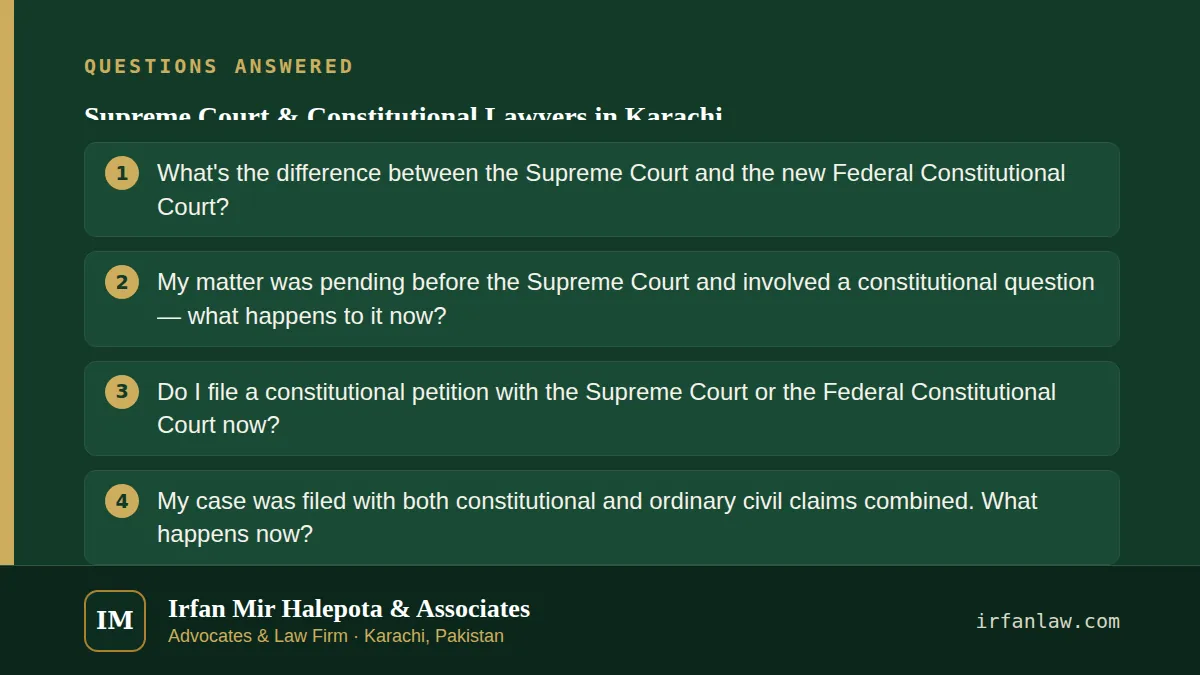
What's the difference between the Supreme Court and the new Federal Constitutional Court?
Following the 26th and 27th Constitutional Amendments, the Federal Constitutional Court — established in November 2025 — now holds exclusive jurisdiction over constitutional interpretation, fundamental rights enforcement, and federal-provincial disputes, along with appeals from the constitutional benches of the High Courts. The Supreme Court of Pakistan remains the apex court for ordinary civil and criminal appeals. Because this restructuring is recent, we assess which forum a specific matter now belongs in individually rather than assuming the pre-2025 position still applies.
My matter was pending before the Supreme Court and involved a constitutional question — what happens to it now?
Under the amendments' transitional provisions, pending matters falling within the Federal Constitutional Court's jurisdiction are being transferred to it. We can check the current status of a specific matter and advise on what a transfer means for its timeline.
Do I file a constitutional petition with the Supreme Court or the Federal Constitutional Court now?
Writ petitions are filed first in the High Court under Article 199. At the apex level, the Supreme Court ruled in May 2026 that writ matters, other than rent and family matters, belong to the Federal Constitutional Court, while regular civil and routine appellate matters remain with the Supreme Court. The two courts are coordinate, with neither subordinate to the other — which court is correct depends on the specific nature of the relief sought, not simply on the fact that a constitutional provision is invoked.
My case was filed with both constitutional and ordinary civil claims combined. What happens now?
The Supreme Court has directed that cases where constitutional writ proceedings and regular civil appellate proceedings were clubbed together should be de-clubbed, with the writ petition transferred to the Federal Constitutional Court and the civil appellate matter remaining with the Supreme Court. Each part now proceeds in the correct forum separately.
Does the Federal Constitutional Court hear tenancy or family law disputes?
Generally not, even where a constitutional question is nominally raised. Reported guidance following the Supreme Court's clarification indicates certain matters, including some tenancy disputes and specific family law cases, remain outside the FCC's scope and continue to be handled through their ordinary forums.
Who is the best constitutional lawyer in Karachi following the 2026 Supreme Court ruling?
Since the Supreme Court's 2026 ruling that it and the Federal Constitutional Court are coordinate courts, the best constitutional counsel is one who can correctly identify whether your matter is an Article 199 writ (now the FCC's jurisdiction) or an ordinary appellate matter (still the Supreme Court's) — filing in the wrong forum after this ruling is now a self-inflicted delay.
Can my Supreme Court case be heard in Karachi?
Often, yes. The Supreme Court's Karachi Branch Registry receives civil, criminal and jail petitions arising from the High Court of Sindh, the Federal Shariat Court and the Federal and Sindh Service Tribunals, and hearings are held there, except in taxation, customs and revenue matters. Constitutional matters now within the Federal Constitutional Court's jurisdiction are heard by that court in Islamabad.
Follow us on Google
If this guide is useful, add this site as a preferred source. Google will then show it more prominently to you in Search, Discover and AI results.
Related areas of practice
- Civil LitigationContract, commercial and property disputes carried from plaint to appeal.→
- Criminal LitigationRepresentation from the first FIR through trial, bail and appeal.→
- Corporate & Commercial LawFormation, governance, contracts and disputes for companies operating in Pakistan.→
- Family LawCourt marriage, divorce and khulla, custody, guardianship and maintenance.→
Speak with an advocate about constitutional & supreme court litigation
Tell us the facts of your matter and we'll advise on forum, timeline and next steps before you commit to anything.
Book a consultation