Khulla in Pakistan: Grounds, Process and What to Expect in Family Court
A wife does not need her husband's consent to obtain khula. But whether she pleads khula simpliciter or a fault ground under the Dissolution of Muslim Marriages Act, 1939 determines whether she must return her dower — the single most consequential decision in the case.
Khula is the judicial dissolution of a Muslim marriage at the wife's instance. Most explanations stop at that, and at the reassurance that the husband cannot block it. Both are true — but they leave out the decision that actually determines what a woman walks away with. This is the question we hear most from women searching for the best khula lawyer in Karachi: not whether khula is available, but which ground actually protects their financial position.
The right does not depend on the husband's consent
This is settled and has been for decades. Where a wife satisfies the Family Court that she cannot live with her husband within the limits prescribed by Allah, the court may dissolve the marriage whether or not the husband agrees. The principle traces to Khurshid Bibi v. Baboo Muhammad Amin and has been consistently applied since. A husband's refusal to appear, or his refusal to consent, delays proceedings; it does not defeat them.
Jurisdiction lies exclusively with the Family Courts under the Family Courts Act, 1964.
Two different routes, two very different financial outcomes
This is the part that matters most and is most often glossed over. There are two distinct ways a wife can obtain dissolution, and they carry opposite consequences for dower:
- Khula simpliciter — dissolution on the basis of the wife's aversion, without proving fault. Here dissolution is granted in exchange for consideration. Under the proviso to section 10(4) of the Family Courts Act, 1964, as it applies in Sindh, the court restores to the husband the dower (haq mehr) the wife received at the time of marriage. What the Nikah Nama records as paid is usually decisive, so those entries matter.
- Dissolution on a fault ground under Section 2 of the Dissolution of Muslim Marriages Act, 1939 — where the wife pleads and proves a statutory ground such as cruelty or failure to maintain. Where the decree rests on such a ground, the wife is not required to return or relinquish dower at all, and remains entitled to claim it in full under Section 5 of that Act.
The financial gap between these two routes can be substantial. A wife with a genuine cruelty or non-maintenance case who pleads khula simpliciter — because it seems simpler, or faster, or because that is the word everyone uses — may give up dower she was entitled to keep.
The DMMA fault grounds
Section 2 of the Dissolution of Muslim Marriages Act, 1939 sets out the grounds on which a Muslim woman may obtain dissolution, including:
- The husband's whereabouts having been unknown for a specified period
- Failure to provide maintenance for two years
- The husband having been sentenced to imprisonment for a specified term
- Failure without reasonable cause to perform marital obligations
- Impotence at the time of marriage and continuing
- Insanity, or certain diseases
- Cruelty, in the various forms the section describes
- Any other ground recognised as valid for dissolution under Muslim law
What "cruelty" now covers
A significant recent development is worth flagging, because it widens this ground considerably. In 2026 the Lahore High Court, responding to a 2022 Federal Shariat Court verdict, held that cruelty under Section 2(viii) is not confined to physical violence. Humiliation, verbal abuse, false imputations against the wife's character, calculated neglect, economic abuse, and a husband's tolerance of ill-treatment by his family all qualify — assessed by their cumulative effect on the particular wife rather than against an abstract standard.
The same judgment made a second point of real practical importance: a decree does not become khula merely because the word appears in the plaint or the decree sheet. Where a wife has pleaded and pursued a Section 2 ground, the suit must be decided on that ground, and khula cannot be substituted for it without her informed consent. This matters because it protects a woman from having a fault-based case quietly converted into one that costs her dower.
The court process
In outline:
- Filing — a suit for dissolution is filed in the Family Court having jurisdiction, setting out the grounds relied on.
- Notice and written statement — the husband is served and given opportunity to respond.
- Pre-trial reconciliation — the Family Courts Act requires the court to attempt reconciliation. This is mandatory, not optional, and cannot be skipped by agreement.
- Framing of issues and evidence — if reconciliation fails, the case proceeds. Where khula simpliciter is pleaded, the wife's own consistent sworn statement that she cannot continue within the limits prescribed by Allah is generally sufficient. Where a fault ground is pleaded, that ground must be proved.
- Decree — the court passes a decree of dissolution.
- Registration — the decree is sent to the Union Council for registration under the Muslim Family Laws Ordinance, 1961, and the statutory period runs before the dissolution takes final effect.
Uncontested cases commonly conclude within a few months. Contested cases — particularly where dower, dowry articles or maintenance are genuinely disputed — take considerably longer, and it is usually the money rather than the dissolution that extends them.
Appeal rights differ by route
A further consequence of the routing decision: no appeal lies against a decree of dissolution by way of khula. Where dissolution is granted on a fault ground such as cruelty under Section 2, the decree is appealable. This cuts both ways — finality is an advantage where the wife wants the matter closed, and a disadvantage where she may wish to challenge the financial terms.
Related claims
Dissolution is often only part of what a wife needs resolved. Claims for recovery of haq mehr, return of dowry articles, maintenance for herself during the iddat period and for children, and custody are commonly brought alongside. Whether to combine them or pursue them separately is a strategic decision that depends on the facts — and on which route to dissolution is being pursued.
Common questions
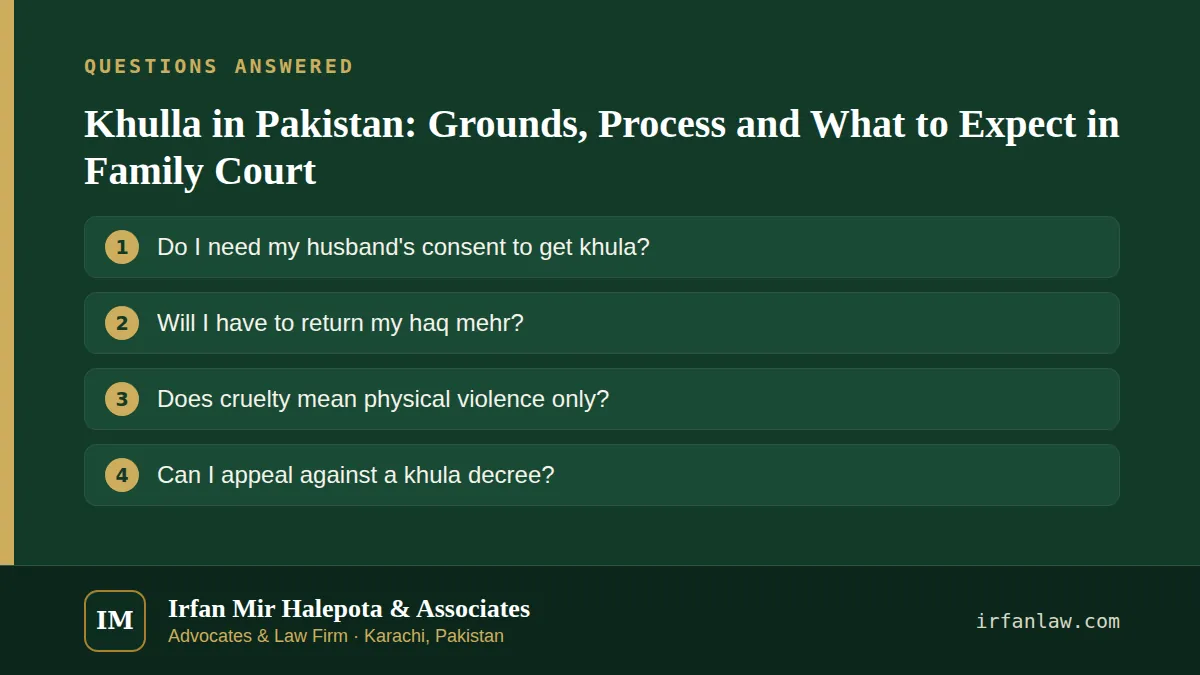
Do I need my husband's consent to get khula?
No. Where a wife satisfies the Family Court that she cannot live with her husband within the limits prescribed by Allah, the court may dissolve the marriage whether or not the husband agrees. A husband's refusal to appear or to consent delays proceedings; it does not defeat them.
Will I have to return my haq mehr?
It depends on how the suit is pleaded, and this is the most consequential decision in the case. Khula simpliciter is granted in exchange for consideration, which in Sindh means restoring to the husband the dower received at the time of marriage (proviso to section 10(4) of the Family Courts Act, 1964). But where dissolution is granted on a fault ground under Section 2 of the Dissolution of Muslim Marriages Act, 1939 — such as cruelty or failure to maintain — the wife is not required to return dower and may claim it in full.
Does cruelty mean physical violence only?
No. Recent High Court authority has held that cruelty under Section 2(viii) is not confined to physical violence. Humiliation, verbal abuse, false imputations against the wife's character, calculated neglect, economic abuse, and a husband's tolerance of ill-treatment by his family all qualify, assessed by their cumulative effect on the particular wife.
Can I appeal against a khula decree?
No appeal lies against a decree of dissolution by way of khula. Where dissolution is granted on a fault ground under Section 2 of the Dissolution of Muslim Marriages Act, the decree is appealable. This cuts both ways — finality is an advantage where you want the matter closed, and a disadvantage where you may wish to challenge the financial terms.
Exactly how much dower can a court require me to surrender for khula?
In Sindh, the proviso to section 10(4) of the West Pakistan Family Courts Act, 1964 provides that where reconciliation fails the Family Court “shall also restore to the husband the Haq Mehr received by the wife in consideration of marriage at the time of marriage”, and the proviso to section 9 applies this to decrees passed on the ground of khula. Two points follow. First, the measure is what you actually received, so the Nikah Nama entries showing dower as paid or unpaid carry great weight. Second, the percentage limits often quoted online (up to 50% of deferred and 25% of prompt dower) come from Punjab's 2015 amendment and do not apply in Sindh; the High Court of Sindh drew this distinction in Mst. Mehwish Janvri v. 3rd Additional District Judge, Larkana (C.P. No. S-214 of 2023, decided 16 May 2025).
Is the husband still required to pay outstanding dower after a khula decree?
Sindh's version of the Family Courts Act has no equivalent of Punjab's section 10(6), which directs the court to order payment of outstanding deferred dower in a dissolution decree. The Sindh proviso to section 10(4) speaks only of dower the wife has received. Whether unpaid dower can still be recovered after a khula decree therefore depends on what was pleaded and offered as consideration and on the terms of the decree, and the decisions are not uniform. It is a point to settle in the pleadings, not to leave for later.
My case is really about cruelty. Does it matter if the court calls it khula?
It matters a great deal, and the Supreme Court has said so. In Civil Petition No. 3268/2024 the Court criticised lower courts for proceeding on “the false assumption that the Petitioner sought khula in place of dissolution as otherwise evident from her plaint”, noting that by treating the suit as khula the courts “wrongly assumed that she had given up her financial rights and took away the benefits that the law” gave her. If you pleaded and pursued a fault ground, the case should be decided on that ground.
Can I be made to give up custody of my children in exchange for khula?
No. In Civil Petition No. 4129/2019 the Supreme Court held that khula “does not contemplate surrendering a child's custody to secure khula nor that it can constitute valid consideration for it”, and that inserting such a condition into a khula agreement is contrary to law — being, among other things, without consideration under the Contract Act. The Court grounded this in Surah Al-Baqarah (2:229) and Surah An-Nisa (4:35).
Do I have to file a separate suit if my husband has sued me for restitution of conjugal rights?
No. Section 9(1b) of the West Pakistan Family Courts Act, 1964 provides that a defendant wife may, in her written statement to a suit for restitution of conjugal rights, make a claim for dissolution of marriage including khula, “which shall be deemed as a plaint and no separate suit shall lie for it.” Reported authority has also treated the word “including” as widening the scope, so that maintenance and custody claims need not be filed separately either.
What must the Family Court do before dissolving the marriage?
Reconciliation must be attempted. The proviso to section 10(4) is framed around what happens “if reconciliation fails” — at which point the Family Court “shall pass decree for dissolution of marriage forthwith”. The reconciliation stage is a statutory requirement rather than a formality the parties can waive by agreement, but once it fails the Act contemplates the decree following immediately rather than after further delay.
Follow us on Google
If these guides are useful, add this site as a preferred source. Google will then show it more prominently to you in Search, Discover and AI results.
Official sources
Looking for representation rather than background? See Divorce Lawyer in Karachi.
This article is general information about Pakistani law and procedure, not legal advice for any specific matter. If this touches on something you're currently facing, get in touch and we'll advise on your facts directly.