Child Custody in Pakistan: How Guardian Courts Decide
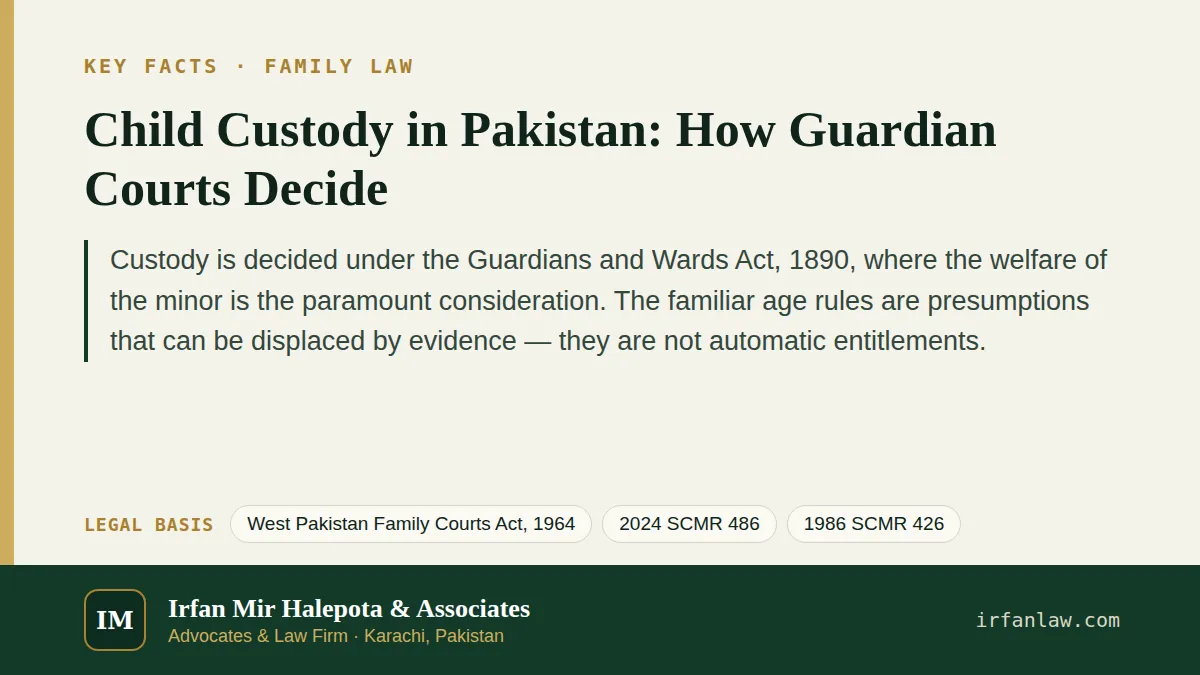
Custody is decided under the Guardians and Wards Act, 1890, where the welfare of the minor is the paramount consideration. The familiar age rules are presumptions that can be displaced by evidence — they are not automatic entitlements.
Custody disputes are among the most painful matters that come before the Family Courts, and they are also among the most widely misunderstood. Parents frequently arrive believing the outcome is fixed by a rule about the child's age. It is not. Parents searching for the best child custody lawyer in Karachi are usually trying to work out one thing first — what the court will actually weigh, not what either parent believes they deserve.
Custody and guardianship are two different things
Pakistani law separates two concepts that English usage tends to merge:
- Hizanat — physical custody: the day-to-day care, upbringing and residence of the child. This commonly rests with the mother, particularly for younger children.
- Wilayat — guardianship: legal authority over major decisions concerning the child's education, property and welfare, together with financial responsibility. The father is ordinarily the natural guardian.
These can and often do sit with different parents simultaneously. A mother having custody does not displace the father's guardianship, and a father remaining natural guardian does not entitle him to physical custody. Confusing the two is the source of a great deal of unnecessary litigation.
The welfare principle overrides everything
Section 17 of the Guardians and Wards Act, 1890 makes the welfare of the minor the paramount consideration. The superior courts have repeatedly held that custody is not a proprietary right of the parents but a trust for the benefit of the child. Every presumption, every parental claim, and every other factor is subordinate to this single test.
A point that matters enormously in practice: the courts treat welfare as a question of fact to be proved by evidence, not established by presumption. A parent who arrives asserting an entitlement, without evidence about the child's actual circumstances, is arguing the wrong case.
The Hizanat age presumptions — and their limits
Under Hanafi principles as applied in Pakistan, the mother has a preferential right to custody of a son until roughly the age of seven, and of a daughter until puberty. After those points the father generally becomes entitled to custody as natural guardian.
But these are presumptions, not automatic switches. They set the starting point of the analysis, not its conclusion. A child does not change households by operation of law on a birthday: the court still applies the welfare test, and a well-evidenced case can displace the presumption in either direction — a father can obtain custody of a young child where the mother is genuinely unfit or absent, and a mother can retain custody past the presumptive age where continuity plainly serves the child.
What courts treat as "welfare"
There is no statutory definition, which is deliberate — it allows case-by-case assessment. In practice the courts have consistently examined:
- The child's health, and the physical safety of each proposed environment
- Education — continuity of schooling, and each parent's capacity to support it
- Physical, mental and psychological development
- Emotional attachment to the proposed custodian, and the disruption a change would cause
- Moral and spiritual upbringing, and the child's religious environment
- Financial capacity to provide for the child — though this is one factor, not the decisive one; a wealthier parent does not win on that basis alone
- Keeping siblings together, which courts generally regard as being in the children's interests
Under Section 17(3), the minor's own preference is given weight where the child is of sufficient understanding to form an intelligent view. Courts do interview children, and the older and more articulate the child, the more this weighs.
Interim custody and visitation
A custody case is a plenary suit — a full trial with pleadings, documentary evidence and examination of witnesses — not a matter disposed of in a single hearing. It takes time, and children cannot wait for the final decree.
Section 12 allows the court to make interim arrangements while the main petition is pending. These orders matter more than their "temporary" label suggests: a child settled in one household for the duration of a long case builds a status quo that is difficult to unwind at final decree, precisely because disruption itself becomes a welfare concern. The non-custodial parent is ordinarily granted visitation, and courts can enforce visitation where one parent obstructs it.
Things that do not automatically decide the case
Several assumptions cause real damage:
- Taking khula does not cost a mother custody. The mode of dissolution — khula, talaq or otherwise — has no automatic effect on custody. Custody remains subject to the welfare test regardless.
- Remarriage does not automatically end a mother's custody. It is a factor the court may consider in context, but it is not a disqualification, and recent Supreme Court authority has confirmed this.
- Being the natural guardian does not equal custody. A father's guardianship is real but distinct from physical custody, as above.
- Withholding a child does not establish a position. Retaining a child in defiance of an order, or removing them to frustrate proceedings, tends to weigh against the parent doing it — courts read it as prioritising the parental dispute over the child.
Relocation
Applications to move a child's residence — particularly abroad — attract closer scrutiny, because relocation directly affects the other parent's contact. These are among the most contested matters in this area, and they require careful evidence about schooling, care arrangements and how contact with the remaining parent would realistically be maintained.
How we approach these cases
The single most useful thing a parent can do is stop arguing about entitlement and start assembling evidence about the child's actual life — school records, medical history, who does the daily care, the living environment, and the practical realities of each proposed arrangement. That is the material the welfare test runs on, and it is what a Guardian Court can act upon.
Common questions
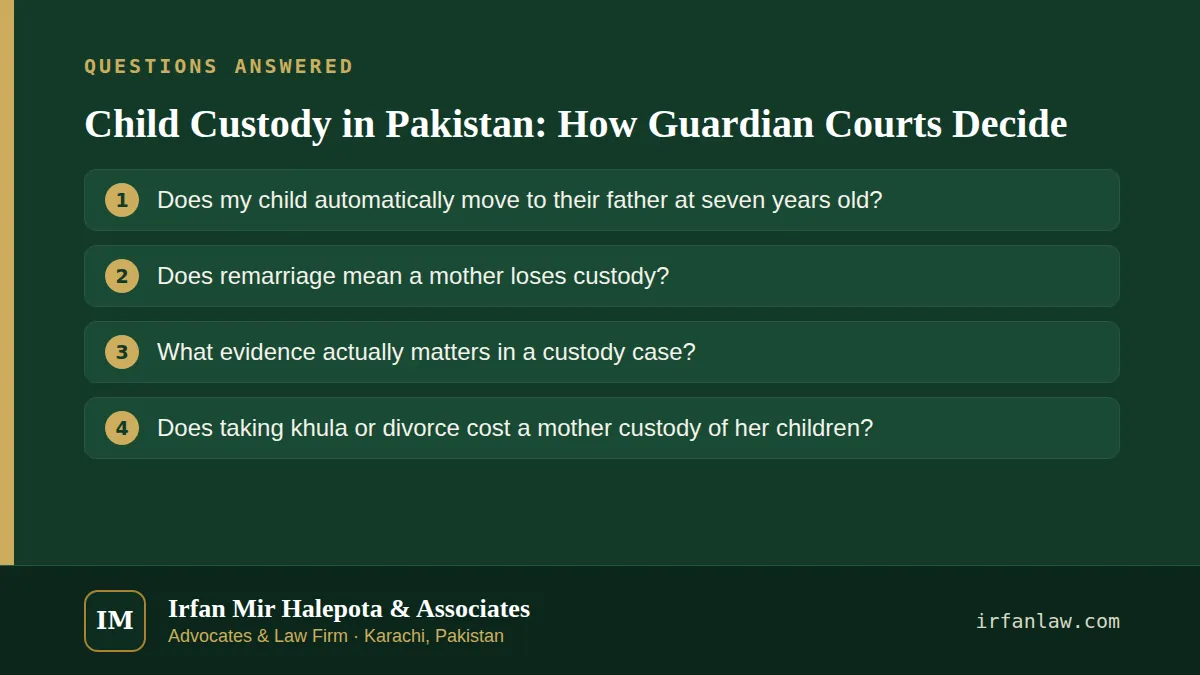
Does my child automatically move to their father at seven years old?
No. The age rules under Hanafi principles are rebuttable presumptions, not automatic switches. They set the starting point of the analysis, not its conclusion. A child does not change households by operation of law on a birthday — the court still applies the welfare test under Section 17 of the Guardians and Wards Act, and a well-evidenced case can displace the presumption in either direction.
Does remarriage mean a mother loses custody?
Not automatically. Remarriage is a factor the court may consider in context, but it is not a disqualification, and recent Supreme Court authority has confirmed this.
What evidence actually matters in a custody case?
Courts treat welfare as a question of fact to be proved by evidence, not established by presumption. School records, medical history, who performs the daily care, the living environment, and the practical realities of each proposed arrangement carry far more weight than assertions of parental entitlement.
Does taking khula or divorce cost a mother custody of her children?
No. Dissolution of marriage — by khula, talaq or any other mode — has no effect on the mother's right of custody. The father remains the natural guardian and the mother holds custody; the two are separate concepts. The Supreme Court has confirmed that khula cannot be conditioned on surrendering custody at all (Civil Petition No. 4129/2019).
If a mother remarries, does she automatically lose custody?
No. In 2024 SCMR 486 the Supreme Court held that a mother's remarriage does not automatically disqualify her from custody of her child. It is a circumstance the court may weigh in context, not a bar. Reported authority has also upheld custody with an unmarried mother providing proper care and education where the father had remarried and moved abroad.
Are the age rules for custody fixed?
No. In PLD 2024 SC 629 the Supreme Court confirmed that there are no strict or rigid rules governing custody — the welfare of the minor is always the paramount consideration. The familiar Hanafi age presumptions are the starting point of the analysis, not its conclusion, and evidence can displace them in either direction.
Can more than one person be appointed guardian?
Yes. Section 15 of the Guardians and Wards Act, 1890 allows a minor to have more than one guardian, of the person or of the property or both, and the court may appoint or declare joint guardians. So responsibilities can be shared rather than allocated wholly to one parent.
Will the court accept an arrangement the parents agree between themselves?
It may, where the arrangement serves the child's welfare. In a matter reported at 1986 SCMR 426 the Supreme Court invited the parties to propose a workable formula for the minors' welfare, and approved a compromise providing a six-month interim arrangement intended to foster conditions for a final custody solution. But an agreement purporting to remove a parent's right to seek custody — particularly as the price of a khula — will not be enforced.
Which court decides custody?
The Family Court. Section 5 read with Part I of the Schedule to the West Pakistan Family Courts Act, 1964 confers exclusive jurisdiction on Family Courts over the listed matters, which include custody of children and the visitation rights of parents to meet them. The substantive law applied is the Guardians and Wards Act, 1890, in which Section 17 makes the minor's welfare paramount.
Follow us on Google
If these guides are useful, add this site as a preferred source. Google will then show it more prominently to you in Search, Discover and AI results.
Official sources
This article is general information about Pakistani law and procedure, not legal advice for any specific matter. If this touches on something you're currently facing, get in touch and we'll advise on your facts directly.