Branch Office vs Liaison Office vs Subsidiary in Pakistan
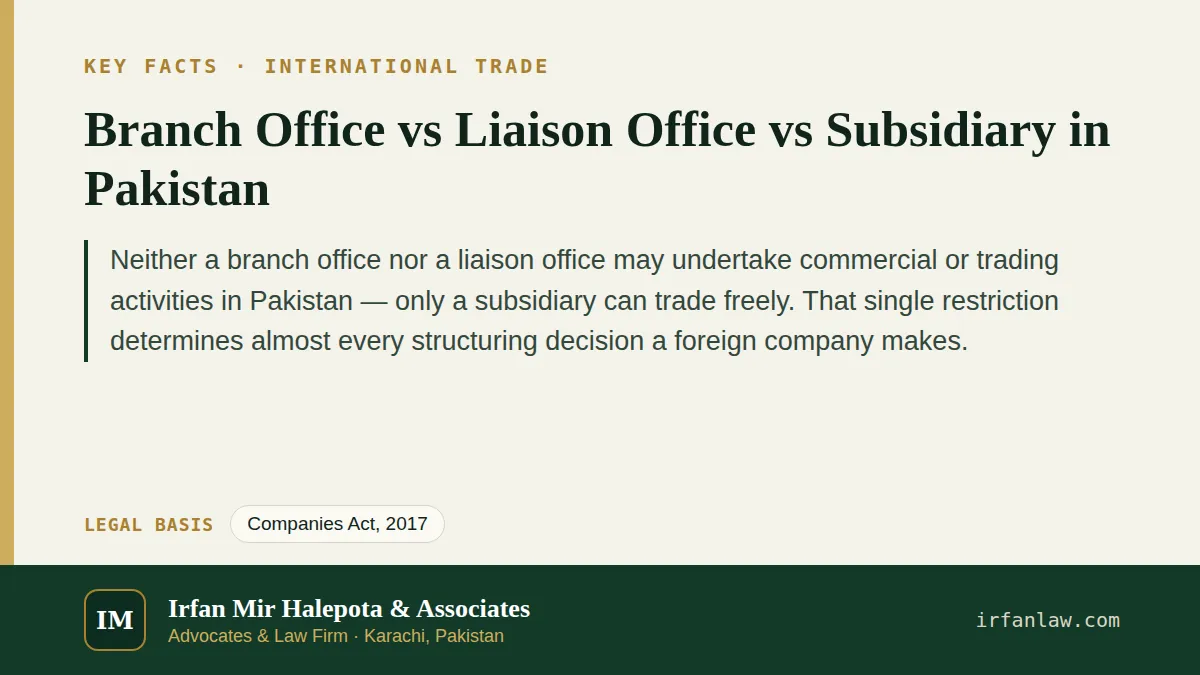
Neither a branch office nor a liaison office may undertake commercial or trading activities in Pakistan — only a subsidiary can trade freely. That single restriction determines almost every structuring decision a foreign company makes.
Foreign companies entering Pakistan are presented with three options and rarely told plainly what separates them. The distinction is not one of scale or formality — it is a distinction of what the entity is legally permitted to do, and choosing wrongly creates problems that surface at the first invoice rather than at incorporation. Foreign companies searching for the best corporate lawyer in Pakistan for market entry need this distinction settled before choosing a structure — it determines what the entity can legally do.
The single distinction that matters most
Neither a branch office nor a liaison office may undertake commercial or trading activities in Pakistan. Only a subsidiary can trade freely, invoice generally, and hold contracts as an ordinary commercial party.
This is the point that determines almost every structuring decision. If the business plan involves selling to Pakistani customers, issuing invoices, or contracting generally in the market, a liaison office is not a lighter version of a subsidiary — it is the wrong instrument, and operating it commercially is a regulatory and tax problem from the outset.
Liaison office
A liaison office is established by a foreign company for the promotion of its products, provision of technical advice and assistance, exploring the possibility of joint collaboration, and export promotion. It is a market-presence and coordination vehicle.
It may not earn revenue in Pakistan. It is funded by remittances from the parent, which cover its own operating costs — office, staff, local expenses. It suits a company that wants people on the ground to build relationships, assess the market and support the parent's export activity, without committing to an operating entity.
A common misconception is that a liaison office has no tax obligations "because it earns nothing". It still requires FBR registration and remains subject to withholding obligations on its own payments — staff salaries, rent, professional fees. That exposure accumulates quietly.
Branch office
A branch office is established by a foreign company to fulfil its contractual obligations with a public or private sector entity in Pakistan. Crucially, its activity is restricted to the work specified in that agreement or contract.
This makes a branch fundamentally contract-specific rather than a general trading presence. It suits a foreign contractor awarded a project — an infrastructure contract, a supply and installation agreement, a technical services engagement — who needs a legal presence to perform it. It does not suit a company that wants to sell across the market generally.
A branch is not a separate legal person from its parent. The foreign company carries the liability directly, which is a material consideration where the underlying contract involves significant performance risk.
Subsidiary
A subsidiary is a Pakistani company — typically a private limited company, or a single member company where the foreign parent wants sole ownership — incorporated with SECP under the Companies Act, 2017. It is a separate legal person with limited liability, and it is the only one of the three structures able to trade without the restrictions above.
Full foreign ownership is permitted in most sectors, subject to SECP requirements and State Bank of Pakistan foreign investment regulations, with some sectors restricted or requiring prior approval. Our guide to SECP company incorporation covers the mechanics.
Approvals: what each route requires
- Branch and liaison offices — permission from the Board of Investment (BOI) before establishment, granted for a defined period (ordinarily one to five years) and renewable on submission of documents and payment of fees. BOI fees are denominated in US dollars, differ between branch and liaison offices, and carry separate lower rates for sub-offices. Current fees should be confirmed with BOI at the time of application.
- All three — where a foreign company establishes a place of business in Pakistan, it must separately register with SECP under the Companies Act, 2017 and the Foreign Companies Regulations. BOI permission does not complete the process, and assuming otherwise is a common gap.
- Subsidiary only — any foreign national becoming a shareholder or director of a Pakistani company requires security clearance from the Ministry of Interior. This may be obtained post-facto provided the application was filed at the time the person became a director or shareholder, which is why it should be lodged alongside incorporation rather than discovered later.
Liability, tax and repatriation compared
Liability. A subsidiary confines liability to the company. A branch and a liaison office do not — the foreign parent is directly exposed.
Tax. A subsidiary is a Pakistani tax resident taxed on its income. A branch is generally taxed on income attributable to its Pakistani operations, with permanent establishment analysis and any applicable double taxation treaty relevant. A liaison office should have no Pakistani taxable income, but retains registration and withholding obligations.
Repatriation. A subsidiary distributes profits as dividends, subject to State Bank foreign exchange requirements. This is where documentation at entry matters: equity capital must be remitted through proper banking channels and recorded correctly on arrival, because that record is what later establishes the right to repatriate dividends and disinvestment proceeds.
Choosing between them
- Testing the market, building relationships, supporting exports — liaison office
- Performing a specific awarded contract in Pakistan — branch office
- Selling, invoicing, contracting generally, or building a durable local business — subsidiary
The structure can be changed later, but not costlessly: a liaison office cannot simply begin trading, and converting a presence usually means winding one entity down and establishing another, with the tax and contractual consequences that follow. Deciding against the actual three-year plan rather than the first-year budget avoids most of that.
For the full procedural detail on each route, see our page on foreign company registration in Pakistan.
Common questions
What does liaison office mean in Pakistan?
A liaison office is an office a foreign company sets up in Pakistan to promote its products, give technical advice and assistance, explore joint collaboration and promote exports. It is a market-presence vehicle only: it may not earn revenue in Pakistan, and its costs are paid by remittances from the parent company. It still needs FBR registration and must meet withholding obligations on its own payments.
Can a liaison office in Pakistan invoice clients or earn revenue?
No. A liaison office is established for promotion of products, technical advice and assistance, exploring collaboration and export promotion. It may not undertake commercial or trading activities or generate revenue in Pakistan. Where the plan involves selling or invoicing, the correct structure is a subsidiary.
Does BOI permission complete the registration process?
No. Where a foreign company establishes a place of business in Pakistan, it must separately register with SECP under the Companies Act, 2017 and the Foreign Companies Regulations. This second step is commonly missed by companies who assume Board of Investment approval is the whole requirement.
Does a foreign director of a Pakistani company need security clearance?
Yes. Any foreign national becoming a shareholder or director of a company incorporated in Pakistan requires security clearance from the Ministry of Interior. It can be obtained on a post-facto basis provided the application was filed at the time the person became a director or shareholder, which is why it should be lodged alongside incorporation.
Can I convert a liaison office into a trading entity later?
Not directly. A liaison office cannot simply begin trading. Changing structure generally means winding one entity down and establishing another, with the tax and contractual consequences that follow. This is why the structure should be chosen against the actual three-year plan rather than the first-year budget.
Follow us on Google
If these guides are useful, add this site as a preferred source. Google will then show it more prominently to you in Search, Discover and AI results.
Official sources
This article is general information about Pakistani law and procedure, not legal advice for any specific matter. If this touches on something you're currently facing, get in touch and we'll advise on your facts directly.