Foreign Company Registration in Pakistan
Foreign companies enter Pakistan through a subsidiary, a branch office or a liaison office. Only a subsidiary may trade freely — neither a branch nor a liaison office may undertake commercial or trading activities, and both require Board of Investment permission.
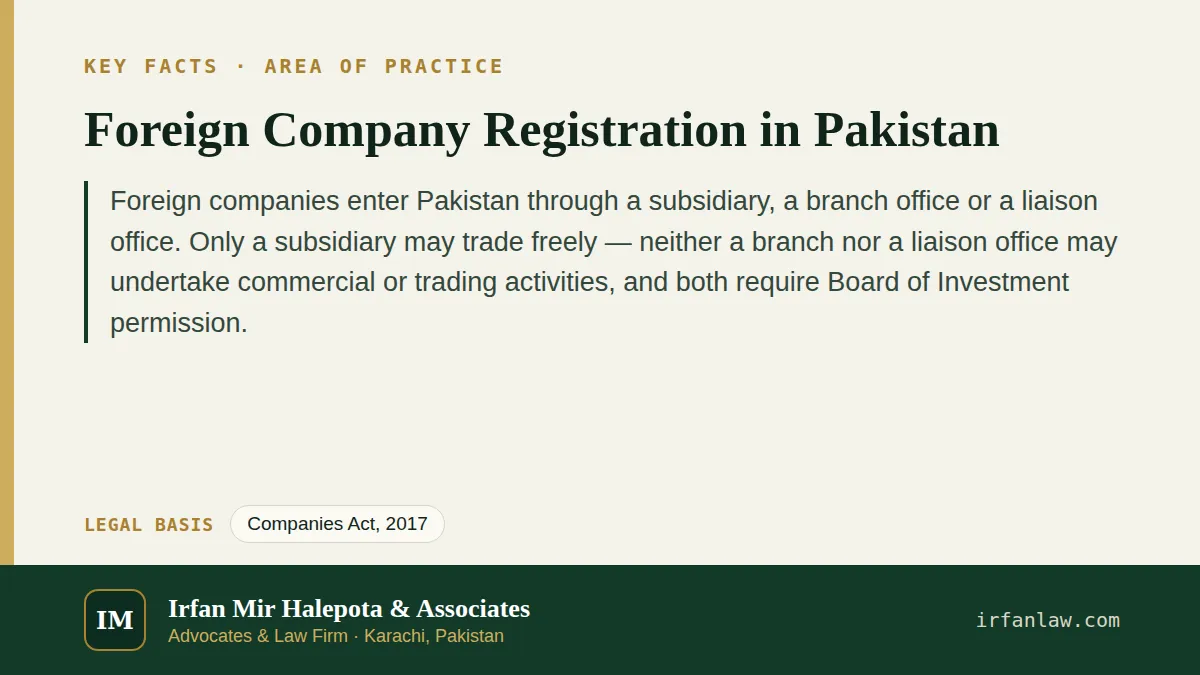
A foreign company can be present in Pakistan in three ways, and the restrictions on each differ sharply. We advise on which structure fits the actual business plan, obtain Board of Investment permission and SECP registration, and deal with the security clearance, tax registration and foreign exchange steps that determine whether capital can later be repatriated.
What this covers
- Branch and liaison office permission from the Board of Investment
- SECP registration of a foreign company establishing a place of business
- Incorporation of wholly or partly foreign-owned subsidiaries
- Ministry of Interior security clearance for foreign directors and shareholders
- Foreign exchange documentation, capital remittance and repatriation planning
- Renewal of BOI permission and ongoing compliance for foreign entities
Where we appear
- Board of Investment (BOI)
- Securities & Exchange Commission of Pakistan (SECP)
- State Bank of Pakistan (foreign exchange matters)
- Federal Board of Revenue (FBR)
- High Court of Sindh (Company Bench)
Forum selection and limitation periods are often decided in the first conversation about a matter — the earlier we're involved, the more options remain open.
What the Companies Act actually requires
Incorporation creates ongoing statutory obligations that continue for the life of the company, whether or not it is trading. The core annual requirements under the Companies Act, 2017:
- Annual return (Form A) — the company's particulars as at the date of its annual general meeting, including shareholding, directors and registered office
- Form 29 — notification of any change in directors, chief executive, secretary, auditors or legal adviser, filed when the change occurs rather than annually
- Financial statements — prepared, audited where applicable, laid before the members and filed with SECP
- Annual general meeting — held within the statutory period, with proper notice and minutes recorded
- Statutory registers — members, directors, charges and mortgages, maintained at the registered office
Filing is made through SECP's eServices portal. Small and single member companies have lighter requirements than public companies, but "lighter" is not "none" — the most common misunderstanding among SMC owners is that a single-shareholder company has no filing obligations at all.
The cost of falling behind
Late filing attracts additional fees that accumulate over time, and the amount grows the longer the default continues. Beyond the money, persistent non-compliance carries consequences that surprise directors:
- Penalties under the Act, which can attach to the company and to its officers personally, not only to the entity
- SECP notices and, in cases of prolonged default, further proceedings
- A filing history that any buyer's due diligence will discover — see our due diligence checklist, where SECP filing status is among the first items verified
- Practical obstruction: banks, tender authorities and counterparties increasingly request current filings before dealing with a company
Bringing a defaulting company back into compliance
A company several years behind can usually be regularised. The sequence is to establish exactly what is outstanding from SECP's records rather than from memory, reconstruct the underlying corporate record — meetings, resolutions and accounts for the relevant years — file the outstanding returns with the applicable late fees, and then put a forward calendar in place so the problem does not recur.
The reconstruction step is what takes the time. Where minute books were never maintained and directors changed without Form 29 being filed, the record has to be rebuilt before anything can be filed accurately.
Beyond SECP
Corporate compliance is not only a SECP exercise, and companies that treat it as one develop gaps elsewhere:
- FBR — income tax and, where applicable, sales tax returns; withholding tax deduction and deposit obligations, which are a frequent and material exposure
- EOBI and provincial social security registration and contributions where employees are engaged
- Sector-specific licences and their renewal dates
- Beneficial ownership information, where required to be reported and kept current
How we work on this
For most clients the value is in the calendar rather than the individual filing — knowing which obligation falls due when, and having the underlying record maintained as decisions are taken rather than reconstructed at year end. For companies already in default, the first step is a status review against SECP's records to establish the actual position, which is often better or worse than management believes.
Three ways a foreign company can be present in Pakistan
The structure chosen determines what the entity may lawfully do, how it is taxed, whether the parent carries liability, and how profits leave the country. Choosing it before understanding the restrictions is the most common and most expensive error.
- Subsidiary (private limited or single member company) — a Pakistani company, separate in law from the foreign parent, with limited liability. The only one of the three that may trade freely, earn revenue and hold contracts generally.
- Branch office — established to fulfil a specific contractual obligation with a public or private sector entity in Pakistan. Its activity is restricted to the work specified in that agreement or contract.
- Liaison office — established for promotion of products, provision of technical advice and assistance, exploring joint collaboration, and export promotion.
The point most foreign companies miss: neither a branch nor a liaison office may undertake commercial or trading activities. A branch executes a defined contract; it is not a general trading vehicle. A liaison office cannot earn revenue in Pakistan at all. Where the business plan involves selling, invoicing or contracting generally, a subsidiary is the structure — and setting up a liaison office instead, on the assumption it can be "upgraded later", creates a compliance problem from the first invoice.
Board of Investment permission for branch and liaison offices
Both branch and liaison offices require permission from the Board of Investment (BOI) before they can be established. Key features of that permission:
- Permission is granted for a defined period, ordinarily between one and five years
- It is renewable, subject to submission of the required documents and payment of the applicable fees
- BOI fees are set in US dollars and differ by office type, with separate lower fees for sub-offices. Current fees should be confirmed with BOI at the time of application, as they are periodically revised
- Fees are deposited into the BOI's designated account with the National Bank of Pakistan
The application requires the parent company's constitutional documents, board resolution, audited accounts, details of the proposed activity, and — for a branch — the underlying contract or agreement being performed. Documents executed abroad require attestation, and non-English documents require certified translation.
SECP registration as a foreign company
BOI permission is not the whole requirement. Where a foreign company establishes a place of business in Pakistan, it must separately register with SECP under the Companies Act, 2017 and the Foreign Companies Regulations. This is a distinct filing with its own documents and timelines, and it is frequently overlooked by companies who assume BOI approval completes the process.
A foreign limited liability partnership is subject to an equivalent principle — it may not carry on business in Pakistan unless registered here.
Ministry of Interior security clearance
A requirement that catches investors late in the process, because it applies to the subsidiary route rather than to branch or liaison offices. Any foreign national who becomes a shareholder or director of a company incorporated in Pakistan requires security clearance from the Ministry of Interior.
Usefully, this clearance may be obtained on a post-facto basis, provided an application has been filed at the time the foreign national becomes a director or shareholder. The practical implication is that the application should be lodged contemporaneously with incorporation — not left until someone notices it is outstanding, by which point the position is harder to regularise.
Tax treatment differs by structure
A subsidiary is a Pakistani tax resident taxed on its income. A branch office is generally taxed on income attributable to its Pakistani operations, with permanent establishment questions and any applicable double taxation treaty relevant to the analysis. A liaison office, being prohibited from earning revenue, should have no Pakistani taxable income — but it still requires registration with FBR and remains subject to withholding obligations on its own payments, including staff salaries and rent.
The assumption that a liaison office has "no tax obligations because it earns nothing" is wrong and is a frequent source of penalty exposure.
Getting capital in, and profits out
Equity capital should be remitted through proper banking channels and documented correctly on arrival. That documentation is what later establishes the right to repatriate dividends and disinvestment proceeds under State Bank of Pakistan foreign exchange regulations. Capital brought in informally, or recorded as something other than equity investment, creates problems years later when profits are to be taken out.
Plan the exit at entry: the question of how profits are repatriated should be answered before capital is committed, not when the first dividend is declared. Our roadmap for foreign-owned business setup sets out the full sequence.
Protecting the brand before launch
Trademark rights in Pakistan generally run from the filing date. A foreign brand that begins trading, advertising or appointing distributors before filing invites opportunistic local registration that is expensive and slow to unwind. Since Pakistan joined the Madrid Protocol in 2021, a foreign owner holding an international registration can often extend it here by subsequent designation rather than filing afresh — see our page on how the Madrid Protocol works for international companies.
Common questions
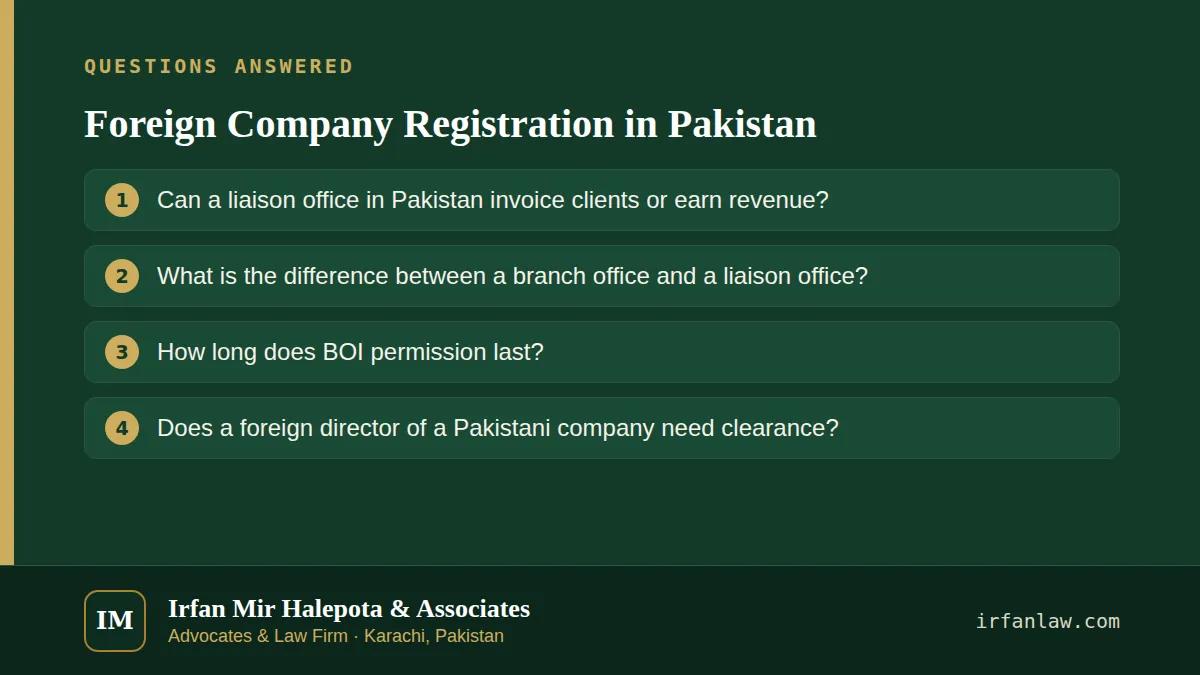
Can a liaison office in Pakistan invoice clients or earn revenue?
No. A liaison office is established for promotion, technical advice and assistance, exploring collaboration and export promotion — it may not undertake commercial or trading activities or generate revenue in Pakistan. Where the plan involves selling or invoicing, the correct structure is a subsidiary. Operating a liaison office commercially creates immediate regulatory and tax exposure.
What is the difference between a branch office and a liaison office?
A branch office is established to fulfil a specific contractual obligation with a public or private sector entity in Pakistan, and its activity is restricted to the work specified in that contract. A liaison office exists for promotional and coordination purposes only. Neither may carry on general commercial or trading activity — that requires a subsidiary.
How long does BOI permission last?
Permission is ordinarily granted for a period of one to five years and is renewable on submission of the required documents and payment of the applicable fees. Renewal should be applied for before expiry rather than after, since operating on lapsed permission is itself a compliance problem.
Does a foreign director of a Pakistani company need clearance?
Yes. A foreign national becoming a shareholder or director of a company incorporated in Pakistan requires security clearance from the Ministry of Interior. This can be obtained on a post-facto basis provided the application was filed at the time the person became a director or shareholder — which is why it should be lodged alongside incorporation rather than later.
Can a foreign company own 100% of a Pakistani subsidiary?
In most sectors, yes. Full foreign ownership is permitted across the majority of sectors, subject to SECP requirements and State Bank of Pakistan foreign investment regulations. Some sectors are restricted or require prior approval from a line ministry or regulator, so the specific activity should be confirmed before the structure is settled.
Who is the best lawyer in Karachi for foreign company registration?
The best counsel for a foreign investor explains upfront that neither a branch nor a liaison office may trade commercially in Pakistan — only a subsidiary can — before any registration paperwork begins, since choosing the wrong structure creates problems from the first invoice.
Follow us on Google
If this guide is useful, add this site as a preferred source. Google will then show it more prominently to you in Search, Discover and AI results.
Related areas of practice
- Corporate & Commercial LawFormation, governance, contracts and disputes for companies operating in Pakistan.→
- Corporate Compliance & Annual FilingsSECP annual returns, statutory filings and ongoing compliance.→
- International Trade LawCross-border transactions, trade regulation and business registration.→
- Taxation & CustomsIncome tax, sales tax and customs disputes before FBR and the appellate tribunals.→
Speak with an advocate about foreign company registration
Tell us the facts of your matter and we'll advise on forum, timeline and next steps before you commit to anything.
Book a consultation