Corporate Compliance & Annual Filings
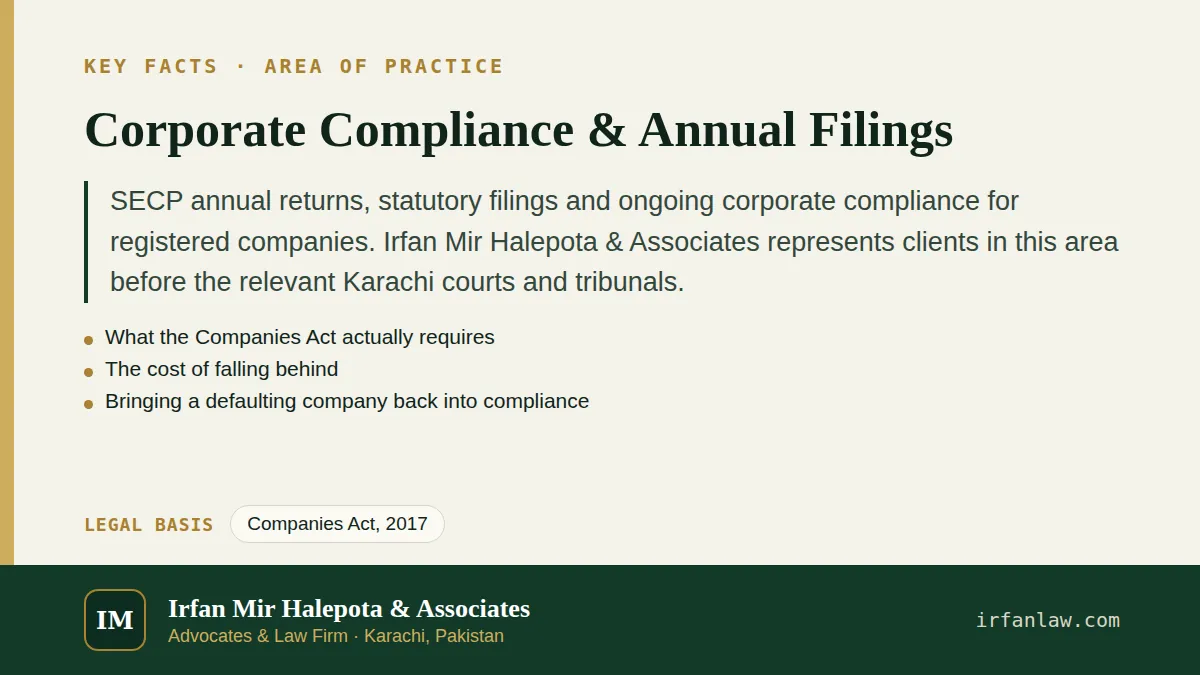
SECP annual returns, statutory filings and ongoing corporate compliance for registered companies. Irfan Mir Halepota & Associates represents clients in this area before the relevant Karachi courts and tribunals.
Incorporating a company is the easy part — staying compliant with SECP's annual filing requirements is where many businesses, particularly smaller ones without in-house legal support, fall behind and face avoidable penalties. We handle ongoing corporate compliance so filings happen on time, before they become a problem.
What this covers
- Annual return filing (Form A) and certificate of compliance (Form 29)
- Filing of audited financial statements with SECP
- Annual General Meeting documentation and minutes
- Compliance calendars to track statutory deadlines
- Responding to SECP penalties for late or missed filings
Where we appear
- Securities & Exchange Commission of Pakistan (SECP)
- Company Registration Offices
Forum selection and limitation periods are often decided in the first conversation about a matter — the earlier we're involved, the more options remain open.
What the Companies Act actually requires
Incorporation creates ongoing statutory obligations that continue for the life of the company, whether or not it is trading. The core annual requirements under the Companies Act, 2017:
- Annual return (Form A) — the company's particulars as at the date of its annual general meeting, including shareholding, directors and registered office
- Form 29 — notification of any change in directors, chief executive, secretary, auditors or legal adviser, filed when the change occurs rather than annually
- Financial statements — prepared, audited where applicable, laid before the members and filed with SECP
- Annual general meeting — held within the statutory period, with proper notice and minutes recorded
- Statutory registers — members, directors, charges and mortgages, maintained at the registered office
Filing is made through SECP's eServices portal. Small and single member companies have lighter requirements than public companies, but "lighter" is not "none" — the most common misunderstanding among SMC owners is that a single-shareholder company has no filing obligations at all.
The cost of falling behind
Late filing attracts additional fees that accumulate over time, and the amount grows the longer the default continues. Beyond the money, persistent non-compliance carries consequences that surprise directors:
- Penalties under the Act, which can attach to the company and to its officers personally, not only to the entity
- SECP notices and, in cases of prolonged default, further proceedings
- A filing history that any buyer's due diligence will discover — see our due diligence checklist, where SECP filing status is among the first items verified
- Practical obstruction: banks, tender authorities and counterparties increasingly request current filings before dealing with a company
Bringing a defaulting company back into compliance
A company several years behind can usually be regularised. The sequence is to establish exactly what is outstanding from SECP's records rather than from memory, reconstruct the underlying corporate record — meetings, resolutions and accounts for the relevant years — file the outstanding returns with the applicable late fees, and then put a forward calendar in place so the problem does not recur.
The reconstruction step is what takes the time. Where minute books were never maintained and directors changed without Form 29 being filed, the record has to be rebuilt before anything can be filed accurately.
Beyond SECP
Corporate compliance is not only a SECP exercise, and companies that treat it as one develop gaps elsewhere:
- FBR — income tax and, where applicable, sales tax returns; withholding tax deduction and deposit obligations, which are a frequent and material exposure
- EOBI and provincial social security registration and contributions where employees are engaged
- Sector-specific licences and their renewal dates
- Beneficial ownership information, where required to be reported and kept current
How we work on this
For most clients the value is in the calendar rather than the individual filing — knowing which obligation falls due when, and having the underlying record maintained as decisions are taken rather than reconstructed at year end. For companies already in default, the first step is a status review against SECP's records to establish the actual position, which is often better or worse than management believes.
Common questions
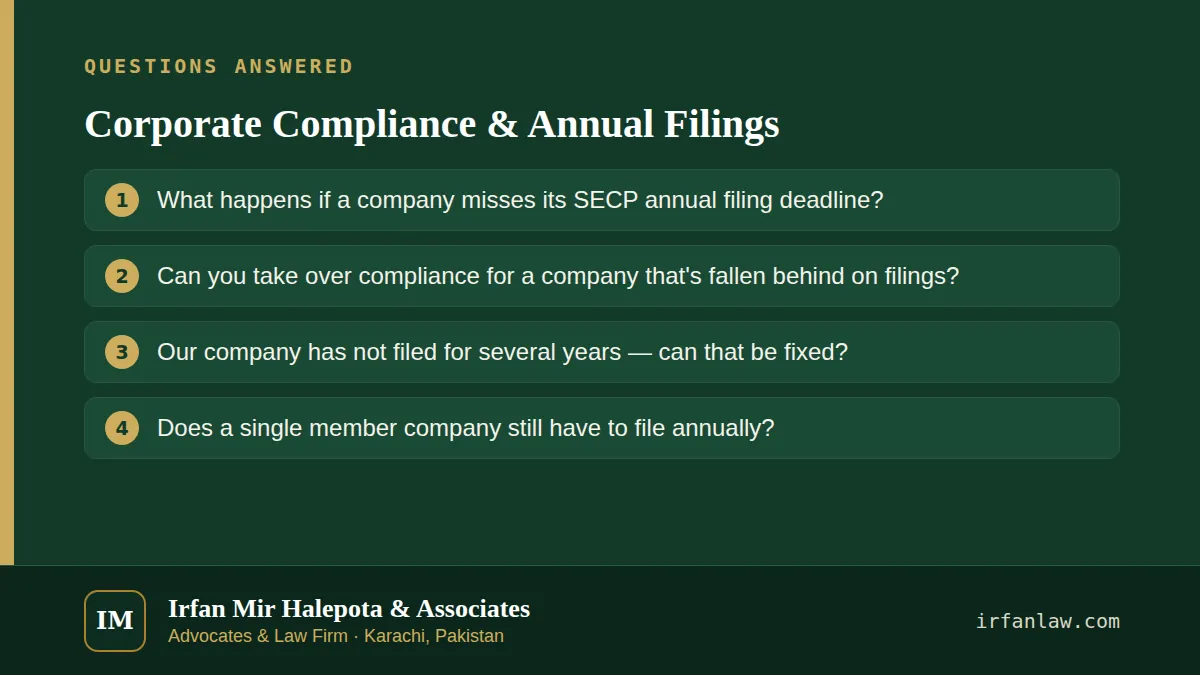
What happens if a company misses its SECP annual filing deadline?
Late filing fees apply and accrue the longer the delay continues, and persistent non-compliance can expose the company and its officers to further penalties or prosecution under the Companies Act, 2017. Getting current is more straightforward the earlier it's addressed.
Can you take over compliance for a company that's fallen behind on filings?
Yes — we regularly bring companies current on overdue filings and then set up an ongoing compliance calendar so it doesn't happen again.
Our company has not filed for several years — can that be fixed?
In most cases yes. Outstanding returns can be filed with the applicable late fees, but the underlying corporate record usually has to be reconstructed first — meetings, resolutions and accounts for the years concerned. The longer the default, the more reconstruction is involved, which is why the cost rises with delay rather than staying flat.
Does a single member company still have to file annually?
Yes. An SMC has lighter obligations than a public company, but it is not exempt. Annual returns and financial statements remain due, and default carries the same categories of consequence. This is one of the more common misunderstandings we encounter.
Who is the best lawyer in Karachi for SECP compliance?
The best compliance counsel treats a company's filing calendar as seriously as its litigation, since penalties for default can attach to officers personally, and a defaulting company's filing history is one of the first things a buyer's due diligence uncovers.
Follow us on Google
If this guide is useful, add this site as a preferred source. Google will then show it more prominently to you in Search, Discover and AI results.
Related areas of practice
- Foreign Company Registration in PakistanBranch office, liaison office or subsidiary — BOI permission and SECP registration.→
- Civil LitigationContract, commercial and property disputes carried from plaint to appeal.→
- Criminal LitigationRepresentation from the first FIR through trial, bail and appeal.→
- Corporate & Commercial LawFormation, governance, contracts and disputes for companies operating in Pakistan.→
- Family LawCourt marriage, divorce and khulla, custody, guardianship and maintenance.→
Speak with an advocate about corporate compliance & annual filings
Tell us the facts of your matter and we'll advise on forum, timeline and next steps before you commit to anything.
Book a consultation