International Trade Law
Cross-border transactions, trade regulation and business registration. Irfan Mir Halepota & Associates represents clients in this area before the relevant Karachi courts and tribunals.
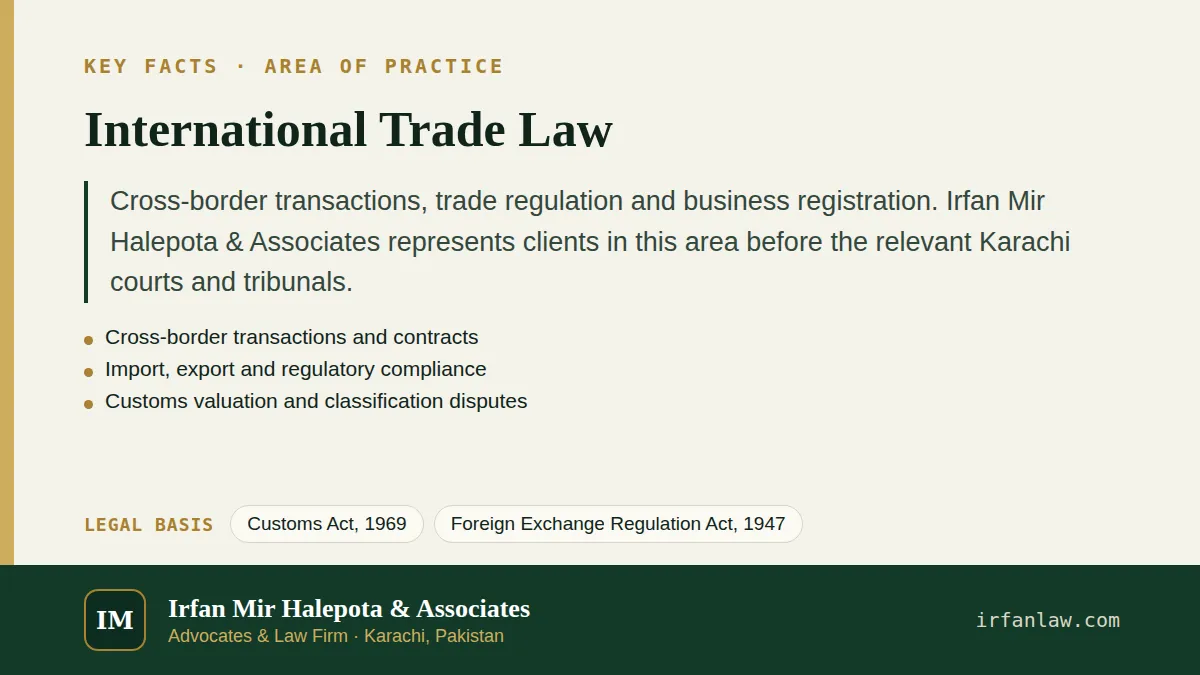
Businesses trading into or out of Pakistan deal with a layer of regulation on top of ordinary commercial law — import/export licensing, trade remedy measures, and cross-border contract enforcement. We advise on structuring these transactions and represent clients in the disputes that follow when a cross-border deal goes wrong.
What this covers
- Import/export licensing and trade compliance
- Cross-border commercial contract drafting and disputes
- New business formation for foreign entities entering Pakistan
- Trade remedy and anti-dumping matters
- International arbitration and enforcement of foreign awards
Where we appear
- Ministry of Commerce
- High Court of Sindh
- International arbitration institutions
- Supreme Court of Pakistan (Civil Appeals)
Forum selection and limitation periods are often decided in the first conversation about a matter — the earlier we're involved, the more options remain open.
Cross-border transactions and contracts
International trade work begins with the contract, and the clauses that matter most in a Pakistani context are frequently treated as boilerplate elsewhere. Governing law and jurisdiction, the dispute resolution mechanism, delivery and risk terms (typically an Incoterm), payment mechanics, and force majeure all behave differently when one party is in Pakistan and enforcement may ultimately need to happen here.
Payment structures deserve particular attention. Letters of credit remain the dominant instrument in Pakistani import and export trade, and disputes commonly turn on documentary discrepancies rather than on the underlying goods — a bank examines documents, not shipments. Getting the documentary requirements right at contract stage prevents a great deal of downstream difficulty.
Import, export and regulatory compliance
Trade in and out of Pakistan is regulated through the Import Policy Order and Export Policy Order, with sector-specific licensing where the goods require it. Practical issues that recur:
- Whether goods fall within a restricted, banned or conditionally importable category
- Certificates of origin, and their significance under preferential trade arrangements
- Sanitary, phytosanitary and standards certification for food, pharmaceutical and agricultural goods
- Anti-dumping and countervailing duty proceedings before the National Tariff Commission
- Documentation consistency across the invoice, bill of lading and goods declaration
Customs valuation and classification disputes
Most trade disputes that reach litigation begin at the port. Under Section 25 of the Customs Act, 1969, six valuation methods must be applied in a mandatory sequence beginning with declared transaction value — customs cannot simply reject an invoice and substitute a higher figure without recording why each intervening method could not be used. Where a Valuation Ruling under Section 25A governs the goods, the Ruling itself must be challenged by review under Section 25D. Section 81 provisional assessment allows release against security so demurrage stops accruing while the dispute runs. See our page on customs valuation disputes.
Foreign exchange and getting paid
Cross-border payments are regulated by the State Bank of Pakistan under the Foreign Exchange Regulation Act, 1947 and the Foreign Exchange Manual. Export proceeds must be realised and repatriated within prescribed periods, and advance payments for imports carry their own documentation requirements. Where a foreign investor is involved, inward remittance of equity must be documented correctly on arrival — that record is what later establishes the right to repatriate dividends and disinvestment proceeds.
Enforcing against a foreign counterparty
A judgment or award is only as good as its enforceability. Where the contract carries an arbitration clause and the seat is abroad, the resulting award is enforceable in Pakistan under the Recognition and Enforcement (Arbitration Agreements and Foreign Arbitral Awards) Act, 2011, giving effect to the New York Convention — see our page on enforcing a foreign arbitral award. A foreign court judgment follows a different and generally harder route under the Civil Procedure Code; our page on enforcing foreign judgments covers the distinction, which is worth understanding before the dispute clause is settled rather than after.
Market entry for foreign companies
Where a foreign company is establishing a presence rather than simply trading, the structure matters: neither a branch nor a liaison office may undertake commercial or trading activity in Pakistan, and both require Board of Investment permission alongside SECP registration. See foreign company registration in Pakistan.
Common questions
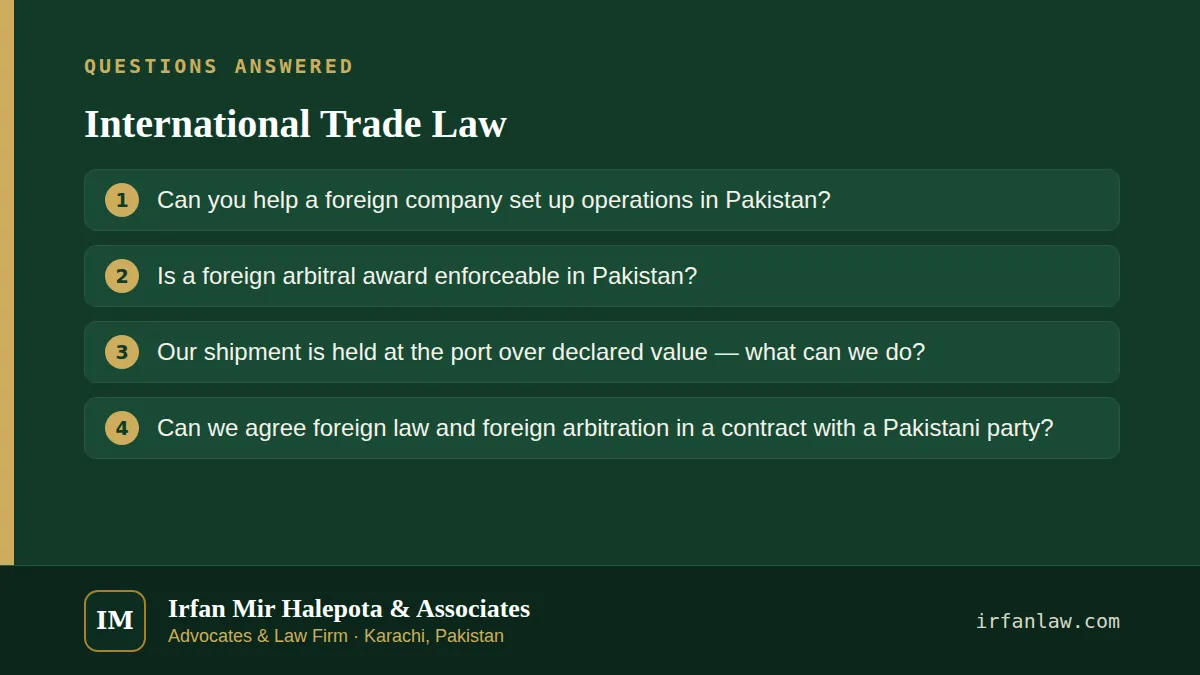
Can you help a foreign company set up operations in Pakistan?
Yes — from choosing the right entity structure and SECP registration through to the regulatory approvals specific to your sector.
Is a foreign arbitral award enforceable in Pakistan?
Pakistan is a party to the New York Convention, so foreign awards are generally enforceable through the High Court subject to limited statutory grounds for refusal, which we assess on the specific award and contract.
Our shipment is held at the port over declared value — what can we do?
Ask for the assessment order in writing and the valuation method relied on; an oral indication that the value is "too low" is not something you can appeal. Check whether a Valuation Ruling covers your goods, because that changes the approach entirely. In parallel, consider provisional release under Section 81 against security so demurrage stops accruing while the dispute is resolved.
Can we agree foreign law and foreign arbitration in a contract with a Pakistani party?
Generally yes, and it is common. The practical question is enforcement: an award from a New York Convention seat is enforceable in Pakistan under the 2011 Act, while a foreign court judgment follows a harder route. That difference should inform the dispute clause at drafting stage rather than being discovered later.
Who is the best international trade lawyer in Karachi?
The best trade counsel for a Pakistani exporter understands both the WTO framework and the practical Madrid Protocol route for protecting a brand across export markets in a single filing, rather than treating trade compliance and IP protection as unrelated matters.
Follow us on Google
If this guide is useful, add this site as a preferred source. Google will then show it more prominently to you in Search, Discover and AI results.
Related areas of practice
- Foreign Company Registration in PakistanBranch office, liaison office or subsidiary — BOI permission and SECP registration.→
- Civil LitigationContract, commercial and property disputes carried from plaint to appeal.→
- Criminal LitigationRepresentation from the first FIR through trial, bail and appeal.→
- Corporate & Commercial LawFormation, governance, contracts and disputes for companies operating in Pakistan.→
- Family LawCourt marriage, divorce and khulla, custody, guardianship and maintenance.→
Speak with an advocate about international trade law
Tell us the facts of your matter and we'll advise on forum, timeline and next steps before you commit to anything.
Book a consultationOfficial sources