Talaq Procedure in Pakistan: The Steps Required Under Section 7 of the MFLO
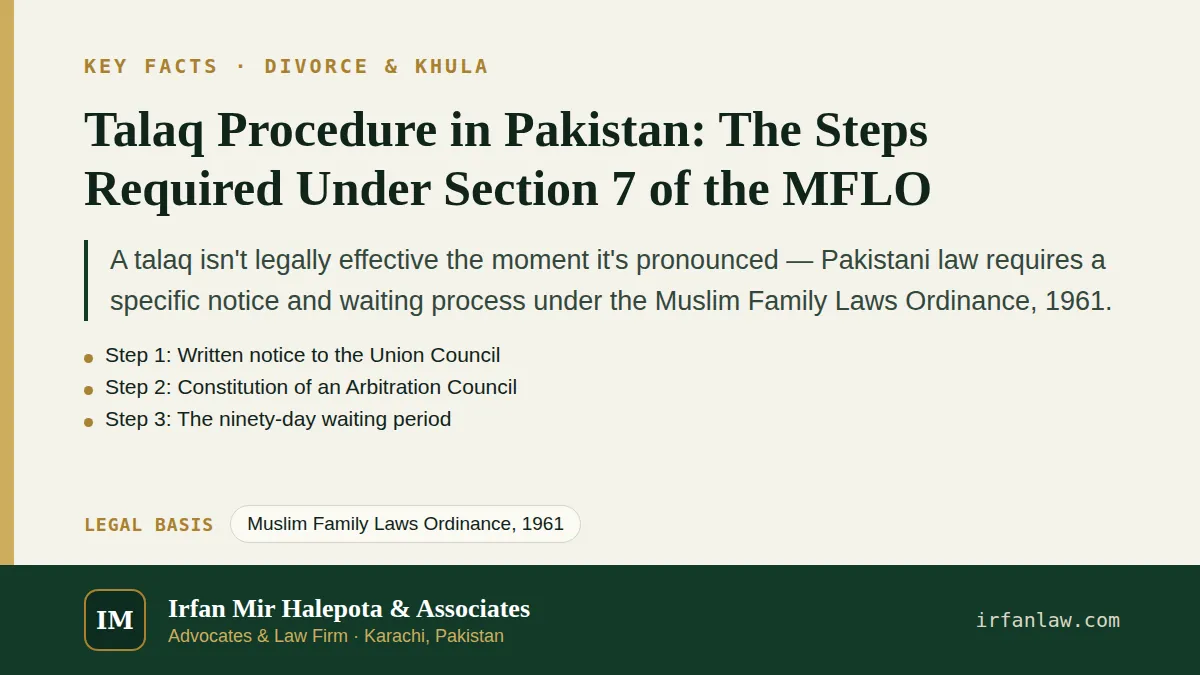
A talaq isn't legally effective the moment it's pronounced — Pakistani law requires a specific notice and waiting process under the Muslim Family Laws Ordinance, 1961.
Free tool: Work out the date a talaq takes effect from the date notice reached the Union Council.
A common misunderstanding we see is the assumption that talaq takes effect the instant it's pronounced. Under Pakistani law it doesn't — Section 7 of the Muslim Family Laws Ordinance, 1961 (MFLO) sets out a mandatory notice and reconciliation procedure, and skipping it can leave the divorce's legal status genuinely unsettled. Anyone searching for the best divorce lawyer in Karachi to handle a talaq needs to know it is not legally complete on pronouncement alone.
Step 1: Written notice to the Union Council
After pronouncing talaq in any form, the husband must give written notice to the Chairman of the Union Council in the area, and supply a copy to the wife. This step isn't optional paperwork — failing to give notice is itself a punishable offence under the Ordinance, separate from any question about the divorce's validity.
Step 2: Constitution of an Arbitration Council
Within thirty days of receiving the notice, the Chairman constitutes an Arbitration Council whose job is to attempt reconciliation between the spouses. This isn't a formality the law expects to fail — the Council is required to take genuine steps toward reconciliation before the process moves forward.
Step 3: The ninety-day waiting period
Unless revoked earlier, the talaq does not become legally effective until ninety days after the notice was delivered to the Chairman. If the wife is pregnant at the time of pronouncement, this period extends until ninety days have passed or the pregnancy ends, whichever is later.
What happens if the notice step is skipped
Case law has consistently treated the Section 7 notice as central to a talaq's legal effect — a pronouncement without proper notice can leave its status open to dispute later, in exactly the situations where clarity matters most: remarriage, inheritance, or a maintenance claim. We handle this notice process for clients precisely to avoid that ambiguity.
After the ninety days
If reconciliation hasn't succeeded, the talaq takes effect and a Talaq Certificate can be issued confirming it — the document that Union Councils, NADRA and other authorities will subsequently rely on.
Follow us on Google
If these guides are useful, add this site as a preferred source. Google will then show it more prominently to you in Search, Discover and AI results.
Official sources
Common questions
What is the consequence of not notifying the Union Council?
Section 7 of the Muslim Family Laws Ordinance, 1961 requires the husband to give written notice of the talaq to the Chairman of the Union Council as soon as may be after pronouncement, and to supply a copy to the wife. Failure to give notice is an offence under the section. Practically, the greater difficulty is evidentiary — an unnotified talaq leaves the marital status undocumented, which surfaces on remarriage, in inheritance disputes, and in visa and NADRA matters.
Does maintenance continue during the ninety days?
The marriage subsists until the talaq takes effect, which under Section 7 is ninety days from delivery of the notice unless revoked earlier. A wife's entitlement to maintenance during that period, and during iddat, is a distinct question from the dissolution itself and may be claimed in the same proceedings.
Does a wife have any equivalent right to pronounce talaq?
Where the right of divorce has been delegated to her in the Nikah Nama — talaq-e-tafweez — she may exercise it in accordance with the terms recorded. This is why the delegation column of the Nikah Nama matters and should never be left blank by default; it is frequently completed without either party appreciating its effect.
This article is general information about Pakistani law and procedure, not legal advice for any specific matter. If this touches on something you're currently facing, get in touch and we'll advise on your facts directly.