Interim Injunctions in Pakistan: When Courts Will (and Won't) Grant One
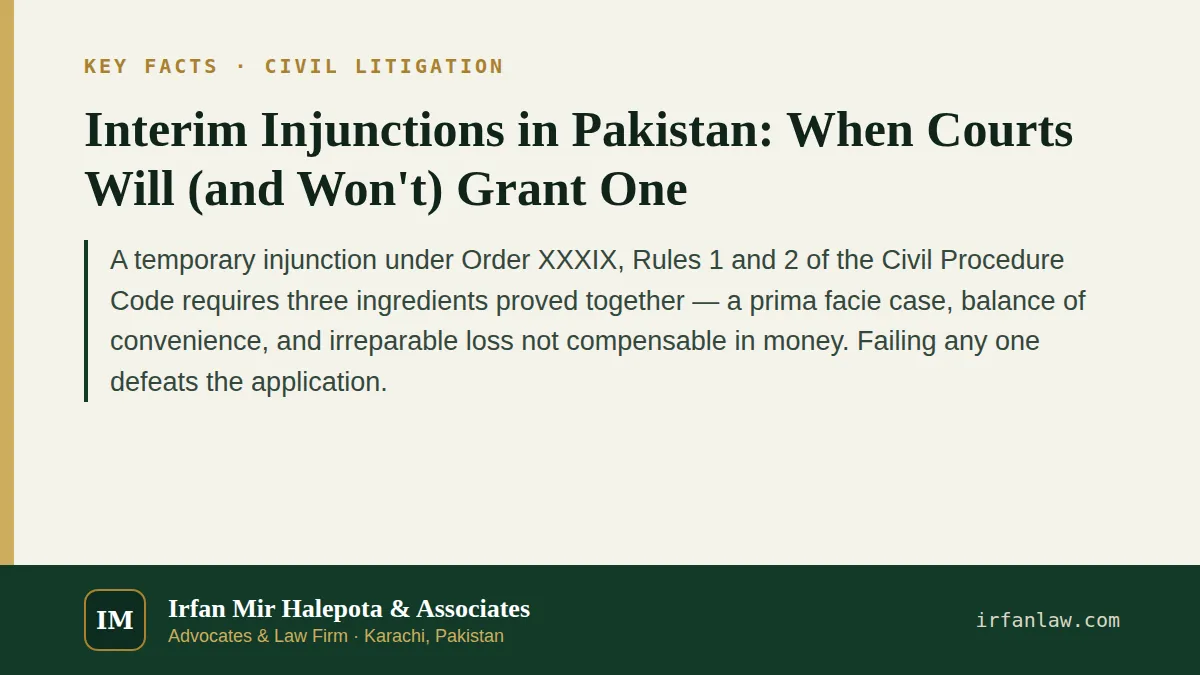
A temporary injunction under Order XXXIX, Rules 1 and 2 of the Civil Procedure Code requires three ingredients proved together — a prima facie case, balance of convenience, and irreparable loss not compensable in money. Failing any one defeats the application.
In a great many civil disputes, the interim injunction is the real contest. A final decree may be years away; whether the property can be sold, the construction continued, the bank guarantee encashed or the goods disposed of in the meantime frequently determines whether winning at trial will still be worth anything. When a client asks for the best civil litigation lawyer in Karachi to stop a transaction or a sale, an interim injunction is usually the tool they actually need — and timing matters more than almost anything else here.
Why the interim stage often decides the case
Courts are conscious that an interim order made in weeks can have more practical effect than a judgment delivered after years. That cuts both ways: it is why applications are taken seriously, and equally why they are refused where the applicant cannot show the relief is genuinely necessary rather than merely convenient.
The three-part test
The jurisdiction arises under Order XXXIX, Rules 1 and 2 of the Code of Civil Procedure, 1908, supplemented by the court's inherent powers under Section 151. The settled test requires all three of the following, together:
- A prima facie case. Not a case that will certainly succeed — a serious question to be tried, supported by material on the record. The court is not deciding the suit at this stage; it is satisfying itself that there is something real to try.
- Balance of convenience. Whether more harm would result from refusing the injunction than from granting it. This is a comparative exercise: the court weighs the inconvenience to each side, not just the applicant's difficulty.
- Irreparable loss. Loss that cannot be adequately compensated in damages. This is where most applications fail, and the reason is straightforward — if money can fix it, an injunction is usually unnecessary. A purely commercial loss, quantifiable in rupees, ordinarily does not qualify.
These are cumulative. An applicant with an overwhelming prima facie case but no irreparable loss will generally be refused, and told that a decree for damages is the appropriate remedy.
Ex parte injunctions and the duty of full disclosure
Where the urgency is genuine, an injunction may be sought ex parte — without notice to the other side — typically where notice would allow the very act complained of to be completed first. Order XXXIX, Rule 3 requires the court to record reasons for proceeding without notice and to have notice served immediately thereafter.
An ex parte application carries a heavy obligation: full and frank disclosure. The applicant must place before the court the material facts against its own case as well as for it — including prior proceedings, earlier refusals, and any weakness in title or standing. Concealment discovered later does not merely lose the injunction; it damages the applicant's credibility for the remainder of the suit, and courts have vacated orders on that ground alone without reaching the merits.
Where applications commonly fail
- Delay. An applicant who waited months after learning of the threatened act undermines their own claim of urgency. Courts ask why, and rarely find the answer satisfying.
- Loss that is plainly compensable. As above — the most frequent single reason for refusal.
- Seeking the final relief at the interim stage. An injunction that would give the plaintiff everything the suit claims, before trial, is generally refused. The interim order preserves the position; it does not decide the case.
- Vague or overbroad prayers. An application asking the court to restrain the defendant from "any adverse action" invites refusal. Specific, enforceable relief is far more likely to be granted.
- Unclean hands. Injunctive relief is equitable. An applicant whose own conduct in the transaction is questionable may be refused on that basis.
Status quo orders and undertakings
Courts frequently prefer a middle path to a full injunction — an order maintaining the status quo, or acceptance of an undertaking from the defendant not to alienate or alter the property pending disposal. An undertaking recorded by the court carries real force: breach is contempt. Where the objective is simply to stop the position from changing, offering to accept an undertaking is often faster and more likely to succeed than pressing for an injunction.
The court may also require the applicant to furnish security, so that the defendant can be compensated if the injunction later proves to have been wrongly obtained.
If an injunction is refused
An order granting or refusing a temporary injunction is appealable as an order under the CPC. But an appeal takes time, and in an urgent matter the practical value of appealing depends on whether the act complained of can still be prevented. Where the position has already changed, the realistic focus shifts to damages, or — in property matters — to relief such as specific performance or cancellation of a subsequent transfer.
The practical point
Injunction applications are won on preparation rather than argument. The affidavit, the documents proving the applicant's right, evidence of the imminent threatened act, and a clear explanation of why damages would not be an answer — assembled before filing — do more than any amount of advocacy at the hearing.
Common questions
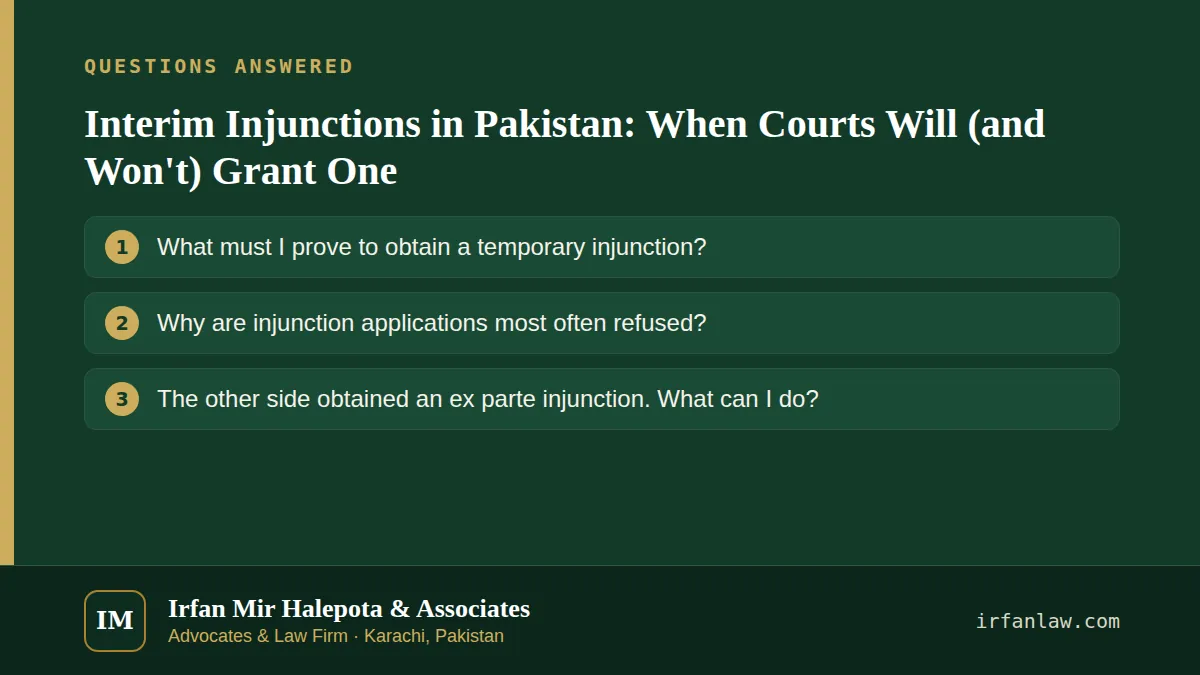
What must I prove to obtain a temporary injunction?
Three things, together: a prima facie case, balance of convenience, and irreparable loss not compensable in money. These are cumulative — failing any one defeats the application. An applicant with an overwhelming prima facie case but no irreparable loss will generally be refused and told that damages are the appropriate remedy.
Why are injunction applications most often refused?
Because the loss claimed is plainly compensable in money. If damages can fix it, an injunction is usually unnecessary. Other frequent reasons are delay in applying, overbroad or vague prayers, and seeking at the interim stage the whole relief the suit claims.
The other side obtained an ex parte injunction. What can I do?
An ex parte order is provisional and an application to vacate can be moved. An applicant seeking relief without notice carries a heavy duty of full and frank disclosure, including material facts against its own case. Concealment discovered later can be sufficient to have the order set aside without the merits being reached at all.
Follow us on Google
If these guides are useful, add this site as a preferred source. Google will then show it more prominently to you in Search, Discover and AI results.
Official sources
This article is general information about Pakistani law and procedure, not legal advice for any specific matter. If this touches on something you're currently facing, get in touch and we'll advise on your facts directly.