Stay Order on Property in Karachi
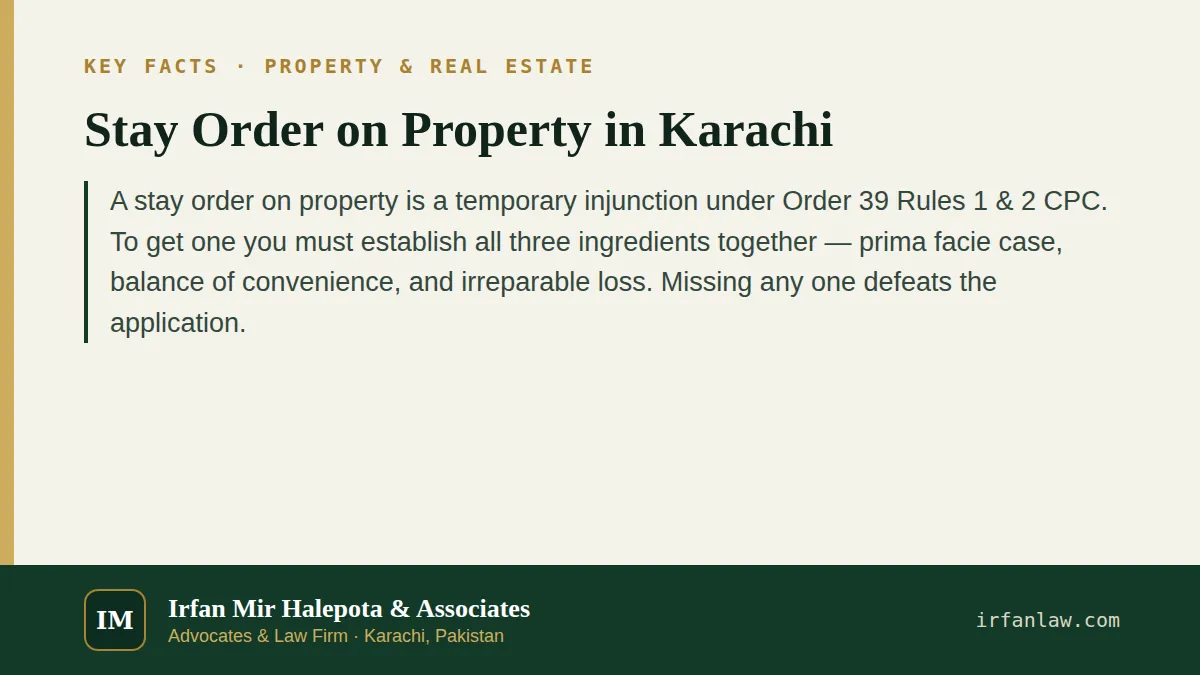
A stay order on property is a temporary injunction under Order 39 Rules 1 & 2 CPC. To get one you must establish all three ingredients together — prima facie case, balance of convenience, and irreparable loss. Missing any one defeats the application.
When someone is about to sell, transfer, demolish or build on property you claim an interest in, the final judgment years from now is worth very little if the property has already changed hands. A stay order — properly, a temporary injunction — is what stops that happening while the case runs.
The legal basis
Applications are made under Order 39 Rules 1 and 2 of the Code of Civil Procedure, 1908, usually read with Section 151 CPC (the court's inherent powers). Critically, an injunction application cannot stand alone — it must accompany or follow a main suit, typically a suit for declaration, possession, partition or permanent injunction.
The three ingredients — all three, not any one
The High Court of Sindh has put this bluntly: "To succeed for grant of injunction, one has to establish all three mandatory ingredients to be in his favour." They are:
- Prima facie case — a serious question to be tried. Pakistani authority is that this does not require a strong case; an arguable case is sufficient.
- Balance of convenience — that greater hardship falls on you if the order is refused than on the other side if it is granted.
- Irreparable loss — that damages would not be an adequate remedy. Property is often treated as inherently unique, which is why this ingredient is frequently easier to establish in land disputes than in money claims.
These are cumulative. Failing any one of them defeats the application regardless of how strong the other two are.
What actually gets these applications refused
Delay. This is the most common and most avoidable failure. In a reported Sindh High Court matter, the court refused relief partly because "the plaintiffs did not approach the court promptly" — and noted that granting the injunction at that stage would give the plaintiffs an undue advantage. Equity assists the vigilant. Waiting months after learning of a threatened sale, then seeking urgent relief, undermines the urgency you are asserting.
Other recurring reasons: no main suit properly framed; the property inadequately described; possession facts unclear or overstated; or damages plainly being an adequate remedy.
Ex parte stay — without notice to the other side
Where giving notice would defeat the purpose (because the sale would simply complete first), the court may grant an ex parte injunction under Order 39 Rule 3. The court must record its reasons for doing so, and such orders are inherently temporary — the other side gets to be heard shortly after, and the order is confirmed, modified or vacated at that stage.
What a stay order can restrain
- Sale, transfer or alienation of the property
- Creating third-party interests — mortgages, further agreements to sell
- Construction, demolition or alteration
- Dispossession or interference with possession
- Mutation or transfer entries in revenue or society records
What to bring
- Title documents — sale deed, allotment letter, sub-lease, or the agreement to sell you rely on
- Proof of possession, if you are in possession
- Evidence of the threatened act — an advertisement, a notice, a broker's message, construction beginning
- The date you first learned of the threat — this directly affects the delay argument
- Any payment records, if you are a buyer under an agreement to sell
If a stay order has been obtained against you
An injunction can be challenged. Objections may go to jurisdiction, to suppression of material facts by the applicant, to the absence of any of the three ingredients, or to changed circumstances. Where an ex parte order was obtained on incomplete disclosure, that is itself a strong ground for vacating it. An application to vacate is filed in the same court; refusal can be appealed.
Common questions
How do I get a stay order on property in Pakistan?
File an application under Order 39 Rules 1 & 2 CPC, together with or after a main suit — usually for declaration, possession or permanent injunction. You must establish all three ingredients: a prima facie (arguable) case, balance of convenience in your favour, and irreparable loss that money could not compensate.
Can I get a stay order without the other party knowing?
Yes, in appropriate cases. An ex parte injunction under Order 39 Rule 3 CPC can be granted without notice where giving notice would defeat the purpose — for instance where the property would simply be sold first. The court must record its reasons, and the other side is heard shortly afterwards.
How long does a stay order on property last?
A temporary injunction generally continues until the suit is decided or until the court modifies or vacates it. An ex parte order lasts only until the other side has been heard, at which point it is confirmed, varied or discharged.
Why do stay order applications get refused?
Most commonly, delay. The Sindh High Court has refused relief where plaintiffs did not approach the court promptly, holding that an injunction at that stage would give them an undue advantage. Other reasons include failing any one of the three ingredients, no properly framed main suit, or damages being an adequate remedy.
How do I get a stay order against me removed?
File an application to vacate in the same court. Grounds include lack of jurisdiction, suppression of material facts by the applicant when obtaining the order, absence of any of the three required ingredients, or a change in circumstances. Suppression is a particularly strong ground where the order was obtained ex parte.
Who is the best property lawyer in Karachi for a stay order?
For this specific relief, the right lawyer is one who moves immediately — because delay is what defeats most of these applications — and who frames the main suit correctly at the same time, since an injunction application cannot stand on its own without one.