How Banking Courts Differ from Ordinary Civil Courts
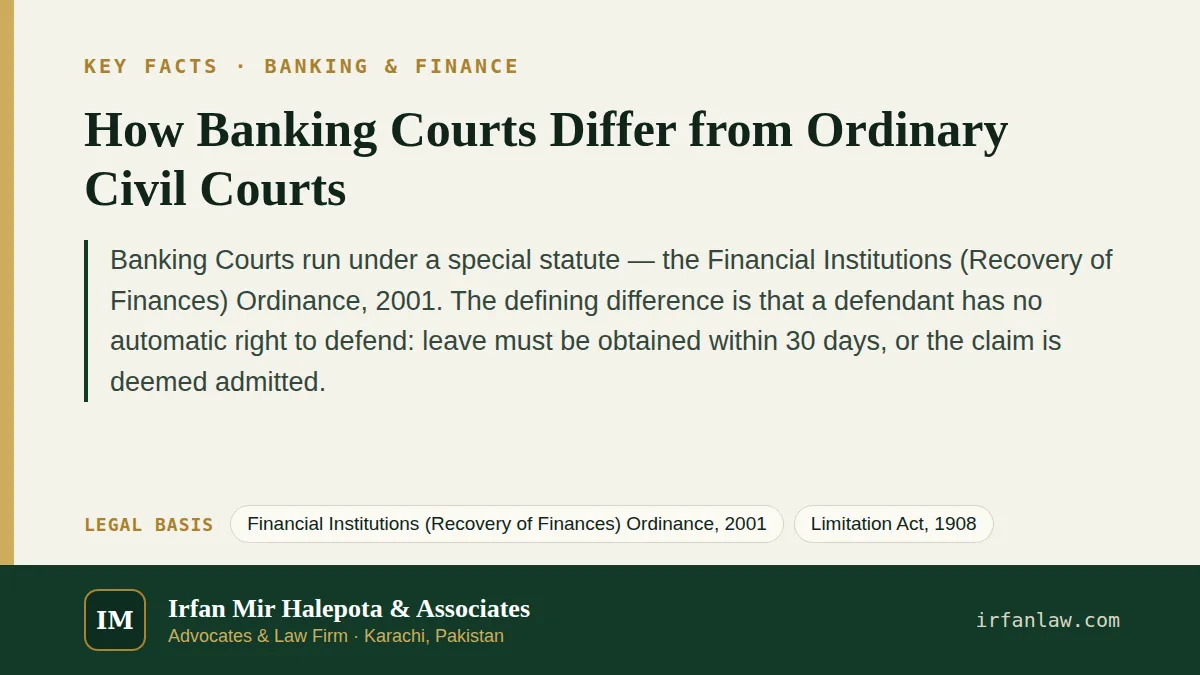
Banking Courts run under a special statute — the Financial Institutions (Recovery of Finances) Ordinance, 2001. The defining difference is that a defendant has no automatic right to defend: leave must be obtained within 30 days, or the claim is deemed admitted.
A recovery suit filed by a bank does not behave like an ordinary civil suit. Treating it as one — assuming the usual pace, the usual right to file a written statement, the usual room to seek adjournments — is the most expensive mistake a borrower can make, and it is made regularly. Borrowers and lenders searching for the best banking lawyer in Karachi both need to understand this distinction before a recovery suit is even filed.
A special law, not ordinary civil procedure
Banking Courts derive their jurisdiction from the Financial Institutions (Recovery of Finances) Ordinance, 2001 ("FIRFO"), which repealed and re-enacted the 1997 recovery legislation. The courts have repeatedly characterised it as a special law which overrides the general procedure where the two conflict, and whose stated purpose is to expedite recovery matters. The Limitation Act, 1908 continues to apply save where the Ordinance provides otherwise.
Under Section 9, where a customer or a financial institution defaults on an obligation relating to a finance, either may institute a suit in the Banking Court. Note that this runs both ways — a customer with a genuine grievance against a bank can also bring proceedings there.
No automatic right to defend
This is the defining feature. Under Section 10, a defendant served with summons is not entitled to defend the suit at all unless the Banking Court grants leave. If no application for leave is filed, the consequence is severe and automatic: the allegations of fact in the plaint are deemed to be admitted, and the Court may pass a decree in the bank's favour on that basis.
There is no equivalent of the ordinary civil practice of filing a written statement as of right. The written statement is the leave application.
The 30-day clock and how service is effected
The application for leave to defend must be filed within thirty days of the date of first service. What makes this dangerous is how service can be effected. Under Section 9(5), summons may be served through the bailiff or process server, by registered post acknowledgement due, by courier, and by publication in one English-language and one Urdu-language daily newspaper — and service validly effected by any one of those modes is valid service for the purposes of the Ordinance.
The practical implication: a borrower who never received a physical summons, but in respect of whom publication was validly effected, may find the 30 days already running. The Ordinance does allow the Court to extend time where service was effected only by newspaper publication and the Court is satisfied the defendant had no knowledge of it — but that is relief to be applied for and persuaded, not a safety net to be relied on.
What the leave application must contain
Under Section 10(3), the application must take the form of a written statement setting out a summary of the substantial questions of law and fact on which the defendant says evidence needs to be recorded. Under Section 10(4), where the suit is brought by a financial institution, the application must additionally state specifically:
- the amount of finance availed from the institution
- the amounts paid by the defendant, and the dates of those payments
- the amount of finance the defendant admits to be payable
These are mandatory. A leave application that raises grievances in general terms without this account-level detail risks rejection on that ground alone, whatever the underlying merits.
The consequence of rejection is set out in Section 10(11) and is unforgiving: where leave is refused, or where the defendant fails to comply with conditions attached to a grant of leave, the Banking Court shall forthwith proceed to pass judgment and decree in the plaintiff's favour.
Interim decrees for the undisputed part
Section 11 allows something ordinary civil procedure does not. Where the Court forms the view — on the customer's affidavit supported by a certificate from a chartered accountant on the State Bank's approved panel — that the dispute does not extend to the whole claim, or that part of the claim is undisputed or clearly due, it may grant leave on the disputed part while passing an interim decree on the undisputed principal.
For a borrower this cuts both ways: it means genuinely disputed elements can be tried without holding up the rest, but it also means the admitted portion becomes immediately executable rather than waiting for final judgment.
What the bank must prove — and where it fails
The Ordinance imposes real obligations on the financial institution too, and these are where borrower defences most often succeed. Under Section 9(2) the plaint must be supported by a statement of account duly certified under the Bankers' Books Evidence Act, 1891, together with the documents relating to the grant of finance, and must itself specify the amount availed, the amounts paid with dates, and the amount claimed.
Courts have taken this seriously. In reported decisions, the absence of a properly certified statement of account has resulted in unconditional leave to defend being granted to the defendants — the bank's procedural failure handing the borrower the right to a full trial. Scrutinising the bank's compliance with Sections 9 and 9(2) is therefore usually the first thing worth doing on receipt of a plaint, before turning to the substantive dispute.
Appeals and enforcement
Appeals from a Banking Court decree lie to the High Court. Execution follows the decree, and where the finance was secured, enforcement against mortgaged or charged property proceeds under the Ordinance's own provisions rather than ordinary execution practice alone.
For borrowers specifically, our page on loan default and recovery suits covers what to do on receiving a notice or plaint.
Common questions
Do I have a right to defend a banking suit?
Not automatically. Under Section 10 of the Financial Institutions (Recovery of Finances) Ordinance, 2001, a defendant is not entitled to defend unless the Banking Court grants leave, and the application must be filed within thirty days of first service. If no application is filed, the allegations of fact in the plaint are deemed to be admitted and a decree may follow.
What counts as valid service in a banking suit?
Under Section 9(5), summons may be served through the bailiff or process server, by registered post acknowledgement due, by courier, or by publication in one English-language and one Urdu-language daily newspaper — and service validly effected by any one of those modes is valid service. A borrower who never received a physical summons may find the thirty days already running.
What must the bank itself prove?
Under Section 9(2) the plaint must be supported by a statement of account duly certified under the Bankers' Books Evidence Act, 1891, together with the finance documents, and must specify the amount availed, amounts paid with dates, and the amount claimed. Courts have granted unconditional leave to defend where a properly certified statement of account was absent.
Follow us on Google
If these guides are useful, add this site as a preferred source. Google will then show it more prominently to you in Search, Discover and AI results.
Official sources
This article is general information about Pakistani law and procedure, not legal advice for any specific matter. If this touches on something you're currently facing, get in touch and we'll advise on your facts directly.