Environmental NOCs in Sindh: Which Projects Need One
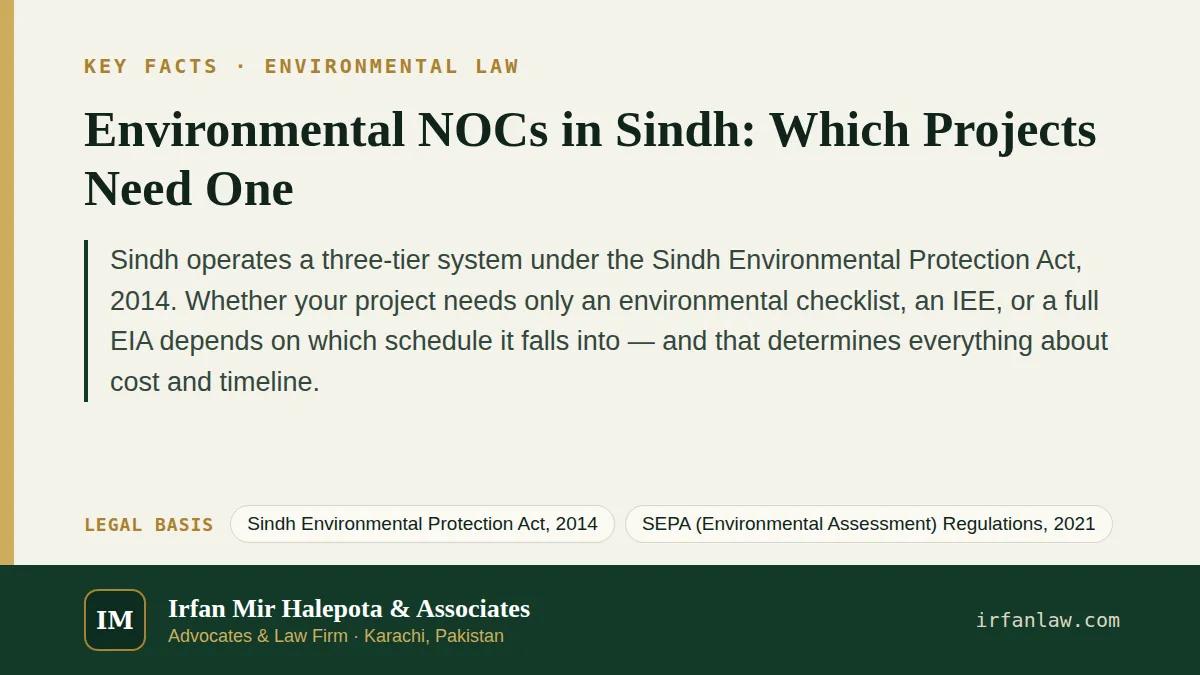
Sindh operates a three-tier system under the Sindh Environmental Protection Act, 2014. Whether your project needs only an environmental checklist, an IEE, or a full EIA depends on which schedule it falls into — and that determines everything about cost and timeline.
Businesses in Sindh often refer to "getting the environmental NOC" as a single step. It is not — it is one of three quite different processes, and identifying which applies to your project is the decision that determines cost, timeline and how much of it is public. Developers searching for the best environmental lawyer in Karachi need to answer one question first — which SEPA schedule the project actually falls under.
The governing framework
The Sindh Environmental Protection Act, 2014 — 37 sections across eleven Parts — is the provincial statute, enacted after environmental protection devolved to the provinces. It establishes the Sindh Environmental Protection Council, the Sindh Environmental Protection Agency (SEPA), the Sindh Environmental Quality Standards (SEQS) and the Sindh Environmental Protection Tribunal.
Section 17 is the operative requirement: no project falling within the prescribed categories may be commenced without filing an environmental assessment and obtaining approval. The detail sits in regulations made under Section 37 — originally the SEPA (Review of Initial Environmental Examination and Environmental Impact Assessment) Regulations, 2014, which repealed the federal 2000 regulations as they applied to Sindh, and were subsequently updated by the SEPA (Environmental Assessment) Regulations, 2021. Confirm the current version applies to your filing, since the categorisation schedules are what determine your tier.
Note also Section 35: the Act has effect notwithstanding anything inconsistent in any other law. An approval under some other licensing regime does not substitute for environmental approval.
The three tiers
The regulations categorise projects by anticipated degree of environmental impact:
- Environmental checklist — for the lowest-impact category. A short-form submission on the prescribed proforma. Fastest and cheapest.
- Initial Environmental Examination (IEE) — for projects in the first schedule. A study identifying likely impacts and proposed mitigation, sufficient where impacts are expected to be limited and manageable.
- Environmental Impact Assessment (EIA) — for projects in the second schedule: larger installations, higher-risk industrial activity, and projects in or near sensitive areas. Substantially more detailed, and — critically — it triggers a public consultation process the other two do not.
Broad categories covered by the schedules include industrial and manufacturing plants, energy projects, chemicals, agriculture and livestock installations, mining and quarrying, transport infrastructure, water and waste management, and urban development and housing schemes. Thresholds within each category matter: the same type of project can fall into different tiers depending on capacity, area or investment size.
The most common and expensive mistake is self-classifying downward — filing an IEE where the schedule required an EIA. Discovering this after construction has begun is considerably worse than the additional cost of the correct study at the outset.
What filing involves
An IEE or EIA is filed with SEPA in hard and electronic copies, accompanied by the prescribed application form, proof of payment of the review fee, and — where applicable — NOCs from other relevant departments. That last item is worth planning for: an environmental filing can stall waiting on a clearance from a separate authority, and those run on their own timelines.
SEPA circulates the submission to other government agencies for comment as part of its review.
Public consultation for EIA projects
For projects requiring a full EIA, the regulations require a public notice stating the project type, its exact location, the proponent's name and address, and where the EIA can be inspected — followed by a public hearing at which objections may be raised.
This deserves genuine attention rather than treatment as a formality. Objections raised at the hearing enter the record, can shape the conditions attached to any approval, and provide material for later challenge before the Environmental Tribunal. Projects near residential areas, agricultural land or water bodies should expect participation and prepare for it.
Timeline and validity
SEPA reviews within the periods prescribed by the regulations and may approve, approve subject to conditions, or refuse. An IEE review is materially shorter than an EIA review, which is one reason correct categorisation matters commercially.
An approval is not open-ended. It carries a validity period, extendable for further periods not exceeding three years at a time where the conditions of approval do not require otherwise. A project delayed past the validity of its approval needs the extension applied for, not assumed.
Ongoing monitoring obligations
Approval is the beginning of a compliance relationship, not the end of a process. The regulations require a report to SEPA on completion of construction, and thereafter — once confirmation of compliance is issued — annual reports summarising operational performance against the conditions of approval and the mitigation measures adopted.
Failure here is what most often triggers enforcement. Where SEPA forms the view that conditions have not been complied with, or that information supplied in the approved IEE or EIA was incorrect, it may issue a show-cause notice as to why the approval should not be cancelled. See our page on responding to a SEPA closure notice.
Starting work without approval
Commencing a scheduled project without approval exposes the proponent to enforcement before the Sindh Environmental Protection Tribunal, penalties under the Act, and orders to stop work. Where a body corporate is involved, liability provisions can reach responsible individuals, not only the company. Dues recoverable by the Agency are recoverable as arrears of land revenue under Section 34 — a notably direct enforcement mechanism.
The practical point for anyone planning a project in Sindh: environmental categorisation belongs in the feasibility stage, alongside land and financing. Retrofitting it after commitments are made is where the real cost arises.
Follow us on Google
If these guides are useful, add this site as a preferred source. Google will then show it more prominently to you in Search, Discover and AI results.
Official sources
Common questions
Does my project need a full EIA or just an environmental checklist in Sindh?
It depends on which schedule under the SEPA regulations the project falls into, based on its category, capacity and location. The most common and expensive mistake is self-classifying downward — filing an IEE where the schedule actually required a full EIA — which is far costlier to correct after construction has begun than to get right at the feasibility stage.
How long is an environmental approval valid in Sindh?
Approval carries a validity period, extendable for further periods of up to three years at a time where the conditions of approval do not require otherwise. A project delayed past that validity needs the extension actively applied for, not assumed.
This article is general information about Pakistani law and procedure, not legal advice for any specific matter. If this touches on something you're currently facing, get in touch and we'll advise on your facts directly.