Capital Gains Tax on Property in Pakistan: Section 37, 236C and 236K After the Finance Act, 2026
A gain on the sale of immovable property is taxed under section 37(1A) of the Income Tax Ordinance, 2001 at the rates in Division VIII of Part I of the First Schedule. For property acquired on or after 1 July 2024, a seller on the Active Taxpayers' List pays a flat 15% whatever the holding period. Property acquired earlier follows a holding-period table that falls to nil. Separately, from 1 July 2026 an ATL seller pays 2.75% advance tax under section 236C and an ATL buyer pays 1.25% under section 236K. The rates for persons not on the list are far higher.
Selling a plot, house or flat in Pakistan triggers two different federal income tax events that people often confuse. One is capital gains tax on the profit, which is worked out in the seller's return. The other is advance tax collected from both the seller and the buyer at the time of transfer, whatever the profit. A seller looking for the best property tax lawyer in Karachi is usually asking a narrower question: given when the property was bought and the seller's filer status, what will actually be payable, and what can be adjusted later? This guide answers that as the law stands after the Finance Act, 2026. It explains the rates, valuation, the end of the section 7E deemed-income tax and the points that most often cause disputes.
What is taxed: the gain under section 37(1A)
Section 37 of the Income Tax Ordinance, 2001 charges tax on capital gains. Sub-section (1A) deals separately with gains on the disposal of immovable property. Those gains are taxed under the head "Capital Gains" at the rates in Division VIII of Part I of the First Schedule, not at ordinary slab rates.
The basic computation is simple. The gain is the consideration received on disposal less the cost of the asset (section 37(2)). Three points shape the figures in practice:
- Inherited and gifted property. Under section 37(4A), where an asset is acquired by gift from a relative, bequest, will, succession or inheritance, its fair market value on the date of acquisition is treated as its cost. That can substantially reduce the taxable gain for heirs.
- Property held as stock-in-trade is not a capital asset. The definition of capital asset in section 37(5) excludes stock-in-trade. A builder or dealer who trades in plots is taxed on business income, not under the capital gains rates. Whether a particular owner is an investor or a trader depends on the facts, such as the frequency of deals, how purchases were financed and how the property was shown in the accounts.
- Cash purchases. According to PwC's summary of the current law, property bought for more than five million rupees otherwise than through the banking channel is penalised: no cost connected with it counts in computing the gain. Keep the bank trail for every payment.
Rates for property acquired on or after 1 July 2024
The Finance Act, 2024 removed the holding-period concession for property acquired on or after 1 July 2024. For that property, the rate depends on the seller's status, not on how long the property was held:
| Seller | Rate on the gain |
|---|---|
| Individual, AOP or company on the Active Taxpayers' List | 15% |
| Individual or AOP not on the ATL | Normal Division I slab rates, but not less than 15% |
| Company not on the ATL | Corporate rates under Division II |
A property bought in 2025 and sold three months later is taxed at 15% for an ATL seller, and so is one sold after ten years. Status is tested at the time of disposal, so a seller who has dropped off the list should regularise the position before the sale. Our guide to the Active Taxpayers' List explains how.
Rates for property acquired on or before 30 June 2024
Property acquired on or before 30 June 2024 keeps the older regime, under which the rate falls the longer the property is held. The rates differ for open plots, constructed property and flats. As summarised in PwC's Worldwide Tax Summaries (reviewed 24 August 2026) and consistent with a published summary of the tax year 2027 rates:
| Holding period | Open plots | Constructed property | Flats |
|---|---|---|---|
| Up to 1 year | 15% | 15% | 15% |
| More than 1, up to 2 years | 12.5% | 10% | 7.5% |
| More than 2, up to 3 years | 10% | 7.5% | 0% |
| More than 3, up to 4 years | 7.5% | 5% | 0% |
| More than 4, up to 5 years | 5% | 0% | 0% |
| More than 5, up to 6 years | 2.5% | 0% | 0% |
| More than 6 years | 0% | 0% | 0% |
Two practical cautions apply. First, the holding period runs from acquisition to disposal, and the dates have to be proved. Allotment letters, transfer orders, registered sale deeds and society records often show different dates, and the department will usually look for the earliest documentary evidence of disposal and the latest of acquisition. Second, the classification can be disputed. A plot on which construction has started, or a flat bought "on file" before completion, may be argued either way, so keep evidence of the property's condition on both dates.
Advance tax on sale (section 236C) and purchase (section 236K)
Advance tax is collected at the transfer stage by the authority registering or recording the transfer, such as the registrar or the housing society. It is collected whatever the gain, and even where the gain is exempt. The Finance Act, 2026 simplified the rates for persons on the ATL:
| Provision | Base | On ATL (from 1 July 2026) | Not on ATL |
|---|---|---|---|
| s.236C, seller | Gross consideration | 2.75% flat | 11.5% |
| s.236K, buyer | Fair market value | 1.25% flat | 10.5% up to Rs 50m; 14.5% Rs 50m to 100m; 18.5% above Rs 100m |
For comparison, the Finance Act, 2025 rates for filers had been slab-based: 4.5% to 5.5% on sale and 1.5% to 2.5% on purchase. Higher "late filer" rates also applied. FBR Circular No. 02 of 2026-27 confirms that the Finance Act, 2026 replaced the slabs with flat rates and abolished the late-filer rates in rule 1A of the Tenth Schedule.
Overseas Pakistanis. FBR guidance allows a non-resident holder of a POC or NICOP, who stayed in Pakistan for less than 183 days in the financial year, to be charged the filer rate even without a filed return. The registering authority or society starts a verification request on the FBR portal, and the Commissioner approves it.
Adjustment. Advance tax is a payment on account. The Sindh High Court has confirmed, in general terms, that advance tax paid or collected can be claimed as an adjustment against the final liability in the return for the year. In practice, the seller sets the section 236C amount against the capital gains tax computed in the return, and the buyer claims the section 236K amount against his or her own liability. Where the advance tax exceeds the liability, the remedy is a refund claim under section 170, which is rarely quick; our guide to income tax refunds explains the process. A seller with no gain at all, for example on an old plot now in the nil band, should still file a return to claim the advance tax back.
Valuation: fair market value and the FBR's Karachi tables
Section 236K is charged on fair market value, not on the price written in the deed. Under section 68(4) of the Ordinance, the FBR notifies the fair market values of immovable property for different cities and localities. Karachi's valuation tables were notified in 2024 (S.R.O. 1724(I)/2024) and, as reported, clarified by S.R.O. 144(I)/2025. That clarification addressed how built-up area, upper floors, amenity plots, mixed-use land and unlisted properties are valued.
Where the declared consideration is below the notified value, expect questions. The department may test whether the true consideration was understated. The buyer may also be asked to explain the source of the funds used, which can lead to proceedings for unexplained investment. Our guide to section 111 and unexplained assets covers that risk. Valuation tables are revised from time to time, so check the table in force on the date of transfer.
Section 7E and federal excise duty: what has gone
Two federal property charges of recent years are no longer in play:
- Section 7E (deemed income on property). On 7 May 2026 the Federal Constitutional Court declared section 7E ultra vires the Constitution and void ab initio, and set aside proceedings and notices taken under it. The Finance Act, 2026 then omitted the section. Our case note on the FCC's section 7E ruling explains what was decided and the open questions on refunds.
- Federal excise duty on property transactions. KPMG's Budget Brief 2026 records that the Finance Act, 2025 withdrew federal excise duty on immovable property transactions. This rests on a secondary source. Anyone who paid the duty on an earlier transaction should check the statutory position for that date.
Neither change affects capital gains tax under section 37(1A) or advance tax under sections 236C and 236K, which continue to apply.
Provincial charges in Sindh: a pointer only
The federal taxes above are only part of the cost of a transfer in Karachi. Stamp duty, registration charges and any provincial levies on the transfer of immovable property are imposed by Sindh, not under the Income Tax Ordinance, and are collected at registration. Those provincial charges are outside the scope of this guide, and their rates are set by provincial law and notifications. Confirm them with the Sub-Registrar or a conveyancing adviser before fixing the price. The Federal Constitutional Court's section 7E judgment turned on the dividing line between federal and provincial power to tax property. It did not affect Sindh's own levies.
Practical points for sellers and buyers in Karachi
- Check ATL status before execution. For a seller of property bought after 1 July 2024, status alone can be the difference between 15% and the full slab rates on the gain, and between 2.75% and 11.5% advance tax on the price.
- Build the cost file before the sale. Keep the purchase deed, payment proofs through banks, transfer and allotment letters, receipts for development or construction charges, and, for inherited property, evidence of fair market value at the date of inheritance.
- Report the disposal correctly. The gain goes in the return for the tax year of disposal, and the wealth statement must show the property leaving and the proceeds arriving. Mismatches between the two are a common trigger for notices.
- Answer notices on the documents. Disputes usually concern the holding period, the classification of the property, cost or the gap between declared price and fair market value. Respond in writing with documents. Answer within the time given in the notice and keep proof of delivery.
- Both sides have a legitimate interest. The department is entitled to test values and sources of funds. The taxpayer is entitled to be assessed on the law and the evidence, within the statutory time limits. Where an assessment is amended, the procedure and limits in section 122 apply; see our guide to amendment of assessment under section 122.
Most property tax problems are avoidable at the planning stage. Checking ATL status, confirming the acquisition date and property type, and assembling the cost evidence before signing the agreement to sell will usually settle the tax position in advance. It also reduces the chance of a notice months or years after the transfer, when documents are harder to find and the buyer and seller have gone their separate ways.
Follow us on Google
If these guides are useful, add this site as a preferred source. Google will then show it more prominently to you in Search, Discover and AI results.
Official sources
- FBR Circular No. 02 of 2026-27: Finance Act 2026, explanation of income tax amendments
- FBR Withholding Tax Rate Card, Tax Year 2027 (updated to 30 June 2026)
- FBR: Overseas Pakistanis FAQs (sections 236C and 236K)
- FBR S.R.O. 1694(I)/2024: valuation notification under section 68(4) (form of notification)
- Sindh High Court, C.P. Nos. D-449, D-2032 and D-8521 of 2019 (order of 09.02.2022) on adjustment of advance tax
- PwC Worldwide Tax Summaries: Pakistan, individual income determination (reviewed 24 August 2026)
Common questions
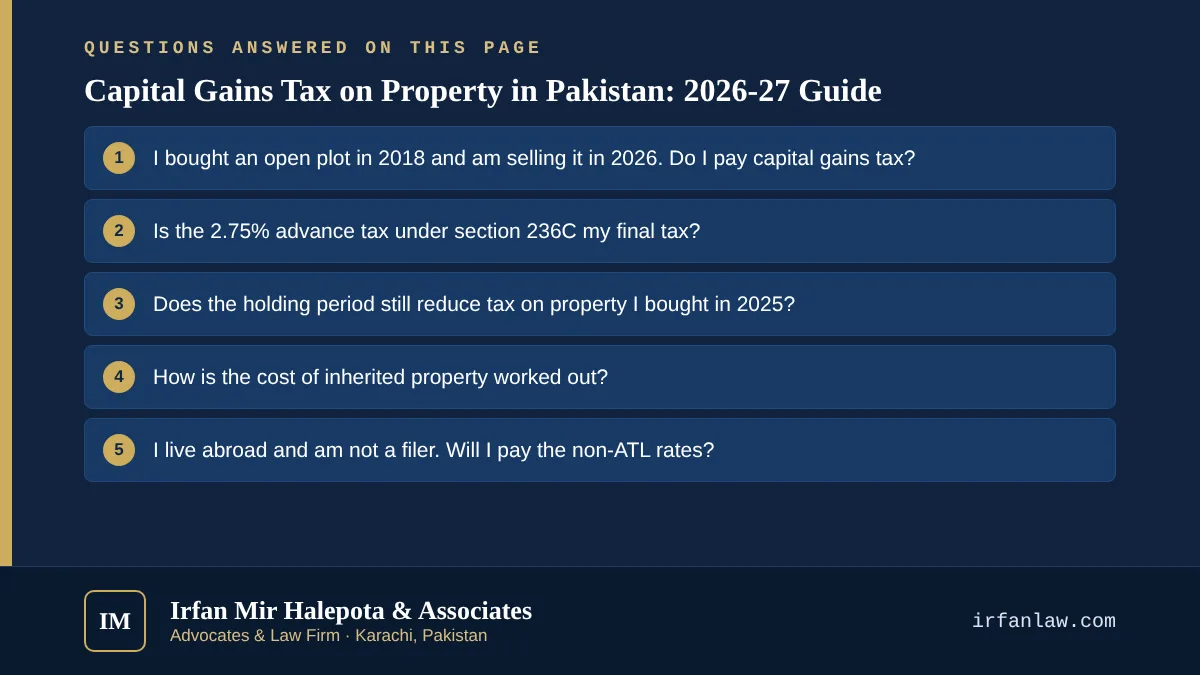
I bought an open plot in 2018 and am selling it in 2026. Do I pay capital gains tax?
Because the plot was acquired before 1 July 2024 and has been held for more than six years, the capital gains tax rate under the holding-period table is nil. Advance tax under section 236C is still collected at the transfer stage: 2.75% if you are on the ATL. You can then claim it against your liability in the return.
Is the 2.75% advance tax under section 236C my final tax?
No. It is advance tax collected on the gross price whatever the profit. Your actual capital gains tax is worked out in your return under section 37(1A), and the advance tax is adjusted against it. Any excess is recoverable only through a refund claim.
Does the holding period still reduce tax on property I bought in 2025?
No. For property acquired on or after 1 July 2024, the Finance Act, 2024 removed the holding-period concession. An ATL seller pays 15% on the gain whenever the property is sold. Individuals and AOPs not on the ATL pay the ordinary slab rates, subject to a 15% minimum.
How is the cost of inherited property worked out?
Under section 37(4A), property acquired by inheritance, will or gift from a relative is treated as having a cost equal to its fair market value on the date it was acquired by the heir. Evidence of that value, such as the FBR valuation table or a valuer's report for that date, is worth keeping.
I live abroad and am not a filer. Will I pay the non-ATL rates?
Not necessarily. FBR guidance lets a non-resident holder of a POC or NICOP, who spent less than 183 days in Pakistan in the financial year, pay the filer rate on property transactions after a verification request approved by the Commissioner.
Can the FBR still charge section 7E tax for earlier years?
The Federal Constitutional Court declared section 7E void ab initio on 7 May 2026 and set aside actions and notices under it, and the Finance Act, 2026 omitted the section. Recovery of tax already paid is a separate and still open question.
This article is general information about Pakistani law and procedure, not legal advice for any specific matter. If this touches on something you're currently facing, get in touch and we'll advise on your facts directly.