Income Tax Refunds in Pakistan under Sections 170, 170A and 171 of the Income Tax Ordinance, 2001
A taxpayer who has paid more income tax than is due may apply for a refund under section 170 of the Income Tax Ordinance, 2001 within three years of the later of the assessment date and the date the tax was paid; the Commissioner must decide the application by written order within 60 days, after a hearing, and may first adjust the excess against other tax liabilities. Under section 171, a refund not paid within three months of becoming due attracts compensation at KIBOR plus 0.5% a year until payment.
Income tax refunds in Pakistan rarely arise because a business has made a mistake. They arise because tax is collected in advance at many points (on contracts, imports, utility bills, bank transactions and vehicles) and the total collected often exceeds the final liability. Appeals that succeed produce refunds too. The money belongs to the taxpayer, but getting it back depends on procedure.
A business searching for the best tax lawyer in Karachi to recover a stuck refund usually needs two dates before anything else: the date the refund application was filed, which starts the Commissioner's 60 days, and the date the refund became due, which starts the three-month clock for compensation under section 171. This guide explains both, as the law stands after the Finance Act, 2025, together with the remedies when the refund does not arrive.
Where income tax refunds come from
Most refunds fall into one of three groups:
- Excess tax credits in the return. Adjustable withholding and advance tax collected during the year exceeds the tax due on the return. This is the most common source for companies with large receipts subject to deduction at source; the deduction side is explained in our guide to withholding tax obligations.
- Appellate relief. The Commissioner (Appeals), the Appellate Tribunal or a court reduces an assessment on which tax has already been paid or recovered.
- Revision and rectification. An order is revised or rectified in the taxpayer's favour.
Not every deduction produces a refund. Tax that the Ordinance treats as final, or minimum tax, discharges the liability on that income and does not become refundable merely because the business made a loss. That is why, in the August 2026 decision discussed below, the Federal Tax Ombudsman directed the Commissioner to determine the nature of the taxes paid or deducted before deciding the claim.
The route differs for each. Return-based refunds go through a refund application under section 170 (or the electronic route in section 170A). Refunds from appellate orders depend first on the department giving effect to the appellate order. Sales tax refunds are a different regime altogether, covered in our guide to sales tax refund claims.
The refund application under section 170
Section 170(1) allows a taxpayer who has paid tax in excess of the amount due to apply to the Commissioner for a refund of the excess. The application must be in the prescribed form, verified in the prescribed manner, and made within three years of the later of:
- the date on which the Commissioner issued (or is treated as having issued) the assessment order for the tax year, which for most taxpayers is the deemed assessment under section 120 on filing the return; or
- the date on which the tax was paid.
Section 170(1A) adds a narrower right: where a loan or advance was earlier treated as a dividend and taxed, and the person later repays it, the tax paid on that deemed dividend can be refunded.
In practice the application is filed online through FBR's IRIS system. Its strength depends on what sits behind the return: withholding certificates, payment receipts, and a clean match between the tax credits claimed and those shown in FBR's own records. Mismatches between the credits claimed and the department's data are the most common reason a claim stalls at verification.
What the Commissioner must do: adjustment and a 60-day order
Where the Commissioner is satisfied that tax has been overpaid, section 170(3) sets the order of application:
- first, the excess is applied against any other tax due from the taxpayer under the Ordinance;
- next, any balance is applied against the taxpayer's outstanding liability for other taxes;
- only the remainder is refunded.
Under section 170(4), the Commissioner must, within 60 days of receiving a refund application, serve a written order either granting the refund or refusing it, after giving the taxpayer an opportunity of being heard. The Ordinance gives an appeal to the Commissioner (Appeals) both against an adverse refund order and where no order is made within the period.
Two practical points arise from adjustment. First, ask the officer to identify precisely which liability the refund has been set against; an adjustment against a demand that is under appeal or covered by a stay order deserves a written objection, with the stay order attached. Second, the department may issue a notice calling for documents to verify the claim, and an unanswered verification notice gives the officer a ready basis to refuse.
From the department's side, the 60-day period is not a licence to pay unverified claims. The Commissioner may reject a claim that cannot be matched to tax actually paid, provided the order is reasoned and made after a hearing.
Electronic refunds under section 170A
The Finance Act, 2021 inserted section 170A. Notwithstanding section 170, for tax year 2021 onwards, the Board may process and issue a refund to a taxpayer who has filed a return, without a separate application, to the extent of the tax credit verified through its computerised system, with the money transferred electronically to the taxpayer's notified bank account.
The provision has not removed the need for applications in practice. In December 2023 the FBR set up a committee on pending income tax refunds and the enforcement of section 170A, with terms of reference drawn from the Islamabad High Court's order in W.P. No. 21731 of 2023; in May 2024 that Court called a senior FBR official to explain the committee's outcome. As recently as August 2026, the Federal Tax Ombudsman recommended that the FBR launch a faceless income tax refund system under section 170A. These reports, from Business Recorder and ProPakistani, indicate that automatic processing is not yet the normal experience.
The safe course is therefore to file a section 170 application within time even where the claim might qualify under section 170A, and to keep the bank account details on IRIS current.
Compensation for delayed refunds under section 171
Section 171 obliges the Commissioner to pay compensation where a refund due to a taxpayer is not paid within three months of the date it becomes due. The rate is KIBOR plus 0.5% a year on the refund amount, for the period from the end of those three months to the date of payment. No compensation is payable while an investigation is pending into a claim the Commissioner has reason to believe may be inadmissible, until the claim is accepted or rejected.
When a refund “becomes due” is fixed by section 171(2):
| Source of the refund | Date it becomes due |
|---|---|
| Order in appeal (for example by the Commissioner (Appeals)) | Date the Commissioner receives the appellate order |
| Revision order under section 122A | Date the order is made |
| Any other case, including a refund application | Date the refund order is made |
An Explanation added by the Finance Act, 2013 clarifies that where a refund order is made on a section 170(1) application, the refund becomes due from the date of that order, not from the deemed assessment date. Business Recorder reported in May 2020 that a three-member bench of the Supreme Court applied this reading, running the three months from the refund order. We have not verified the citation of that judgment.
Compensation is not added automatically in practice. It should be claimed in writing, with a computation, once the refund is paid late. In one Karachi complaint (No. 766 of 2018) the Federal Tax Ombudsman directed the Commissioner to decide a compensation claim after a hearing, and the President upheld that direction in January 2019, noting that the department remained free to decide the claim on its merits.
Refunds that follow an appeal
Where an appellate order reduces a demand that has already been paid, the refund depends on the department first giving effect to that order. According to a May 2026 report of a decision of the President's Secretariat on a representation against the Federal Tax Ombudsman, failure to implement appellate orders within the two months allowed by section 124(4) was held to be maladministration. The same decision rejected the arguments that a pending departmental reference in the High Court automatically suspends an appellate order, and that the taxpayer should furnish a surety bond before the refund is paid. This rests on a press report, not the decision text.
The department's position is protected in a different way: it may seek a stay of the appellate order from the High Court in its reference. Where a stay is granted, the refund may lawfully be withheld while it remains in force. For the appeal and reference stages, see our guide to the income tax appeal route.
When the refund does not arrive: remedies
The right remedy depends on what has gone wrong:
- Adverse order or no order within 60 days: appeal to the Commissioner (Appeals). Merits disputes about whether tax was overpaid belong here.
- Delay, neglect or inconsistent treatment: a complaint to the Federal Tax Ombudsman. The FTO has treated refunds held beyond the statutory period as maladministration, rejected first-in-first-out processing as a justification, and directed uniform verification of identical claims. The limits matter: in a 2019 decision on complaint No. 342 of 2018 the President held that the FTO had no jurisdiction where the dispute concerned the refund and tax liability itself, because those matters are appealable. The office and its procedure are explained in our sibling guide on Federal Tax Ombudsman complaints.
- A determined refund that is simply not paid: a constitutional petition in the High Court is sometimes used. In 2024 the Lahore High Court issued notice to the FBR to explain why a verified and determined refund had not been paid, and the Islamabad High Court has supervised the refund backlog more generally.
Taxpayers should also note that a refund and a demand can run on separate tracks: an unpaid demand for another year can be recovered by the department even while a refund is pending, which is why the adjustment mechanism in section 170(3) matters. Recovery and stay are covered in our guide to tax recovery and bank attachment.
A practical checklist
- Diarise the three-year limit in section 170(1) from the later of the assessment date and the payment date.
- Before filing the return, reconcile every tax credit with withholding certificates and FBR's records.
- File the section 170 application online and keep the acknowledgement; the 60 days run from receipt.
- Answer verification notices fully and on time.
- Ask for the adjustment order in writing and object promptly to any adjustment against a stayed or appealed demand.
- Keep the notified bank account current.
- Keep the return, the refund computation and supporting certificates on file for as long as the department can still amend that tax year.
- Once the refund is paid late, claim section 171 compensation in writing with a computation.
- Choose the forum carefully: appeal for merits, the FTO for delay, the High Court only where no adequate remedy is available.
Follow us on Google
If these guides are useful, add this site as a preferred source. Google will then show it more prominently to you in Search, Discover and AI results.
Official sources
- FTO complaint No. 766 of 2018 and President's order of 07.01.2019 (FBR copy): section 171 compensation
- FTO complaint No. 342/LHR/IT/2018 and President's order of 07.01.2019 (FBR copy): FTO jurisdiction
- Business Recorder, 23 May 2020: compensation for delayed refunds under section 171
- Business Recorder, 8 May 2024: IHC on electronic processing of refunds (s.170A)
- Business Recorder, 1 August 2026: FTO recommends faceless refund system
- PkRevenue: text summary of sections 170 and 171
Common questions
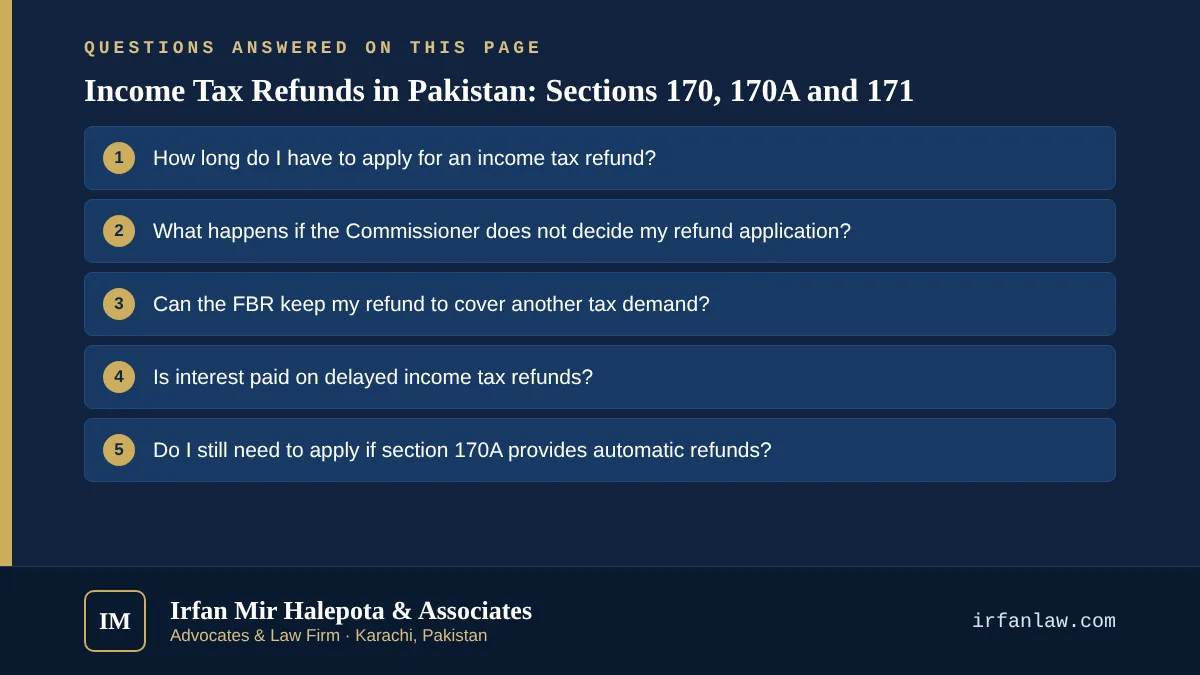
How long do I have to apply for an income tax refund?
Three years under section 170(1) of the Income Tax Ordinance, 2001. The period runs from the later of the date of the assessment order for the tax year (usually the deemed assessment on filing the return) and the date the tax was paid. A late application can be refused on limitation alone.
What happens if the Commissioner does not decide my refund application?
Section 170(4) requires a written order within 60 days of receiving the application, after a hearing. If no order is made, the Ordinance allows an appeal to the Commissioner (Appeals). Persistent delay can also be taken to the Federal Tax Ombudsman as maladministration.
Can the FBR keep my refund to cover another tax demand?
Yes, within limits. Section 170(3) requires the excess to be applied first against other income tax due and then against outstanding liabilities for other taxes, with only the balance refunded. If the demand used for adjustment is under appeal or stayed, object in writing and ask for the adjustment order.
Is interest paid on delayed income tax refunds?
Section 171 provides compensation, not interest as such, at KIBOR plus 0.5% a year where a refund is not paid within three months of becoming due. It runs from the end of the three months until payment. It is not payable while a genuine investigation into an apparently inadmissible claim is pending.
Do I still need to apply if section 170A provides automatic refunds?
Section 170A, inserted by the Finance Act, 2021, allows the FBR to issue refunds without an application to the extent its system verifies the tax credit. Reports from 2023 to 2026 show that this is not yet working as a general system, so filing a section 170 application within time remains the safer course.
Can the department withhold a refund because it has filed a reference in the High Court?
Filing a reference does not by itself suspend the appellate order, according to a reported 2026 decision of the President's Secretariat. The department can, however, apply to the High Court for a stay, and if a stay is granted the refund may be withheld while it is in force.
This article is general information about Pakistani law and procedure, not legal advice for any specific matter. If this touches on something you're currently facing, get in touch and we'll advise on your facts directly.