Tax recovery in Pakistan: demand notices, bank attachment under section 140 and how a stay of demand works
Once an assessment or other order creates a demand, the Commissioner serves a notice under section 137(2) of the Income Tax Ordinance, 2001 and the tax becomes payable after the period it gives, usually 30 days. Only after that can coercive recovery begin, including notices to banks under section 140. A taxpayer who appeals can ask the Commissioner (Appeals) for a short stay under section 128(1A) and the Appellate Tribunal for a stay under section 131(5); the High Court can intervene under Article 199 of the Constitution where those forums have not dealt with the request.
Filing an appeal does not, by itself, stop the FBR from recovering a disputed demand. Recovery and appeal run on separate tracks, and a business that concentrates only on the merits can find its accounts frozen before the first hearing. People looking for the best tax recovery lawyer in Karachi often call after the money has left the account, yet the strongest position is built in the days after the demand notice, while an appeal and stay application can still be filed before section 140 is lawfully available. This guide explains the recovery powers, the limits the courts have placed on them and the routes to a stay.
When a demand becomes recoverable
Section 137 of the Income Tax Ordinance, 2001 (the Ordinance) is headed “due date for payment of tax”. Where an order creates or increases a liability, the Commissioner serves a notice of demand under section 137(2), which in practice gives 30 days to pay. Tax is not “due” in the recovery sense until that period ends.
The High Court of Sindh has explained why the period matters. In Imtiaz Group (Private) Limited v. Federation of Pakistan, C.P. No. D-2261 of 2026, decided 25.05.2026, the Court said the purpose of the thirty days “is so that the taxpayer has an opportunity to avail their statutory right of appeal”, and that the department was bound to wait for the period to expire. A bank notice issued three days after the demand was set aside and the money recovered under it was ordered to be refunded.
The practical point for a business is simple: the demand notice date starts two clocks at once, one for payment and one for the appeal. Both need to be diarised the day the notice arrives.
The recovery powers available to the Commissioner
The recovery provisions follow section 137 in Chapter X of the Ordinance. The ones most often used are:
- Section 138 (recovery of tax out of property and through arrest of taxpayer): the Commissioner first serves a notice requiring payment within a stated time, and if the amount is not paid may proceed against the taxpayer’s property by the modes the section sets out.
- Section 138A (recovery of tax by District Officer (Revenue)), which allows recovery through the revenue administration.
- Section 139 (collection of tax in the case of private companies and associations of persons), which can reach directors and members where tax cannot be recovered from the company. In Shaikh Hisham Mehmood v. Federation of Pakistan, C.P. Nos. D-1915 and D-1916 of 2025, decided 26.09.2025, the High Court of Sindh read “cannot be recovered from the company” as requiring genuine recovery efforts against the company first, and dismissed the directors’ petitions because the department had shown such efforts and the company had ceased business.
- Section 140 (recovery of tax from persons holding money on behalf of a taxpayer), the provision used to attach bank accounts and amounts owed to the taxpayer by customers.
These powers are lawful and the department is entitled to use them once a demand is due and not stayed. Disputes usually turn on timing and procedure rather than on whether the power exists.
Bank attachment under section 140: what the courts require
Section 140(1) begins: “For the purposes of recovering any tax due by a taxpayer, the Commissioner may, by notice, in writing, require any person” who owes or holds money for the taxpayer to pay it to the Commissioner. Banks comply with these notices quickly, which is why they are the most effective, and most contested, recovery tool.
The Supreme Court has addressed the limits in Commissioner Inland Revenue (Legal) Islamabad v. Pakistan LNG Ltd., 2026 PTD 192. As quoted by the High Court of Sindh in Imtiaz Group, the Supreme Court held that “the language of Section 140 of the Ordinance does not envisage immediate or mechanical recovery”, that the notice must set a date for payment, and that a notice seeking recovery on the day it is issued would defeat that purpose. The High Court described section 140 as “an extreme measure, that is to be utilized only in very particular circumstances.”
Several High Courts have also held that a section 138 notice should precede recovery under section 140; the High Court of Sindh noted that line of authority in Shaikh Hisham Mehmood (citing, among others, 2025 PTD 282, 2024 PTD 242, 2022 PTD 1763 and 2021 PTD 162) but did not need to decide it because notices had been sent. The FBR has itself issued internal instructions, reported in February 2024, requiring a section 138(1) notice allowing seven days before section 140 action, approval of bank attachment by a committee of senior Commissioners, and the halting of recovery once a stay order from a court, the Tribunal or the Commissioner (Appeals) is received. Those instructions are administrative and can be changed, but officers are expected to follow them.
Stay from the Commissioner (Appeals)
The first appellate stay power is in section 128(1A). Where the Commissioner (Appeals) is of the opinion that recovery “shall cause undue hardship to the taxpayer”, he may, after hearing the Commissioner whose order is under appeal, stay recovery “for a period not exceeding thirty days in aggregate.” Section 128(1AA) allows a further thirty days, on the condition that the appeal itself is decided within that further period.
Three practical consequences follow:
- The stay application should be filed with the appeal and must explain hardship with evidence: cash flow, bank balances, the size of the demand against turnover, and any strong legal ground on the merits.
- The stay is short. Its real purpose is to protect the taxpayer until the appeal is heard, so the appellant should press for an early hearing rather than seek adjournments.
- When a stay application is pending but has not been heard, the High Court of Sindh has repeatedly directed the Commissioner (Appeals) to decide it at the earliest and restrained coercive action until then. Examples are C.P. No. D-4109 of 2026 (order of 08.07.2026) and Martin Dow Limited v. Pakistan, C.P. No. D-5734 of 2022 (order of 29.09.2022), the latter arising from a section 161 order.
The Commissioner (Appeals) only hears appeals within monetary limits introduced by the Tax Laws (Amendment) Act, 2024; larger cases go directly to the Appellate Tribunal. The forums and thresholds are explained in our guide to the tax appeal route in Pakistan.
Stay from the Appellate Tribunal Inland Revenue
Section 131(5) provides that, although an appeal has been filed, tax remains payable in accordance with the assessment “unless recovery thereof has been stayed by the Appellate Tribunal.” Before 2024, the provisos allowed the Tribunal, on grounds of undue hardship and after hearing the Commissioner, to stay recovery for up to 180 days in aggregate, with any period of stay granted by a High Court excluded from the count.
The Tax Laws (Amendment) Act, 2024, in force from 16 June 2024, is reported to have shortened that period to 90 days and tied the stay to the appellant’s compliance with the Tribunal’s hearing schedule. Professional summaries also report that, in a reference to the High Court, a stay of recovery may be granted only on payment of 30 per cent of the tax determined by the Tribunal, and that such a stay lapses after six months unless the reference is decided earlier. These changes have been challenged in court and the current statutory text should be checked before any application is drafted.
As with the Commissioner (Appeals), the High Court of Sindh has dealt with unheard Tribunal stay applications by directing the Tribunal to decide them and restraining coercive steps in the meantime: see C.P. Nos. D-4169 and D-4170 of 2026 (orders of 17.07.2026), which record that section 131(5) gives the Tribunal a discretion to stay recovery.
Constitutional petitions in the High Court and their limits
A petition under Article 199 of the Constitution is the usual route when a stay application is not being heard, when recovery begins before the demand is due, or when a notice is issued without jurisdiction. Relief in these cases is usually limited and practical: a direction that the forum decide the stay application or the appeal within a fixed time, and an interim restraint on coercive action meanwhile. In some cases the Court has required the disputed amount to be deposited with the Nazir of the Court, with undisputed amounts released to the department.
The High Court will not, however, act as a substitute for the appeal itself. In Trustees of Hindaya Trust v. Federation of Pakistan, C.P. No. D-3099 of 2025, decided 26.01.2026, the High Court of Sindh dismissed a petition as not maintainable where the petitioner had already chosen the statutory appellate route and the relief sought required reappraisal of evidence; the Court cited Sprint Oil & Gas Services Pakistan v. OGDC, 2024 SCMR 117 and Orient Energy Systems v. Assistant Commissioner Inland Revenue, 2025 PTD 431. In Ali Gohar & Company (Pvt.) Ltd. v. Federation of Pakistan, C.P. No. D-3985 of 2026, order of 18.08.2026, the Court declined to interfere with an appeal that was already reserved for decision and directed the appellate authority to decide it within 30 days.
The constitutional route therefore works best for procedural failures and premature recovery, not as a second hearing on the merits. More on the Court’s practice is in our guide to litigation in the High Court of Sindh.
Sales tax demands: section 48 of the Sales Tax Act, 1990
Federal sales tax has its own recovery code. Section 48 of the Sales Tax Act, 1990 allows the officer to deduct the amount from money owed to the registered person by the tax authorities, require third parties holding money for the person to pay it over, stop removal or clearance of goods, attach bank accounts, seal business premises, and attach and sell movable or immovable property.
A proviso to section 48 provides that no recovery notice is to be issued while an appeal under section 45B is pending before the Commissioner (Appeals), if ten per cent of the tax due has been paid. That wording is taken from the text as it stood in 2021 and should be checked against the current Act. Stay powers in sales tax appeals sit in sections 45B and 46 and follow the same broad pattern as income tax.
Sindh sales tax on services is a separate provincial levy with its own recovery and appeal provisions under the Sindh Sales Tax on Services Act, 2011, administered by the Sindh Revenue Board. Federal sales tax rules should not be assumed to apply to an SRB demand.
A practical sequence for a Karachi business facing a demand
- Day one: note the date of service of the demand notice and the order. Calculate the payment deadline and the appeal deadline separately.
- Separate the disputed and undisputed amounts. Paying the undisputed part strengthens a hardship application and reduces exposure to default surcharge.
- File the appeal and the stay application together, with evidence of hardship and a short statement of the strongest legal ground.
- Follow up the hearing of the stay application. An unheard application is the most common reason a business ends up in the High Court.
- If a bank notice arrives before the demand is due or without a prior notice, write to the Commissioner at once, referring to the Supreme Court’s ruling in Pakistan LNG, and seek release; if the attachment continues, consider a petition promptly.
- Remember that a stay suspends recovery, not liability. Whether default surcharge accrues while recovery is stayed is disputed. The Lahore High Court in Honda Atlas Cars (Pakistan) Ltd v. Federation of Pakistan, W.P. No. 24928 of 2026 (30.04.2026), remitted a surcharge notice for a reasoned decision, as reported, without settling the point. See our guide to tax penalties and default surcharge.
The department, for its part, is entitled to recover tax that is due and not stayed, and taxpayers who use appeals only to delay payment tend to find stays refused. A credible appeal and a prompt, well-supported stay application are what keep recovery in step with the dispute.
Follow us on Google
If these guides are useful, add this site as a preferred source. Google will then show it more prominently to you in Search, Discover and AI results.
Official sources
- Income Tax Ordinance, 2001, amended up to 30 June 2026 (FBR)
- High Court of Sindh, Imtiaz Group (Pvt.) Ltd v. Federation of Pakistan, C.P. No. D-2261 of 2026 (25.05.2026)
- High Court of Sindh, Shaikh Hisham Mehmood v. Federation of Pakistan, C.P. Nos. D-1915 and D-1916 of 2025 (26.09.2025)
- High Court of Sindh, Trustees of Hindaya Trust v. Federation of Pakistan, C.P. No. D-3099 of 2025 (26.01.2026)
- Business Recorder: stay of recovery by the Appellate Tribunal, s.131(5) and s.133(7)
- EY tax alert: Tax Laws (Amendment) Act, 2024
Common questions
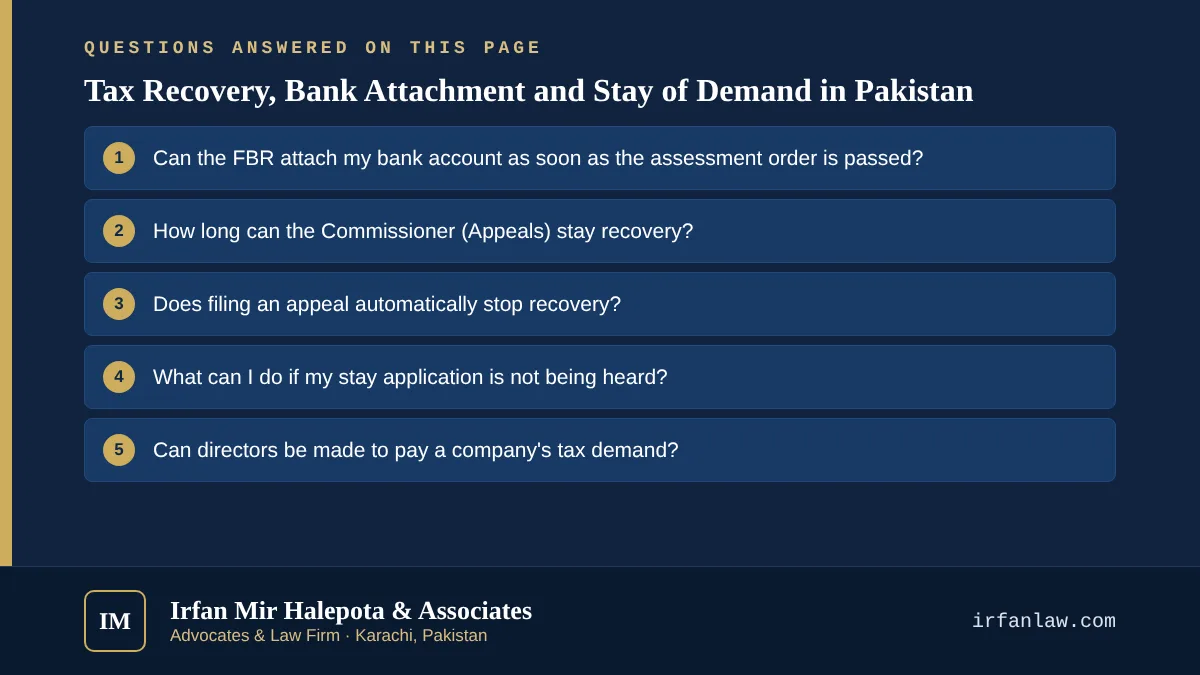
Can the FBR attach my bank account as soon as the assessment order is passed?
Not lawfully in the ordinary case. The demand notice under section 137(2) gives a period to pay, usually 30 days, and the High Court of Sindh held in Imtiaz Group (C.P. No. D-2261 of 2026) that the department must wait for that period to end before using section 140. The Supreme Court in Pakistan LNG (2026 PTD 192) held that section 140 does not envisage immediate or mechanical recovery.
How long can the Commissioner (Appeals) stay recovery?
Under section 128(1A) of the Income Tax Ordinance, 2001, for up to thirty days in aggregate, where recovery would cause undue hardship and after hearing the Commissioner. Section 128(1AA) allows a further thirty days, provided the appeal is decided within that extra period.
Does filing an appeal automatically stop recovery?
No. Section 131(5) states expressly that tax remains payable unless recovery has been stayed, and the same approach applies before the Commissioner (Appeals). A separate stay application must be filed and decided.
What can I do if my stay application is not being heard?
The High Court of Sindh has, in a series of 2026 orders, directed the Commissioner (Appeals) or the Appellate Tribunal to decide pending stay applications at the earliest and restrained coercive recovery until then. A constitutional petition for that limited relief is the usual route; the Court will not decide the merits of the tax dispute in it.
Can directors be made to pay a company's tax demand?
Section 139 allows collection from directors and members of private companies and associations of persons where the tax cannot be recovered from the company. The High Court of Sindh in Shaikh Hisham Mehmood (C.P. Nos. D-1915 and D-1916 of 2025) read this as requiring real efforts to recover from the company first, but upheld recovery where the company had ceased business and disposed of its assets.
Is the procedure the same for a sales tax demand?
The structure is similar but the provisions are different. Federal sales tax is recovered under section 48 of the Sales Tax Act, 1990, which includes bank attachment and sealing of premises, and has its own appeal and stay provisions in sections 45B and 46. Sindh sales tax on services is governed by the Sindh Sales Tax on Services Act, 2011 and the Sindh Revenue Board.
This article is general information about Pakistani law and procedure, not legal advice for any specific matter. If this touches on something you're currently facing, get in touch and we'll advise on your facts directly.