Active Taxpayers List in Pakistan: How the ATL Works and What Non-Filers Face (2026)
The Active Taxpayers' List (ATL) is the FBR's list of persons who have filed their income tax return, kept under section 181A of the Income Tax Ordinance, 2001. A person who is not on it pays withholding and advance tax at higher rates under the Tenth Schedule. For most provisions this is double the normal rate, and for property and vehicles it is far more. That person can also face enforcement orders under section 114B. A late filer can join the list by filing the return and paying the surcharge under section 182A.
Almost every taxable transaction in Pakistan now asks the same question first: is this person on the Active Taxpayers' List? Banks, property registrars, vehicle registration offices, companies paying dividends and businesses paying suppliers all check ATL status before deciding how much tax to withhold. When a Karachi business owner asks the best tax lawyer in Karachi why a registrar or bank took far more tax than expected, the explanation is usually that the person was not on the ATL on the day of the transaction. This guide explains how the list works, how to get onto it, what changed with the Finance Act, 2026, and what non-filers risk beyond higher withholding. It states the law as amended up to the Finance Act, 2026.
What the ATL is and how inclusion works
Section 181A of the Income Tax Ordinance, 2001 provides for the active taxpayers' list, which the Federal Board of Revenue maintains and publishes. Rules made under the Ordinance refer to names being "included in the active taxpayers' list under section 181A" and, in some cases, removed from it. In practice, ATL status works like a switch: you are either on the list or not, and withholding agents apply the rate that follows.
The FBR's own guidance sets out the main rules:
- The return must match the list. Inclusion depends on filing the return for the tax year that the list covers. A return for an earlier year does not keep a person on a later list.
- Timely filing. Since the Finance Act, 2018, a person must file by the due date to be included automatically.
- Late filing. Since the Finance Act, 2019, a person who files after the due date can still be included, but only after paying the surcharge for ATL under section 182A.
- New companies and associations of persons. A company or AOP formed or incorporated after 30 June of the relevant tax year is included without having to file a return for that year.
- Joint and minors' accounts. A joint account is treated as on the ATL if any joint holder qualifies. A minor's account is treated the same way if the parent, guardian or depositor qualifies.
The FBR's examples refer to lists published on 1 March for the preceding tax year, with late filers added once the surcharge is paid. The list is renewed for each tax year, so a person who stops filing will eventually drop off.
Getting on the list: filing, surcharge and the 2026 undertaking
For most people, getting on the ATL means registering on the FBR's IRIS portal and filing the income tax return under section 114, together with the wealth statement in the case of individuals. A return filed by the due date brings automatic inclusion.
A late filer must also pay the ATL surcharge under section 182A. The FBR describes it plainly: only after the surcharge is paid does the late filer's name become part of the ATL. The surcharge is a fixed amount that varies with the type of person (individual, AOP or company). The Finance Act, 2026 "substantially enhanced" those amounts, according to FBR Circular No. 02 of 2026-27. Check the current amount in the Ordinance before paying.
The Finance Act, 2026 also added a new subsection (3) to section 182A. According to the FBR circular, an individual who gives an undertaking before the Commissioner that he or she will not purchase, acquire or otherwise obtain ownership or a beneficial interest in any property for six months is exempted from the surcharge conditions. This is new, and how it will work in practice through IRIS is not yet clear. An individual who intends to buy property soon should not give the undertaking without advice, because it restricts exactly that transaction.
For compliance with the filing obligation itself and the penalties for late or non-filing, see our guide to tax penalties and default surcharge. The ATL surcharge is separate from those penalties.
Higher withholding for persons not on the ATL
The main financial consequence of being off the list comes from the Tenth Schedule to the Ordinance. For most withholding and advance tax provisions, a person not on the ATL pays twice the normal rate. Rule 10 of the Tenth Schedule lists provisions to which the enhancement does not apply. Some provisions, notably those on property and vehicles, set their own separate rates for persons not on the ATL, and these are much steeper than double.
The FBR's Withholding Tax Rate Card for tax year 2027 (updated to 30 June 2026 as per the Finance Act, 2026) shows the gap:
| Provision | On ATL | Not on ATL |
|---|---|---|
| s.151 profit on bank deposits | 20% | 40% |
| s.150 dividends (general case) | 15% | 30% |
| s.153 supply of goods by a company | 5% | 10% |
| s.153 other services | 14% | 28% |
| s.236H sales to retailers | 0.5% | 2.5% |
| s.231AB cash withdrawal | Not applicable | 0.8% |
| s.231B motor vehicles (by engine capacity) | 0.5% to 12% | 1.5% to 36% |
| s.236C sale of immovable property | 2.75% | 11.5% |
| s.236K purchase of immovable property | 1.25% | 10.5% to 18.5% |
The FBR's card states that the Ordinance prevails if the two differ. Rates are reviewed in every Finance Act, so check them again before any large transaction.
The burden falls on both sides. The person paying must deduct or collect at the correct rate. If a withholding agent applies the ATL rate to a person who is not on the list, it can itself be held liable for the shortfall under section 161. Our withholding tax guide explains that exposure.
What the Finance Act, 2026 changed
FBR Circular No. 02 of 2026-27 (8 September 2026) explains several ATL-related amendments:
- Late-filer rates on property abolished. Rule 1A of the Tenth Schedule had set intermediate, higher rates under sections 236C and 236K for persons who were on the ATL but had filed late. The circular records that "those relatively higher" rates have been abolished. Property buyers and sellers are now simply on the ATL or not.
- Flat property rates for ATL persons. Advance tax under section 236C is now a flat 2.75% of the gross consideration. Under section 236K it is a flat 1.25% of fair market value. These replace the earlier slab rates. Our capital gains tax on property guide covers both provisions in detail.
- Securities gains. Clause (y) of rule 10 of the Tenth Schedule was omitted. As a result, the enhanced rate for persons not on the ATL now applies to tax on capital gains on securities under section 37A.
- Higher ATL surcharge and the new six-month property undertaking under section 182A(3), discussed above.
Enforcement beyond withholding: section 114B
Higher withholding is the automatic consequence. Section 114B adds an active enforcement power against persons who are not on the ATL but are required to file a return. Under it, the FBR may issue an income tax general order directing that a person's mobile SIMs be disabled or that electricity or gas connections be discontinued.
The power has been used. On 30 April 2024 the FBR announced an order under section 114B for disabling the SIMs of 506,671 individuals who were not on the ATL but were required to file returns for tax year 2023. The FBR said the services would remain blocked until it, or the Commissioner Inland Revenue with jurisdiction, restored them, and urged those affected to file their returns.
Two points matter in practice. First, the power applies to persons who are liable to file. Someone whose income is below the filing threshold, and who is not otherwise required to file, can raise that with the Commissioner and ask for restoration. Second, the remedy for a person who is liable is to file. Restoration follows compliance, and an order can usually be lifted quickly once the return is on record. A separate notice from the Commissioner under section 114(4) requiring a return should always be answered in writing and within time. Our notice response guide explains how.
Section 114C and 'ineligible persons': not yet in force
The Finance Act, 2025 inserted section 114C into the Ordinance. It goes further than the ATL. It restricts certain high-value economic transactions by "ineligible persons", meaning broadly individuals who have not filed a return for the preceding year or whose declared resources do not support the proposed transaction. As described in secondary sources, the restricted transactions are:
- purchase, booking or registration of motor vehicles above a value threshold;
- purchase or transfer of immovable property above a value threshold;
- investment in securities and similar instruments above an annual threshold; and
- large annual cash withdrawals from bank accounts.
The thresholds sit in the Fifteenth Schedule and can be revised. The key point for planning is that ATL status alone will not be enough. Eligibility turns on whether the person's wealth statement or financial statements show enough declared resources to fund the transaction. For individuals, family members' resources can count in some cases.
The restrictions take effect only from a date the Federal Government notifies in the official Gazette, and the FBR must also make rules on how declared resources are verified. A report of 4 August 2026 stated that neither the notification nor the rules had been issued. We have not found an official notification since. Treat section 114C as enacted but not yet operative, and check the position again before any large purchase.
Common problems and how they are resolved
- Return filed, but not on the list. The usual causes are a return filed for the wrong tax year, a late return without the surcharge, or a return still in draft on IRIS. Check the acknowledgement and the surcharge payment before assuming an FBR error.
- Extra tax already deducted. Whether the excess can be recovered depends on the provision. Where the deduction is adjustable advance tax, it is claimed against the final liability in the return, and any excess leads to a refund claim. Where the provision imposes a final or minimum tax, recovering the excess is much harder. Getting on the list before the transaction is almost always cheaper than recovering tax after it.
- Disputed status at the time of a transaction. Withholding agents rely on the FBR's online status check at the time they deduct. Keep a printout or screenshot of your status when you complete a large transaction.
- Overseas Pakistanis. FBR guidance allows non-resident holders of a POC or NICOP, who stayed in Pakistan for less than 183 days in the financial year, to obtain the filer rate on property transactions through a verification procedure. The registrar or housing society starts the procedure through the FBR portal, and the Commissioner approves it.
- Companies. A company that misses its own filing deadline drops off the next list, which can raise withholding on every payment it receives. Annual compliance calendars should treat the return date as an ATL date too.
For the department, the ATL is a compliance tool that is meant to make non-filing expensive. For a taxpayer, the practical answer nearly always lies in timely filing rather than litigation. Disputes do arise, however: wrongful exclusion, misapplied rates and section 114B orders made against persons not liable to file. Those are handled first through the Commissioner and, where necessary, through the remedies explained on our tax and customs practice page.
Follow us on Google
If these guides are useful, add this site as a preferred source. Google will then show it more prominently to you in Search, Discover and AI results.
Official sources
- FBR Withholding Tax Rate Card, Tax Year 2027 (updated to 30 June 2026 as per Finance Act, 2026)
- FBR Circular No. 02 of 2026-27: Finance Act 2026, explanation of income tax amendments
- FBR: Inclusion in the Active Taxpayers List
- FBR press release: Income Tax General Order under section 114B (30 April 2024)
- FBR: Overseas Pakistanis FAQs (property transactions)
- FBR draft amendment to Income Tax Rules, 2002 referring to section 181A (December 2025)
Common questions
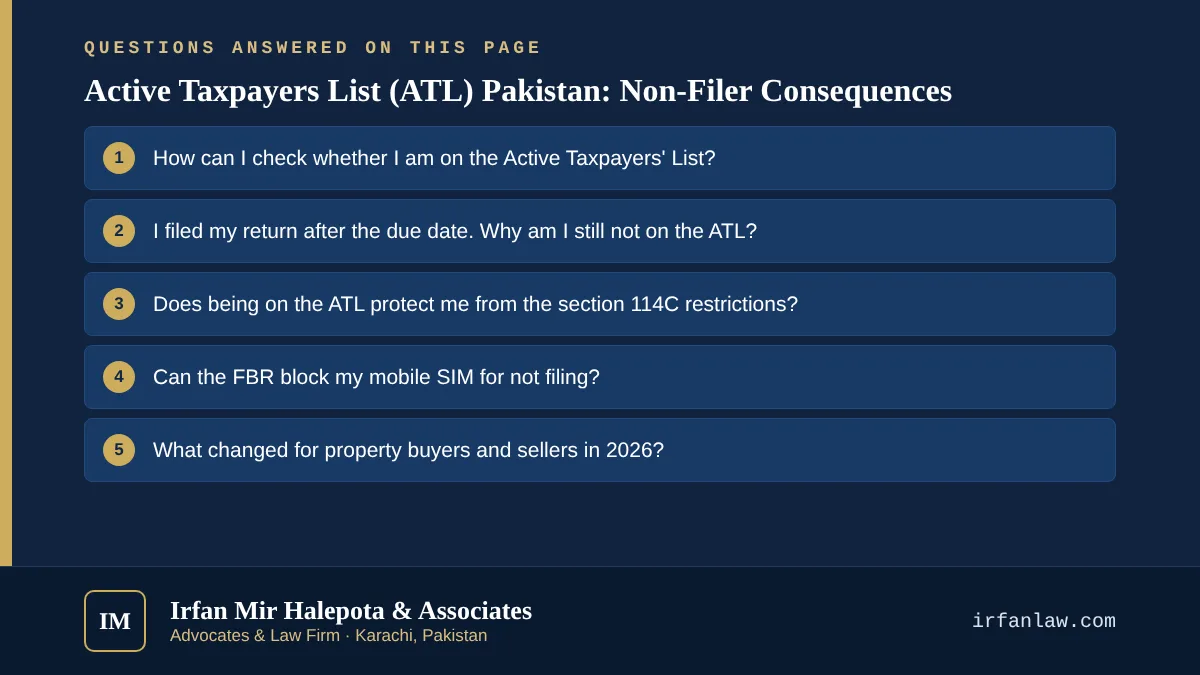
How can I check whether I am on the Active Taxpayers' List?
The FBR provides an active taxpayer status check on its website, and withholding agents use the same facility. Check your status, and keep a record of it, before any large banking, vehicle or property transaction, because the agent applies the rate shown on the day it deducts the tax.
I filed my return after the due date. Why am I still not on the ATL?
A late return alone is not enough. Under section 182A the late filer must also pay the ATL surcharge, and the FBR's guidance says the name is added only after that payment. The Finance Act, 2026 substantially increased the surcharge amounts.
Does being on the ATL protect me from the section 114C restrictions?
Not by itself. Section 114C, inserted by the Finance Act, 2025, looks at whether your declared resources support the transaction, not only at whether you filed. In any case it is not yet operative, because the Federal Government has to notify a commencement date in the Gazette.
Can the FBR block my mobile SIM for not filing?
Yes, if you are not on the ATL and are liable to file a return. Section 114B lets the FBR issue a general order to disable SIMs or discontinue electricity and gas connections. The FBR used this power in April 2024. Services are restored by the FBR or the Commissioner once the position is regularised.
What changed for property buyers and sellers in 2026?
The Finance Act, 2026 abolished the separate higher rates for late filers and made the ATL rates flat: 2.75% under section 236C on sale and 1.25% under section 236K on purchase. The rates for persons not on the ATL remain much higher, at 11.5% on sale and 10.5% to 18.5% on purchase according to the FBR's rate card.
Is a newly incorporated company treated as a non-filer?
No. According to the FBR, a company or association of persons formed after 30 June of the relevant tax year is included in the ATL without having to file a return for that year. It must then file on time for later years to stay on the list.
This article is general information about Pakistani law and procedure, not legal advice for any specific matter. If this touches on something you're currently facing, get in touch and we'll advise on your facts directly.