Unexplained Income and Assets under Section 111 of the Income Tax Ordinance, 2001: Procedure, Remittances and Defences
Under section 111 of the Income Tax Ordinance, 2001, where a person cannot satisfactorily explain the nature and source of an amount credited in the books, an investment or asset, an expenditure, or concealed income, the Commissioner may treat that amount as income from other sources. The Supreme Court in Millat Tractors (2024 SCMR 700) held that section 111 proceedings must be initiated and concluded with the Commissioner's opinion before an assessment is amended under section 122 on that basis, and the Sindh High Court has held that the Explanation dispensing with a separate notice operates prospectively only.
A section 111 notice usually asks a simple question: where did this money come from? It may concern a bank deposit, a plot or car bought in the taxpayer's name, foreign travel or school fees, or sales that third-party data suggests were not declared. The answer decides whether the amount is added to taxable income, often years after the event.
For anyone searching for the best tax lawyer in Karachi after receiving such a notice, the first issue is procedural rather than factual: has the Commissioner run separate section 111 proceedings, and does the 2021/2022 Explanation apply to that tax year at all. This guide explains the provision as it stands after the Finance Act, 2025, the controlling case law, the remittance exclusion and the evidence that usually carries the day.
What section 111 covers
Section 111(1) applies in four broad situations, each turning on whether the person offers an explanation about the nature and source of the money that the Commissioner finds satisfactory:
- Credits in books of account (clause (a)): any amount credited in the person's books.
- Investments and assets (clause (b)): investments made, or ownership of money, bullion, jewellery or other valuable articles.
- Expenditure (clause (c)): money spent by the person.
- Concealment (clause (d)): concealed income or inaccurate particulars, including suppression of production, sales or other taxable receipts.
Where no explanation is given, or the explanation is not satisfactory in the Commissioner's opinion, the amount is included in the person's income chargeable to tax under the head “Income from Other Sources”.
Three further rules shape the outcome. First, a proviso limits an explanation based on agricultural income: it is accepted only to the extent of agricultural income worked back from the agricultural income tax paid under the provincial law. Second, income from activities taxed under the final tax regime can explain an investment beyond the imputable income only where the excess is attributable to that business and supported by audited accounts. Third, section 111(2) fixes the tax year: amounts relating to Pakistan are included in the year to which they relate, while foreign assets, expenditure and concealed foreign income are allocated by reference to the year of discovery, which the Ordinance ties to the year in which the Commissioner issues the notice. Section 111(3) separately allows the Commissioner to add the difference where the declared cost of an investment, article or expenditure is lower than its reasonable value.
The procedure: section 111 first, section 122 second
Section 111 does not by itself create a demand. The addition is made through an assessment, almost always an amendment under section 122. The courts have insisted that the two steps are kept distinct.
In Commissioner Inland Revenue, Lahore v. Millat Tractors Ltd, 2024 SCMR 700, the Supreme Court held that before an assessment can be amended under section 122 on the basis of section 111, proceedings under section 111(1) must be initiated, the taxpayer must be confronted with the information and grounds, and the proceedings must end in the Commissioner's opinion. That opinion is what becomes “definite information” for section 122(5). The Court had taken a similar view in CIR v. Bashir Ahmed, 2021 SCMR 1290.
The Sindh High Court applied this in ITRA No. 399 of 2023 (Abdul Qadir, judgment of 24.03.2025). A section 111 notice may be issued together with a section 122(9) notice, but no action under section 122 can proceed until the section 111 proceedings produce an opinion against the taxpayer. If no such opinion is formed, both sets of proceedings fall away. On the facts (tax year 2015), no separate section 111 notice or order existed and the addition was held unlawful.
The section 122 time limits also apply: the five-year window to amend and, since the Finance Act, 2025, one year from the section 122(9) notice to pass the order. These are explained in our guide to amendment of assessment under section 122.
The Explanation and its prospective effect
The Finance Act, 2021 added an Explanation to section 111 stating that a separate notice under the section is not required where the explanation about the nature and source of the amount has been confronted to the taxpayer through a section 122(9) notice. The Finance Act, 2022 substituted a wider version covering all the clause (1) categories, including suppressed production, sales and receipts.
The High Courts have read the Explanation narrowly in time:
- Sindh High Court, ITRA 399/2023: because the Explanation abridges the right to a separate notice and separate proceedings, it is substantive and applies prospectively, so it did not reach tax year 2015. The Court added that even where it applies, it does not remove the need to conclude section 111 proceedings before section 122(5) is invoked.
- Sindh High Court, ITRAs 300 to 304 of 2025 (order of 08.10.2025): disposed of on the same terms as ITRA 399/2023, on a joint statement that the questions were covered.
- Sindh High Court, ITRA 320 of 2025 (order of 15.10.2025): the Explanation does not apply to tax years before its introduction, here tax year 2017, following ITRA 234 of 2025.
- Lahore High Court, ITR No. 59534 of 2021 (CIR v. Shazia Zafar, heard 09.06.2022): a notice inviting explanation and an unsatisfactory reply are preconditions for an addition, and the 2021 Explanation is prospective.
What remains open. These decisions concern older tax years. For tax years after the Explanation, the department's position is that confrontation through a section 122(9) notice is enough; the taxpayer's position is that the Commissioner must still form and record a distinct section 111 opinion before amending. The Abdul Qadir reasoning supports the second view, but we have not found a reported Supreme Court ruling on a post-2022 tax year, so the point should be treated as unsettled.
Foreign remittances: the section 111(4) exclusion
Section 111(4)(a) excludes from section 111 foreign exchange remitted from outside Pakistan through normal banking channels that is encashed into Pakistani rupees by a scheduled bank, with a certificate from that bank. According to FBR Circular No. 5 (Operations), a Rs 10 million cap was introduced in 2018 and the Finance Act, 2019 reduced it to Rs 5 million in a tax year. Exchange companies and money transfer operators are treated as normal banking channels for this purpose.
A Finance Bill, 2023 proposal to replace the cap with US$100,000 was withdrawn after objections from the International Monetary Fund, and press reports in May 2026 described a further review. We have not verified any change by the Finance Act, 2026; the Rs 5 million figure should be checked against the current text before reliance.
Two practical points follow. Amounts above the cap are not automatically taxable; they simply lose the statutory immunity and must be explained like any other receipt. And the conditions are applied with some flexibility by the courts: in CIR v. Anushay Usman (ITR No. 254 of 2015, Islamabad High Court, 08.10.2025, reported as 2026 SLD 882), remittances received through banking channels were held not to be unexplained merely because they were not converted into rupees or no encashment certificate was produced, where the source was otherwise established. That decision is known to us through press reports, not the full text. Overseas Pakistanis should also read our sibling guide on tax residency and foreign income.
Burden of proof and the evidence that matters
Section 111 places the first burden on the person: once the department identifies a specific credit, asset or expenditure, the person must explain its nature and source. The department, in turn, must identify the information it relies on. In CIR v. Muhammad Amin Arshad, 2021 SCMR 437, credit entries in a bank account were accepted as a proper basis for proceeding, so bank data, property registration records and vehicle records are all legitimate starting points.
The Commissioner's opinion must then deal with the explanation actually given. An opinion that ignores documents on file, or rejects an explanation without reasons, is open to challenge on appeal. Evidence that usually persuades:
- bank statements tracing the funds from a declared source;
- sale deeds or transfer records of an earlier asset whose proceeds were used;
- loans and gifts documented in writing, routed through banks, with the lender's or donor's own tax profile;
- the wealth statement and wealth reconciliation for the relevant years, showing the asset or cash already declared;
- agricultural income tax receipts and land records where farm income is relied on;
- encashment certificates and remittance advices for foreign funds.
A related Finance Act, 2025 change should be kept in mind: according to KPMG's brief on that Act, a statement of sources of investment filed under the new section 114C (eligibility to make certain transactions) is not treated as a disclosure of income for section 111. That statement therefore does not by itself protect the person from a later section 111 inquiry.
Common defences, and common mistakes
The defences that most often succeed are procedural and factual together:
- No separate proceedings. No section 111 notice, or no recorded opinion, before the section 122 order.
- Tax year before the Explanation. Reliance on the Explanation for a year it does not reach.
- Limitation. The amendment is outside the section 122 time limits.
- Wrong year. The amount relates to a different tax year under section 111(2).
- Already declared. The cash or asset appears in an earlier wealth statement.
- Double counting. The same money is added twice, for example as a bank deposit and again as the price of the plot it paid for.
- Statutory exclusions. The remittance or agricultural income provisions apply.
The common mistakes are equally consistent: replying late or not at all, sending a general denial instead of documents, relying on affidavits from relatives without banking evidence, and filing a revised wealth statement that contradicts the earlier one. An unanswered notice leaves the Commissioner free to form an opinion on the record alone.
Additions under section 111 can also attract penalty and default surcharge; see our guide to tax penalties and default surcharge.
The department's side and the appeal route
For Commissioners Inland Revenue the case law sets a clear checklist: issue a notice under section 111 that identifies the amount and the information relied on, consider the reply, record a reasoned opinion, and only then rely on that opinion as definite information under section 122(5) within time. Additions made this way are far more likely to survive appeal, because the challenge then has to go to the merits of the explanation rather than to jurisdiction.
For taxpayers, an adverse amended assessment is appealable to the Commissioner (Appeals), then the Appellate Tribunal Inland Revenue, with a reference to the High Court on questions of law. The procedural defences above are questions of law and can be pressed at every level. The forums, limitation periods and stay applications are explained in our guide to the income tax appeal route.
Follow us on Google
If these guides are useful, add this site as a preferred source. Google will then show it more prominently to you in Search, Discover and AI results.
Official sources
- Sindh High Court, ITRA No. 399 of 2023 (Abdul Qadir), judgment of 24.03.2025
- Sindh High Court, ITRAs 300-304 of 2025, order of 08.10.2025
- Sindh High Court, ITRA No. 320 of 2025, order of 15.10.2025
- Lahore High Court, CIR v. Shazia Zafar, ITR No. 59534 of 2021 (FBR copy)
- FBR Circular No. 5 (Operations): Foreign remittances exemption
- FBR compilation of Supreme Court judgments (Amin Arshad, Bashir Ahmed)
Common questions
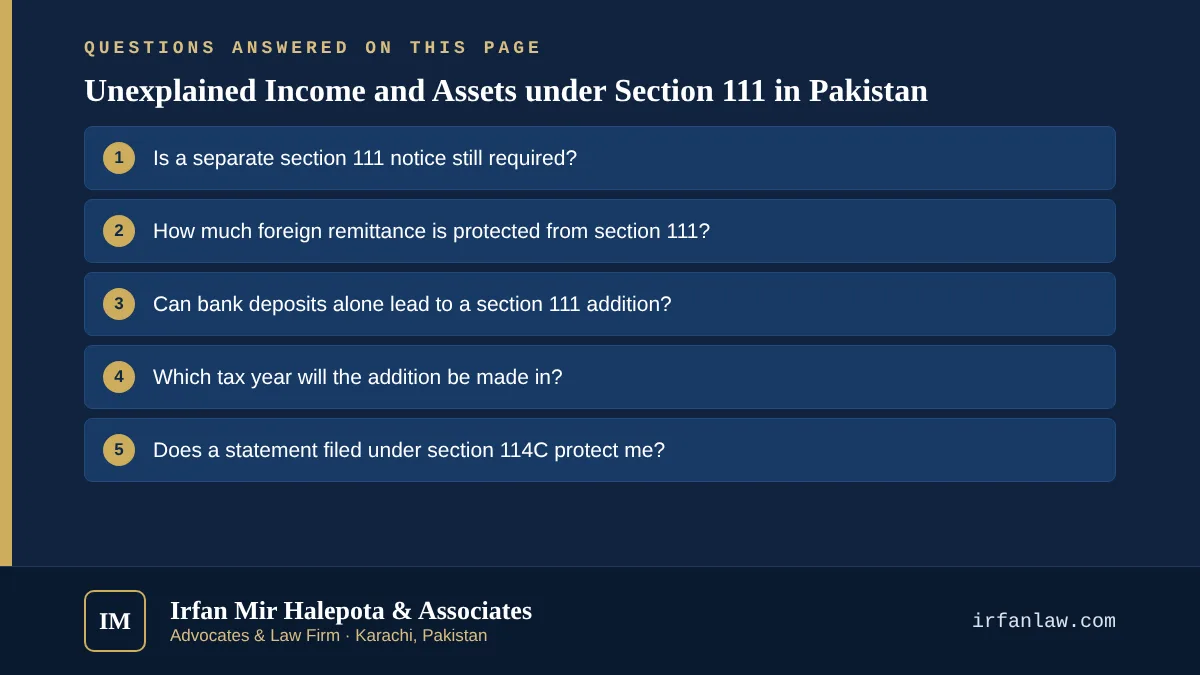
Is a separate section 111 notice still required?
For older tax years, the Sindh and Lahore High Courts have held that a separate notice and proceedings are required, because the 2021/2022 Explanation is prospective. The Sindh High Court applied this to tax years 2015 and 2017. For later tax years the department relies on the Explanation, but the Sindh High Court has said that even then section 111 proceedings must be concluded before section 122(5) is used, so the point remains contested.
How much foreign remittance is protected from section 111?
Under section 111(4)(a), foreign exchange remitted through normal banking channels and encashed into rupees by a scheduled bank, with a bank certificate, is excluded up to Rs 5 million in a tax year, according to FBR Circular No. 5 and later reports. Amounts above the cap can still be explained with evidence. Check the current text, as reform has been under discussion in 2026.
Can bank deposits alone lead to a section 111 addition?
Bank credit entries can be the starting point: the Supreme Court in CIR v. Muhammad Amin Arshad, 2021 SCMR 437, accepted them as a basis for proceeding. They are not conclusive. The person can show that deposits came from declared income, loans, sale of assets or transfers between their own accounts.
Which tax year will the addition be made in?
Under section 111(2), amounts relating to Pakistan are included in the tax year to which they relate. Foreign assets, expenditure and concealed foreign income are allocated by reference to the year of discovery, linked to the year in which the Commissioner issues the notice. An addition placed in the wrong year is open to challenge.
Does a statement filed under section 114C protect me?
Not from section 111. According to KPMG's brief on the Finance Act, 2025, a statement of sources of investment filed under the new section 114C is not treated as a disclosure of income for section 111 purposes. The underlying funds may still be examined.
Can agricultural income explain a large investment?
Only to a limited extent. A proviso to section 111(1) accepts an agricultural income explanation only up to the agricultural income worked back from the agricultural income tax actually paid under the provincial law. Land records and provincial tax receipts are therefore essential.
This article is general information about Pakistani law and procedure, not legal advice for any specific matter. If this touches on something you're currently facing, get in touch and we'll advise on your facts directly.