Amendment of Assessment under Section 122 of the Income Tax Ordinance, 2001: Time Limits, Grounds and Defence
Under section 122 of the Income Tax Ordinance, 2001, the Commissioner may amend a deemed or best-judgment assessment within five years from the end of the financial year in which it was issued, but only on the basis of audit or “definite information” (section 122(5)) or because the order is erroneous and prejudicial to the revenue (section 122(5A)). A show-cause notice and hearing under section 122(9) are compulsory, and since the Finance Act, 2025 the amended order must be made within one year of that notice, extendable by no more than 90 days for reasons recorded in writing.
Most income tax assessments in Pakistan are never “made” by an officer at all: the return itself becomes the assessment order. Section 122 is the door through which the Commissioner reopens that position, and nearly every large income tax demand a Karachi business receives passes through it. Anyone looking for the best tax lawyer in Karachi after receiving a section 122(9) notice really needs one question answered first: was the notice issued on a lawful ground and within time, because that often decides the case before the figures are even argued. This guide explains the statutory scheme as amended up to the Finance Act, 2025, the leading case law on both sides, and the practical points that matter when a notice arrives.
From deemed assessment to amendment: how sections 120 and 122 fit together
Under section 120(1), where a taxpayer files a complete return for a tax year, the Commissioner is taken to have made an assessment of taxable income and tax due, and the return is treated for all purposes as an assessment order issued on the day it was furnished. That date matters: it starts the limitation clock for any later amendment.
If the return is incomplete, section 120(3) requires the Commissioner to issue a notice identifying the deficiencies and asking for the missing information by a stated date. As the text stood after the Finance Act, 2021, such a notice cannot be issued after 180 days from the end of the financial year in which the return was filed. If the taxpayer does not comply, the return is treated as invalid, as if it had never been filed; if the taxpayer complies, the return is treated as complete from the day it was originally furnished.
Section 122(1) then allows the Commissioner to amend an assessment order treated as issued under section 120, or issued under section 121 (best-judgment assessment), by making such alterations or additions as he considers necessary. Where the taxpayer files a revised return under section 114(6), section 122(3) treats that revised return itself as an amended assessment order issued on the day it was filed.
Time limits: the five-year rule and further amendments
Section 122(2) bars the Commissioner from amending an order under section 122(1) “after the expiry of five years” from the end of the financial year in which the assessment order was issued or treated as issued. Because a deemed assessment is issued on the date of filing, the clock runs from the end of the financial year (30 June) in which the return was filed, not from the end of the tax year.
Take a return for tax year 2020 filed on 29 September 2020. It falls in the financial year ending 30 June 2021, so the five-year period ends on 30 June 2026. The text bars the amendment itself after that date, so a show-cause notice issued shortly before expiry does not, on its own, keep the door open.
Where an assessment has already been amended, section 122(4) permits further amendment within the later of five years from the end of the financial year of the original assessment, or one year from the end of the financial year in which the amended order was issued.
| Step | Statutory limit | Provision |
|---|---|---|
| Notice for an incomplete return | 180 days from the end of the financial year in which the return was filed | Section 120 |
| First amendment of a deemed or best-judgment assessment | Five years from the end of the financial year in which the order was issued or treated as issued | Section 122(2) |
| Further amendment | Later of five years (original order) or one year from the end of the financial year of the amended order | Section 122(4) |
| Order after a show-cause notice | One year from the notice, extendable by up to 90 days for written reasons (certain periods excluded) | Section 122(9), first and second provisos |
The Supreme Court treats these limits strictly. In Additional Commissioner Inland Revenue v. Eden Builders, 2018 SCMR 991, it held that the 2009 amendment to section 122(2) did not apply retrospectively to revive the department’s right to amend, observing that statutes of limitation are by their nature strict and inflexible.
Grounds under section 122(5): audit or definite information
An amendment under section 122(1), and a further amendment under section 122(4), is permitted only where, on the basis of audit or definite information, the Commissioner is satisfied that:
- income chargeable to tax has escaped assessment;
- total income has been under-assessed, assessed at too low a rate, or has been the subject of excessive relief or refund; or
- an amount under a head of income has been mis-classified.
Section 122(8) gives “definite information” an inclusive meaning: information on sales or purchases of goods, receipts from services or other taxable receipts, and the acquisition, possession or disposal of money, assets, valuable articles or investments, or expenditure incurred by the taxpayer. Where the amendment follows an audit, the audit itself must have been lawfully selected and conducted; see our guide to tax audit selection under sections 177 and 214C.
The case law pulls in two directions, and the outcome usually depends on the quality of the material the officer actually holds:
- Limits on the department. A mere change of opinion on the same record is not definite information (2019 SCMR 158, under the corresponding provisions of the 1979 Ordinance), and definite information does not mean a re-analysis of information already on record (2019 SCMR 1639). In CIR v. Fauji Foundation, 2024 PTD 637, the absence of definite information rendered both the section 122(9) notice and the amended order void, and in CIR v. Khudadad Heights (Civil Petition 862 of 2024) bare bank credit entries, without analysis, were held not to be definite information.
- Support for the department. In CIR v. Muhammad Amin Arshad, 2021 SCMR 437, credit entries in a bank account were accepted as definite information for an addition under section 111. Third-party data on purchases, property transfers or vehicle registrations falls squarely within the statutory definition.
The practical lesson is that a notice should identify the information relied on and how it came to the officer’s knowledge. A taxpayer is entitled to know what the information is; an officer who records it clearly in the notice makes the order far easier to defend on appeal.
Section 122(5A): erroneous and prejudicial to the revenue
Section 122(5A) is a separate power. Subject to section 122(9), the Commissioner may amend or further amend an assessment order if he considers it “erroneous in so far it is prejudicial to the interest of revenue”. Both elements are required: an order can be erroneous without loss to the revenue, and a lower assessment is not erroneous merely because another view was possible.
The provision is aimed at errors apparent from the existing record, such as a deduction allowed contrary to the statute, a wrong rate, or an exemption that does not apply. In a decision reported by Business Recorder in April 2025, a division bench of the Appellate Tribunal Inland Revenue at Islamabad described section 122(5) as narrower and focused on specific errors, and section 122(5A) as broader in discretion but primarily based on the existing record, so that it does not permit the Commissioner to reopen an assessment on later-received information or to call for fresh documents.
On who may exercise the power, the Supreme Court held in Allied Bank Ltd v. CIR, 2023 SCMR 1166, that section 122(5A) powers could be delegated to an Additional Commissioner Inland Revenue under section 210. A notice that invokes section 122(5A) but in substance relies on new external information, or one that cites both sub-sections without explaining which ground is pursued, is a common point of challenge.
Additions under section 111: separate proceedings come first
Many amendments add unexplained income or assets under section 111 (unexplained deposits, investments or expenditure). In Commissioner Inland Revenue, Lahore v. Millat Tractors Ltd, 2024 SCMR 700, the Supreme Court held that before an assessment is amended under section 122 on the basis of section 111, proceedings under section 111 must be initiated and concluded with the Commissioner’s opinion; that opinion then becomes the definite information for section 122(5), and only then can a section 122(9) notice be acted on. The Court had earlier taken a similar approach in CIR v. Bashir Ahmed, 2021 SCMR 1290.
The Sindh High Court has applied this line consistently. In ITRA 399 of 2023 (judgment of 24 March 2025, reproduced and followed in ITRAs 300 to 304 of 2025 on 8 October 2025), it held that the Explanation added to section 111 in 2021 and substituted in 2022 operates prospectively, so earlier tax years are governed by the law as it stood before. For tax years after the Explanation, the department argues that combined proceedings are now authorised by the statute itself; how far that is so turns on the wording of the Explanation and is still being worked out in the courts.
Section 122(9): notice, hearing and the deadline for the order
Section 122(9) is the procedural core: no assessment may be amended or further amended unless the taxpayer has been given an opportunity of being heard. In practice this means a written show-cause notice setting out the proposed amendment and its basis, a reasonable time to reply, and an order that deals with the reply. Our guide to answering an FBR show-cause notice covers drafting the reply.
The deadline for the order has changed three times in five years:
- The Finance Act, 2021 inserted a first proviso requiring the order within 120 days of the show-cause notice, extendable by the Commissioner for reasons recorded in writing by no more than 90 days, for notices issued on or after 1 July 2021.
- The Finance Act, 2022 increased the 120 days to 180 days, the period described in decisions of 2023 and 2024, including the Supreme Court’s judgment in Millat Tractors.
- The Finance Act, 2025 rejected a proposal to remove the limit altogether and instead extended it to one year from the issuance of the show-cause notice, keeping the 90-day maximum extension.
A second proviso excludes from the count any period during which proceedings are adjourned because of a stay order, alternative dispute resolution, or agreed assessment proceedings under section 122D, and time taken by adjournments sought by the taxpayer, up to 60 days.
Two points remain open. First, the law does not expressly say which limit governs a notice issued before 1 July 2025 that was still pending on that date; where the earlier 180-day period (plus any valid extension) had already expired before the amendment took effect, the reasoning in Eden Builders strongly suggests the later amendment cannot revive the proceedings, but cases where time had not yet run are arguable both ways. Secondly, the consequence of an order passed out of time is regularly litigated; taxpayers treat such orders as void, and the department examines whether excluded periods or a written extension bring the order within time. The Finance Act, 2026 should be checked for any further change before relying on these limits.
Practical points for taxpayers and for the department
For a Karachi business that receives a section 122(9) notice, the following checks usually decide the strategy:
- Build a date chart. Record the return filing date, the end of that financial year, the notice date, each adjournment (and who sought it), any stay order, and any written extension. Most limitation points are won or lost on this chart.
- Identify the ground. Is the notice under section 122(5) or 122(5A)? An officer who proceeds on one ground generally cannot defend the order on the other.
- Test the information. Ask what the definite information is, when it was received and whether it was already on record at filing.
- Check for section 111. Where the addition is for unexplained income or assets, check whether a separate section 111 notice and opinion preceded the amendment notice.
- Answer on the merits as well. A strong jurisdictional objection is not a reason to ignore the merits; reply in writing, attach documents, and keep proof of filing. Records need only be kept for the period in section 174; in CIR v. Panther Sports and Rubber Industries, 2022 SCMR 1135, the Supreme Court held a taxpayer cannot be compelled to produce records beyond six years.
- Use adjournments sparingly. Taxpayer adjournments of up to 60 days are excluded from the deadline, so repeated requests can extend the department’s time.
For officers, the same points apply in reverse: record the source of the information in the notice, decide which sub-section is invoked, conclude any section 111 proceedings first, and record written reasons for an extension before the original period expires.
An amended assessment order is appealable; the forums and limitation periods are explained in our guide to the tax appeal route, and penalties and default surcharge that often follow an amended demand are covered in tax penalties and default surcharge in Pakistan. For representation in amendment proceedings, see our taxation and customs practice.
Follow us on Google
If these guides are useful, add this site as a preferred source. Google will then show it more prominently to you in Search, Discover and AI results.
Official sources
- Federal Board of Revenue: Income Tax Ordinance, 2001 (consolidated texts)
- Federal Board of Revenue: compilation of Supreme Court tax judgments (2025)
- Sindh High Court: ITRA 320 of 2025 (applying Millat Tractors, 2024 SCMR 700)
- Sindh High Court: ITRAs 300 to 304 of 2025 (section 111 and section 122)
- KPMG Taseer Hadi & Co.: A Brief on Finance Act, 2025
- Business Recorder: ATIR on the scope of sections 122(5) and 122(5A) (April 2025)
Common questions
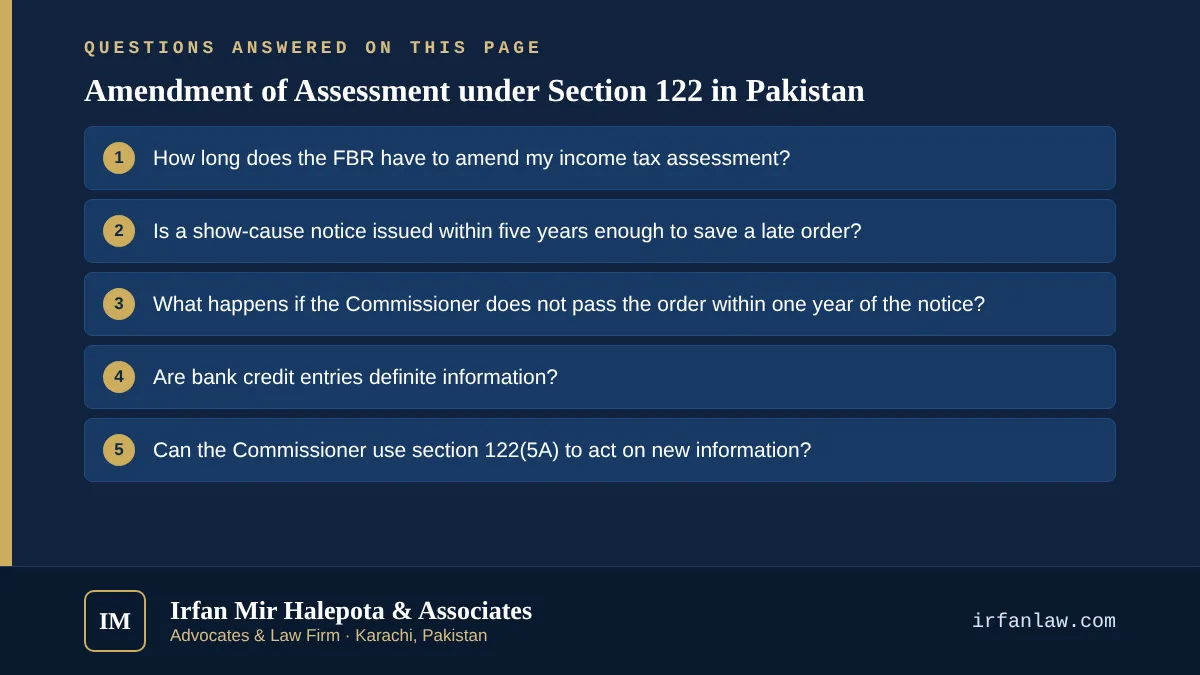
How long does the FBR have to amend my income tax assessment?
Under section 122(2), an assessment cannot be amended after five years from the end of the financial year in which the assessment order was issued or treated as issued. For a deemed assessment, that is the financial year in which the return was filed. If the assessment has already been amended once, section 122(4) allows a further amendment within the later of that five-year period or one year from the end of the financial year of the amended order.
Is a show-cause notice issued within five years enough to save a late order?
No, not on the wording of section 122(2), which bars the amendment itself after five years. The officer must also respect the separate deadline in section 122(9), which runs from the date of the show-cause notice. Both limits have to be satisfied.
What happens if the Commissioner does not pass the order within one year of the notice?
Since the Finance Act, 2025, the first proviso to section 122(9) requires the order within one year of the show-cause notice, extendable by up to 90 days only for reasons recorded in writing. Periods of stay, alternative dispute resolution, agreed assessment proceedings and up to 60 days of taxpayer adjournments are excluded. Whether an order passed outside the period is void is regularly argued, and the answer depends on a careful calculation of the excluded periods and any extension.
Are bank credit entries definite information?
There are competing Supreme Court decisions. In Muhammad Amin Arshad (2021 SCMR 437) bank credits were accepted as definite information for an addition under section 111, while in Khudadad Heights (Civil Petition 862 of 2024) bare credit entries without analysis were held insufficient. The outcome depends on what the officer actually analysed and recorded.
Can the Commissioner use section 122(5A) to act on new information?
Section 122(5A) applies where the existing order is both erroneous and prejudicial to the revenue. The Appellate Tribunal at Islamabad has described it as based primarily on the existing record, not on later-received information. New information is normally the territory of section 122(5), which has its own requirement of audit or definite information.
Can the department add unexplained income under section 111 directly in a section 122 notice?
For earlier tax years, no. In Millat Tractors (2024 SCMR 700) the Supreme Court held that section 111 proceedings must first be concluded with the Commissioner's opinion, which then serves as definite information for section 122. The Sindh High Court has held the 2021 and 2022 Explanation to section 111 to be prospective, so later years may be treated differently.
This article is general information about Pakistani law and procedure, not legal advice for any specific matter. If this touches on something you're currently facing, get in touch and we'll advise on your facts directly.