When Brothers Refuse to Give a Sister Her Share of Inheritance: Rights and Remedies in Karachi
A sister's share vests in her the moment the parent dies; it is not something brothers can grant or withhold. If they keep possession, mutate the property into their own names or press her to sign a relinquishment, she can sue in the civil court for declaration, cancellation of documents, partition and possession under sections 39 and 42 of the Specific Relief Act, 1877, and depriving a woman of her inheritance by deceitful or illegal means is a criminal offence under section 498A of the Pakistan Penal Code. Move early: limitation and onward sales are the real risks.
In many Karachi families the father dies, the house and any plots stay in the brothers' hands, and the sisters are told to wait, to keep the peace, or to sign a paper. Pakistani law does not accept that arrangement. The share each heir takes is fixed by Muslim personal law, it passes on death, and the Supreme Court has repeatedly refused to let deeds of relinquishment or so-called gifts from sisters stand without close scrutiny. Anyone looking for the best inheritance lawyer in Karachi to recover a sister's share should start with one practical question: has the property already been mutated or sold, and when did the brothers first openly deny her claim? The answer decides which remedy comes first and how urgent it is.
What a sister is entitled to, and when it becomes hers
For Muslims in Pakistan, succession is governed by Muslim personal law through the Muslim Personal Law (Shariat) Application Act, 1962. The basic rule for children comes from Surah An-Nisa (4:11): where a parent leaves both sons and daughters, each son takes a share equal to that of two daughters. A daughter does not take nothing, and her share is not at anyone's discretion. Where there are only daughters, one daughter takes half and two or more share two-thirds, with the rest going to other heirs.
A worked example: a father leaves a widow, two sons and one daughter. The widow takes one-eighth. The remaining seven-eighths is divided into five parts, two for each son and one for the daughter. Our inheritance share calculator runs these figures for common family combinations under Sunni (Hanafi) rules; Shia (Ja'fari) rules differ and should be checked separately.
Timing matters as much as arithmetic. In Ghulam Ali v. Mst. Ghulam Sarwar Naqvi (PLD 1990 SC 1) the Supreme Court held that as soon as an owner dies, succession to his property opens and title passes to the heirs in their shares, with no intermediary. A brother is not an executor holding the estate until he decides to distribute it. In Mst. Brikhna v. Faiz Ullah Khan (Civil Petition No. 989 of 2015, decided 1 July 2020) the Court added that a daughter is entitled from the day her father died and that a mutation entry is not a document of title. The same principles apply where sisters inherit from a brother who died without children, or where one brother is shut out by the others.
How sisters are usually kept out
The methods are familiar to anyone who practises in Karachi's civil courts. Recognising which one has been used tells you which documents to challenge.
- Mutation or transfer in the brothers' names. The property is transferred in the records of a cooperative housing society, KDA, a cantonment board or, for agricultural land, the revenue record, showing only the sons, sometimes on the strength of an affidavit that leaves the daughters out.
- A tanazul nama or relinquishment deed. The sister is asked, often soon after the funeral or at her wedding, to sign a stamp paper saying she gives up her share. Courts have recognised the pressure behind such documents; the Federal Shariat Court in March 2025 declared customs of forced relinquishment such as haq bakhshwai un-Islamic, in the petition of Syeda Fouzia Jalal Shah.
- A 'gift' from the sister, or an earlier gift from the father. A hiba deed or an oral gift recorded in a mutation is produced to show that she gave her share to her brothers, or that the father gave the property to the sons before he died.
- Possession without paperwork. Nothing is transferred, but the brothers live in the house, collect the rent and treat the matter as closed.
- Sale to an outsider. The most damaging step, because a buyer who paid value without notice of her claim may be protected.
Is a relinquishment or gift by a sister binding?
The answer depends first on when it was signed.
Before the parent's death. A promise to give up a future inheritance has no legal effect. While the parent is alive the daughter has only a hope of inheriting, and section 6(a) of the Transfer of Property Act, 1882 provides that the chance of an heir-apparent succeeding to an estate cannot be transferred. A paper she signed during her father's lifetime does not prevent her claiming her share after his death.
After the death. The share is now her property, and in principle an adult owner can transfer what she owns. But the courts do not treat these documents as ordinary transactions. In Ghulam Ali the Supreme Court described the so-called relinquishment by a female of her inheritance as opposed to public policy in the Islamic sense, and held the agreement constituting it void. In Mirza Abid Baig v. Zahid Sabir (2020 SCMR 601), relied on by the Sindh High Court, the Court noted that vulnerable women are sometimes compelled to give up their inheritance to male relatives.
Two judgments of 2026 sharpen the test. In Mst. Bibi Amina v. Shamsullah (C.P.L.A. No. 143-Q of 2025, decided 4 June 2026) the Federal Constitutional Court held that a female heir cannot be deprived of her inheritance on the basis of a relinquishment deed, compromise, gift or similar arrangement unless it is proved to have been voluntary and fully understood, that the beneficiary bears a heavy burden where the woman is parda nasheen, illiterate or otherwise vulnerable, and it issued directions binding courts and revenue authorities to apply heightened scrutiny. In Noor Muhammad v. Ghulam Haider, reported in July 2026, the Supreme Court set aside a 1955 gift mutation in favour of two sons, holding that an oral gift that deprives women heirs must be strictly proved by independent evidence, and that mutation entries and long possession are not proof of a gift.
In practice, a document is weakest where it was unregistered, signed in a hurry, without independent advice, without any real payment or benefit to her, by a woman who did not read it or was not told what her share was worth, and where she never received possession of anything. A transfer of immovable property also normally requires a registered instrument under the Registration Act, 1908, which many tanazul papers are not.
Civil remedies in Karachi: which suit, which court
Most of these cases are decided in the civil courts of the district where the property is located (Karachi South, East, Central, West, Malir, Korangi or Keamari), with high-value suits filed on the Original Side of the High Court of Sindh. One plaint usually combines several prayers:
- Declaration under section 42 of the Specific Relief Act, 1877 that she is a legal heir entitled to a specified share.
- Cancellation under section 39 of the same Act of the tanazul nama, gift deed, sale deed or other instrument that is void or voidable against her, together with a direction to correct the mutation or society record.
- Partition and separate possession of her share, or sale and division of proceeds where a flat or house cannot be divided. Our guide to the partition suit for inherited property explains preliminary and final decrees.
- Mesne profits: a share of the rent or rental value the brothers have enjoyed, which the court can inquire into under Order XX, Rule 12 of the Code of Civil Procedure, 1908.
- Injunction: a temporary injunction under Order XXXIX, Rules 1 and 2 CPC restraining any sale, gift, mortgage or construction while the suit is pending.
Every legal heir must be made a party, including other sisters who are not suing and the widow if she is alive. Leaving one out is a common reason for decrees being reopened years later.
Succession certificates and the NADRA route in Sindh
Sindh moved the uncontested process out of court. Under the Sindh Letters of Administration and Succession Certificates Act, 2021 (Sindh Act No. VII of 2021), NADRA's Succession Facilitation Units issue succession certificates and letters of administration for both movable and immovable property (section 3), on the basis of NADRA's family registration record. NADRA publishes a public notice, waits fourteen days for objections, verifies all heirs biometrically and issues the certificate showing each heir's share (section 6). The service was launched in Karachi in June 2021.
This route depends on every heir cooperating. Where there is a 'controversy' (an objection, an identity dispute or a matter needing evidence) NADRA declines the application and the parties go to the court under the Succession Act, 1925 (section 5). A 2025 amendment provides that where an heir is a minor or mentally disabled, the certificate takes effect only once a guardianship certificate is issued under the Guardians and Wards Act, 1890. Anyone aggrieved by a certificate issued without them has thirty days to approach a competent court (section 8).
Two cautions. A brother cannot lawfully obtain a NADRA certificate without his sisters' biometric verification, so if one has been issued, find out how. And a certificate identifies heirs and shares; it does not put a sister in possession. Our page on succession and heirship certificates covers the court route in more detail.
The criminal route: section 498A PPC
Section 498A was added to the Pakistan Penal Code by the Criminal Law (Third Amendment) Act, 2011. It makes it an offence for anyone, by "deceitful or illegal means", to deprive a woman of inheriting movable or immovable property when succession opens. The punishment is imprisonment of not less than five and up to ten years, or a fine, or both. Where documents have been forged, offences such as sections 467, 468 and 471 PPC may also be relevant.
To use it, a written complaint is made to the officer in charge of the police station with jurisdiction, attaching the death certificate, the NADRA family registration certificate and the documents showing the transfer or mutation. If the police do not act, an application can be made to the Sessions Judge acting as ex-officio Justice of Peace under section 22-A(6) of the Code of Criminal Procedure, 1898, or a private complaint can be filed before the competent court.
Be realistic about what this achieves. A prosecution punishes; it does not transfer the property back or decide shares. It is most useful alongside a civil suit, where the brothers' conduct was plainly dishonest, or to bring them to the table. A complaint built on a genuine dispute about shares can be resisted as a civil matter given a criminal colour, so the facts should be checked before it is filed. Section 498A protects women; a brother shut out by his brothers relies on the civil remedies alone.
Is there an Ombudsperson route in Karachi?
This is where much of the online material is wrong for Sindh. The Enforcement of Women's Property Rights Act, 2020 lets a woman deprived of ownership or possession of property complain to the Ombudsperson, who can have the Deputy Commissioner restore her. But section 1 says it extends to the whole of the Islamabad Capital Territory, and nothing more. Punjab has its own Punjab Enforcement of Women's Property Rights Act, 2021 and Khyber Pakhtunkhwa its own 2019 law, each with a provincial Ombudsperson; even there, the Peshawar High Court in December 2025 set aside a series of decisions of the KP Ombudsperson for going beyond the Act into disputed ownership.
At the time of writing we are not aware of an equivalent Sindh statute in force. For property in Karachi, the routes are therefore the civil court, the NADRA succession process where heirs agree, and a criminal complaint under section 498A. If a Sindh law is enacted, this page will be updated.
Limitation, evidence and what to do first
Delay is the brothers' best defence. The Supreme Court has not been consistent on limitation in inheritance cases, and the law is genuinely unsettled. In Saadat Khan v. Shahid-ur-Rehman (PLD 2023 SC 362) the Court applied the six-year period in Article 120 of the Limitation Act, 1908 to a sister's declaratory suit, running from the brothers' actual and open denial of her rights, such as a sale, a gift or a mutation claiming she had given up her share; where the denial was concealed by fraud, section 18 delays the start until she learns of it, but not against a bona fide purchaser for value. Mst. Grana v. Sahib Kamala Bibi (PLD 2014 SC 167) refused relief after decades of silence while the land changed hands. Other benches, including in Noor Muhammad, have refused to defeat women's claims on delay alone. A further risk: where a woman never claims her share in her lifetime, her own children may be held unable to claim it later (Abdul Haq v. Mst. Surrya Begum, 2002 SCMR 1330, applied by the Sindh High Court in January 2025).
Collect, in this order:
- Death certificate and NADRA family registration certificate.
- Title documents, society transfer letters, the current mutation or record extract, and certified copies of any registered deed from the Sub-Registrar.
- Any paper she signed, and the circumstances: date, who was present, whether she was given a copy or any money.
- Messages or witnesses showing her share was demanded and refused.
- Who is in possession, since when, and any rent received.
If a sale, transfer or construction is imminent, file with an application for a stay order against sale rather than waiting. Widows facing the same tactics from in-laws should also read our guide to the widow's share in her husband's property.
Official sources
- Sindh Letters of Administration and Succession Certificates Act, 2021 (as amended by Sindh Act XXVII of 2025)
- Supreme Court of Pakistan, Mst. Brikhna v. Faiz Ullah Khan, C.P. 989 of 2015
- High Court of Sindh, Suit 878 of 2020, order of 18 January 2025 (limitation and locus in inheritance claims)
- High Court of Sindh, Civil Revision S-42 of 2000 (relinquishment by female heirs)
- Enforcement of Women's Property Rights Act, 2020 (Act XII of 2020)
- Business Recorder: Federal Shariat Court on customs depriving women of inheritance and s.498A PPC (March 2025)
Common questions
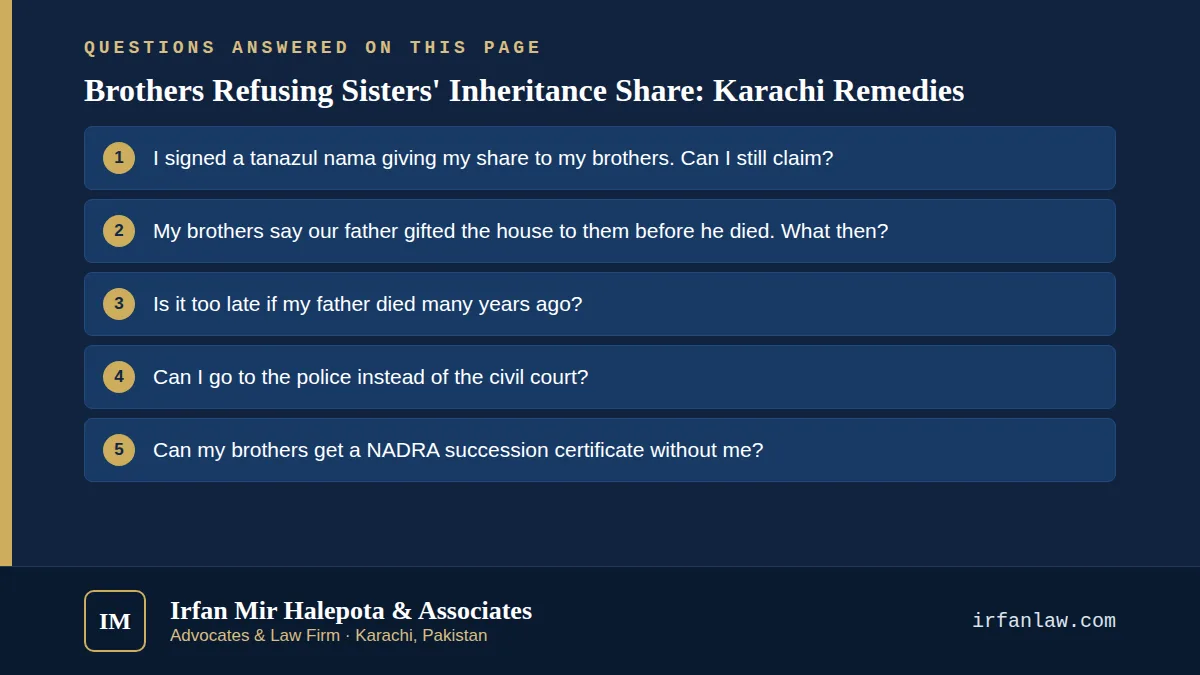
I signed a tanazul nama giving my share to my brothers. Can I still claim?
Often, yes. If you signed before your parent died it has no effect at all, because a future inheritance cannot be transferred. If you signed afterwards, courts examine whether it was truly voluntary and fully understood, and the brothers must prove that. An unregistered stamp paper signed under family pressure, without advice and without receiving anything, is open to challenge in a suit for cancellation and declaration.
My brothers say our father gifted the house to them before he died. What then?
The brothers must prove the gift: a clear declaration by the father, acceptance and delivery of possession, supported by independent evidence. The Supreme Court has held that mutation entries and long possession do not by themselves prove a gift that deprives women heirs. If the father kept living in the house and controlling it, that is a strong point against the gift.
Is it too late if my father died many years ago?
Not necessarily, but it is the main risk. The Supreme Court has applied a six-year period running from when your brothers openly denied your share, while other benches have refused to defeat women's claims for delay alone. Fraud or concealment can postpone the start. Get advice before more time passes, and do not rely on the matter staying open.
Can I go to the police instead of the civil court?
You can file a complaint under section 498A PPC, which punishes depriving a woman of her inheritance by deceitful or illegal means. A criminal case does not, however, return the property or fix your share. For that you need a civil suit, and the two are often pursued together.
Can my brothers get a NADRA succession certificate without me?
They should not. In Sindh NADRA verifies every legal heir biometrically and publishes a public notice before issuing a certificate, and any heir's objection sends the matter to court. If a certificate was issued leaving you out, an aggrieved person has thirty days under the Sindh Act to approach a competent court, and a lawyer should check how it was obtained.
Does the federal women's property rights Ombudsperson help me in Karachi?
No. The Enforcement of Women's Property Rights Act, 2020 extends only to the Islamabad Capital Territory. Punjab and Khyber Pakhtunkhwa have their own laws. We are not aware of an equivalent Sindh law in force, so in Karachi the routes are the civil courts, NADRA where heirs agree, and section 498A PPC.
This article is general information about Pakistani law and procedure, not legal advice for any specific matter. If this touches on something you're currently facing, get in touch and we'll advise on your facts directly.