Inheritance Share Calculator (Wirasat)
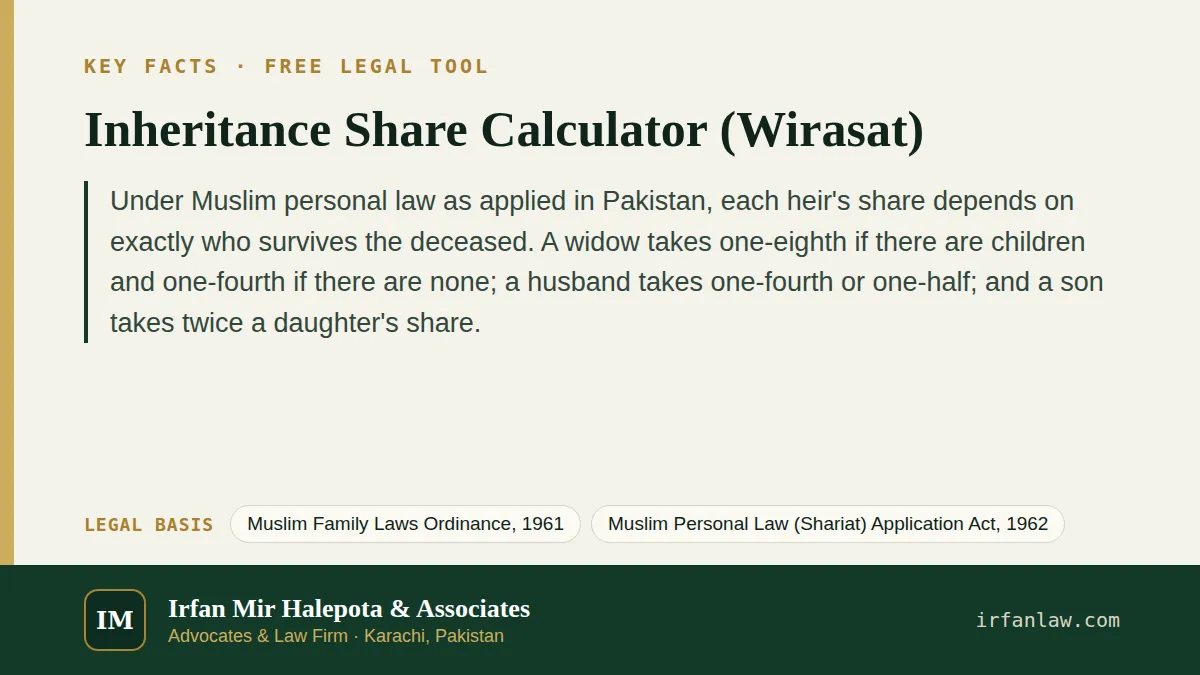
Under Muslim personal law as applied in Pakistan, each heir's share depends on exactly who survives the deceased. A widow takes one-eighth if there are children and one-fourth if there are none; a husband takes one-fourth or one-half; and a son takes twice a daughter's share. This calculator works out the Sunni (Hanafi) shares for a spouse, children and parents.
This calculator gives general information about Pakistani law, not legal advice on your case. Nothing you enter is sent anywhere or stored: the calculation runs entirely in your browser.
Before any shares are divided
The estate is first used for funeral expenses, then for the debts of the deceased, then for any valid bequest (wasiyyat) of up to one-third to people who are not heirs. Only what remains is divided. Unpaid haq mehr is a debt owed by the husband, so a widow recovers it in full as a creditor and then takes her share of what remains. See recovering haq mehr.
How the shares are worked out
| Heir | With children | Without children |
|---|---|---|
| Husband | 1/4 | 1/2 |
| Wife (two or more wives share this equally) | 1/8 | 1/4 |
| Mother | 1/6 | 1/3, or 1/6 if there are two or more brothers or sisters; 1/3 of what remains after the spouse's share when a spouse and the father survive |
| Father | 1/6, plus the remainder if there are daughters but no son | The remainder after the other shares |
| Daughters (no son) | One daughter 1/2; two or more share 2/3 | |
| Sons and daughters together | They share what remains after the fixed shares, each son taking twice a daughter's share | |
These fractions come from Surah An-Nisa (4:11–12). The Muslim Personal Law (Shariat) Application Act, 1962 makes Muslim personal law the rule of decision in questions of succession where the parties are Muslims. Two adjustments complete the calculation. If the fixed shares add up to more than the whole estate, each is reduced in proportion ('awl). If something remains and there is no son, father or other residuary heir, the surplus returns to the blood relatives in proportion to their shares (radd); a husband or wife does not share in the return while any other heir survives.
What this calculator does not cover
- Shia (Ja'fari) estates. Sunni and Shia principles allocate the residue differently, so which applies depends on the sect of the deceased.
- Grandchildren of a son or daughter who died first. Section 4 of the Muslim Family Laws Ordinance, 1961 gives them the share their parent would have taken.
- Brothers, sisters, grandparents, uncles and cousins in the cases where they inherit, and wills beyond one-third.
- Non-Muslim estates, which follow different succession laws.
If the calculator says your case is not covered, it will not guess. Ask us to work out the shares, or read our guides to the widow's share and succession certificates.
Common questions
What share does a widow get in Pakistan?
One-fourth of her husband's estate if he left no children, and one-eighth if he did, following Surah An-Nisa (4:12). Where there is more than one widow, that portion is divided equally among them. Unpaid haq mehr is paid to her first, as a debt of the estate.
What share does a daughter get?
With no son, one daughter takes one-half and two or more daughters share two-thirds. With a son, sons and daughters share what remains after the fixed shares, each son taking twice the share of each daughter (Surah An-Nisa, 4:11).
Is unpaid haq mehr part of the inheritance?
No. Unpaid dower is a debt of the deceased husband, payable out of the estate before it is divided. A widow therefore recovers her unpaid haq mehr in full and then also takes her inheritance share of what remains.
Do Sunni and Shia inheritance shares differ?
Yes. Sunni (Hanafi) and Shia (Ja'fari) principles differ, particularly in how the residue is allocated among the remaining heirs. This calculator applies Sunni (Hanafi) rules only.
Do grandchildren inherit if their parent died first?
Yes. Under Section 4 of the Muslim Family Laws Ordinance, 1961, the children of a son or daughter who died before the deceased receive, per stirpes, the share their parent would have taken. Because that changes every other figure, the calculator refers those cases to an advocate.
Related guides
- Share of widow in propertyOne-fourth or one-eighth, and haq mehr as a debt.→
- Succession certificate in PakistanGetting the assets into the heirs' names.→
- Partition suit for inherited propertyWhen co-heirs cannot agree on division.→
- Inheritance and succession lawyersShares, certificates and disputes between heirs.→
Want an advocate to check the result?
Calculators handle the standard rules. Real cases often turn on a date, a document or a family detail the rules do not show. Send us the facts and we will tell you where you stand.
Follow us on Google
If these tools are useful, add this site as a preferred source. Google will then show it more prominently to you in Search, Discover and AI results.