Sales Tax Registration, Suspension and Blacklisting in Pakistan: Section 14, Section 21 and Rule 12 Explained
Every person making taxable supplies in the categories covered by section 14 of the Sales Tax Act, 1990 must register before making those supplies, and the Commissioner may register a person compulsorily if they do not. Under section 21 of the Act read with Rule 12 of the Sales Tax Rules, 2006, the Commissioner may suspend a registration through the system without prior notice where fake invoicing, evasion or fraud is suspected, must follow it with a show-cause notice, and may then blacklist the person by a reasoned order. Since the Finance Act, 2025, suspension and blacklisting orders are appealable to the Commissioner Inland Revenue (Appeals).
A sales tax registration is more than a number on the FBR portal. It decides whether a business may charge sales tax, claim input tax and receive refunds, and whether its customers can claim credit on its invoices. Suspension can happen overnight through the computerised system, and a blacklisting order can reach back over past tax periods. Anyone searching for the best sales tax lawyer in Karachi after a registration has been suspended is usually up against a short deadline to answer a show-cause notice, so this guide sets out what the law requires of both the registered person and the Commissioner at each step.
Who must register under section 14
Section 14 of the Sales Tax Act, 1990 requires registration by persons who make taxable supplies (including zero-rated supplies) in the course of a taxable activity and who fall within the listed categories. FBR's own registration guidance summarises those categories as:
- importers;
- wholesalers, including dealers and distributors;
- manufacturers, other than those falling within the definition of a cottage industry;
- retailers who are liable to register, in particular Tier-1 retailers such as units of national or international chains and shops in air-conditioned malls;
- persons required by federal or provincial law to register for a duty or tax that is collected as sales tax;
- persons making zero-rated supplies, including commercial exporters who want sales tax refunds.
The thresholds that separate a cottage industry from a manufacturer, or a Tier-1 retailer from an ordinary retailer, are set in the definitions in section 2 and are changed by Finance Acts from time to time. Check the current figures before deciding that a business is outside the net.
Registration is made on the computerised system in Form STR-1 under Rule 5 of the Sales Tax Rules, 2006, and must be in place before taxable supplies are made. The rules also require bank, premises and utility details, geo-tagged photographs and biometric verification through NADRA. Failing to complete biometric verification in time leads to removal from the Active Taxpayers List.
The definition of "registered person" in section 2(25) covers a person who is registered or is liable to be registered, but its proviso says that a person who is liable to register and has not done so "shall not be entitled to any benefit available to a registered person". In practice this means tax can be assessed against an unregistered business, but it cannot claim input tax against that assessment.
Sales tax on services provided in Sindh is a separate provincial tax under the Sindh Sales Tax on Services Act, 2011, with its own registration with the Sindh Revenue Board. A Karachi business that both supplies goods and renders services may need two registrations (see our guide to Sindh sales tax on services).
Compulsory registration and the cost of staying out
Where a person who should be registered has not applied, Rule 6 of the Sales Tax Rules, 2006 allows the Commissioner to issue a notice (Form STR-6) and, if there is no satisfactory response, to register the person compulsorily. The Finance Act, 2025 inserted sub-section (2A) in section 14 to give this power an express statutory footing, as FBR's explanatory Circular No. 02 of 2025-26 (paragraph 11) confirms.
The Act also contains a set of enforcement measures aimed at persons who are liable but remain unregistered. As the Act stood on 30 June 2026, sections 14AB to 14AE deal with discontinuance of gas and electricity connections, a bar on operating bank accounts, a bar on transferring immovable property, and other measures for non-registration.
If a notice of compulsory registration arrives and the business genuinely believes it is not liable (for example, because it is a cottage industry or makes only exempt supplies), reply in writing with evidence: turnover figures, utility bills, the nature of the products and the relevant exemption. Silence is the worst option because it allows the department to proceed on its own information.
Active taxpayer status
Many of the practical consequences of a suspension flow through the definition of "active taxpayer" in section 2(1A) of the Act (renumbered by the Finance Act, 2025). A registered person is an active taxpayer unless it:
- is blacklisted or its registration is suspended;
- has failed to file sales tax returns under section 26 by the due date for two consecutive tax periods;
- has failed to file its income tax return under section 114 (or statement under section 115) of the Income Tax Ordinance, 2001 by the due date; or
- has failed to file a withholding statement under section 165 of the Income Tax Ordinance, 2001.
Section 21A provides for the sales tax Active Taxpayers List, and Rules 12A and 12B of the Sales Tax Rules, 2006 deal with a registered person becoming non-active and being restored. This list is separate from the income tax Active Taxpayers List. A business can drop off the sales tax list simply by missing two monthly returns, without any order being made against it, and its customers and withholding agents will see the change.
Suspension: grounds and procedure under section 21 and Rule 12
Section 21 of the Act deals with de-registration, blacklisting and suspension of registration; the detailed procedure is in Rule 12 of the Sales Tax Rules, 2006. Under Rule 12, where the Commissioner has reason to believe that a registered person has issued fake invoices, evaded tax or committed tax fraud, the registration may be suspended through the system without prior notice, pending inquiry.
Rule 12 has been amended several times, including by S.R.O. 350(I)/2024 and again in 2025. As reported in the business press in 2025, the grounds now listed include:
- the person is not found at the registered business address;
- refusal of access to business premises under sections 40B and 40C, or refusal to produce records under sections 25 and 37;
- business activity disproportionate to the declared capital and liabilities;
- significant purchases from, or supplies to, persons who are themselves suspended;
- failure to file returns for consecutive months, or filing nil returns over a sustained period; and
- tax fraud as defined in section 2(37), which the Finance Act, 2025 substituted to cover knowingly, intentionally or dishonestly causing loss of tax.
Suspension is meant to be a holding measure, not a final finding. Under the text of Rule 12 as consolidated by FBR up to 31 October 2023, the Commissioner had to issue a show-cause notice within seven days of the suspension (failing which the suspension order was void), giving the person time to reply and warning that blacklisting would follow if no satisfactory reply, records or access were provided. Press reports on the 2025 amendments refer to a 30-day period for responding. FBR's Circular No. 02 of 2025-26 (paragraph 13) also describes a Finance Act, 2025 insertion in section 21 tying the Commissioner's further action to 30 days of receiving the reply. Because these timelines have moved repeatedly, read the notice against the current text of section 21 and Rule 12 on the day it is received.
What suspension and blacklisting actually do
The consequences fall on the registered person and on everyone who dealt with it:
- No input tax or refunds during suspension. Under Rule 12, a suspended person cannot adjust input tax or receive refunds while the suspension lasts.
- Buyers lose credit. Other registered persons cannot claim input tax or refunds on invoices issued by a suspended person. This is why a supplier's suspension often surfaces first as a buyer's problem (see our page on input tax adjustment).
- Blacklisting reaches back. A blacklisting order is passed after a hearing, must give reasons, and specifies the period during which refunds and input tax based on the person's invoices are inadmissible, together with any recovery and penalty. Under the 2023 consolidated rule, the order had to be made within ninety days of the hearing notice, failing which the suspension lapsed.
- Knock-on proceedings. The order is circulated to other tax offices and to the computerised system, and officers then issue show-cause notices to buyers who claimed credit on the blacklisted person's invoices. Each buyer's case is decided by its own appealable order.
- Refund claims stall. Pending refund claims are typically held while a suspension is in force (our separate page on sales tax refund claims explains the refund process).
For a buyer, the strongest position is usually evidence that the purchase was genuine: goods actually received, payment through the banking channel, the supplier's active status on the date of the invoice, and the supplier's declaration of the sale in its own return.
Remedies: reply, appeal and the High Court
Reply to the show-cause notice. The reply is the most important document in the case. It should address each ground in the notice, attach evidence (lease or ownership of premises, utility bills, stock and production records, bank statements, gate passes and delivery documents) and ask for a personal hearing. Our show-cause notice guide covers drafting in more detail.
A reasoned order is mandatory. In M/s. Roomi Tex v. Federal Board of Revenue (C.P. No. D-4421 of 2024, decided 26 September 2024), a Division Bench of the Sindh High Court set aside a suspension order that recorded only that the reply was "unsatisfactory", holding that an order without reasons does not meet section 24A of the General Clauses Act, 1897, and remanded the matter for a speaking order after hearing the petitioner.
Departmental appeal. The Finance Act, 2024 inserted section 21(5), giving a remedy before the Chief Commissioner against a suspension order. In Metpak Industries (Pvt.) Ltd. v. Pakistan (Suit No. 464 of 2024, order dated 24 February 2025) the Sindh High Court treated that remedy as procedural and therefore applicable to pending matters. The Finance Act, 2025 then omitted sub-section (5) and made orders of suspension and blacklisting appealable to the Commissioner Inland Revenue (Appeals) under section 45B (Circular No. 02 of 2025-26, paragraphs 13 and 23). Further appeal lies to the Appellate Tribunal Inland Revenue and, on a question of law, to the High Court, as explained in our page on sales tax assessments and appeals.
Constitutional petitions. The High Court will not ordinarily interfere with a show-cause or pre-suspension notice. In Metpak the court declined to suspend a pre-suspension notice because the objections (that the fake-invoice allegation was conjectural) went to facts that the Commissioner was yet to decide, relying among others on Commissioner Inland Revenue v. Jahangir Khan Tareen, 2022 SCMR 92. A petition stands a better chance where there is a jurisdictional defect, a time-bar, or an order passed without hearing or reasons.
The department's position and common mistakes
Suspension exists to stop the circulation of fake and flying invoices before the revenue is lost, and the courts have accepted that it may be imposed quickly. The safeguards are in the procedure: the Commissioner must have material giving reason to believe that the grounds exist, must issue the show-cause notice within the prescribed time, must hear the person, and must decide by a reasoned order. A department that follows these steps is on firm ground; one that skips them invites remand.
The mistakes we most often see on the taxpayer side are avoidable:
- Not monitoring the e-mail address and portal inbox registered with FBR, so a notice goes unanswered.
- Moving premises without updating the registration under Rule 7, which later looks like "not found at the address".
- Filing nil returns for months while the registration is kept alive for a future project.
- Buying from new suppliers without checking their registration and active status on the date of each invoice.
- Abandoning a business without applying for de-registration under Rule 11; once an application is filed, the obligation to file monthly returns is suspended under sub-rule (2A).
For a wider view of FBR enforcement, see our taxation and customs practice page.
Follow us on Google
If these guides are useful, add this site as a preferred source. Google will then show it more prominently to you in Search, Discover and AI results.
Official sources
- FBR: Who is required to register for sales tax
- Sales Tax Act, 1990 (FBR consolidated text, amended up to 30.06.2026)
- Sales Tax Rules, 2006 (FBR consolidated text, updated up to 31.10.2023)
- FBR Circular No. 02 of 2025-26: Finance Act, 2025 amendments to the Sales Tax Act, 1990
- Sindh High Court: M/s. Roomi Tex v. FBR, C.P. No. D-4421 of 2024 (26.09.2024)
- Sindh High Court: Metpak Industries (Pvt.) Ltd. v. Pakistan, Suit No. 464 of 2024 (24.02.2025)
Common questions
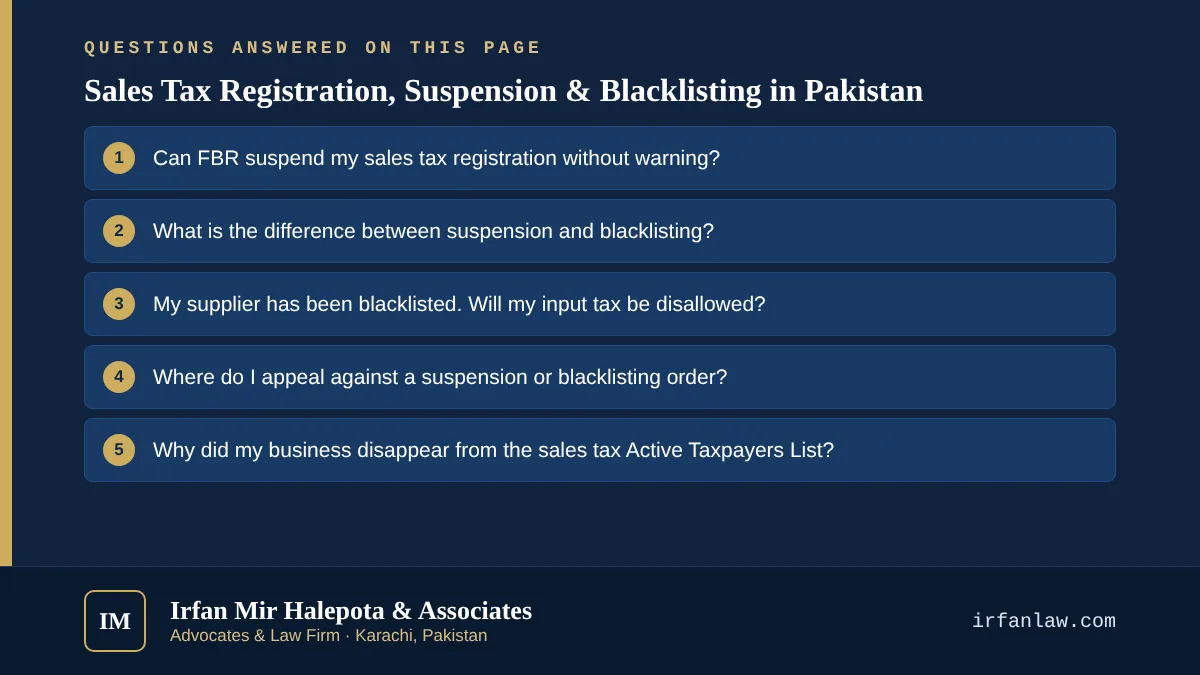
Can FBR suspend my sales tax registration without warning?
Yes. Rule 12 of the Sales Tax Rules, 2006 allows the Commissioner to suspend a registration through the system without prior notice where there is reason to believe that fake invoices were issued, tax was evaded or fraud was committed. The suspension must then be followed by a show-cause notice within the time fixed by the rules, and the person must be heard before any blacklisting order is made.
What is the difference between suspension and blacklisting?
Suspension is an interim measure taken pending inquiry, during which the person cannot claim input tax or refunds and buyers cannot claim credit on its invoices. Blacklisting is a final, reasoned order passed after a hearing that fixes the period during which input tax and refunds based on the person's invoices are inadmissible, and may include recovery and penalty.
My supplier has been blacklisted. Will my input tax be disallowed?
It may be. After a blacklisting order is circulated, officers can issue show-cause notices to buyers who claimed input tax on the blacklisted supplier's invoices. Each buyer's case is decided separately, so evidence that the purchase was genuine, paid through the banking channel and made when the supplier was active is important.
Where do I appeal against a suspension or blacklisting order?
Since the Finance Act, 2025, orders of suspension and blacklisting are appealable to the Commissioner Inland Revenue (Appeals) under section 45B of the Sales Tax Act, 1990. The earlier remedy before the Chief Commissioner under section 21(5), added in 2024, was omitted by the same Finance Act. Further appeal lies to the Appellate Tribunal Inland Revenue.
Why did my business disappear from the sales tax Active Taxpayers List?
Under section 2(1A) of the Sales Tax Act, 1990 a registered person is not an active taxpayer if it is suspended or blacklisted, misses two consecutive sales tax returns, or fails to file its income tax return or withholding statements on time. Incomplete biometric verification can also lead to removal. Filing the missing returns and applying under the rules for restoration is the usual route back.
Do I need a separate registration for services in Karachi?
Yes, if you provide taxable services in Sindh. Sales tax on services in Sindh is levied under the Sindh Sales Tax on Services Act, 2011 and administered by the Sindh Revenue Board, which maintains its own registration. FBR registration under section 14 of the Sales Tax Act, 1990 covers sales tax on goods.
This article is general information about Pakistani law and procedure, not legal advice for any specific matter. If this touches on something you're currently facing, get in touch and we'll advise on your facts directly.