Input Tax Adjustment in Pakistan: Sections 7, 8, 8A, 8B and 73 of the Sales Tax Act, 1990
A registered person may deduct the sales tax paid on its business purchases from the tax charged on its own supplies, but only within the limits of sections 7, 8, 8B and 73 of the Sales Tax Act, 1990. The claim needs a valid invoice or goods declaration in the buyer's name, payment through the banking channel, and a purchase that is not on the section 8 blocked list; adjustment in any tax period is generally capped at 90 per cent of output tax.
Input tax is where most federal sales tax disputes in Karachi begin. A manufacturer or trader claims credit for tax paid on purchases, and months later an audit or a CREST mismatch questions the supplier, the payment trail or the use of the goods. Businesses searching for the best sales tax lawyer in Karachi usually do so after a notice has already disallowed input tax, yet the strongest position is built much earlier, when invoices are booked and suppliers are vetted. This guide explains the statutory conditions, the main lines of case law and what each side must prove, as the Sales Tax Act, 1990 stands after the Finance Act, 2026.
What counts as input tax and when it can be deducted
Section 2(14) of the Sales Tax Act, 1990 defines input tax for a registered person. It covers sales tax on goods supplied to that person, tax on goods the person imports, specified federal excise duty treated as sales tax, provincial sales tax on services received (excluding services the Board specifies, a carve-out added by the Finance Act, 2024), and tax charged under the Act as adapted in Azad Jammu and Kashmir.
Section 7(1) then allows the registered person to deduct input tax paid or payable in a tax period from output tax due for the same period, subject to sections 8, 8B and 73. Section 7(2) makes the deduction document-based. The buyer must hold:
- a tax invoice in its own name bearing its registration number (or a utility bill showing the registration number and the business address);
- for imports, a goods declaration cleared under the Customs Act, 1969; or
- for goods bought at auction, the treasury challan showing payment of sales tax.
A proviso inserted by the Finance Act, 2008 lets a person who missed input tax in the relevant period claim it in the return for any of the six succeeding tax periods. Beyond that window the route is narrower; see our companion guide on sales tax refund claims for how section 66 has been applied to unadjusted input tax.
Inadmissible input tax under section 8
Section 8(1) lists purchases on which input tax cannot be claimed at all, whatever the paperwork says. The clauses that most often feature in Karachi assessments are:
- Clause (a): goods or services used, or to be used, for anything other than taxable supplies.
- Clause (b): goods or services the Federal Government notifies. In Rajby Industries v. Federation of Pakistan, 2023 SCMR 1407, the Supreme Court upheld such a restriction on packing material and held that its later withdrawal took effect only from the stated date, not retrospectively.
- Clauses (ca) and (caa): purchases where the supplier has not deposited the tax, and purchases showing a CREST discrepancy or input tax that cannot be verified in the supply chain.
- Clause (d): fake invoices.
- Clauses (g), (h) and (i): personal or non-business use; goods used in or permanently attached to immovable property (building materials); and vehicles, appliances, furniture and office equipment, unless bought for resale.
Clause (h) was recently tested in the Supreme Court. In July 2026 a three-member bench accepted the Commissioner's appeal in Commissioner Inland Revenue v. Bawany Sugar Mills (Civil Appeal No. 939 of 2018), holding that input tax on cement, steel and similar materials used to build a factory is not admissible, and restoring the original assessment. A reported citation was not available at the time of writing.
Section 8(2) adds an apportionment rule. A business making both taxable and exempt supplies may reclaim only the share of residual input tax attributable to taxable supplies, and section 8(3) confines the right to registered persons.
The section 8B cap and how it can be lifted
Even admissible input tax cannot always be used in full in the month it arises. Section 8B(1) caps adjustment at 90 per cent of output tax for the tax period. The balance is not lost: under the first proviso to section 10(1) it is carried forward as input tax of the next period.
- Exclusions: the cap does not apply to input tax on fixed assets or capital goods, and the Board may exclude persons or classes by notification.
- Annual reconciliation: under section 8B(2) and (3), a company whose audited accounts, certified by its auditors, show value addition below the cap may adjust or obtain a refund of the excess once a year, in the second month after its financial year ends.
- Finance Act, 2025: section 8B(4) now lets the Board use a data-based automated risk management system to defer specified input tax or set higher or lower limits. A registered person may contest that action by application to the Commissioner, who must decide within thirty days.
- Finance Act, 2026: a new proviso to section 8B(1) lets the Board raise or lower the limit for a registered person according to its compliance with production monitoring, electronic invoicing, point-of-sale and similar systems.
- Tier-1 retailers: under section 8B(6), a Tier-1 retailer that fails to integrate its outlets as required loses 60 per cent of its adjustable input tax for the whole period.
Paying suppliers through the banking channel: section 73
Section 73 is the most common technical ground for disallowance, and it is easy to breach by accident. Where a transaction exceeds Rs 50,000 in value (utility bills excepted), the buyer must pay from its declared business bank account to the supplier's business bank account, by crossed cheque, pay order, bank draft, online transfer or other traceable banking instrument. Adjustment of mutual debts between registered persons is accepted only with the Commissioner's prior approval.
If the buyer pays any other way, it loses input tax, refund and zero-rating on that transaction. On credit sales, payment must be made within 180 days of the invoice. The supplier carries a matching duty to bank the receipt in its own declared business account. A business bank account means an account used for business that has been declared to the Commissioner through the registration form or a change of particulars.
Common Karachi mistakes include paying a supplier's director or agent personally, paying from a proprietor's personal account, and netting off invoices against amounts owed without written approval.
Supplier defaults, blacklisted suppliers and section 8A
Section 8A makes a registered buyer jointly and severally liable for tax its supplier fails to pay, but only where the buyer knew, or had reasonable grounds to suspect, that tax on that supply or an earlier or later supply of the same goods would go unpaid. Since the Finance Act, 2015 the section states expressly that the burden of proving that knowledge lies on the department.
The difficult question is how section 8A fits with section 8(1)(ca), which on its face disallows input tax whenever the supplier has not deposited the tax. The courts have not answered it uniformly:
- A Division Bench of the Lahore High Court in the D.G. Khan Cement litigation struck down clause (ca), as the Sindh High Court later recorded.
- The High Court of Sindh in Total Parco Pakistan v. Pakistan, PTCL 2021 CL 576, chose to read the clause down: it cannot be applied on its own and must be read with section 8A, so the department must first establish the buyer's knowledge or reasonable suspicion.
- Applying that approach on 21 March 2025 in Special Sales Tax Reference Application No. 217 of 2024, the Sindh High Court also relied on an order of the Supreme Court dated 16 January 2025 in C.P.L.A. No. 2400-L of 2022 (Eagle Cables) that input tax cannot be refused merely because a supplier, active at the time of purchase, was later suspended or blacklisted.
The Sindh High Court noted that an appeal against Total Parco is pending before the Supreme Court, so the point is not finally settled. For now, a Karachi buyer who checked that its supplier was active, received a proper invoice and paid through the bank is in a defensible position; a buyer who ignored obvious warning signs is not. How suspension and blacklisting work is covered in our guide to sales tax registration, suspension and blacklisting.
Fake and flying invoice allegations: what each side must show
A fake invoice claim is serious for both sides. For the department, it is a recognised revenue risk, and section 8(1)(d) bars input tax on such invoices outright. Where inadmissible input tax has been claimed, section 11(2) lets an officer of Inland Revenue, after a show-cause notice, determine the amount and impose default surcharge and penalty. The current consolidated text should be checked for the time limits that apply to the notice and the order.
For the taxpayer, the Supreme Court has drawn limits. In Commissioner Inland Revenue v. Al Habib Silk Mills, 2023 SCMR 1797, a demand founded on presumption, without any attempt to verify the invoices and raised through a vague and mechanically issued show-cause notice, could not stand. On the other hand, in Fateh Yarn v. Commissioner Inland Revenue, 2021 SCMR 1133, the Court accepted the lower forums' refusal of input tax where the taxpayer produced no reliable documents and the evidence it did produce was found to be fake.
The practical lesson is that the outcome turns on evidence, not labels. The department should identify the invoices, the basis for calling them fake and the enquiry it made; the buyer should be ready with:
- the supplier's registration and active-status record on the purchase date;
- purchase orders, delivery challans, gate passes and transport receipts;
- bank statements matching each payment to an invoice;
- stock and production records showing the goods were received and used.
A reply drafted along these lines, as explained in our FBR show-cause notice guide, is usually more effective than a general denial.
Practical checklist for Karachi businesses
- Verify each new supplier on the FBR active taxpayer list before the first order, and keep a dated screenshot.
- Reconcile purchase invoices monthly with the supplier-side data shown in your sales tax return annexures; chase mismatches before the six-period window under section 7(1) closes.
- Pay every invoice over Rs 50,000 from the declared business account to the supplier's account, and never through third parties.
- Tag purchases that fall within section 8(1)(g), (h) or (i) at the time of booking so they are not claimed by mistake.
- Apportion common input tax where you make exempt as well as taxable supplies.
- Keep Sindh sales tax on services under separate review. Provincial tax on services can count as federal input tax under section 2(14), but the Sindh Revenue Board applies its own rules to adjustments under the Sindh Sales Tax on Services Act, 2011, so a service invoice should be checked under both regimes.
Forum and remedies when input tax is disallowed
Disallowance normally comes through a show-cause notice followed by an order under section 11. That order can be appealed to the Commissioner Inland Revenue (Appeals) under section 45B, generally within thirty days, then to the Appellate Tribunal Inland Revenue, with a reference to the High Court of Sindh on questions of law. The steps and time limits are explained in our guide to sales tax assessment and appeals, and our tax and customs practice acts for both taxpayers and the department in these proceedings.
One point applies to both sides: concessions on points of law do not bind the court. The Supreme Court said so in the Bawany Sugar Mills appeal, and it also faulted the lower forums for treating legal questions as disputes of fact. Pleadings should therefore state the legal question precisely from the first stage.
Follow us on Google
If these guides are useful, add this site as a preferred source. Google will then show it more prominently to you in Search, Discover and AI results.
Official sources
- Sales Tax Act, 1990, amended up to 30 June 2026 (FBR consolidated text)
- FBR compilation of Supreme Court tax judgments (2025)
- High Court of Sindh, Special Sales Tax Reference Application No. 217 of 2024, order dated 21 March 2025
- Associated Press of Pakistan: Supreme Court on input tax for construction materials (July 2026)
- Section 73, Sales Tax Act, 1990 (text as reproduced by PkRevenue)
Common questions
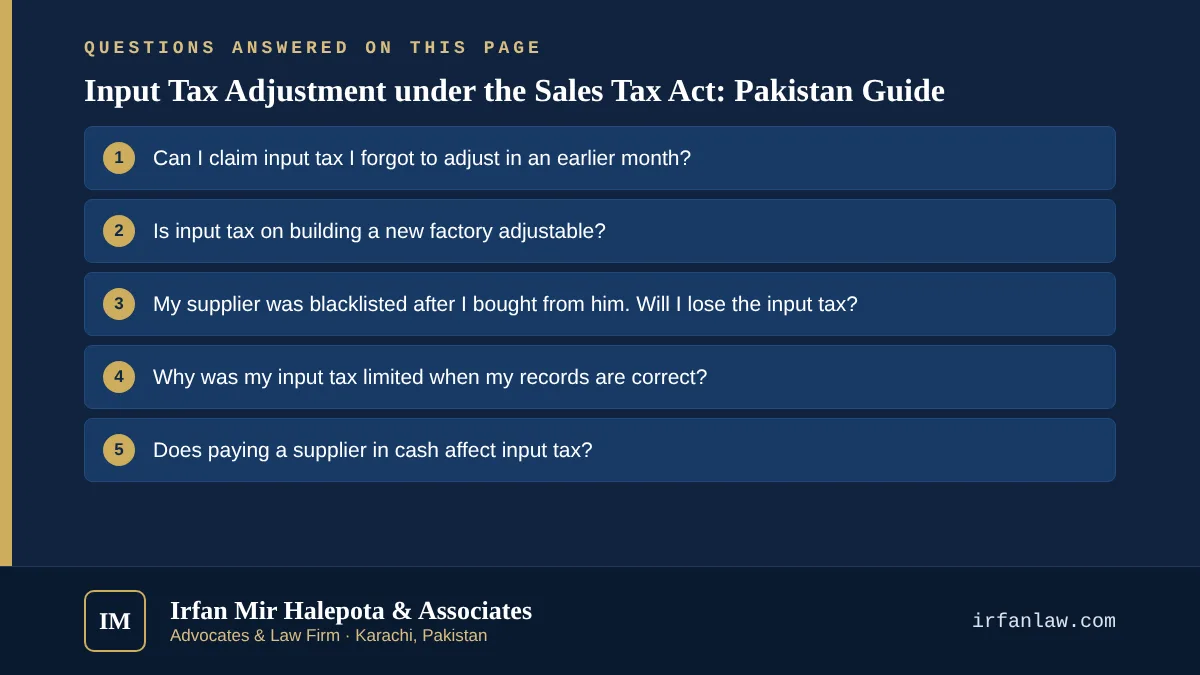
Can I claim input tax I forgot to adjust in an earlier month?
Yes, within limits. The proviso to section 7(1) of the Sales Tax Act, 1990 allows input tax not deducted in the relevant period to be claimed in the return for any of the six succeeding tax periods. After that, the claim has to be pursued through section 66, which carries its own one-year limit and conditions.
Is input tax on building a new factory adjustable?
Generally not. Section 8(1)(h) bars input tax on goods used in or permanently attached to immovable property, and in July 2026 the Supreme Court held in the Bawany Sugar Mills appeal that cement, steel and similar construction materials used for a factory are inadmissible. Plant and machinery that is a capital good stands on a different footing.
My supplier was blacklisted after I bought from him. Will I lose the input tax?
Not automatically. The Sindh High Court has held, relying on a January 2025 Supreme Court order, that input tax cannot be refused only because a supplier active at the time of purchase was later suspended or blacklisted. The department can still disallow the claim if it shows the invoice was fake or that you knew or had reason to suspect the tax would go unpaid.
Why was my input tax limited when my records are correct?
Section 8B(1) caps adjustment in any tax period at 90 per cent of output tax, except for fixed assets and capital goods. The excess carries forward, and a company whose audited accounts show lower value addition can reconcile it annually. Since the Finance Act, 2025 the Board may also defer some input tax through automated risk management, which can be contested before the Commissioner.
Does paying a supplier in cash affect input tax?
Yes, for any transaction above Rs 50,000. Section 73 requires payment from the buyer's declared business bank account to the supplier's, and a cash or third-party payment costs the buyer its input tax on that transaction. On credit sales the bank payment must be made within 180 days of the invoice.
Who has to prove that I knew my supplier would not pay the tax?
The department. Section 8A, as amended by the Finance Act, 2015, places the burden of proving the buyer's knowledge or reasonable suspicion on the department. The Sindh High Court has also held that section 8(1)(ca) must be read with section 8A rather than applied on its own, although an appeal on that point is pending before the Supreme Court.
This article is general information about Pakistani law and procedure, not legal advice for any specific matter. If this touches on something you're currently facing, get in touch and we'll advise on your facts directly.