Sales Tax Assessment and Appeals in Pakistan: From Section 11 to Sections 11A-11H, Limitation and the Appeal Route
The Finance Act, 2024 omitted section 11 of the Sales Tax Act, 1990 and replaced it with separate provisions: section 11A (short-paid amounts recoverable without notice), section 11D (best judgment assessment), section 11E (tax not levied, short-levied or erroneously refunded) and section 11F (failure to withhold). Under section 11G, the show-cause notice must issue within five years from the end of the financial year in which the relevant date falls, and the order must follow within 180 days of the notice, extendable by up to 90 days for recorded reasons; the Supreme Court treats such limits as mandatory. Appeals lie to the Commissioner (Appeals) under section 45B, to the Appellate Tribunal under section 46, and on a question of law to the High Court under section 47.
Most federal sales tax disputes in Karachi begin the same way: a show-cause notice alleging short payment, inadmissible input tax or failure to withhold, followed by an order-in-original and a demand with default surcharge and penalty. The Finance Act, 2024 rewrote the assessment provisions, and the time limits that frame every such case have since been tightened by statute and confirmed by the Supreme Court. For anyone looking for the best sales tax lawyer in Karachi to contest an assessment, the first question is often not the merits but whether the notice and the order were issued within the windows that section 11G allows. This page covers sales tax assessments and the sales tax appeal route; the income tax route is explained in our guide to the tax assessment appeal route.
What replaced section 11
Until 30 June 2024, section 11 of the Sales Tax Act, 1990 was the general assessment provision. Section 11(2) covered tax not paid or short-paid, section 11(5) contained the limitation rules, and section 11(7) defined the "relevant date". The Finance Act, 2024 omitted section 11 and distributed its contents across a series of new sections. As the Act stood on 30 June 2026, the structure is:
| Section | Subject |
|---|---|
| 11A | Short-paid amounts recoverable without notice |
| 11B | Limitation for issuing orders in certain cases |
| 11C | Power of tax authorities to modify orders |
| 11D | Best judgment assessment |
| 11E | Assessment and recovery of tax not levied, short-levied or erroneously refunded |
| 11F | Failure to withhold sales tax |
| 11G | Limitation for assessment |
| 11H | Faceless audit and assessment |
The Finance Act, 2025 made further changes. According to FBR's Circular No. 02 of 2025-26, it added sub-section (5) to section 11D, allowing an officer to assess, on estimated value addition, a wholesaler who became liable to register because of withholding under section 236G of the Income Tax Ordinance, 2001 and then fails to file returns after notice. It also substituted sub-section (1) of section 11E and provided that section 11E does not apply where proceedings have been initiated under section 37A.
Section 11A is different in kind. It deals with tax that the registered person itself has declared but not paid in full, which can be recovered without a show-cause notice. A dispute about whether tax is due at all belongs under sections 11D to 11F, where a notice and hearing are required.
Transitional cases: old section 11 or the new sections?
Proceedings for tax periods before July 2024 raise the question of which provision should be used for an order passed after the Finance Act, 2024. In a decision reported by Business Recorder on 23 March 2025, the Appellate Tribunal Inland Revenue at Peshawar vacated an assessment order dated 30 August 2024 that had been made under the omitted section 11(2), holding that the procedural provision then in force, section 11E, should have been applied. It also found the order time-barred under the first proviso to the old section 11(5).
That is a Tribunal view, not a High Court ruling, and the question of how the omission interacts with substantive liability for earlier periods is not settled by any reported Sindh High Court decision that we have found. Both sides should therefore check, in every legacy case, which section the notice and the order invoke and whether the time limits were met under both the old and the new text.
Limitation under section 11G
Section 11G sets two separate clocks.
- The notice. A show-cause notice under sections 11D to 11F must be issued within five years from the end of the financial year in which the relevant date falls. The old section 11(5) counted five years from the relevant date itself, so the new wording gives the department a somewhat longer window.
- The order. The order must be made within 180 days of the show-cause notice. When section 11G was first enacted in 2024 the period was 120 days, matching the old section 11(5); the text now reads 180 days, a change reported as made by the Finance Act, 2025. The Commissioner may extend the period for reasons recorded in writing, but the extension cannot exceed 90 days.
Periods during which proceedings are adjourned because of a stay order or Alternative Dispute Resolution, or because of an adjournment sought by the registered person (up to a maximum of 60 days), are excluded from the computation.
The relevant date is (a) the time of payment of tax under section 6; (b) for tax that should have been withheld under section 3(7), the time of payment for the goods or services; and (c) for an erroneous refund, the date of the refund.
As a simple illustration, if tax for a period was payable in August 2020, the relevant date falls in the financial year ending 30 June 2021, and the notice must issue by 30 June 2026.
Section 74 allows the Board to condone or extend time limits, and the department sometimes relies on such notifications. In C.P. No. D-6565 of 2020 and connected petitions (order announced 2 September 2025), the Sindh High Court held that an FBR notification dated 30 June 2020 extending limitation by six months could only save periods whose limitation was expiring on that date, and partly set aside notices issued outside the five-year period.
How the courts treat the time limits
The courts read sales tax time limits strictly:
- In Collector of Sales Tax, Gujranwala v. Super Asia Mohammad Din, 2017 SCMR 1427 (also reported as 2017 PTD 1756), a three-member bench of the Supreme Court held the time limits for passing orders to be mandatory.
- A five-member larger bench, constituted to review that view, confirmed it in Wak Limited v. Collector Central Excise and Sales Tax, 2025 SCMR 1280. The court held that the periods in the first proviso to section 11(5) are mandatory, that an order made after them is invalid subject to any permissible use of section 74, and that an extension requires reasons in writing and cannot go beyond the statutory cap.
- In January 2026, the Associated Press of Pakistan reported that the Supreme Court refused leave in C.P.L.A. No. 1990 of 2025 (Assistant Commissioner Inland Revenue, Rawalpindi v. Umar Tariq Khan), holding that an order passed beyond 120 days of the show-cause notice could not be sustained.
- The Lahore High Court in Abdul Ghani v. Federation of Pakistan, 2019 PTD 764, described the limits as jurisdictional, not procedural.
These decisions concern the old section 11(5), but the Sindh High Court has described section 11G as substantially similar, so the same approach is likely to apply to it.
The High Court will entertain a constitutional petition against a show-cause notice that is barred by law, following Commissioner Inland Revenue v. Jahangir Khan Tareen, 2022 SCMR 92. The relief is often partial: limitation runs tax period by tax period, so a notice may be quashed for some months and survive for others.
Show-cause notice and order: duties on both sides
The department's notice should identify the tax periods, the transactions or invoices in question, the legal provision invoked and the material relied on, including any audit report. In Special Sales Tax Reference Application No. 665 of 2023 (order dated 3 August 2026), the Sindh High Court dismissed in limine a departmental reference against a Tribunal decision that had upheld the annulment of an assessment that identified no specific transactions and rested on an audit report never shared with the registered person.
For the registered person, the reply should:
- raise limitation first, period by period, with a calculation;
- address each transaction with documents: invoices, proof of payment through the banking channel, delivery records and the supplier's registration status at the time;
- ask for any material relied on that has not been supplied, and for a personal hearing;
- avoid unnecessary adjournment requests, because time sought by the registered person (up to 60 days) is excluded from the period allowed for the order.
Penalties under section 33 and default surcharge under section 34 usually follow an assessment, and orders imposing them are appealable in the same way. Our show-cause notice response guide covers drafting in more detail.
The sales tax appeal route
The appeal provisions have changed twice in two years: first by the Tax Laws (Amendment) Act, 2024 (Act No. V of 2024, assented to on 3 May 2024), and then by the Finance Act, 2025.
| Stage | Provision | Position after the Finance Act, 2025 |
|---|---|---|
| Commissioner Inland Revenue (Appeals) | Section 45B | The Rs10 million ceiling introduced in 2024 (section 43A) was omitted. Orders under sections 10, 11A, 11D, 11E, 11F, 21, 33, 34 and 66 are appealable regardless of amount. |
| Appellate Tribunal Inland Revenue | Section 46 | A person other than a state-owned enterprise may appeal from the Commissioner (Appeals) or may file directly before the Tribunal. State-owned enterprises must first go through Alternative Dispute Resolution. |
| High Court | Section 47 | A reference lies only on a question of law arising from the Tribunal's order, and the period for filing it is sixty days. |
| Supreme Court | Constitution | Petition for leave to appeal against the High Court's decision. |
The Tax Laws (Amendment) Act, 2024 applied section 133 of the Income Tax Ordinance, 2001 to sales tax references with necessary modifications (see our page on tax references under section 133). It also inserted section 47A, which provides Alternative Dispute Resolution for disputes involving tax liability of fifty million rupees or more. As the Act stood on 30 June 2026, it also contains section 45C (faceless appeals) and section 47AA (algorithmic settlement mechanism). Their detailed operation should be checked against the current text and any FBR rules.
Appeal periods are short. Under the 2024 text, an appeal to the Tribunal had to be filed within thirty days of receipt of the order. Verify the period in force against the current consolidated Act on the day the order is received, because these provisions have been substituted more than once.
How this differs from the income tax route
The income tax and sales tax systems share the same appellate bodies (the Commissioner (Appeals), the Appellate Tribunal Inland Revenue and the High Court), but the provisions, time limits and pre-conditions differ. An income tax amendment under section 122 of the Income Tax Ordinance, 2001 has its own limitation rules, and income tax appeals run under sections 127, 131 and 133 of the Ordinance. Recovery of a sales tax demand proceeds under section 48 of the Sales Tax Act, 1990, and stay must be sought at each forum (see tax recovery, bank attachment and stay).
Sales tax on services rendered in Sindh is a separate provincial levy under the Sindh Sales Tax on Services Act, 2011. Its assessments are made by the Sindh Revenue Board, with appeals to the Commissioner (Appeals) of the SRB and the SRB's Appellate Tribunal, not to the federal forums described above.
For the department, the practical lesson from recent case law is to plan the timetable from the outset: issue the notice well inside the five-year window, share the material relied on, record reasons for any extension, and pass a speaking order within time. For registered persons, the lesson is to check limitation before arguing the merits, and to preserve every ground of appeal at the first stage.
Follow us on Google
If these guides are useful, add this site as a preferred source. Google will then show it more prominently to you in Search, Discover and AI results.
Official sources
- Sales Tax Act, 1990 (FBR consolidated text, amended up to 30.06.2026)
- FBR Circular No. 02 of 2025-26: Finance Act, 2025 amendments to the Sales Tax Act, 1990
- Tax Laws (Amendment) Act, 2024 (Act No. V of 2024)
- Sindh High Court: C.P. No. D-6565 of 2020 and connected petitions (02.09.2025)
- Business Recorder: Supreme Court larger bench confirms Super Asia (18.05.2025)
- Sindh High Court: Special STRA No. 665 of 2023 (03.08.2026)
Common questions
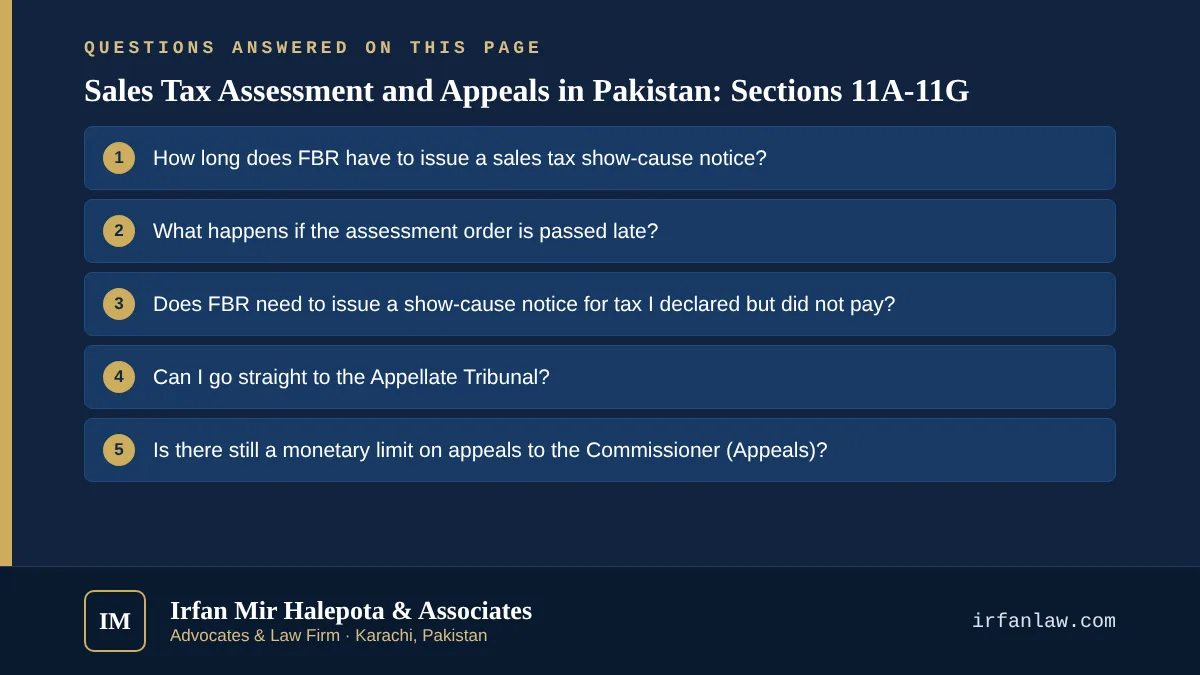
How long does FBR have to issue a sales tax show-cause notice?
Under section 11G of the Sales Tax Act, 1990, a notice under sections 11D to 11F must be issued within five years from the end of the financial year in which the relevant date falls. The relevant date is usually the time when the tax was payable under section 6, the payment date for goods or services where tax should have been withheld, or the date of an erroneous refund.
What happens if the assessment order is passed late?
Section 11G requires the order within 180 days of the show-cause notice, extendable by up to 90 days for reasons recorded in writing, after excluding stay, ADR and adjournments sought by the registered person (up to 60 days). The Supreme Court in Wak Limited, 2025 SCMR 1280, confirming Super Asia, 2017 SCMR 1427, held the equivalent limits under the old section 11(5) to be mandatory, so a late order is open to challenge as invalid.
Does FBR need to issue a show-cause notice for tax I declared but did not pay?
No. Section 11A allows short-paid amounts to be recovered without notice. A show-cause notice and hearing are required where the department alleges that tax was not levied, short-levied, erroneously refunded or not withheld, or makes a best judgment assessment.
Can I go straight to the Appellate Tribunal?
After the Finance Act, 2025, a person other than a state-owned enterprise may file an appeal directly before the Appellate Tribunal Inland Revenue instead of first appealing to the Commissioner (Appeals). Whether that is wise depends on the case: the Commissioner (Appeals) stage gives an additional chance to build the factual record.
Is there still a monetary limit on appeals to the Commissioner (Appeals)?
No. The Rs10 million ceiling introduced by the Tax Laws (Amendment) Act, 2024 through section 43A was omitted by the Finance Act, 2025. Orders under sections 10, 11A, 11D, 11E, 11F, 21, 33, 34 and 66 are now appealable to the Commissioner (Appeals) regardless of amount.
When can a sales tax case go to the High Court?
A reference under section 47 lies against the Appellate Tribunal's order only where a question of law arises, and must be filed within sixty days. Separately, the High Court may entertain a constitutional petition against a show-cause notice that is barred by law, as recognised in Jahangir Khan Tareen, 2022 SCMR 92.
This article is general information about Pakistani law and procedure, not legal advice for any specific matter. If this touches on something you're currently facing, get in touch and we'll advise on your facts directly.