Sindh Sales Tax on Services: Registration, Returns, Withholding and SRB Appeals
Services provided in Sindh are taxed under the Sindh Sales Tax on Services Act, 2011, administered by the Sindh Revenue Board (SRB), not the FBR. Since the Sindh Finance Act, 2025, section 3 treats every service as taxable unless it is exempted, at a standard rate of 15 per cent under section 8(1) with higher and reduced rates in the Second Schedule. Disputes go to the Commissioner (Appeals) SRB under section 57, then to the Appellate Tribunal SRB under section 61, and on questions of law to the High Court of Sindh under section 63.
A Karachi business can owe sales tax to two different authorities: the FBR on goods under the Sales Tax Act, 1990, and the Sindh Revenue Board on services under the Sindh Sales Tax on Services Act, 2011. The Sindh law changed shape on 1 July 2025, when the Sindh Finance Act, 2025 moved it from a list of taxable services to a general charge on all services with listed exemptions. People who search for the best sales tax lawyer in Karachi are usually facing exactly that question: is this activity a taxable service in Sindh at all, and at which rate. This guide explains the charge, registration, monthly compliance, withholding, assessments and the appeal route, as amended up to the Sindh Finance Act, 2026.
Who taxes services: the federal and provincial boundary
Entry 49 of Part I of the Federal Legislative List in the Constitution gives the Federation power over taxes on the sale and purchase of goods, but expressly excludes sales tax on services. That exclusion is why each province has its own services law and its own revenue authority. In Sindh the law is the 2011 Act and the authority is the SRB.
The High Court of Sindh has drawn the line in both directions. In Pakistan Stock Exchange Limited v. Sindh (C.P. No. D-3601 of 2018 and connected petitions, judgment dated 27.01.2022) it held that entry 49 shifts the taxing power over services to the provinces, and that federal subject-matter entries, such as the entry on stock exchanges, do not carry a federal power to tax services. In Sami Pharmaceuticals (Pvt.) Ltd. v. Province of Sindh (C.P. No. D-5220 of 2017, decided 17.11.2020) the same Court held that the provincial power reaches services only, not goods, and that a rule cannot create a charge the Act itself does not impose.
The 2025 amendments added Explanation II to section 3: a service on which tax can be imposed in terms of entry 53 of the Federal Legislative List (terminal taxes and taxes on fares and freights) is not a taxable service under the Sindh Act. Mixed supplies of goods and services remain the commonest boundary dispute, and the answer usually turns on what the contract and invoices show the customer is actually paying for.
What is taxable after the Sindh Finance Act, 2025
Before 1 July 2025, section 3(1) said that a taxable service was a service listed in the Second Schedule. The Sindh Finance Act, 2025 replaced that with the words "Taxable service means a service", and replaced the definition of "service" in section 2(79) with a broad one covering "any activity, facility, utility or advantage, including the granting, assignment, cession or surrender of any right". The practical effect is a negative-list system: unless a service is exempt under the First Schedule or a notification under the new section 10, it is taxable when provided in the course of an economic activity from an office or place of business in Sindh.
Three transitional and structural points matter:
- Grandfathering. New section 72C provides that services taxed on 30 June 2025 continue to be taxed at the same rate unless expressly exempted or given a reduced rate.
- Classification. New section 72B lets the Board prescribe a service classification (CPC) code, but inclusion or exclusion of a service in the code does not by itself decide taxability. The Board's decision on a classification dispute is stated to be final, although the general appeal and reference provisions still need to be considered.
- Small providers. Serial 44 of the First Schedule exempts providers whose annual turnover does not exceed four million rupees, but not services provided to withholding agents or to persons registered with the SRB or FBR, and not services that were not exempt on 30 June 2025.
Because the charge is now general, a business that was outside the old list should not assume it is still outside. Review each revenue stream against the First Schedule exemptions rather than against the old list.
Rates under section 8 and the Second Schedule
Section 8(1), as replaced by the Sindh Finance Act, 2025, charges tax at fifteen per cent of the value of the taxable service. The Second Schedule now has two parts: Part I lists services taxed above the standard rate and Part II lists reduced rates, often with conditions in the Schedule itself. The Sindh Finance Act, 2026 did not change the standard rate but revised several Part II entries.
| Service (examples) | Rate | Source |
|---|---|---|
| Standard rate for taxable services not otherwise listed | 15% | Section 8(1), Sindh Finance Act, 2025 |
| Telephony and internet telecommunication services (CPC 841, 842) | 19.5% | Second Schedule, Part I |
| Legal and accounting services | 8% | Second Schedule, Part II, S. No. 22 (replaced by Sindh Finance Act, 2026) |
| Licensing of trademarks and franchises (CPC 83960) | 8% | Second Schedule, Part II |
| Insurance agents / insurance brokers | 2% / 3% | Second Schedule, Part II, S. No. 16 (Sindh Finance Act, 2026) |
Value for tax purposes is the consideration for the service. In Sami Pharmaceuticals the High Court of Sindh held that, for labour and manpower supply, the value is the net service charge and does not include salaries and allowances reimbursed at actual cost. Where a reduced rate applies, read the conditions column of the Schedule entry before charging it: a reduced rate claimed without meeting its conditions is a frequent finding in SRB audits.
Registration with the SRB
Section 24 requires registration by persons providing taxable services from an office or place of business in Sindh, and by others the Board specifies. Where a person who ought to be registered has not applied, section 24B allows compulsory registration after notice. Failure to register attracts a penalty under serial 1 of the Table to section 43. A recent example of how these disputes arise is Sindh Revenue Board v. Ali Transport Service (Special SSTRA Nos. 91 and 92 of 2021, decided 23.09.2024), where compulsory registration was ordered on the view that intercity road transport of goods was a taxable service.
Registration also affects the business's dealings with others. Section 72A requires licensing authorities to check SRB registration, and the Sindh Finance Act, 2025 added a condition that the person be an active taxpayer. Leaving the system is not instant: the Sindh Finance Act, 2026 amended section 25A so that the de-registration period is 180 days, and new section 25A(4) confirms that liability for services already provided survives an application to de-register.
A business operating in more than one province should check each province's law separately. The Punjab and other provincial services laws are distinct statutes; nothing in this guide describes them.
Monthly returns, payment, surcharge and penalties
Section 17 requires tax to be paid for each tax period, and section 30 requires every registered person to e-file a true and correct return through the SRB's online system, in Form SST-03 for service providers and SSTW-03 for withholding agents, by the due dates fixed in rules 12 and 13 of the Sindh Sales Tax on Services Rules, 2011. The SRB sometimes extends the return date by notification while leaving the payment date unchanged, so a late payment can attract surcharge even where the return is on time.
Input tax on services and goods received can be adjusted under section 15, subject to the restrictions in section 15A (amended again in 2025). The adjustment rules are narrower than many businesses expect; the federal position is explained in our guide to input tax adjustment, but Sindh's own sections govern SRB returns.
- Default surcharge (section 44) runs on late-paid tax at the inter-bank rate plus three per cent per annum. In Sindh Revenue Board v. Seaboard Logistics (SMC-Pvt.) Ltd. (Special STRA No. 1301 of 2023, decided 25.09.2026) the High Court of Sindh held that default surcharge is a strict statutory liability, payable "whether wilfully or otherwise", so mens rea is not required.
- Penalties (section 43) are different. In the same case the Court held that the department must show on the record that the default was wilful, contumacious or dishonest before a penalty can stand.
- New duties from 1 July 2026: the Sindh Finance Act, 2026 added a penalty entry for invoicing software that does not meet SRB invoice rules, section 52A (display of tax notices on the premises when the Commissioner directs) and section 73A (confidentiality of return and assessment information).
Withholding: when the recipient pays
Section 9(1) puts the liability on the registered person providing the service, but section 9(2) puts it on the person receiving the service in the cases the Act or the Board specifies. Section 13 and the Sindh Sales Tax Special Procedure (Withholding) Rules, 2014 designate withholding agents who must deduct and deposit Sindh sales tax from payments to service providers and file a separate return.
Liability for getting this wrong depends on the date. In Fatima Fertilizer Company Ltd. v. Commissioner-II, SRB (Special STRA No. 30 of 2020, decided 22.12.2020) the High Court of Sindh held that a withholding agent's personal liability under section 13(3) arose only when the Finance Act, 2019 introduced it, that it was not retrospective, and that default surcharge could not be charged for earlier periods. For periods after that change, a withholding agent that fails to deduct is personally liable for the tax and surcharge.
The 2017 amendments also added a proviso to section 9(1) making a registered recipient and a provider jointly and severally liable where the recipient has not paid the provider's tax within 180 days of the invoice and the provider has not deposited it. Both sides of a services contract therefore have a reason to check that tax was invoiced, deducted and deposited.
Assessment, recovery and limitation
Under section 23, an SRB officer who concludes after audit, inquiry or other information that tax has been unpaid or short-paid may assess it, with penalty and default surcharge, but only after a show-cause notice and an opportunity of hearing. Section 47 deals separately with tax not levied or short-levied. Both are the SRB equivalents of the federal provisions discussed in our section 11 assessment guide.
The time limits have changed over the years. The 2011 text required the notice within five years. The Sindh Finance Act, 2016 extended the period for recovery notices under section 47 to eight years, as recorded by the High Court of Sindh in Fatima Fertilizer, and the Pakistan Stock Exchange judgment records an argument on the same change in relation to section 23. Whether the longer period can reach tax periods that were already outside five years when it was enacted was argued but not decided in that judgment, so it should be treated as open. The 2011 text also required the order within 120 days of the show-cause notice; the Sindh Finance Act, 2017 lengthened that period, and the current text fixes 180 days with a limited extension for reasons recorded in writing. Check the period applicable to the tax period in question before replying.
Section 47A, added in 2017, allows recovery of short-paid self-declared tax from bank accounts without a show-cause notice. For a general approach to drafting a reply, see our show-cause notice guide; the same discipline (answer each allegation, attach documents, raise limitation and jurisdiction first) applies before the SRB.
Appeals: Commissioner (Appeals), Appellate Tribunal and High Court
- Commissioner (Appeals) SRB, section 57. Orders under sections 22, 23, 24B, 25(5), 25A, 43, 44, 47, 68 and 76 are appealable. The 2011 text requires the appeal within thirty days of receipt of the order, with power to admit a late appeal for sufficient cause. According to the SRB, the appeal must be decided within 180 days of filing, extendable by 60 days for written reasons; an undecided appeal is transferred to the Appellate Tribunal under section 59(7). In Ali Transport Service the High Court of Sindh held that a late transfer does not make the appeal abate or entitle either side to succeed by default. From 1 July 2026, an inquiry ordered by the Commissioner (Appeals) under section 59(2) must be completed within 60 days.
- Appellate Tribunal SRB, section 61. Either the taxpayer or the SRB officer may appeal against the Commissioner (Appeals)' order. Limitation is applied strictly to both sides: in Special STRA No. 424 of 2017 (order dated 20.11.2017) the High Court of Sindh upheld the Tribunal's dismissal of a departmental appeal filed nine days late, holding that every day of delay must be explained.
- Reference to the High Court of Sindh, section 63. Only questions of law arising from the Tribunal's order go to a division bench, and findings of fact are not reopened, as the Court emphasised in Seaboard Logistics.
Recovery while an appeal is pending is governed by section 66. The first proviso to section 66(1) bars recovery notices during a pending appeal where a specified part of the tax demanded has been paid; the Sindh Finance Act, 2026 amended that proviso again, including extending it to appeals before the Appellate Tribunal, so read the current text. Where recovery is pressed regardless, the High Court of Sindh has in a number of constitutional petitions directed the Commissioner (Appeals) to decide the pending appeal, preferably within 60 days, and restrained coercive action meanwhile (for example C.P. Nos. D-6079 to D-6081 of 2023, orders dated 02.02.2024). Those are case-by-case directions, not an automatic stay. For how the High Court approaches such petitions, see our Sindh High Court litigation guide.
Practical points for Karachi businesses: map every revenue stream against the First Schedule; keep contracts and invoices that separate goods from services; reconcile withholding deducted by customers with your own returns monthly; diarise thirty days from receipt of any SRB order; and remember that a successful appeal on penalty does not necessarily remove default surcharge. Our tax and customs practice acts for both taxpayers and the revenue in these proceedings.
Follow us on Google
If these guides are useful, add this site as a preferred source. Google will then show it more prominently to you in Search, Discover and AI results.
Official sources
- Sindh Finance Act, 2025 (Sindh Act No. XVI of 2025), section 7: amendments to the Sindh Sales Tax on Services Act, 2011
- Sindh Finance Act, 2026 (Sindh Act No. XX of 2026)
- Sindh Revenue Board: Appeals
- Pakistan Stock Exchange Ltd. v. Sindh, C.P. No. D-3601 of 2018 (High Court of Sindh, 27.01.2022)
- Fatima Fertilizer Company Ltd. v. Commissioner-II, SRB, Special STRA No. 30 of 2020 (High Court of Sindh, 22.12.2020)
- Sindh Revenue Board v. Seaboard Logistics (SMC-Pvt.) Ltd., Special STRA No. 1301 of 2023 (High Court of Sindh, 25.09.2026)
Common questions
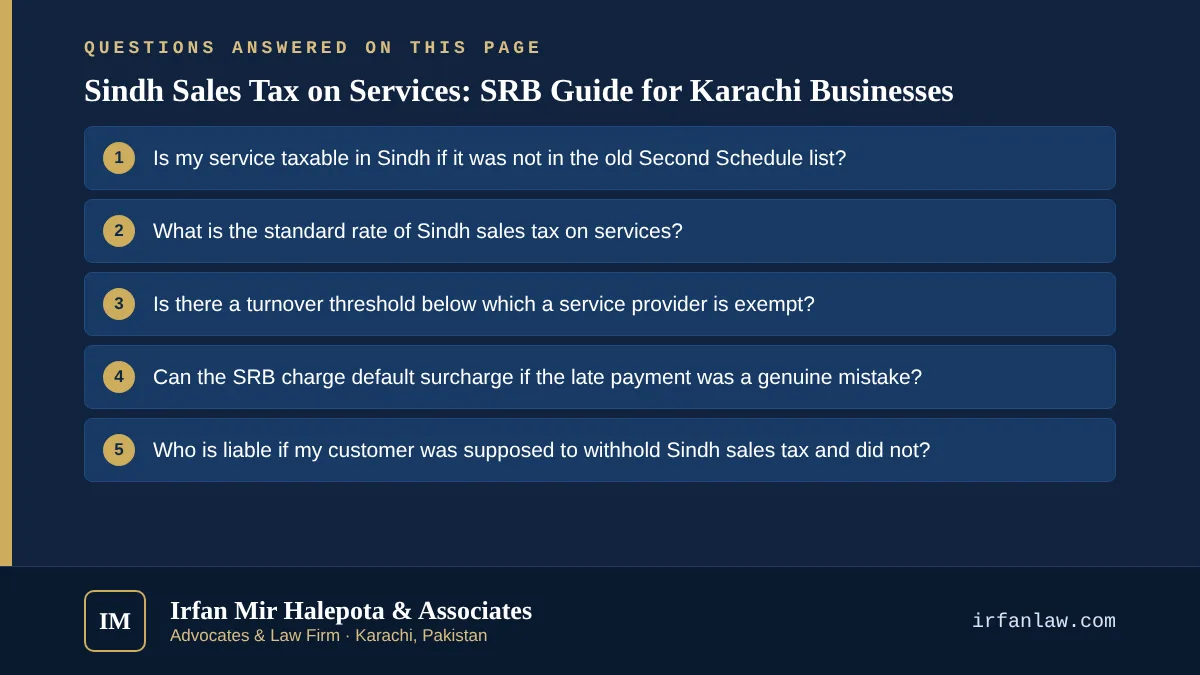
Is my service taxable in Sindh if it was not in the old Second Schedule list?
Possibly yes. Since 1 July 2025, section 3 of the Sindh Sales Tax on Services Act, 2011 treats any service as a taxable service unless it is exempted in the First Schedule or by notification. The old list no longer decides the question, so each service should be checked against the exemptions.
What is the standard rate of Sindh sales tax on services?
Section 8(1), as replaced by the Sindh Finance Act, 2025, sets a standard rate of fifteen per cent of the value of the taxable service. Part I of the Second Schedule sets higher rates, such as 19.5 per cent for telephony and internet services, and Part II sets reduced rates, often with conditions.
Is there a turnover threshold below which a service provider is exempt?
Serial 44 of the First Schedule exempts providers whose annual turnover does not exceed four million rupees. The exemption does not cover services provided to withholding agents or to persons registered with the SRB or FBR, or services that were already taxable on 30 June 2025.
Can the SRB charge default surcharge if the late payment was a genuine mistake?
Yes. In Seaboard Logistics (decided 25.09.2026) the High Court of Sindh held that default surcharge under section 44 is a strict statutory liability that applies whether the default was wilful or not. Penalties under section 43 are treated differently, and the department must show wilful or dishonest default for a penalty to stand.
Who is liable if my customer was supposed to withhold Sindh sales tax and did not?
For periods after the Finance Act, 2019 introduced section 13(3), the withholding agent is personally liable for the tax and default surcharge. The High Court of Sindh held in Fatima Fertilizer that this liability is not retrospective. The 2017 proviso to section 9(1) can also make the provider and a registered recipient jointly and severally liable in some cases.
How long do I have to appeal an SRB order?
The 2011 text of section 57 allows thirty days from receipt of the order to appeal to the Commissioner (Appeals) SRB, with power to admit a late appeal for sufficient cause. Limitation is enforced strictly against both taxpayers and the department, so the date of receipt should be recorded as soon as an order arrives.
Does filing an appeal stop the SRB from recovering the tax?
Not automatically. Section 66 and its first proviso govern recovery during a pending appeal and require part of the tax to be paid; the proviso was amended by the Sindh Finance Act, 2026. The High Court of Sindh has, in individual petitions, directed early decision of appeals and restrained coercive action for a limited period.
This article is general information about Pakistani law and procedure, not legal advice for any specific matter. If this touches on something you're currently facing, get in touch and we'll advise on your facts directly.