Federal Excise Duty in Pakistan: Chargeability, Compliance, Recovery and Appeals under the Federal Excise Act, 2005
Federal excise duty is levied under section 3 of the Federal Excise Act, 2005 on goods made in or imported into Pakistan and on certain services, but in practice only on items listed in the First Schedule, because section 16(1) exempts everything that is not listed. Unpaid duty is recovered through a show cause notice under section 14, issued within five years of the relevant date, and the order must ordinarily follow within 120 days; appeals lie to the Commissioner (Appeals) or directly to the Appellate Tribunal Inland Revenue, and then, on a question of law only, to the High Court.
Federal excise duty (FED) applies to a short list of goods and services, but for the businesses on that list it is often a heavier cost than sales tax. FBR collection figures for 2025-26, as reported in the press, show cigarettes, cement, air travel, beverage concentrates and aerated drinks, fertiliser and motor cars as the largest heads. A company looking for the best federal excise lawyer in Karachi usually needs one question answered before any other: does this product, or this service supplied in Sindh, actually fall within an entry of the First Schedule that the Federation can lawfully charge? This guide explains how the Act works as amended up to the Finance Act, 2025, notes the Finance Act, 2026 changes we could verify, and sets out what each side must establish when a dispute arises.
What section 3 charges, and why the First Schedule decides it
Section 3(1) of the Federal Excise Act, 2005 levies duty on goods produced or manufactured in Pakistan, goods imported into Pakistan, certain goods brought in from non-tariff areas, and "services provided in Pakistan including the services originated outside but rendered in Pakistan". The sub-section refers to a rate of fifteen per cent ad valorem, but it carves out the goods and services specified in the First Schedule. Section 16(1) then exempts every good and service that is not listed in the First Schedule. The working rule is therefore simple: if an item is not in the Schedule, it is not chargeable; if it is, the rate shown against that entry governs.
The First Schedule is arranged in tables. Table I covers goods and Table II covers services. Rates may be ad valorem or a fixed sum per unit. Two recent examples show the range:
- the Finance Act, 2025 levied duty of Rs 10 per day-old chick, which the FBR explained as a measure to track poultry production; and
- according to a September 2026 press report on FBR Federal Excise Circular No. 1 of 2026, the Finance Act, 2026 imposed Rs 80 per litre on certain petroleum products outside the petroleum levy, such as solvent oil and mineral turpentine.
The Finance Act, 2026 also added section 3(3B), which imposes a special excise duty, in addition to the ordinary duty, on goods listed in a new Table-IA of the First Schedule. Press reports say imported cars, SUVs and other motor vehicles are currently in that table. Where duty is charged on value, section 12(1) applies the definition of value in section 2(46) of the Sales Tax Act, 1990.
Liability normally sits with the manufacturer, importer or service provider. Since the Finance Act, 2025, section 3(5)(e) allows the law to place liability on any other person in the supply chain, including a middleman, where that is specified.
Federal excise on services and the provinces
The Eighteenth Amendment changed Entry 49 of the Federal Legislative List so that sales tax on services became a provincial subject. In Sindh, services are taxed under the Sindh Sales Tax on Services Act, 2011 and administered by the Sindh Revenue Board (see our guide to Sindh sales tax on services). That has made FED on services one of the most contested parts of the Act.
In Pakistan International Freight Forwarders Association v. Province of Sindh, 2017 PTD 1, the High Court of Sindh held that federal excise duty on services rendered in Sindh from 1 July 2011 was unconstitutional. Applying that reasoning, a division bench in Pakistan Mobile Communication Ltd. v. Federation of Pakistan (C.P. Nos. D-4778 to 4780 of 2021, short order dated 8 October 2021) struck down Entry 6A of Table II, the duty on mobile phone calls lasting more than five minutes. The court reasoned that a call originating in Sindh is an event within the province and that no other federal entry supported the levy.
The FBR's position is different. When the Supreme Court granted leave to appeal against that judgment in September 2022, the FBR argued that Parliament may legislate on federal subjects under Article 73 and that excise duty has its own entry in the Federal Legislative List. We have not been able to trace a reported final decision of the appeal. The question is therefore not settled at the apex level. A service provider should not assume that every Table II entry is unenforceable, and the department should not assume that every entry survives in Sindh. The answer depends on the nature of the service, where it is rendered, and whether a federal entry other than taxation of services supports the levy. Inland air travel, for example, continues to be charged and collected federally.
Registration, returns, adjustment and enforcement
Section 13(1) requires a person liable to duty to register "regardless of his annual turnover or volume of sales". There is no small-business threshold. Under section 13(2), an existing sales tax registration is deemed to be registration under the Federal Excise Act, so most manufacturers do not need a separate number.
Section 4 requires a monthly return and payment of the duty for that month. Section 2(8a) defines the due date as the 15th day of the month following the end of the month.
Duty paid on inputs can, within limits, be set off:
- section 6(1) allows duty paid on input goods used directly in manufacture to be deducted from duty on the output;
- section 6(2A) allows the adjustment only if the supplier has declared the supply in its own return, which is the provision behind many disallowances when a supplier defaults; and
- section 7 allows a registered manufacturer, for goods charged in sales tax mode, to deduct input tax paid from the excise duty due.
Goods exempt under the Third Schedule carry no right of adjustment under section 6.
Enforcement is strongest for goods that must bear tax stamps. The Finance Act, 2025 amended sections 25 and 27 so that dutiable goods made without tax stamps, or with counterfeit stamps, banderols, labels or barcodes, can be seized together with the conveyance and outright confiscated. The Board may also authorise provincial revenue and excise officers to exercise powers of seizure and confiscation. Section 19 sets penalties for late or non-filing, short payment and more serious offences. Most are a fixed sum or a percentage of the duty, whichever is higher, and the serious offences carry imprisonment of up to five years on conviction.
Recovery of unpaid duty: section 14 and its time limits
Where duty has not been levied or paid, has been short-paid, or has been wrongly refunded or adjusted, section 14(1) allows the officer to issue a show cause notice within five years of the relevant date. This period was three years until 2011. Section 14(2) then requires the order to be made within 120 days of the notice. The Commissioner may extend that period for recorded reasons, but the extension cannot exceed sixty days. Time during which proceedings are stayed by a court, or are pending before alternative dispute resolution, is excluded.
These limits are not formalities. In Wak Limited v. Collector Central Excise and Sales Tax, 2025 SCMR 1280, a five-member bench of the Supreme Court treated comparable time limits for orders in the Sales Tax Act as mandatory. The High Court of Sindh has since applied the same approach to customs adjudication. We have not found a reported decision applying Wak Limited specifically to section 14 of the Federal Excise Act, but the wording is materially similar and both sides should expect the argument to be run.
For the taxpayer, the first checks are the relevant date, the date the notice was served and the date the order was made, together with any extension order and whether it was made before the original period ran out. For the department, a notice that states the basis of the charge and the period clearly, and an extension that is reasoned and on file in time, is what keeps a sound demand from failing on limitation. Our guide to answering FBR show cause notices covers drafting the reply. Section 14 also makes unpaid duty a first charge on the assets of a business that is sold or discontinued, a point buyers of manufacturing assets should not overlook.
Appeals and references after the Finance Act, 2025
The appeal provisions were rewritten twice in two years. The Tax Laws (Amendment) Act, 2024 split appeals by value through section 33A. The Finance Act, 2025 then omitted section 33A and the value limit in section 33, and gave a registered person the option of going directly to the Appellate Tribunal. The FBR's Circular No. 02 of 2025-26 dated 2 August 2025 summarises these changes.
| Stage | Provision | Key points |
|---|---|---|
| Commissioner Inland Revenue (Appeals) | Section 33 | Against orders of officers up to Additional Commissioner; filed within thirty days of receipt of the order; no value ceiling after the Finance Act, 2025 |
| Appellate Tribunal Inland Revenue | Sections 33(5) and 34 | Appeal from the Commissioner (Appeals), or directly where the section 33(5) option is used; section 34(1) substituted in 2025 for persons other than state-owned enterprises |
| High Court | Section 34A | Reference only on a question of law arising from the Tribunal's order, filed within sixty days (Finance Act, 2025) |
Before relying on any period, check the text in force on the date of the order, because transitional cases can fall under the older wording. References are heard in the manner of income tax references; see our page on tax references to the High Court. The High Court of Sindh repeatedly declines references that only re-argue facts. Evidence therefore has to be placed on record at the Commissioner (Appeals) or Tribunal stage.
Alternative dispute resolution
Section 38 of the Federal Excise Act provides for alternative dispute resolution. As substituted by the Tax Laws (Amendment) Act, 2024, it applies where the disputed liability is fifty million rupees or more, unless criminal proceedings have been initiated. For state-owned enterprises the threshold does not apply and the process is mandatory. The FBR's 2025 circular does not describe any Finance Act, 2025 change to the FED provision, but the committee procedure is common to all the federal tax statutes and has been amended more than once. Our page on alternative dispute resolution in tax matters explains how a committee is constituted and when the route makes sense.
Time spent before the committee is excluded when computing the section 14(2) period. A failed ADR application does not, by itself, revive an order that was already out of time.
Where FED disputes usually arise
In practice, most contested FED cases in Karachi turn on a small number of recurring questions:
- Scope of an entry. Whether a product or service falls within the description in the First Schedule, often read with the relevant Pakistan Customs Tariff heading. Charging entries are read strictly, so the department must bring the item within the words of the entry; once it does, a person claiming an exemption must show that its conditions are met.
- Value and quantity. Whether the declared value, retail price or production quantity reflects reality. Production capacity, electricity consumption and tax-stamp data are now routinely used as evidence.
- Input adjustment. Disallowance under section 6(2A) where a supplier did not declare the supply. The taxpayer's best evidence is the purchase record, banking trail and correspondence with the supplier.
- Services in a province. Whether a Table II entry can be enforced for a service rendered in Sindh in light of the 2017 and 2021 High Court of Sindh judgments, and whether the same service is also exposed to Sindh sales tax.
- Limitation. Whether the notice was issued within five years and the order within the section 14(2) period.
Practical points help on either side. Keep each month's working papers with the return. Raise jurisdiction and limitation at the first stage rather than for the first time before the High Court. Treat a seizure of unstamped goods as urgent, because confiscation and prosecution move on a faster track than an assessment. For the wider litigation framework, see our taxation and customs practice.
Follow us on Google
If these guides are useful, add this site as a preferred source. Google will then show it more prominently to you in Search, Discover and AI results.
Official sources
- Federal Excise Act, 2005, amended up to 30 June 2026 (FBR consolidated text)
- FBR Circular No. 02 of 2025-26 (Sales Tax and Federal Excise), 2 August 2025
- Tax Laws (Amendment) Act, 2024 (Act No. V of 2024)
- High Court of Sindh, Pakistan Mobile Communication Ltd. v. Federation of Pakistan, C.P. No. D-4778 of 2021
- Dawn: Supreme Court grants leave in FBR appeal on FED on phone calls (30 September 2022)
- PkRevenue: FED on petroleum products under the Finance Act, 2026 (15 September 2026)
Common questions
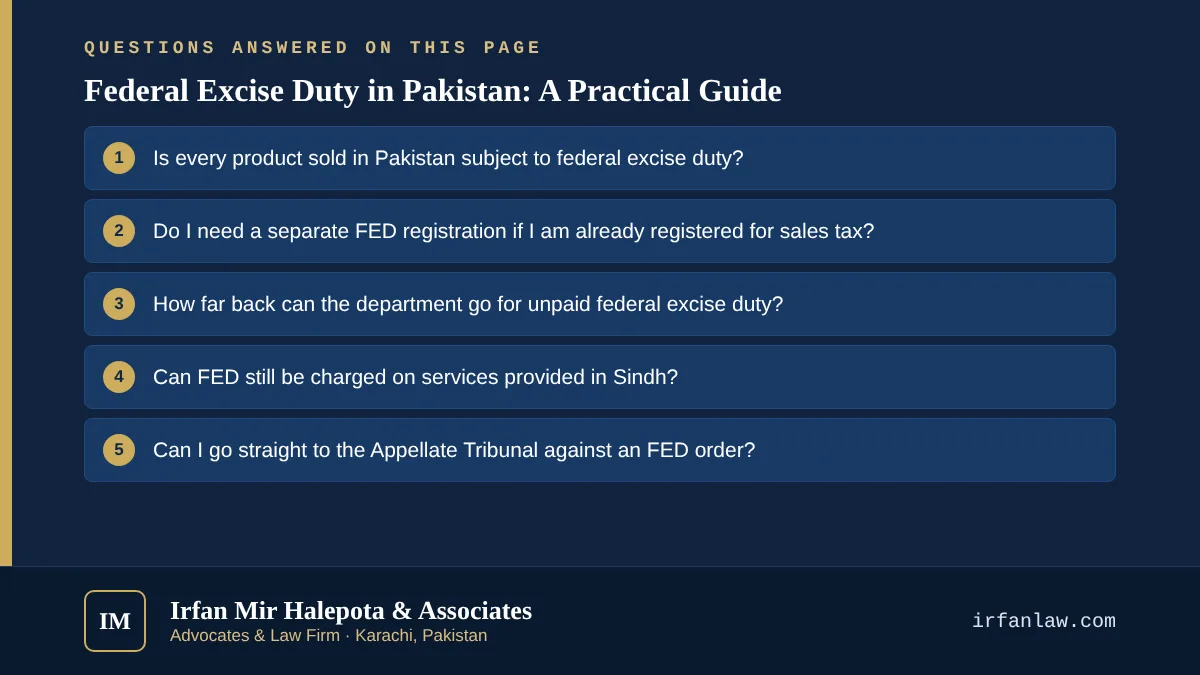
Is every product sold in Pakistan subject to federal excise duty?
No. Section 16(1) of the Federal Excise Act, 2005 exempts every good and service that is not specified in the First Schedule. Duty applies only to listed items, such as cigarettes, cement, certain beverages and concentrates, and specified services, at the rate shown against each entry.
Do I need a separate FED registration if I am already registered for sales tax?
Usually not. Section 13(2) treats a sales tax registration as registration under the Federal Excise Act. A person who is liable to duty but not registered for sales tax must register, because section 13(1) applies regardless of turnover.
How far back can the department go for unpaid federal excise duty?
Section 14(1) allows a show cause notice within five years of the relevant date. Before 2011 the period was three years. The order on that notice must then be made within 120 days, extendable by the Commissioner for recorded reasons by no more than sixty days.
Can FED still be charged on services provided in Sindh?
It depends on the entry. The High Court of Sindh held in 2017 PTD 1 that FED on services rendered in Sindh after 1 July 2011 was unconstitutional, and in 2021 struck down the duty on long mobile calls. The Supreme Court granted leave against the 2021 judgment, and we have not traced a final reported decision, so the issue remains open.
Can I go straight to the Appellate Tribunal against an FED order?
Since the Finance Act, 2025, a registered person may use the option in section 33(5) to appeal directly to the Appellate Tribunal Inland Revenue instead of first going to the Commissioner (Appeals). Check the text in force on the date of the order before choosing the route.
What happens to cigarettes or other goods found without tax stamps?
After the Finance Act, 2025, dutiable goods made without tax stamps, or with counterfeit stamps, labels or barcodes, can be seized along with the vehicle carrying them and are liable to outright confiscation. Provincial revenue and excise officers authorised by the Board can also exercise these powers.
This article is general information about Pakistani law and procedure, not legal advice for any specific matter. If this touches on something you're currently facing, get in touch and we'll advise on your facts directly.