Alternative Dispute Resolution in Pakistani Tax Disputes: How an ADRC Works Under Section 134A, Section 47A and Section 195C
A taxpayer with a dispute involving tax of fifty million rupees or more, or a dispute about refund admissibility or waiver of default surcharge and penalty, can apply to the FBR for an Alternative Dispute Resolution Committee under section 134A of the Income Tax Ordinance, 2001, which was substituted by the Income Tax (Amendment) Act, 2026 (Act No. IX of 2026). The three-member committee is chaired by a retired superior court judge and must decide within ninety days, recovery is deemed stayed meanwhile, and the decision binds the Commissioner only if the taxpayer withdraws its pending appeal and communicates that within sixty days. Section 47A of the Sales Tax Act, 1990 and the Federal Excise Act, 2005 apply the same scheme; customs ADR under section 195C of the Customs Act, 1969 runs on its own rules.
Most tax disputes in Pakistan travel the long road from the Commissioner (Appeals) to the Appellate Tribunal and then to the High Court, often for years. Alternative Dispute Resolution offers a negotiated exit for larger disputes, and its statutory machinery was rewritten in January 2026. Anyone looking for the best tax lawyer in Karachi for an ADR application should know that the decisive work happens before filing: choosing a qualified nominee, framing a realistic settlement proposal, and deciding whether withdrawing a pending appeal within the statutory window makes commercial sense. This guide explains the current scheme, how the committee is formed, what its decision does, and where ADR helps and where litigation remains the better route.
Where ADR sits in the tax statutes
Each federal tax law has its own ADR provision, but three of them now point to the same scheme. As amended up to 2026, the position is:
| Tax | Provision | How it works |
|---|---|---|
| Income tax | Section 134A, Income Tax Ordinance, 2001 | Full scheme, substituted by Act No. IX of 2026 |
| Federal sales tax | Section 47A, Sales Tax Act, 1990 | Applies section 134A with necessary modifications (Tax Laws (Amendment) Act, 2024) |
| Federal excise duty | Section 38, Federal Excise Act, 2005 | Applies section 134A with necessary modifications (Tax Laws (Amendment) Act, 2024) |
| Customs | Section 195C, Customs Act, 1969, with Chapter XVII of the Customs Rules, 2001 | Separate customs committee; its decision binds the Collector (section 195C) |
Section 134A first appeared in 2004 and is probably the most frequently amended provision in the Ordinance. The Sindh High Court's order of 5 September 2024 in C.P. No. D-3642 of 2024 traces part of that history: the original threshold was one hundred million rupees, amendments in 2018 made committee decisions binding, amendments in 2020 stayed pending proceedings once a committee was constituted and barred decisions from being used as precedent, and the Tax Laws (Amendment) Act, 2024 lowered the threshold to fifty million rupees and made ADR compulsory for state-owned enterprises.
The latest version came through the Income Tax (Amendment) Act, 2026 (Act No. IX of 2026), which received presidential assent on 26 January 2026 and was published in the Gazette on 27 January 2026. Commentators often call it the Income Tax Ordinance (Third Amendment) Act, 2026; the Gazette short title is the one to cite.
Which disputes qualify
Under section 134A(1), an aggrieved person may apply to the Board for a committee to resolve a dispute about:
- tax liability of fifty million rupees or more;
- admissibility of a refund;
- the extent of waiver of default surcharge and penalty; or
- any other specific relief.
Two exclusions matter in practice. No application lies where criminal proceedings have been initiated. And the threshold does not apply to state-owned enterprises, for whom an application is compulsory, not optional. The Finance Act, 2025 reinforced this on the sales tax side: according to FBR Circular No. 02 of 2025-26, an SOE can file an appeal only after exhausting the ADRC option.
The statute does not define "dispute" or "specific relief". Commentators have pointed out that, in practice, ADR becomes available only once an assessment or other order exists and an appeal or reference is pending. A taxpayer who has merely received a show-cause notice should usually answer it on the merits first.
Applying and forming the committee
The application must contain an initial proposal for resolving the dispute, which in practice includes an offer of tax payment, and an undertaking that the applicant will be bound by the committee's decision and will withdraw all related pending cases within fifteen days of receiving it.
Within fifteen days of receiving the application, the Chairman of the FBR appoints a three-member committee:
- Chairperson: a retired judge of a High Court, the Federal Constitutional Court or the Supreme Court with experience in tax or commercial matters. The taxpayer's nominee proposes three names. If the Chairman of the FBR does not agree, the other two members each propose one name and the Federal Minister for Law and Justice makes the final nomination.
- Departmental member: an Inland Revenue officer of BS-21 or above, other than the Chief Commissioner who has jurisdiction over the case.
- Taxpayer's nominee: a chartered accountant, cost and management accountant, advocate with at least fifteen years' experience in tax or commercial matters, retired Inland Revenue officer of BS-21 or above, or a businessman from a Board list recommended by the FPCCI. The taxpayer cannot nominate an accountant or advocate who is or was its auditor or authorised representative.
The Chairperson's remuneration is fixed by the Board and shared equally between the Board and the taxpayer; the nominee is paid by the taxpayer alone. Rule 231C of the Income Tax Rules, 2002 prescribes the application form. The FBR published draft amendments in September 2026 (S.R.O. 1496(I)/2026) and, according to trade press reports, notified revised rules through S.R.O. 1827(I)/2026 in October 2026, requiring the nominee's details and the three proposed judges to accompany the application. Check the notified text before filing.
The ninety-day clock, stay of recovery and court referrals
The committee may hold an inquiry, seek expert opinion, or direct an Inland Revenue officer or another person to conduct an audit. It decides by majority within ninety days of its appointment; the earlier version allowed sixty days.
Under section 134A(7), recovery of the tax in dispute is deemed stayed from the committee's constitution until its decision or dissolution, whichever comes first. This is a statutory stay, but it does not exist before constitution. If the FBR is already pursuing recovery or bank attachment, filing an application alone does not stop it.
If no decision is made within ninety days, the Chairman of the FBR dissolves the committee by written order, and the dispute returns to the court, tribunal or tax authority where it was pending. That forum must then decide the matter within ninety days of receiving the dissolution order.
Section 134A(18) is new. The Federal Constitutional Court, the Supreme Court or a High Court may refer a pending dispute to the Board, on its own motion or on either party's application. Where both parties consent, the court, tribunal or authority must record that consent and refer the dispute. The Board must then appoint a committee within fifteen days. All disputes of state-owned enterprises pending in any forum were transferred to the Board when the 2026 Act came into force.
What the decision does
The binding effect is conditional and turns on strict time limits:
- The decision binds the Commissioner only once the applicant, having accepted it, withdraws its pending appeal and communicates the withdrawal order to the Commissioner. If this is not done within sixty days of service of the decision, the decision does not bind the Commissioner.
- The Commissioner must withdraw any appeal the department has pending within thirty days of receiving the taxpayer's withdrawal order.
- The applicant must pay the tax within the time the committee fixes, and earlier orders are modified accordingly.
- A decision cannot be cited as precedent in any other case, or in the same taxpayer's case for a different tax year.
For an SOE wholly owned, directly or indirectly, by the Federal Government, the decision is final and binding on both sides. For any other SOE, either party may appeal the decision, or a dissolution order, to the Federal Constitutional Court or the Supreme Court within sixty days. The section gives no corresponding appeal to a private taxpayer, whose choice is to accept the decision and withdraw, or let the sixty days pass and continue litigating.
According to KPMG's brief on the Finance Act, 2026, the committee may now rectify a mistake apparent from the record within thirty days of communicating its decision. That point rests on a secondary source and should be checked against the Act.
Sales tax, federal excise and customs
Section 47A of the Sales Tax Act, 1990 and section 38 of the Federal Excise Act, 2005 repeat the eligibility rules and then apply section 134A to the procedure with necessary modifications. Because the 2026 Act substituted section 134A itself, the new committee structure, ninety-day limit and withdrawal rules should apply to sales tax and excise disputes as well, and commentators read it that way. No separate amendment to section 47A was made in 2026, so expect arguments about how far "mutatis mutandis" carries provisions written for income tax. The ordinary sales tax assessment and appeal route remains available if ADR is not pursued.
Customs ADR under section 195C works differently, and the 2026 overhaul did not touch it. FBR's published guidance on the customs mechanism describes a committee of one officer not below the rank of Collector and two members from a Board panel, covering disputes over duty liability, refunds, fines and penalties, confiscation and relaxation of procedural conditions. Under FBR's published text, the committee itself decides the dispute and its decision binds the Collector. Matters involving an FIR or criminal proceedings are excluded. The procedure sits in Chapter XVII of the Customs Rules, 2001 and was revised in 2022. FBR's published text of Chapter XIX of the Customs Act states that the committee's decision is binding on the Collector, subject to the conditions in section 195C, including withdrawal of any pending appeal; confirm the current time limits in that section before relying on them. See the customs appeals route for the ordinary path.
Sales tax on services in Sindh is a provincial levy under the Sindh Sales Tax on Services Act, 2011, administered by the Sindh Revenue Board. The federal ADR provisions do not apply to SRB disputes.
What the courts have said
The superior courts have generally encouraged ADR. In C.P. No. D-3642 and D-4059 of 2024 (order of 5 September 2024), a Sindh High Court bench of Muhammad Junaid Ghaffar and Mohammad Abdur Rahman JJ. held that a state-owned enterprise must exhaust the section 134A mechanism before it can be treated as an aggrieved person for the court's constitutional jurisdiction under Article 199. The court followed its earlier judgment in C.P. No. D-1513 of 2024 (30 May 2024) and drew on the Supreme Court's emphasis on settlement outside court in Province of Punjab v. Haroon Construction Company, 2024 SCP 123. Recording that the FBR had constituted a committee and directed field formations to withdraw recovery notices against SOEs, the court disposed of the petitions.
For private taxpayers, ADR remains voluntary. Neither side can be compelled to settle, and an unresolved committee simply returns the case to its original forum.
When ADR helps and when it does not
ADR works best where the dispute turns on facts, quantum or documentation: reconciling a turnover figure, accepting part of an addition, agreeing the admissible portion of a refund, or settling surcharge and penalty once the principal is agreed. Both sides gain. The taxpayer gets certainty and an end to recovery pressure, and the Commissioner gets revenue without years of appellate risk.
It is less suited to pure questions of law that affect many taxpayers, such as the vires of a provision or the reading of a section that also governs other years. A committee decision cannot be cited as precedent, so a taxpayer who needs a ruling that settles future years should consider a reference to the High Court. Equally, the department may prefer a reported judgment where an issue is recurring.
Common mistakes include filing without a credible payment proposal, nominating a member who is disqualified because of a prior audit or representation role, missing the sixty-day withdrawal window, and assuming recovery is stayed from the date of filing rather than from constitution. Before applying, set out what you are prepared to pay, the documents that support it, and what happens to your pending appeal if the committee is dissolved.
Follow us on Google
If these guides are useful, add this site as a preferred source. Google will then show it more prominently to you in Search, Discover and AI results.
Official sources
- Income Tax (Amendment) Act, 2026 (Act No. IX of 2026), Gazette of Pakistan, 27 January 2026: substituted section 134A
- Tax Laws (Amendment) Act, 2024 (Act No. V of 2024): section 134A ITO, section 47A Sales Tax Act, section 38 Federal Excise Act
- FBR Circular No. 02 of 2025-26 (Sales Tax and Federal Excise): Finance Act, 2025 changes
- Sindh High Court: C.P. No. D-3642 and D-4059 of 2024 (order dated 05.09.2024)
- FBR: The Mechanism of Alternative Dispute Resolution (customs and income tax guidance)
- KPMG Taseer Hadi: Brief on the 2026 amendment to section 134A
Common questions
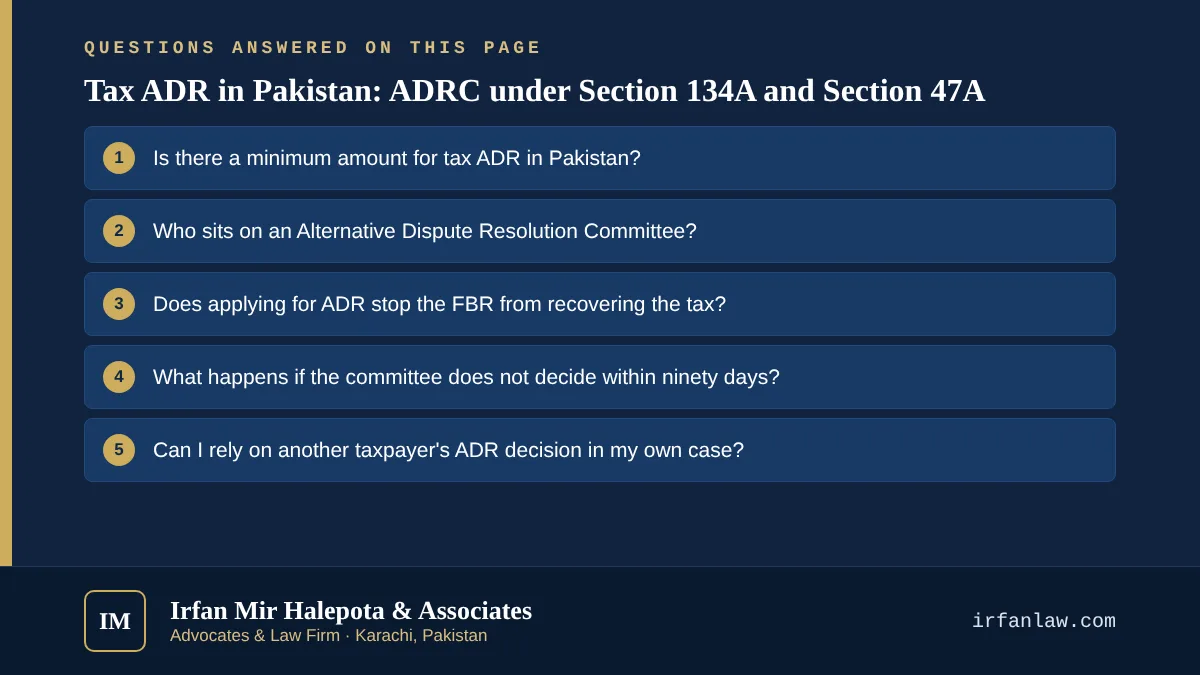
Is there a minimum amount for tax ADR in Pakistan?
Yes. For a dispute about tax liability, section 134A of the Income Tax Ordinance, 2001 requires an amount of fifty million rupees or more. Disputes about refund admissibility, waiver of default surcharge and penalty, or other specific relief are listed separately. State-owned enterprises are exempt from the threshold but must use ADR.
Who sits on an Alternative Dispute Resolution Committee?
Three members: a retired judge of a High Court, the Federal Constitutional Court or the Supreme Court as chairperson, an Inland Revenue officer of BS-21 or above who is not the jurisdictional Chief Commissioner, and a nominee of the taxpayer from the categories the section lists. The taxpayer's nominee proposes three names for chairperson.
Does applying for ADR stop the FBR from recovering the tax?
Recovery is deemed stayed from the date the committee is constituted until its decision or dissolution. The application by itself does not create a stay, so a taxpayer facing immediate recovery may still need a stay from the appellate forum or the court until the committee is appointed.
What happens if the committee does not decide within ninety days?
The Chairman of the FBR dissolves the committee by written order and the dispute returns to the court, tribunal or tax authority where it was pending. That forum is then required to decide it within ninety days of receiving the dissolution order.
Can I rely on another taxpayer's ADR decision in my own case?
No. Section 134A provides that a committee decision cannot be cited or treated as precedent in any other case, or even in the same taxpayer's case for a different tax year.
Is the committee's decision automatically binding on the department?
Not automatically. It binds the Commissioner only once the taxpayer accepts it, withdraws the pending appeal and communicates the withdrawal order to the Commissioner within sixty days of service of the decision. The Commissioner must then withdraw any departmental appeal within thirty days.
Does the same ADR scheme apply to customs disputes?
No. Customs ADR is governed by section 195C of the Customs Act, 1969 and Chapter XVII of the Customs Rules, 2001, under which a separate customs committee decides the dispute and, under FBR's published text, its decision binds the Collector. The 2026 rewrite of section 134A did not amend the customs provision.
This article is general information about Pakistani law and procedure, not legal advice for any specific matter. If this touches on something you're currently facing, get in touch and we'll advise on your facts directly.