Customs Misdeclaration, Show Cause Notices and Adjudication in Pakistan: Sections 32, 32A and 179 of the Customs Act, 1969
Where duty is short-levied because of an untrue statement or collusion, section 32(2) of the Customs Act, 1969 allows a show cause notice within five years of the relevant date; a shortfall caused by inadvertence, error or misconstruction has a shorter three-year window under section 32(3). The case is then adjudicated under section 179, and the Supreme Court has repeatedly held that an order passed after the 120-day limit, without a valid extension granted before the limit expired, is without lawful authority.
A misdeclaration case usually starts months or years after the goods have left the port. A post-clearance audit, a data match or an intelligence report suggests that the description, quantity, origin or value in a goods declaration was wrong, and a show cause notice follows demanding the duty difference and a penalty. Importers searching for the best customs lawyer in Karachi at that point need to know three things quickly: which limb of section 32 the notice relies on, whether it was issued in time, and whether the officer adjudicating it has the power and the time to decide. This guide explains those rules as they stand after the Finance Act, 2025, with the High Court of Sindh and Supreme Court decisions that shape them.
What counts as misdeclaration under section 32(1)
Every import or export is declared in a goods declaration under section 79, and most clearances now take place on self-assessment through the automated clearance system. Section 32(1) makes it an offence for a person, in connection with any matter of customs, knowingly or intentionally to make or deliver a false declaration, statement or document. Clause (c) expressly covers a false statement or document submitted "electronically through automated clearance system".
Misdeclaration can concern any material particular, for example:
- description or specification of the goods, which often decides the tariff heading (see our page on tariff classification disputes);
- quantity or weight;
- country of origin, where a preferential or anti-dumping rate depends on it;
- value, which is a distinct body of law under sections 25 and 25A (see customs valuation disputes); and
- eligibility for a concessionary SRO or exemption.
Not every wrong declaration is an offence. The Act separates a deliberate untrue statement from an honest mistake, and that distinction controls both the time limit and the penalty.
How misdeclaration cases usually begin
Most notices come from one of three sources:
- Post-clearance audit. An audit or examination of the importer's accounts, which section 32(3A) addresses separately.
- Intelligence and investigation. Cases developed by the Directorate General of Intelligence and Investigation (Customs) or a collectorate's enforcement wing, often from data comparisons across many consignments of the same importer or product.
- Examination at the port. A physical examination at clearance finds goods that differ from the declaration, which can lead to seizure and confiscation proceedings as well as a demand.
The source matters because it shapes the evidence. An audit-based notice usually turns on documents and accounts. An intelligence case may rely on statements, data analysis and third-party records that the importer has not seen and should ask to inspect. A port examination case depends on the examination report and any samples or test results, and on whether these were taken and recorded properly. In each case, the importer should ask to see the material relied on before replying, and the department should make sure that material is on the file before the notice is issued, because an allegation that cannot be supported by the record rarely survives appeal.
Section 32(2) and 32(3): which time limit applies
Section 32 provides two recovery routes with different limitation periods. The difference between them is often the first and most important question in the case.
| Provision | Cause of the shortfall | Time for show cause notice |
|---|---|---|
| Section 32(2) | An untrue document or statement, or collusion, leading to duty not levied, short-levied or erroneously refunded | Five years of the relevant date |
| Section 32(3) | Inadvertence, error or misconstruction, without any untrue statement | Three years of the relevant date |
| Section 32(3A) | Shortfall found during audit or examination of accounts | Five years |
Secondary reproductions of the current text also record a small-amount exclusion in section 32(3), and the absence of proceedings where the full amount is paid voluntarily before an audit, inquiry or investigation begins. Section 32(4) prevents the officer from determining more than the amount specified in the notice.
The "relevant date" is defined in section 32(5) by type of clearance. For goods cleared through the computerised system on self-assessment, clause (e) refers to "the date of detection". In Micro Innovations and Technologies (Pvt) Ltd. v. Federation of Pakistan (C.P. No. D-2890 of 2020, decided 12 December 2022), a division bench of the High Court of Sindh rejected the department's argument that time ran from detection. It held that the five years ran from the date of the goods declaration and quashed thirteen of fourteen notices as time-barred. The department's counter-argument rests on the literal wording of clause (e). Until the Supreme Court settles the point, both sides should plead it fully.
A simple illustration shows why the dates matter. Take a goods declaration filed on 10 March 2021 for goods cleared the same day. On the reading in Micro Innovations, a notice alleging an untrue statement had to be issued by March 2026. A notice treating the shortfall as an honest error had to be issued by March 2024. If the department relies on the date of detection instead, both periods may run much later. The answer can therefore decide whether there is any case to meet at all.
For the department, the practical lesson is that a notice relying on the five-year period must state the facts that make the statement untrue, not merely that the duty was short-paid. For the importer, a notice issued after three years that does not identify any untrue statement is open to challenge on limitation.
Fiscal fraud under section 32A
Section 32A deals with a more serious category: fiscal fraud. Secondary reproductions of the provision list concocted, altered or forged documents, declarations in the name of importers or exporters who do not exist at the stated address, untrue information in electronically filed declarations, and grossly under- or over-stated values, together with abetment of any of these. They also describe a show cause notice within 180 days of detection, followed by adjudication and recovery.
The criminal consequences differ sharply. In a 2025 bail order (Spl. Cr. Bail Application Nos. 170 and 171 of 2025, decided 23 July 2025), the High Court of Sindh noted that an offence under section 32(1), punishable under clause (14) of section 156(1), does not carry imprisonment beyond three years. Section 32A offences can attract imprisonment of up to ten years. The court granted bail to warehouse employees because the investigation did not show how they had aided the importers, which is a reminder that the department must link each accused person to the false document.
Adjudication under section 179: jurisdiction and the 120-day rule
A show cause notice for recovery, penalty or confiscation is decided by an adjudicating officer under section 179. Two limits apply to that officer.
Pecuniary jurisdiction. Section 179(1) allocates cases among the Collector, Additional Collector and lower officers according to the amount of duty and taxes involved. The thresholds have been revised by several Finance Acts, so the table in force on the date of the notice must be checked. An order by an officer acting above their limit is void. In a reference decided on 5 August 2026 (SCRA No. 62 of 2013), the High Court of Sindh upheld a Tribunal ruling that an Assistant Collector's 2010 order involving more than the then limit of Rs 300,000 was void ab initio.
Time. Section 179(3) requires the order to be passed within 120 days of the show cause notice. The Collector can extend this by up to sixty days, but only for exceptional reasons recorded before the 120 days run out. Section 179(4) gives the Board a further power of extension. The Supreme Court has treated these limits as mandatory in Khalid Mahmood v. Collector of Customs, 1998 SCMR 1881, Mujahid Soap & Chemical Industries (Pvt.) Ltd. v. Customs Appellate Tribunal, 2019 SCMR 1735, A.J. Traders v. Collector of Customs, PLD 2022 SC 817 and, by a five-member bench, Wak Limited v. Collector Central Excise and Sales Tax, 2025 SCMR 1280.
The High Court of Sindh applies the rule strictly. In SCRA No. 1518 of 2023 (order of 17 January 2025), an extension sought from the FBR months after the period had lapsed could not save the order. In SCRA No. 950 of 2023 (16 February 2026), the department withdrew its reference because the record showed no extension at all, despite a line in the order saying one had been granted.
Penalties and other consequences
Section 156(1) sets out the penalty for each contravention in a table. Clause (14) is the penalty clause for false statements under section 32(1). Depending on the clause, the consequences can include:
- recovery of the duty and taxes short-levied, with default surcharge;
- a penalty, which the adjudicating officer fixes within the limits of the relevant clause;
- confiscation of the goods where the clause provides for it, usually with an option to redeem them on payment of a fine (see our page on seizure, confiscation and redemption fines); and
- prosecution for the more serious offences.
The size of the penalty is a matter of discretion and fact. In one recent reference (SCRA No. 1174 of 2023, order of 28 January 2026), the Customs Appellate Tribunal had found a knowing misdescription of the goods and imposed a penalty of 20 per cent of the value of the offending goods under clause (14). The High Court of Sindh declined to interfere because no question of law arose.
Preparing a defence or building a sound case
Whichever side we act for, the same checklist decides most files:
- Identify the limb. Is the notice under section 32(2), 32(3), 32(3A) or 32A? Does it state facts showing an untrue statement or collusion, or only a shortfall?
- Compute limitation. Work out the relevant date, the date of the notice and the 120-day deadline for the order, and look for any extension order and its date.
- Check jurisdiction. Compare the amount in the notice with the section 179(1) limits for the adjudicating officer.
- Assemble the documents. Gather the commercial invoice, packing list, bill of lading, letter of credit, technical literature, test reports and earlier goods declarations for identical goods. If customs officers examined and assessed the goods at the time of clearance, that history is relevant to whether the importer misled anyone.
- Reply in substance. Answer every allegation, ask for the documents relied on, and request a personal hearing. Our general guide to responding to show cause notices covers structure and tone.
- Consider early payment. Where an error is genuine and the amount is small, voluntary payment before an audit or inquiry begins may avoid proceedings altogether.
For the department, the strongest orders deal with each defence, record the evidence of intent where section 32(2) or 32A is invoked, and are signed by an officer with pecuniary jurisdiction within time.
Appeals after an order-in-original
An order-in-original can be appealed to the Collector (Appeals) under section 193, generally within thirty days of communication. Further appeals lie to the Customs Appellate Tribunal under section 194A, and a reference can be taken to the High Court under section 196, which since the Finance Act, 2024 may raise mixed questions of law and fact. Alternative dispute resolution under section 195C is available for disputes about liability to duty. The Tribunal is the last fact-finding forum, and the High Court of Sindh regularly dismisses references that only re-argue facts. Evidence and jurisdictional objections therefore need to be put on the record early. The sequence, time limits and stay applications are explained in our guide to the customs appeals route.
Follow us on Google
If these guides are useful, add this site as a preferred source. Google will then show it more prominently to you in Search, Discover and AI results.
Official sources
- High Court of Sindh, Micro Innovations and Technologies (Pvt) Ltd. v. Federation of Pakistan, C.P. No. D-2890 of 2020 (12 December 2022)
- High Court of Sindh, SCRA No. 1518 of 2023, order dated 17 January 2025
- High Court of Sindh, SCRA No. 950 of 2023, order dated 16 February 2026
- High Court of Sindh, SCRA No. 62 of 2013, order dated 5 August 2026
- High Court of Sindh, Spl. Cr. Bail Application Nos. 170 and 171 of 2025 (23 July 2025)
- Customs Act, 1969, Chapter XIX (Appeals and Revisions), FBR text amended to Finance Act, 2025
Common questions
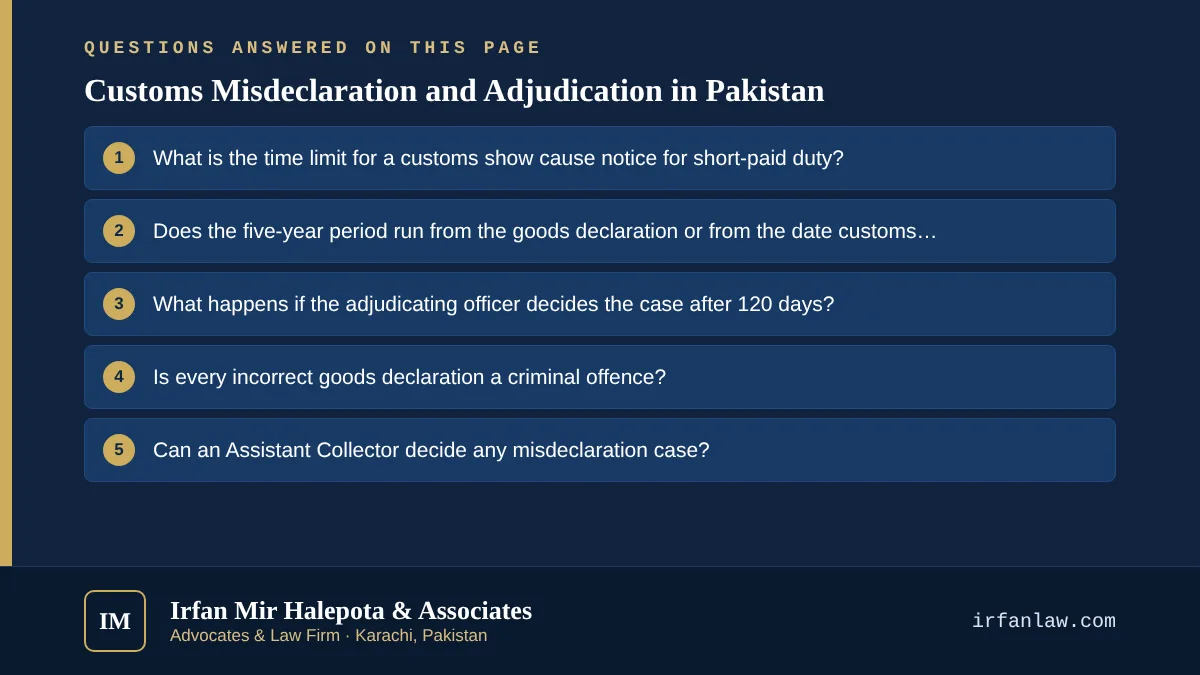
What is the time limit for a customs show cause notice for short-paid duty?
It depends on the cause. If the shortfall arose from an untrue statement or collusion, section 32(2) allows five years from the relevant date. If it arose from inadvertence, error or misconstruction, section 32(3) allows three years. Shortfalls found on audit fall under section 32(3A).
Does the five-year period run from the goods declaration or from the date customs detected the shortfall?
Section 32(5)(e) refers to the date of detection for self-assessed clearances, but the High Court of Sindh held in Micro Innovations (C.P. No. D-2890 of 2020) that time ran from the goods declaration date. The department may still argue the literal reading, so the point should be argued fully until the Supreme Court decides it.
What happens if the adjudicating officer decides the case after 120 days?
If no valid extension was granted before the period expired, the order is liable to be set aside as without lawful authority. The Supreme Court has applied this rule in cases including Mujahid Soap (2019 SCMR 1735) and, by a five-member bench, Wak Limited (2025 SCMR 1280).
Is every incorrect goods declaration a criminal offence?
No. Section 32(1) requires a statement made knowingly or intentionally, and a genuine error is dealt with under section 32(3) by recovery of the duty. Fiscal fraud under section 32A covers forged or concocted documents and non-existent importers and carries much heavier punishment.
Can an Assistant Collector decide any misdeclaration case?
No. Section 179(1) limits each adjudicating officer to cases up to a specified amount of duty and taxes. The High Court of Sindh has upheld the view that an order passed by an officer above that limit is void.
Can new evidence be produced before the High Court in a customs reference?
Generally not. The Customs Appellate Tribunal is the last fact-finding forum, and although section 196, as amended by the Finance Act, 2024, allows references on mixed questions of law and fact, the High Court decides them on the record built below. Documents should be produced at the adjudication or appeal stage.
This article is general information about Pakistani law and procedure, not legal advice for any specific matter. If this touches on something you're currently facing, get in touch and we'll advise on your facts directly.