Customs seizure and confiscation in Pakistan: the section 168 time limit, redemption fine under section 181 and the smuggling exception
Under section 168(2) of the Customs Act, 1969, if no show-cause notice is issued under section 180 within two months of a seizure (extendable by the Collector for up to two more months, for reasons recorded in writing), the goods must be returned to the person from whom they were seized. If the goods are later confiscated, section 181 lets the adjudicating officer offer release on payment of a redemption fine, but FBR’s SRO 499(I)/2009 bars that option for smuggled goods and for conveyances used in specified ways. Criminal smuggling cases run separately before the Special Judge (Customs, Taxation and Anti-Smuggling).
A customs seizure starts several clocks at once: a statutory deadline for the show-cause notice, an adjudication that may end in confiscation, and sometimes a criminal case. Each runs in a different forum and under different rules. Importers and transporters looking for the best customs lawyer in Karachi after goods or a vehicle have been taken usually need, before anything else, an accurate count of the two months that section 168(2) gives the department, because that date decides whether the goods must be handed back while the case continues. This guide explains seizure, confiscation, redemption fine and the smuggling exception as the Sindh High Court currently applies them.
Seizure, detention and the paperwork that should follow
Section 168 of the Customs Act, 1969 (the Act) deals with the seizure of things liable to confiscation. In Karachi, seizures are made at the ports during examination, by the Collectorate of Customs Enforcement on the roads and in warehouses, and by the Directorate General of Intelligence and Investigation, sometimes after a goods declaration has already been processed and the goods cleared. The Sindh High Court’s decision in Collector of Customs v. Al-Waleed PVC Plastic & Metal Industries (SCRA No. 304 of 2013, decided 23.01.2025) arose from exactly that situation: goods cleared by the Collector were later seized by the Intelligence Directorate.
Section 171 requires that, when a seizure or arrest is made, the reason be given in writing. The seizure report or mashirnama, the inventory and any sampling record are the first documents to collect, because every later argument about time limits, identity of goods and chain of custody depends on them.
It is worth separating a seizure from routine detention during examination. A consignment held while the department checks a declaration has not necessarily been seized in the section 168 sense. Lawyers on both sides should confirm from the record which step was taken and when, because the two-month clock in section 168(2) runs from the seizure.
The two-month limit in section 168(2)
Section 168(2) provides that where goods are seized under sub-section (1) “and no show-cause notice in respect thereof is given under section 180 within two months of the seizure of the goods, the goods shall be returned to the person from whose possession they were seized.” A proviso allows the Collector of Customs, “for reasons to be recorded in writing”, to extend the period by not more than two months.
What happens when the notice is late? The leading authority is Collector of Customs, Karachi v. Mazhar-ul-Islam, 2011 PTD 2577, a Division Bench decision of the Sindh High Court. In Al-Waleed (2025) the Court applied it and corrected forums that had treated a late notice as a nullity: a notice issued after the two months (and any valid extension) does not by itself become void, but the person from whom the goods were seized becomes entitled to their return. The adjudication can continue; the department simply cannot keep the goods while it does.
The extension must be real and on the record. In Al-Waleed the Court noted that the order granting the extension was not produced. In a 2026 reference by the Collector of Customs (Enforcement), Karachi (SCRA No. 158 of 2026, order dated 27.08.2026), goods seized on 25.10.2024 were the subject of a notice issued on 17.07.2025; the Tribunal had ordered release of the goods and vehicle, no extension had been placed before it, and the High Court dismissed the department’s reference in limine as raising no question of law.
- For owners: diarise the seizure date, ask in writing for a copy of any extension order, and apply for return of the goods once the period lapses without a notice.
- For the department: record the reasons for any extension in a signed order before the first two months end, and keep it on the adjudication file so it can be produced on appeal.
Confiscation, penalty and vehicles
Confiscation is imposed by the adjudicating officer, not by the seizing officer. Section 180 requires a show-cause notice before goods are confiscated or a penalty imposed, and section 179 (read with section 180) allocates adjudication among customs officers. Appeals then lie under sections 193 and 194A. Pecuniary limits, the time limit for passing the order and the rules on misdeclaration are covered in our sibling guide on customs misdeclaration and adjudication.
The penalties themselves are set out clause by clause in the table in section 156(1). For seizure cases the clauses that matter most are clauses 8 and 89, which deal with smuggling and carry imprisonment as well as confiscation, and clauses 9 and 90, which provide for confiscation and penalty without imprisonment. Which clause the notice invokes affects both the adjudication and whether a criminal court is involved at all.
Vehicles are often seized with the goods. Section 157 makes every conveyance used in the removal of goods liable to confiscation also liable to confiscation. In Collector of Customs v. Shahzad (Spl. Cus. Ref. A. No. 05 of 2016, judgment dated 18.03.2022) the Sindh High Court held that this is not automatic; the authority must weigh the circumstances and the owner’s explanation. But the Court also held that under clause 89(i) of section 156(1) the burden lies on the owner of the conveyance to show that he was not complicit, and the Tribunal had erred by requiring the investigating officer to prove the owner’s involvement first. A transporter with a genuine hire contract should produce it, with evidence that it was acted on, at the first hearing.
When goods count as “smuggled”
Whether goods are “smuggled” within section 2(s) of the Act changes almost everything: the criminal exposure, the burden of proof and, as explained below, whether a redemption fine can be offered. Section 2(s) has three limbs. Broadly, it covers bringing goods into or taking them out of Pakistan in breach of a prohibition or restriction, or while evading duty, where the goods are of listed kinds (precious metals and stones, currency, narcotics and similar goods) or are other goods notified by the Federal Government above a value threshold set in the clause; and it covers any goods brought in or taken out by an undeclared route or from a place that is not a customs station. Attempt, abetment and connivance are included.
The notified list matters in practice. In bail matters in 2024 and 2025 the Sindh High Court (Adnan Iqbal Chaudhry J.) treated it as at least arguable that the offence of smuggling was not attracted where the goods in the FIR were not among those notified under section 2(s) by SRO 566(I)/2005: Muhammad Qasim v. The State (Spl. Cr. Bail Application No. 80 of 2024, 30.08.2024) and Zia-ud-din v. The State (Spl. Cr. Bail Application No. 92 of 2025, 15.05.2025). Those were tentative bail observations, not final findings, and they relied on older authority including Hiam Tabbara v. Director-General, Pakistan Coast Guards, PLD 1980 Karachi 44.
Section 187 places on an accused person the burden of proving lawful authority, permit or licence. Courts have described the initial burden as light: production of purchase invoices and returns can shift it back to the department, as the Tribunal found in a matter whose reference the High Court dismissed (SCRA No. 576 of 2024, order dated 06.08.2026), relying on Muhammad Hasan Nadeem v. Model Customs Collectorate, 2021 PTD 764. The Supreme Court’s observation in Sikandar A. Karim v. The State, 1995 SCMR 387, that goods freely available in the open market and not banned for import may raise a presumption of lawful import, is still regularly cited.
Redemption fine under section 181 and SRO 499(I)/2009
Section 181 provides that whenever an order for confiscation is passed, “the officer passing the order may give the owner of the goods an option to pay in lieu of the confiscation of the goods such fine as the officer thinks fit.” Its Explanation makes the fine additional to any duty and charges and to any penalty. Two provisos give the Federal Board of Revenue (the Board) control over the discretion: the Board may specify goods for which the option “shall not be given”, and may fix the fine for goods imported in breach of section 15, a notification under section 16 or any other law.
The Board exercised those powers through SRO 499(I)/2009 dated 13 June 2009. It directs that no option to pay a fine in lieu of confiscation be given for, among other things, “(a) smuggled goods falling under clause (s) of section 2” and (b) lawfully registered conveyances, including packages and containers, found carrying smuggled goods in false cavities or used exclusively or wholly for transporting offending goods. The Supreme Court confirmed in Collector of Customs v. Wali Khan, 2017 SCMR 585 that the officer’s option is subject to such Board orders.
| Issue | Current position in the Sindh High Court |
|---|---|
| Smuggled goods | No redemption option once smuggling is found; a Tribunal order releasing smuggled tyres on fine was set aside (Director I&I (Customs) v. Rehmatullah, SCRA No. 715 of 2023, 11.12.2023). |
| Basis of the fine | Under SRO 499(I)/2009 the fine is a percentage of the customs value, not of the duty evaded; Tribunal orders following Weave and Knit (decided under the earlier SRO 1374(I)/1998) have been set aside (SCRA No. 561 of 2011, 22.08.2023; SCRA No. 129 of 2015, 01.10.2026). |
| Goods already released | Where goods have left customs control, adjudicating officers have imposed a penalty in place of confiscation, as noted in Al-Waleed. |
The upshot is that the fight over whether goods are “smuggled” or merely “liable to confiscation” for some other breach often decides whether the owner gets the goods back at all.
The criminal track: Special Judge (Customs, Taxation and Anti-Smuggling)
Smuggling offences are tried by the Special Judges appointed under section 185, who take cognisance under section 185A. In Karachi, cases begin with an FIR registered at a customs police station, and refusals of bail by the Special Judge go to the Sindh High Court as special criminal bail applications.
Two points are often misunderstood. First, the criminal case and the adjudication are separate. Acquittal or bail does not release the goods, and an adjudication order does not decide guilt. Second, the Special Judge cannot order release of goods that are liable to confiscation. In Anoop Kumar Kundanani v. Muhammad Saleem (Spl. Cr. Revision Application No. 223 of 2024, 28.02.2025) the Sindh High Court, relying on Government of Pakistan v. Mahmood Ahmed Qureshi, 2002 SCMR 1527, held that adjudication of confiscation belongs to the customs officer under sections 179 and 180, and directed the applicant to apply to that officer for release.
Where the FIR invokes only clauses 9 and 90 of section 156(1), which carry no imprisonment, the High Court has indicated that the matter may fall outside the Special Judge’s domain altogether (Muhammad Qasim, above).
Appeals, and what each side should prepare
An order-in-original confiscating goods, refusing redemption or imposing a penalty is appealable to the Collector (Appeals) under section 193 and then to the Customs Appellate Tribunal under section 194A; a reference then lies to the Sindh High Court under section 196, which since the Finance Act, 2024 may raise mixed questions of law and fact. The Tribunal is the last fact-finding forum, and the High Court has repeatedly refused references that only challenge its appreciation of evidence (for example, SCRA No. 576 of 2024 and SCRA No. 158 of 2026). That makes the record built before the adjudicating officer and the Tribunal decisive. The forums and time limits are set out in our guide to the customs appeals route, and High Court practice in our page on Sindh High Court litigation.
- Dates: seizure, any extension order and the show-cause notice, set side by side.
- Identity and origin: goods declarations, commercial invoices, local purchase invoices, sales tax returns, and photographs of packing and markings.
- Sampling and testing: whether samples were drawn in the owner’s presence and whether any laboratory report exists; in SCRA No. 576 of 2024 the Tribunal had noted that no laboratory test was conducted.
- Classification of the charge: whether the goods are on the section 2(s) notified list, and which clauses of section 156(1) are invoked.
- Conveyance: hire contract, route documents and the owner’s explanation, given the burden under clause 89(i).
For the department, the same list works in reverse: an extension order recorded in time, a notice that identifies the notified goods relied on, and a sampling record that will survive cross-examination. Valuation disputes, which often accompany seizures at the port, are covered separately in our guide to customs valuation disputes, and the wider practice in taxation and customs.
Follow us on Google
If these guides are useful, add this site as a preferred source. Google will then show it more prominently to you in Search, Discover and AI results.
Official sources
- Sindh High Court, SCRA No. 158 of 2026 (section 168(2) text and proviso)
- Sindh High Court, Collector of Customs v. Al-Waleed PVC Plastic & Metal Industries, SCRA No. 304 of 2013 (23.01.2025)
- Sindh High Court, Collector of Customs v. Shahzad, Spl. Cus. Ref. A. No. 05 of 2016 (section 181, section 157, SRO 499(I)/2009)
- Sindh High Court, Director I&I (Customs) v. Rehmatullah, SCRA No. 715 of 2023
- Sindh High Court, Anoop Kumar Kundanani v. Muhammad Saleem, Spl. Cr. Revision No. 223 of 2024
- FBR consolidated Customs Act, 1969 (as of 31.12.2019): section 2(s) and table of contents
Common questions
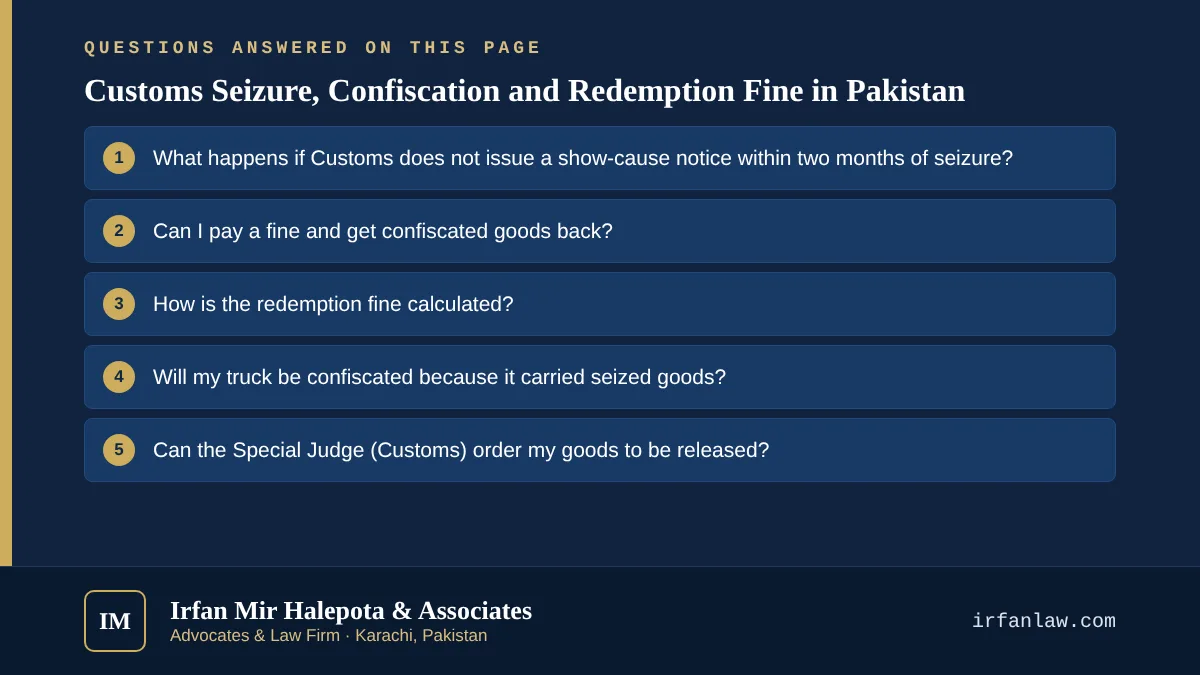
What happens if Customs does not issue a show-cause notice within two months of seizure?
Under section 168(2) of the Customs Act, 1969 the goods must be returned to the person from whom they were seized, unless the Collector has extended the period (by up to two months, for reasons recorded in writing). Following Mazhar-ul-Islam (2011 PTD 2577), the Sindh High Court treats a late notice as still valid for adjudication, so the case can go on, but the department cannot keep the goods.
Can I pay a fine and get confiscated goods back?
Often, yes. Section 181 lets the adjudicating officer offer an option to pay a redemption fine in lieu of confiscation, in addition to duty, taxes and any penalty. The option is not available where the Board has excluded it: SRO 499(I)/2009 bars it for smuggled goods under section 2(s) and for conveyances found carrying smuggled goods in false cavities or used wholly for offending goods.
How is the redemption fine calculated?
SRO 499(I)/2009 bases the fine on the customs value of the goods. The Sindh High Court has set aside Tribunal orders that calculated it on the duties and taxes involved, which was the method under the superseded SRO 1374(I)/1998.
Will my truck be confiscated because it carried seized goods?
Not automatically. Section 157 makes a conveyance used to remove goods liable to confiscation also liable to confiscation, but the Sindh High Court held in Shahzad (2022) that the authority must consider the circumstances and the owner's explanation. The owner, however, carries the burden under clause 89(i) of section 156(1) of showing he was not complicit, so a genuine hire contract and supporting evidence should be produced early.
Can the Special Judge (Customs) order my goods to be released?
No. The Sindh High Court held in Anoop Kumar Kundanani (2025), relying on 2002 SCMR 1527, that release of goods liable to confiscation is for the customs adjudicating officer under sections 179 and 180, not the criminal court. Bail in the criminal case and the release of goods are separate questions.
Are all imported goods found in the market without documents treated as smuggled?
No. Smuggling under section 2(s) has defined limbs, and for many goods it depends on their being notified by the Federal Government; recent Sindh High Court bail orders refer to the list in SRO 566(I)/2005. Where goods are not notified, the High Court has said in bail matters that the smuggling offence may not be attracted, although confiscation for other breaches can still follow.
This article is general information about Pakistani law and procedure, not legal advice for any specific matter. If this touches on something you're currently facing, get in touch and we'll advise on your facts directly.