Litigating in the Supreme Court of Pakistan from Karachi: Leave Petitions, Appeals, Time Limits and Review After the 27th Amendment
Most High Court judgments reach the Supreme Court only through a petition for leave to appeal under Article 185(3) of the Constitution, filed within 60 days; a few categories carry an appeal as of right under Article 185(2). Since 13 November 2025, appeals from High Court judgments made under Article 199 (other than rent and family cases) go instead to the Federal Constitutional Court under Article 175F, so the forum must be settled before anything is drafted.
The Supreme Court of Pakistan is still the final court for most civil, criminal, corporate, property, tax-reference and service disputes, but it is no longer the only apex court. The 27th Amendment moved a large share of what used to be filed in Islamabad and at the Karachi Branch Registry to the new Federal Constitutional Court. A litigant looking for the best Supreme Court lawyer in Pakistan after a High Court loss usually has sixty days or less, and the first of those days should go to settling which apex court the judgment actually belongs to. This guide is the procedural playbook: forum, routes, limitation, filing, hearings, interim relief and review, for petitioners and for respondents defending a favourable judgment.
First question: Supreme Court or Federal Constitutional Court?
Article 185 was substituted by the Constitution (Twenty-seventh Amendment) Act, 2025, with effect from 13 November 2025. Clause (1) now gives the Supreme Court appellate jurisdiction over High Court judgments, decrees, final orders and sentences "subject to this Article and Article 175F", and a new proviso to clause (3) says that no appeal lies to the Supreme Court in cases to which Article 175F(1) applies.
Article 175F(1) gives the Federal Constitutional Court (FCC) appeals from a High Court in three situations:
- (a) where an Act of Parliament provides for an appeal to the FCC;
- (b) where the High Court certifies that the case involves a substantial question of law as to the interpretation of the Constitution; and
- (c) from a judgment or order of a High Court made under Article 199, but only if the FCC grants leave.
The proviso to Article 175F(1) keeps Article 199 judgments in rent and family cases out of the FCC (guardianship and other matters specified by law are treated separately). Article 175F(2) sent pending leave petitions, appeals and reviews of this kind from the Supreme Court to the FCC.
The Supreme Court has since drawn the line itself. In January 2026 a bench headed by Chief Justice Yahya Afridi held that the bar in the proviso to Article 185(3) is narrowly confined to Article 175F(1) cases, so rent and family matters decided under Article 199 still come to the Supreme Court with leave. In May 2026 it described the two courts as coordinate courts in separate domains, directed that clubbed writ and non-writ matters be separated and sent to their proper forum, and kept contempt of its own orders with itself. In July 2026 it held that appeals in accountability cases now lie to the FCC under section 32A of the National Accountability Ordinance, 1999, a statutory route under Article 175F(1)(a).
In practical terms, the Supreme Court keeps regular first appeals, civil revisions and second appeals decided by the High Court, company and banking matters decided in the High Court's ordinary jurisdiction, tax references under section 133 of the Income Tax Ordinance, 2001, criminal appeals and bail matters (outside accountability cases), service tribunal appeals, and rent and family writs. Constitution petitions decided under Article 199 on any other subject go to the FCC. Where one High Court judgment decides both a writ and a suit or appeal, the boundary is still being worked out case by case; identify the jurisdiction under which each part was decided. The wider change is explained on our Supreme Court and constitutional practice page, and FCC procedure in our FCC litigation guide.
Appeal as of right or petition for leave
Article 185(2) lists the cases in which an appeal lies without leave. In its current form they are: where the High Court has, on appeal, reversed an acquittal and sentenced the accused to death, transportation for life or imprisonment for life (or has enhanced a sentence to one of those on revision); where the High Court has withdrawn a case to itself, tried it and convicted and sentenced the accused to one of those penalties; where the High Court has punished a person for contempt of the High Court; and, in civil cases, where the amount or value in dispute meets the threshold in Article 185(2)(d) (raised by the 26th Amendment) and the High Court has varied or set aside the decision of the court immediately below, or where the judgment involves a claim or question respecting property of like value and the High Court has varied or set aside the decision below.
An affirming decision does not qualify under clauses (d) and (e), however large the claim.
Everything else goes by petition for leave to appeal under Article 185(3): civil petitions (CPLAs), criminal petitions and jail petitions. Leave is discretionary. Appeals from the Federal and Sindh Service Tribunals come under Article 212(3), which is stricter on its face: leave is granted only if the Court is satisfied that the case involves "a substantial question of law of public importance". For civil servants, the record built before the Tribunal is the record the Supreme Court will see (see our note on Service Tribunal appeals).
Time limits under the Supreme Court Rules, 2025
The Supreme Court Rules, 2025 replaced the Supreme Court Rules, 1980 with effect from 6 August 2025. Proceedings filed before that date continue under the old Rules. The main change for new filings is that criminal petitions, criminal appeals and direct civil appeals now share the 60-day period that civil leave petitions always had.
| Type of matter | Route | Time limit |
|---|---|---|
| High Court judgment in a suit, appeal, revision, tax reference, company or rent/family matter | Civil petition for leave, Article 185(3), Supreme Court | 60 days from the judgment |
| High Court has varied or set aside the decision below in a high-value civil or property case | Direct civil appeal, Article 185(2)(d) or (e), Supreme Court | 60 days (30 days under the 1980 Rules) |
| Criminal conviction, acquittal or sentence by the High Court (non-accountability) | Criminal petition for leave, Article 185(3), Supreme Court | 60 days (30 days under the 1980 Rules) |
| High Court reverses acquittal and imposes death or life sentence; contempt punishment by High Court | Criminal appeal as of right, Article 185(2)(a) to (c), Supreme Court | 60 days |
| Federal or Sindh Service Tribunal decision | Petition for leave, Article 212(3), Supreme Court | 60 days |
| High Court judgment under Article 199 (other than rent and family) | Petition for leave, Article 175F(1)(c), Federal Constitutional Court | Set by the FCC's own rules; confirm before filing |
| Supreme Court's own judgment or order | Review, Article 188 | 30 days from pronouncement |
| Registrar's objection refusing to receive a filing | Appeal to the Court in chambers | 14 days |
Time runs from the date of the judgment, not the date the certified copy arrives, so the copy application should go in the day the judgment is announced. A late petition needs a separate application for condonation of delay, supported by an affidavit that accounts for the whole period. The 1980 Rules expressly allowed the Court to extend time for sufficient cause; in practice the Court expects each stage of the delay to be explained with documents, and vague references to illness, file movement or departmental procedure are routinely rejected, including when the petitioner is a government department.
Who files, and what the petition must contain
A party may file in person, but almost every petition is filed through an Advocate-on-Record (AOR), who is responsible for the filing, the record and correspondence with the Registry, and argued by an Advocate of the Supreme Court. Under the 2025 Rules the written AOR test has been abolished and advocates of five years' standing at the Supreme Court bar may apply directly; a party may revoke a power of attorney and appoint a new AOR. If a hearing is lost because the AOR fails to attend or file documents, the Court may make the AOR personally pay the costs.
All petitions and paper books must now be filed electronically with scanned copies; documents sent by post are not accepted, and notices, orders and certified copies issue digitally. A well-prepared civil petition for leave contains:
- the petition itself, stating the facts briefly and every point of law that arises, framed as numbered questions;
- a certified copy of the impugned High Court judgment and order, and the judgments of every forum below;
- a paper book with the pleadings, the evidence and documents the questions actually depend on, indexed and paginated;
- the previous Supreme Court decisions bearing on the questions, including any against the petitioner;
- an affidavit verifying the facts, and an application for interim relief or condonation where needed; and
- the AOR's power of attorney (vakalatnama), with service on the respondent and, where the State is a party, the Attorney-General, Advocate-General or Prosecutor-General.
The questions of law do the persuading; re-arguing the evidence page by page reads as a request for a third appeal on facts. Respondents who expect a petition can lodge a caveat so that they receive notice of the leave hearing instead of learning of it after leave has been granted ex parte.
Where the case is heard: Karachi Branch Registry or Islamabad
Branch Registries are retained in every provincial capital, and filings may be made at Islamabad or at the relevant Registry. The Karachi Branch Registry, on M.R. Kayani Road, receives petitions arising from the High Court of Sindh, and benches sit there on a roster. In practice, taxation, customs and revenue matters have generally been fixed at the Principal Seat in Islamabad, which is why tax petitions from Karachi are usually argued there. The 2025 Rules also permit hearings by video link on application, useful for a short leave hearing.
Cases are listed by benches formed by the committee under the Supreme Court (Practice and Procedure) Act, 2023, discussed below. A matter cannot be steered to a particular bench, and requests for early hearing must be made by application with reasons.
Stopping the High Court judgment while the petition is pending
Filing a petition does not suspend the High Court judgment. A decree can be executed, a tax demand recovered, a dismissal from service take effect and a convict remain in custody unless the Supreme Court makes an order. Interim relief is sought by a separate application in the petition: suspension of the operation of the judgment, stay of execution or recovery, or, in criminal matters, bail or suspension of sentence. Under the 2025 Rules, applications marked urgent or seeking interim relief are to be listed within 14 days or at the earliest practicable date.
The Court looks at three things: whether the petition raises a point that is arguable enough for leave, whether the petitioner will suffer harm that a later order cannot undo, and what conditions protect the other side. Stays in money matters are often conditional on depositing the amount or furnishing security. If leave is granted in a civil case, security for the respondent's costs must be deposited within 30 days, failing which leave stands rescinded unless the Court orders otherwise. A respondent should oppose interim relief at the first hearing, with a short reply showing the prejudice a stay would cause.
Interim relief also depends on the forum: in July 2026 the Supreme Court held that it cannot grant bail or interim orders in accountability cases because the appellate jurisdiction now lies with the FCC.
Why leave is refused
Most petitions are decided at the leave stage, often in a short order. The common reasons are predictable:
- Concurrent findings of fact. Where two or three forums have reached the same factual conclusion, the Court will not reappraise the evidence unless the findings rest on misreading or non-reading of material evidence, or are perverse. In M. Hamad Hassan v. Mst. Isma Bukhari (Civil Petition No. 1418 of 2023, decided 17 July 2023), a family matter, the Court declined leave, repeating that interference with findings of fact is "on limited grounds as an exception and not the rule" and relying on Mst. Tayyeba Ambareen v. Shafqat Ali Kiyani, 2023 SCMR 246.
- No question of law. A petition that disputes how the evidence was weighed, without identifying a legal error, does not raise anything for the Court to decide.
- Limitation. An unexplained delay ends the petition before the merits are reached.
- Wrong forum. After 13 November 2025, a petition against an Article 199 judgment outside rent and family matters is returned or transferred, at the cost of weeks.
- Points not taken below. New factual grounds, and new documents not on the High Court record, are rarely allowed.
Leave is granted where the petition shows a genuine legal question: a conflict between High Courts, a misreading of a statute, a departure from binding precedent, or an issue affecting many cases. In service matters the question must also be of public importance under Article 212(3).
Review, the Practice and Procedure Act and intra-court appeals
Article 188 lets the Supreme Court review its own judgments, subject to Acts of Parliament and its Rules. Review is not a rehearing. The application must be filed within 30 days of pronouncement, with a certified copy of the judgment and a reasoned certificate from the advocate that review is justified; where it rests on newly discovered evidence, certified copies and an affidavit explaining the discovery are required. As far as practicable the review goes to the same bench, and if a judge has retired the remaining judges hear it. Only one review lies against a judgment, it may be filed through different counsel, and frivolous reviews attract costs.
The Supreme Court (Practice and Procedure) Act, 2023 still governs how benches are formed. As amended by the Supreme Court (Practice and Procedure) (Amendment) Act, 2025 (published on 15 November 2025 and effective from the commencement of the 27th Amendment), a committee of the Chief Justice, the next most senior judge and a judge nominated by the Chief Justice constitutes benches for every cause, appeal and review, deciding by majority. The same Act omitted section 5, which had provided an intra-court appeal against orders under Article 184(3); that original jurisdiction itself was omitted by the 27th Amendment and fundamental-rights petitions now go to the FCC. The 2025 Rules still provide an intra-court appeal in contempt proceedings, but for ordinary civil and criminal litigants there is now no appeal from a Supreme Court bench, which makes the leave hearing and any review the last word.
One further change: Article 189 now makes FCC decisions binding on all courts, including the Supreme Court, while Supreme Court decisions bind every court except the FCC. Where a High Court judgment from Sindh rests on a point the FCC has since decided, that decision should be cited at the leave stage. Earlier stages of a Karachi case are covered in our Sindh High Court litigation guide.
Follow us on Google
If these guides are useful, add this site as a preferred source. Google will then show it more prominently to you in Search, Discover and AI results.
Official sources
- Constitution of Pakistan, Part VII Chapter 2 (Articles 185, 188, 189, 191 as amended)
- Constitution of Pakistan, Part VII Chapter 1A (Federal Constitutional Court, Articles 175E to 175G)
- Supreme Court (Practice and Procedure) (Amendment) Act, 2025 (Gazette, 15 November 2025)
- PID: Supreme Court issues Supreme Court Rules, 2025
- Supreme Court of Pakistan: Frequently Asked Questions
- Supreme Court of Pakistan: C.P. No. 1418 of 2023 (order dated 17.07.2023)
Common questions
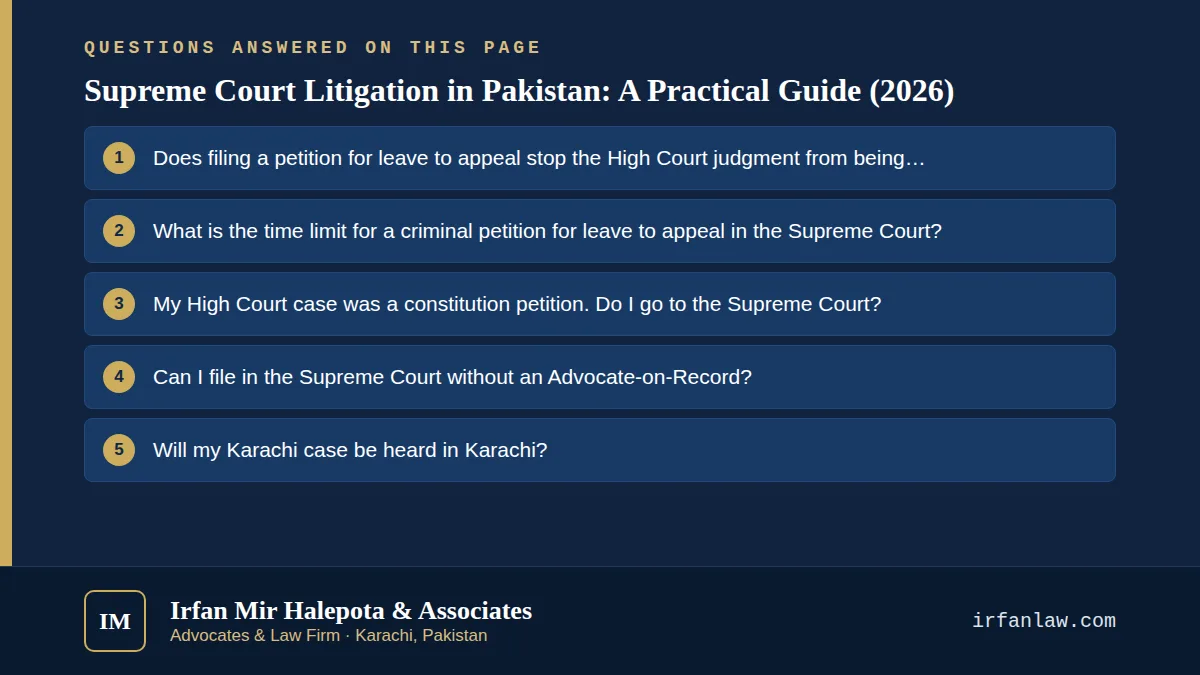
Does filing a petition for leave to appeal stop the High Court judgment from being enforced?
No. The judgment remains enforceable until the Supreme Court suspends it on a separate application for interim relief. Stays in money matters are often granted only on deposit of the amount or furnishing of security.
What is the time limit for a criminal petition for leave to appeal in the Supreme Court?
Under the Supreme Court Rules, 2025, which apply to filings from 6 August 2025, it is 60 days from the High Court's judgment. Under the 1980 Rules it was 30 days, which still matters for older matters. A late petition needs a condonation application explaining the whole period of delay.
My High Court case was a constitution petition. Do I go to the Supreme Court?
Only if it was a rent or family matter. Other judgments made under Article 199 now go to the Federal Constitutional Court, which hears them only if it grants leave under Article 175F(1)(c).
Can I file in the Supreme Court without an Advocate-on-Record?
Yes, a party may file in person. In practice an Advocate-on-Record handles the filing and record, and an Advocate of the Supreme Court argues the case, because the leave hearing turns on how the questions of law are framed.
Will my Karachi case be heard in Karachi?
Usually, if it arises from the High Court of Sindh and is not a tax, customs or revenue matter, which have generally been fixed in Islamabad. Video-link hearings are permitted on application under the 2025 Rules.
Can I appeal against a Supreme Court judgment?
There is no appeal from a Supreme Court bench in ordinary civil or criminal cases. A single review under Article 188 may be filed within 30 days, supported by an advocate's reasoned certificate; it is not a rehearing.
If leave is refused, can I file a new petition on different grounds?
No. Refusal of leave ends the matter in the Supreme Court, subject to one review of the refusal order within 30 days. That is why every point of law should be taken in the first petition.
This article is general information about Pakistani law and procedure, not legal advice for any specific matter. If this touches on something you're currently facing, get in touch and we'll advise on your facts directly.