Litigating Before the Federal Constitutional Court of Pakistan: A Practical Guide for Karachi and Sindh
The Federal Constitutional Court (FCC) hears appeals from High Court judgments in constitutional petitions under Article 199 (with its leave), inter-governmental disputes, fundamental-rights petitions of public importance and presidential references, under Articles 175E to 175H of the Constitution as inserted by the Twenty-seventh Amendment. Under the Federal Constitutional Court (Practice and Procedure) Rules, 2026, a civil petition for leave to appeal must be filed within 60 days of the High Court's judgment. Its seat is Islamabad, but its benches also sit at the Karachi Registry.
Since 13 November 2025, when the Constitution (Twenty-seventh Amendment) Act, 2025 took effect, the last word on constitutional questions in Pakistan has belonged to a new court. The Federal Constitutional Court took over the Supreme Court's fundamental-rights and constitutional work, and appeals from High Court writ judgments now go to it rather than to the Supreme Court. For a Karachi business that has lost a writ petition against a tax notice, or a government servant whose petition the High Court of Sindh has dismissed, the right forum and the 60-day clock are now the first things to settle. Anyone looking for the best constitutional lawyer in Karachi after an adverse Article 199 judgment should start with one question: is this an FCC matter or a Supreme Court matter? This guide explains how the FCC works in practice, from jurisdiction and filing to who may appear, interim relief and review.
What the FCC is and where it sits
The Court is created by Chapter 1A of Part VII of the Constitution (Articles 175B to 175L). Article 175B provides for a Chief Justice and other Judges, the number to be fixed by Act of Parliament or, until then, by the President, with an equal number of Judges from each Province and at least one from the Islamabad High Court. Under Article 175D, a Judge must be a current or former Supreme Court Judge, a High Court Judge of at least five years, or an advocate of a High Court of at least twenty years who is also an advocate of the Supreme Court. Judges retire at sixty-eight, and the Chief Justice serves a three-year term (Article 175I). Justice Aminuddin Khan was appointed the first Chief Justice on 14 November 2025.
Article 175L fixes the permanent seat in Islamabad but allows the Court to sit elsewhere with the Chief Justice's approval and the President's prior approval. In practice the FCC does sit in Karachi. Its published cause lists for the Karachi Registry list two-judge benches sitting at the Court House in the Supreme Court Building, Karachi, and its case numbers carry a "-K" suffix for Karachi matters (for example, Final Cause List No. 2-K of 2026, for 30 March to 2 April 2026). The Practice and Procedure Rules define a Branch Registry as one established by the Chief Justice with the President's approval and notified in the Gazette.
Jurisdiction at a glance
| Jurisdiction | Provision | What it covers |
|---|---|---|
| Original: inter-governmental | Article 175E(1)-(2) | Disputes between two or more of the Federal and Provincial Governments, exclusively, by declaratory judgment only |
| Original: fundamental rights | Article 175E(3) | Orders to enforce Fundamental Rights where a question of public importance arises, only on an application filed by a person |
| Calling for a pending case | Article 175E(5) | The Court may, on its own motion or otherwise, call for the record of a case pending in any court that involves a substantial question of constitutional interpretation, and pass any order it thinks fit |
| Appellate | Article 175F(1) | Appeals from High Court judgments, decrees, final orders or sentences (a) where an Act of Parliament provides, (b) where the High Court certifies a substantial question of constitutional interpretation, or (c) from an Article 199 judgment, with leave |
| Review | Article 175G | Review of its own judgments and orders, subject to statute and its rules |
| Advisory | Article 175H | Questions of law of public importance referred by the President |
Three points matter most for clients. First, the old public-interest jurisdiction of the Supreme Court under Article 184(3) no longer exists: Article 184 was omitted, and its fundamental-rights role now sits in Article 175E(3). The words "only if an application is filed by a person" mean the FCC does not act on its own motion under that clause. Second, Article 175F(1)(c) bars appeals from Article 199 judgments in rent and family cases, except guardianship and other matters fixed by law. Third, the FCC does not hold a general power to move cases between High Courts. The former Article 186A was omitted, and the Article 175E(5) power is a power to call up a case raising a constitutional question, not an ordinary transfer power.
FCC or Supreme Court: choosing the forum
The Supreme Court still exists and still hears most ordinary appeals. Article 185, as substituted, is expressly "subject to" Article 175F, and no appeal lies to the Supreme Court in a case covered by Article 175F(1). Appeals from Service Tribunals remain with the Supreme Court under Article 212(3), which the amendment did not change. Our explainer on Supreme Court and FCC appeals sets out the split category by category; the working test is simple:
- The High Court decided an Article 199 constitutional petition: the FCC, by petition for leave to appeal.
- The High Court certified a substantial question of constitutional interpretation: the FCC, as of right.
- The High Court decided a regular first appeal, civil revision, criminal appeal or other non-constitutional proceeding: ordinarily the Supreme Court, through the Supreme Court route.
- A statute names the appellate court: read it with Article 175F(1)(a). Statutes enacted before the amendment still refer to the Supreme Court, so check how the registries are currently treating that category before filing.
The boundary is not fully settled. In May 2026 a two-member Supreme Court bench led by Chief Justice Yahya Afridi held that neither court is subordinate to the other: they are coordinate courts with demarcated jurisdictions, Article 189 does not displace either court's power to decide finally the matters before it, and judicial comity should prevent conflicting rulings. The judgment also warned that hearing constitutional and non-constitutional matters together could cause constitutional difficulty. Where a High Court judgment mixes both, or where the petition's label is in doubt, the classification of the proceeding below usually decides the forum. If the Registrar refuses to receive a petition, the Rules allow an appeal to the Judge-in-Chambers within 14 days (Order XIX, rule 5), so a filing objection is not the end of the road.
Binding effect and the transferred cases
Article 189, as amended, makes the FCC's decisions binding "on all other courts in Pakistan including the Supreme Court" to the extent they decide or enunciate a principle of law. Supreme Court decisions bind every court except the FCC. Under Article 190, executive authorities must act in aid of the FCC. For litigants, this means an FCC ruling on the validity of a federal tax, a service rule or a provincial levy will be followed by the High Court of Sindh, the tribunals and the departments.
The amendment also moved the existing caseload. Articles 175E(4) and 175F(2) transferred to the FCC the petitions, leave petitions, appeals and review applications within its jurisdiction that were pending before the Supreme Court or its Constitutional Benches. The Associated Press of Pakistan reported on 24 December 2025 that 22,910 cases had been sent to the FCC. Transferred matters now carry FCC numbers, so check the FCC's online case information for the new number before writing to the registry or the other side.
The early tax judgments show how this works. On 27 January 2026 a three-member bench upheld the super tax under sections 4B and 4C of the Income Tax Ordinance, 2001 in appeals that had been heard at length in the Supreme Court before transfer. On 7 May 2026 the FCC struck down section 7E in a batch led by a Karachi petition, after calling up pending intra-court appeals from the Islamabad High Court under Article 175E(5); our case note on section 7E covers that decision.
Filing from a High Court of Sindh writ judgment
The FCC's procedure is governed by the Federal Constitutional Court (Practice and Procedure) Rules, 2026, made under Article 191, notified as S.R.O. 1580(I)/2026 on 14 September 2026 and in force at once. The main civil time limits are:
| Step | Time limit | Rule |
|---|---|---|
| Civil petition for leave to appeal | 60 days from the judgment, decree or final order, or from refusal of a certificate | Order XV, rule 1 |
| Appeal on a High Court certificate | 60 days from the certificate | Order XIII, rule 3(b) |
| Appeal after leave is granted | 60 days from the grant of leave | Order XIII, rule 3(c) |
| Court-fee after leave | 30 days from the grant of leave | Order XVI, rule 6 |
| Security after leave | One month, failing which leave "shall stand rescinded" | Order XV, rule 7(2) |
| Respondent's appearance | 30 days from notice | Order XVIII, rule 1 |
| Restoration after dismissal for non-prosecution | 30 days from the dismissal | Order XVII, rule 5(1) |
The Court may extend time for sufficient cause, but it is not bound to, and a late petition should never be filed on the assumption that delay will be condoned.
A petition for leave must include a certified copy of the High Court's judgment together with the grounds or petition that was before the High Court, the order refusing a certificate if one was sought, and supporting affidavits (Order XV, rule 3). Apply for certified copies at the High Court of Sindh the day judgment is announced and track the application, since the copy is often what delays a Karachi filing. If a certified copy is not yet available, the Rules allow copies certified as true by the Advocate-on-Record to be accepted (Order XVI, rule 9), but this is a discretion, not a right. For the High Court stage itself, see our guide to litigation in the High Court of Sindh.
Who can appear before the FCC
Order IV of the Rules creates the FCC's own rolls of Senior Advocates, Advocates and Advocates-on-Record. Signing a roll requires an enrolment certificate from the Pakistan Bar Council. An Advocate ordinarily needs at least seven years' enrolment as an advocate of a High Court, with certification by that High Court, and an Advocate-on-Record needs at least five years' standing in the Court. An Advocate who is not an Advocate-on-Record appears only when instructed by one.
Transitional rules cover the existing Supreme Court bar. Under Order IV, rule 8, an advocate on the Supreme Court's roll may appear and plead as if enrolled in the FCC, and Supreme Court Advocates-on-Record are treated as FCC Advocates-on-Record. From 1 January 2027, however, only those on the FCC's own roll of Advocates-on-Record may act in that capacity. Check that your counsel's filing arrangements will still be valid on that date if your case will run past it.
A party may appear in person, but one who is represented will not be heard in person without the Court's special leave, and a litigant in person is held to the same discipline as an Advocate-on-Record (Order IV, rule 12(3)).
Interim relief, hearings and review
No automatic stay. Filing a petition or appeal "shall not, by itself, operate as a stay" (Order XXII, rule 1). A separate application is needed, and the Court may grant a stay on terms, including security. Where delay would cause prejudice or hardship, an ex parte ad-interim order may be sought on affidavit, and urgent applications are to be fixed within 14 days (Order VI, rule 1). A Judge in Chambers deals with stays of execution and of sentence. Until a stay is granted, the High Court's judgment stands and the department may act on it; for a taxpayer, that can mean recovery proceedings.
Benches and hearings. Every matter is heard by a bench of at least two Judges nominated by the Chief Justice, who may also constitute a larger bench at any stage. Where Judges are equally divided, the Chief Justice decides whether the matter goes to another Judge or a larger bench. Press reports on the Rules state that oral arguments are time-limited and that adjournments are an exception, with compensatory costs for delay. Prepare a short written synopsis and expect to be held to time.
Fundamental-rights and habeas petitions. An Article 175E(3) petition for the production of a detained person may be filed at the Registry or a Branch Registry with an affidavit, must disclose whether the High Court was approached, and is to be fixed within seven days of filing. No court-fee is payable where it arises from criminal proceedings.
Review. Article 175G allows the FCC to review its own judgments. Reports of the Rules state that a review must be filed within 30 days and requires a deposit of security, that it goes as far as practicable to the same bench, that frivolous reviews attract costs and disciplinary consequences for counsel, and that no review lies from an order made on review. Treat review as a narrow remedy, not a second appeal: where it relies on new evidence, the reports indicate that an affidavit explaining why it was not produced earlier is required.
Practical checklist for Karachi clients
- Diary the 60 days from the High Court's judgment or order, not from receipt of the copy, and work backwards.
- Classify the proceeding below. An Article 199 judgment goes to the FCC; most other High Court decisions go to the Supreme Court. If the High Court refused a certificate, the 60 days run from that refusal.
- Order certified copies immediately of the judgment, the petition and the key annexures from the High Court of Sindh.
- Decide on interim relief now. If the department or employer can act on the High Court's judgment, apply for a stay with the petition.
- Keep complying with anything the High Court ordered until the FCC suspends it.
- Watch the Karachi cause lists on fccp.gov.pk. Benches sit in Karachi for set weeks, and the Court's online services cover copy applications, early hearing requests and adjournment requests.
- Expect notice to the Advocate General, Sindh where the Province or a provincial department is a party.
For advice on whether your case belongs in the FCC and how to frame it, see our Supreme Court and constitutional practice.
Follow us on Google
If these guides are useful, add this site as a preferred source. Google will then show it more prominently to you in Search, Discover and AI results.
Official sources
- Constitution of Pakistan, Part VII Chapter 1A: The Federal Constitutional Court (Articles 175B-175L)
- Constitution of Pakistan, Part VII Chapter 2: The Supreme Court (Articles 184, 185, 186, 186A, 191A as amended)
- Federal Constitutional Court (Practice and Procedure) Rules, 2026, S.R.O. 1580(I)/2026
- The News: SC, FCC parallel, independent courts (7 May 2026)
- Dawn: FCC upholds super tax (28 January 2026)
- APP: SC pendency drops after transfer of cases to the FCC (24 December 2025)
Common questions
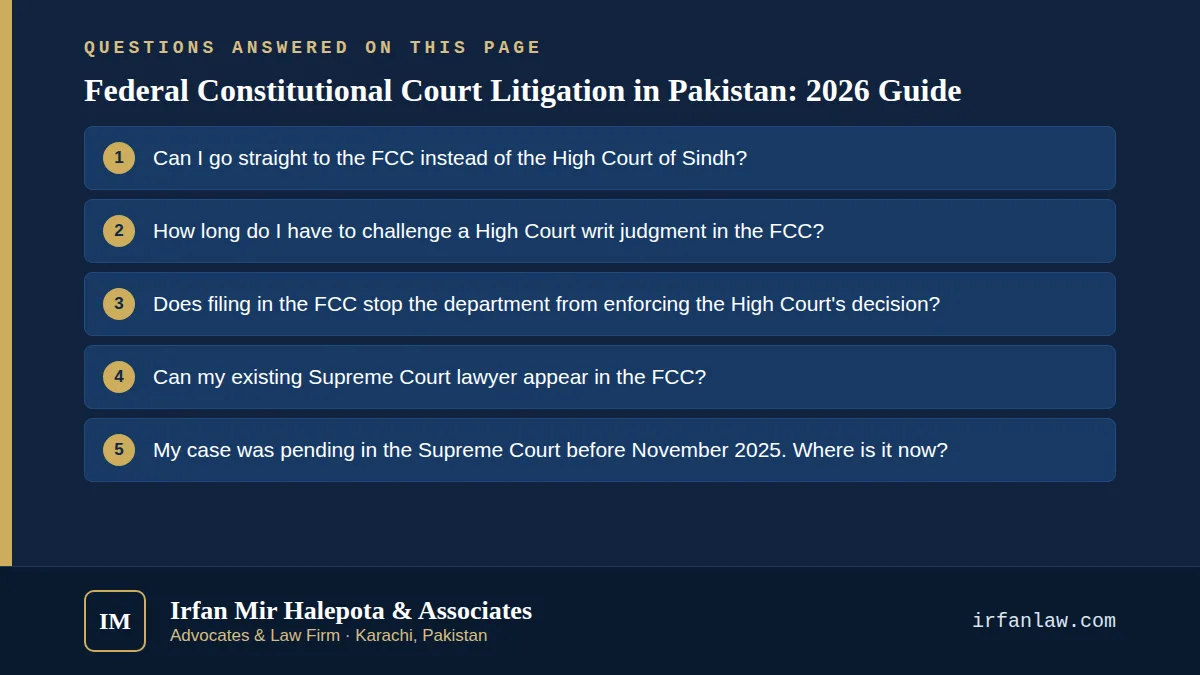
Can I go straight to the FCC instead of the High Court of Sindh?
Only in limited cases. Article 175E(3) lets the FCC enforce Fundamental Rights where a question of public importance arises and a person applies, but it operates without prejudice to Article 199, and most grievances against a department or authority still start with a writ petition in the High Court. Inter-governmental disputes under Article 175E(1) are for governments, not private parties.
How long do I have to challenge a High Court writ judgment in the FCC?
Sixty days from the judgment, decree or final order, under Order XV, rule 1 of the Federal Constitutional Court (Practice and Procedure) Rules, 2026. The Court can extend time for sufficient cause but is not obliged to. Order the certified copy at once so the deadline is not lost waiting for it.
Does filing in the FCC stop the department from enforcing the High Court's decision?
No. The Rules say a petition or appeal does not by itself operate as a stay. You must apply for a stay, and the Court may impose terms such as security.
Can my existing Supreme Court lawyer appear in the FCC?
Yes, for now. Advocates on the Supreme Court's roll may appear as if enrolled in the FCC, and Supreme Court Advocates-on-Record are treated as FCC Advocates-on-Record. From 1 January 2027, only those on the FCC's own roll of Advocates-on-Record may act in that role.
My case was pending in the Supreme Court before November 2025. Where is it now?
If it fell within the FCC's jurisdiction, such as a petition for leave from an Article 199 judgment, it was transferred to the FCC by Articles 175E(4) and 175F(2) and has a new FCC number. Other matters, such as ordinary civil appeals and Service Tribunal appeals, stayed in the Supreme Court.
Is an FCC decision binding on the Supreme Court?
Yes. Under the amended Article 189, FCC decisions on questions of law bind all other courts, including the Supreme Court. Supreme Court decisions bind every court except the FCC.
Can I appeal to the FCC in a rent or family case decided on a writ petition?
Generally no. Article 175F(1)(c) excludes appeals from Article 199 judgments in rent and family cases, except guardianship and other matters fixed by law.
This article is general information about Pakistani law and procedure, not legal advice for any specific matter. If this touches on something you're currently facing, get in touch and we'll advise on your facts directly.