Appealing a Service Tribunal Judgment to the Supreme Court under Article 212(3)
A Federal or Sindh Service Tribunal judgment can be challenged only in the Supreme Court of Pakistan, by a civil petition for leave to appeal under Article 212(3) of the Constitution. Leave is granted only if the case involves a substantial question of law of public importance, and the petition should be filed within 60 days of the Tribunal's judgment. The 27th Amendment did not change this route.
A judgment of the Federal Service Tribunal or the Sindh Service Tribunal is not the end of the road, but the next step is narrow. There is no automatic second appeal: the only route is a civil petition for leave to appeal (CPLA) to the Supreme Court of Pakistan under Article 212(3) of the Constitution, and the Court will hear the appeal only if it first grants leave. If you are looking for the best service lawyer or Supreme Court service lawyer in Karachi to take a Tribunal judgment further, the first question to put to them is not whether the Tribunal was wrong, but whether its error raises a substantial question of law of public importance. This guide explains that test, the deadline, the post-27th Amendment position and what happens to the Tribunal's judgment while the petition is pending, for civil servants and for government departments alike.
What Article 212(3) actually allows
Article 212 lets Parliament and the Provincial Assemblies set up administrative courts and tribunals for, among other things, matters relating to the terms and conditions of persons in the service of Pakistan. The Federal Service Tribunal under the Service Tribunals Act, 1973 and the Sindh Service Tribunal under the Sindh Service Tribunals Act, 1973 are both tribunals of this kind. Once a matter falls within a Tribunal's jurisdiction, Article 212(2) shuts out every other court, including the High Court's writ jurisdiction under Article 199.
Article 212(3) then provides the single exit. An appeal to the Supreme Court from a judgment, decree, order or sentence of an administrative court or tribunal lies only if the Supreme Court, being satisfied that the case involves a substantial question of law of public importance, grants leave to appeal. Three things follow from that wording:
- Leave comes first. The petition is a request for permission; most petitions are decided at that stage.
- A question of law is required. A disagreement with how the Tribunal weighed the evidence is not enough on its own.
- Public importance is a separate hurdle. The question must matter beyond the individual case, or the Court must be satisfied that it otherwise warrants its attention.
The test is the same whether the petition comes from the Federal Service Tribunal or the Sindh Service Tribunal, and whether it is filed by the civil servant or by the department. For the boundaries of Tribunal jurisdiction itself, see our guide to Service Tribunal jurisdiction under Article 212.
Which court after the 26th and 27th Amendments
The Constitution (Twenty-seventh Amendment) Act, 2025, which received assent on 13 November 2025, created the Federal Constitutional Court and gave it, under the new Article 175F, appellate jurisdiction over High Court judgments, including (with leave) judgments made under Article 199. The same Act re-wrote Article 185 so that the Supreme Court no longer hears appeals in cases covered by Article 175F.
The 27th Amendment did not amend Article 212. The result for service matters in Karachi is a split route that clients often find confusing:
| Decision you want to challenge | Where it goes |
|---|---|
| Judgment of the Federal Service Tribunal or Sindh Service Tribunal | Supreme Court of Pakistan, by CPLA under Article 212(3) |
| Judgment of a High Court Constitutional Bench in a service-related writ under Article 199 (for example, an employee of a body whose staff are not civil servants) | Federal Constitutional Court, with leave, under Article 175F(1)(c) |
| Tribunal judgment challenged by writ in the High Court | Not maintainable: Article 212(2) bars it |
The last row is a common and costly mistake. In Lal Bux v. Province of Sindh and others (Constitution Petition No. D-149 of 2026, order dated 25.03.2026), a Division Bench of the High Court of Sindh at its Larkana circuit dismissed in limine a writ petition against a Sindh Service Tribunal order that had dismissed an appeal as time-barred, holding that the only remedy was to approach the Supreme Court under Article 212(3). Time spent in the wrong forum is time lost from the Supreme Court deadline. Our guides to Supreme Court litigation and the Federal Constitutional Court explain the wider post-amendment structure.
What counts as a substantial question of law of public importance
The phrase has no statutory definition, and whether it is met is ultimately for the bench hearing the petition. From practice, petitions are more likely to cross the threshold where they turn on points such as:
- the meaning of a provision of the Civil Servants Act, 1973, the Sindh Civil Servants Act, 1973, or rules made under them, where the reading affects a class of employees rather than one person;
- whether the Tribunal had jurisdiction at all, for instance whether the appellant was a civil servant or whether the matter was one of fitness for promotion that the Tribunals Acts exclude;
- limitation and condonation, where the Tribunal refused to hear the appeal on merits;
- conflicting Tribunal decisions on the same rule, or a Tribunal decision that departs from Supreme Court authority;
- a disciplinary process so defective (no charge sheet, no hearing, no inquiry where one was required) that the outcome raises a legal rather than factual issue.
Petitions that simply re-argue facts usually fail. Two reported orders illustrate the approach. In Pakistan Railways v. Muhammad Aslam, 2024 SCMR 97, the Supreme Court refused leave against a Federal Service Tribunal judgment that had set aside the withdrawal of an employee's absorption made some six years earlier, finding no illegality or perversity and no substantial question of law of public importance under Article 212(3). In Dr. Yasmeen Jaffar v. Dr. Shehla Sami, 2019 SCMR 993, leave was refused in a proforma promotion dispute because no legal, procedural or jurisdictional defect in the Tribunal's judgment had been shown.
The practical lesson for both sides: frame the petition around a clearly stated legal question, show why it matters beyond the parties, and do not bury it under a factual narrative.
Deadline and filing a CPLA against a Service Tribunal judgment
The Supreme Court's own guidance states that a civil petition for leave to appeal under Article 212(3) is to be filed within 60 days of the Tribunal's judgment or order. The Supreme Court Rules, 2025 replaced the 1980 Rules with effect from 6 August 2025, and the 60-day period should be confirmed against the current Rules on the day the file is opened. Count from the date the judgment is announced, not from the date you happen to receive it, and do not assume that time spent waiting for a certified copy will be excluded unless the Rules or the Limitation Act clearly allow it.
A petition filed late must be accompanied by an application for condonation of delay explaining the whole period of delay. Government departments are not exempt from this; delay caused by internal file movement between the department, the Law Department or the Solicitor's office is a frequent reason why departmental petitions are dismissed as time-barred. Our guide to limitation and condonation of delay in service appeals covers the principles at Tribunal level.
| Step | What to do |
|---|---|
| Day 1 | Note the date the Tribunal's judgment was announced; apply for a certified copy at once. |
| Within the first fortnight | Obtain the full Tribunal record: memo of appeal, departmental replies, impugned orders, inquiry report and any written arguments. |
| Before day 60 | File the CPLA with the grounds, the questions of law, the certified copy and the record relied upon. |
| With the petition | File any application for suspension of the Tribunal's judgment or for interim relief, supported by reasons. |
Petitions from Karachi are filed at the Supreme Court's Branch Registry on M.R. Kayani Road. The Court's guidance allows filing through an Advocate-on-Record, and a party may also file in person. The petition should state the questions of law in short numbered form at the outset; a bench reading dozens of petitions in a day will look for them first.
Petitions by civil servants and by departments
Article 212(3) is available to whichever side loses before the Tribunal. In practice the two sides face different problems.
A civil servant who lost usually needs to show that the Tribunal misapplied a rule, decided without jurisdiction, wrongly dismissed the appeal on limitation, or overlooked a legal defect in the disciplinary process. If the Tribunal has already reduced or modified the penalty, the petition must explain why that modification is itself unlawful, not merely insufficient.
A department that lost must take a decision to challenge the judgment quickly and record it properly. A department that intends to petition the Supreme Court should also ask for suspension of the Tribunal's judgment; filing a CPLA does not by itself suspend it. If the Court declines to suspend, the department is expected to implement the judgment, usually subject to the outcome of the petition.
A successful civil servant who becomes the respondent should keep the Tribunal judgment, joining and pay records ready, appear when notice is issued, and resist suspension where the department has shown no strong case. Where the Tribunal ordered reinstatement or arrears, the respondent should also be ready to show what has, and has not, been paid.
After leave: the appeal, the outcome and review
If leave is granted, the petition is converted into a civil appeal and heard on the questions on which leave was given. The Supreme Court can then allow the appeal and set aside or modify the Tribunal's judgment, remand the matter to the Tribunal for fresh decision, or dismiss the appeal. Where leave is refused, the Tribunal's judgment stands and becomes final between the parties.
A party aggrieved by the Supreme Court's own judgment or order may seek review under Article 188 of the Constitution. Under the Supreme Court Rules, 2025, as reported when they were notified, a review application must be filed within 30 days of the judgment and must state the grounds clearly with a certified copy of the judgment. Review is not a rehearing: an argument already considered and rejected will not ordinarily be entertained again, and a review petition should be reserved for a genuine error apparent on the face of the record.
Implementing a Tribunal judgment: execution and contempt
Many service disputes are won on paper and lost in implementation. The position differs by forum.
- Sindh Service Tribunal. Section 5(2) of the Sindh Service Tribunals Act, 1973 deems the Tribunal a civil court with Code of Civil Procedure powers, and clause (d), added by Sindh Act No. V of 2012, expressly includes the execution of its decisions. A Sindh civil servant whose Tribunal judgment is ignored can therefore apply to the Tribunal itself for execution. Section 5(1) also confirms the Tribunal's power to confirm, set aside, vary or modify the order appealed against.
- Federal Service Tribunal. The Service Tribunals Act, 1973 likewise deems the Tribunal a civil court for deciding appeals. The precise execution procedure before the Federal Service Tribunal should be checked against the current text of the Act and its procedure rules before an application is filed.
- Supreme Court orders. Once the Supreme Court decides the matter, its orders are enforceable throughout Pakistan under Article 187(2), every executive and judicial authority must act in its aid under Article 190, and wilful disobedience can be punished as contempt under Article 204.
For departments, the point cuts the other way. A Tribunal judgment that has not been suspended should be implemented, or a suspension sought, within the time available. Sitting on a judgment while no petition is pending exposes officers to execution proceedings and, once the Supreme Court is seized, to contempt proceedings. More on the overall sequence is on our civil services law practice page.
Common mistakes and a Karachi checklist
- Filing a writ in the Sindh High Court against a Tribunal judgment. Article 212(2) bars it, and the time lost counts against the 60 days.
- Waiting for the certified copy before starting work, instead of reading the announced judgment and preparing grounds in parallel.
- Re-arguing facts without identifying a question of law and explaining its public importance.
- Ignoring the Tribunal record. The Supreme Court decides on the record that was before the Tribunal; documents never produced there will rarely help.
- Assuming a pending petition stops implementation. It does not unless the Court suspends the judgment.
- Using review as a second appeal after leave has been refused.
Before filing, bring the Tribunal judgment, the memo of appeal and replies, the impugned departmental orders, the inquiry papers if any, and your service record. An early, honest assessment of whether a real question of law exists saves time for civil servants and departments alike.
Official sources
- High Court of Sindh, Lal Bux v. Province of Sindh and others, C.P. No. D-149 of 2026 (order dated 25.03.2026)
- Supreme Court of Pakistan, Frequently Asked Questions
- Constitution (Twenty-seventh Amendment) Act, 2025
- Sindh Service Tribunals Act, 1973 (High Court of Sindh copy)
- Business Recorder, SC enacts Supreme Court Rules 2025
- Pakistan Railways v. Muhammad Aslam, 2024 SCMR 97 (headnote)
Common questions
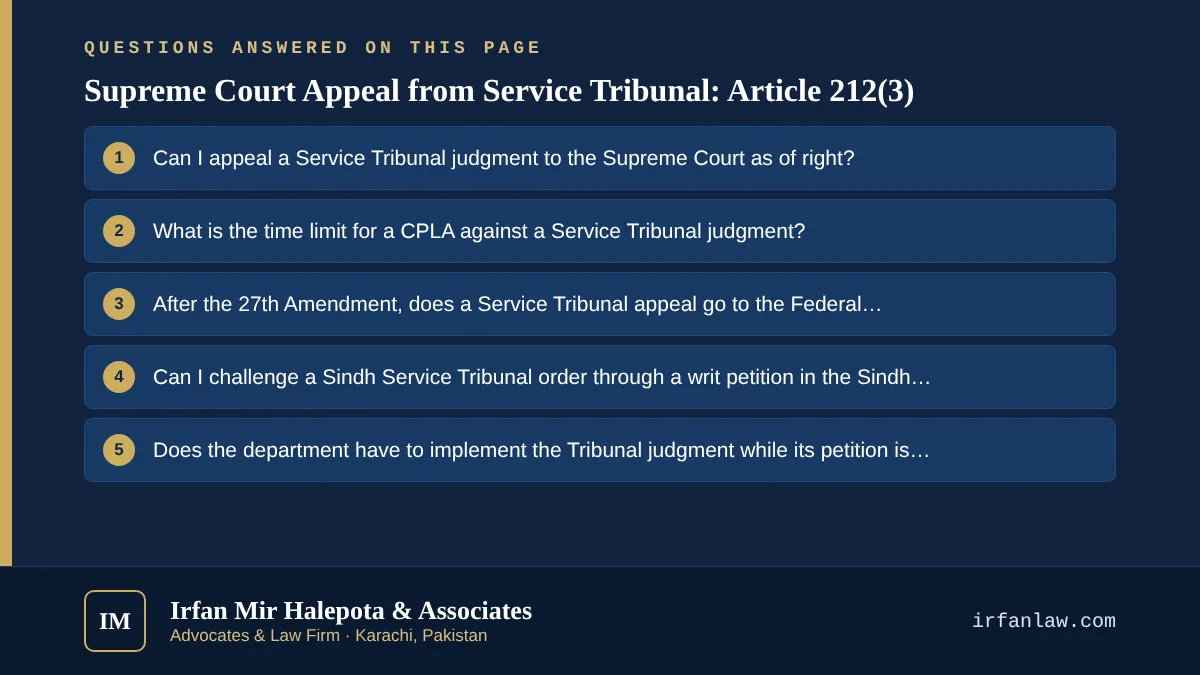
Can I appeal a Service Tribunal judgment to the Supreme Court as of right?
No. Under Article 212(3) of the Constitution there is no appeal as of right. You must file a civil petition for leave to appeal, and the Supreme Court hears the appeal only if it is satisfied that the case involves a substantial question of law of public importance.
What is the time limit for a CPLA against a Service Tribunal judgment?
The Supreme Court's published guidance gives 60 days from the Tribunal's judgment or order for a civil petition for leave to appeal under Article 212(3). The Supreme Court Rules, 2025 apply from 6 August 2025, so confirm the period against the current Rules. A late petition needs a separate application explaining the entire delay.
After the 27th Amendment, does a Service Tribunal appeal go to the Federal Constitutional Court?
No. The 27th Amendment gave the Federal Constitutional Court appeals from High Court judgments, including Article 199 writ judgments with leave, but it did not amend Article 212. Petitions against Federal and Sindh Service Tribunal judgments continue to go to the Supreme Court under Article 212(3).
Can I challenge a Sindh Service Tribunal order through a writ petition in the Sindh High Court?
Ordinarily no. Article 212(2) bars other courts from matters within the Tribunal's jurisdiction, and the High Court of Sindh has dismissed such petitions as not maintainable, directing the petitioner to the Supreme Court. Filing a writ instead of a CPLA can cost you the Supreme Court deadline.
Does the department have to implement the Tribunal judgment while its petition is pending?
Filing a petition does not suspend the Tribunal's judgment by itself. Unless the Supreme Court grants a suspension or other interim order, the judgment remains operative, and in Sindh the Tribunal has express power to execute its decisions.
Can the Supreme Court's decision on my service appeal be reviewed?
Yes, under Article 188 of the Constitution, but review is narrow. It is meant for an error apparent on the record, not for re-arguing the case, and under the Supreme Court Rules, 2025 the review application must be filed within 30 days with a certified copy of the judgment.
Where do Karachi litigants file a petition in the Supreme Court?
At the Supreme Court's Branch Registry in Karachi on M.R. Kayani Road. Petitions may be filed through an Advocate-on-Record or by the party in person, although most service petitions are argued by counsel enrolled to appear before the Supreme Court.
This article is general information about Pakistani law and procedure, not legal advice for any specific matter. If this touches on something you're currently facing, get in touch and we'll advise on your facts directly.