Regularisation, Probation, Ad Hoc Appointments and Deputation: A Guide for Federal and Sindh Civil Servants
Whether you can be let go without an inquiry, regularised, repatriated or absorbed depends first on the type of your appointment. Probationers and ad hoc appointees are “civil servants” whose service can be ended under section 11 of the Civil Servants Act, 1973 (and the identical section 11 of the Sindh Civil Servants Act, 1973), while contract employees and deputationists are expressly excluded from the definition in section 2(1)(b). Contract employees have no vested right to regularisation unless a law or policy gives one, such as the Sindh (Regularization of Adhoc and Contract Employees) Act, 2013.
Most service disputes are argued about what an officer did. Disputes about regularisation, probation, ad hoc posts and deputation turn instead on what the officer is: probationer, ad hoc appointee, contract employee, deputationist or confirmed civil servant. Each label carries different security, a different way of being ended and, often, a different forum. Anyone searching for the best service lawyer in Karachi after a contract was not renewed, a regularisation file stalled or a repatriation order arrived should start with one question: does the law treat me as a “civil servant” at all? This guide answers that for federal and Sindh employees and explains what each side, the employee and the department, is entitled to expect.
Your appointment type decides your rights and your forum
Both service statutes start from the same definition. Under section 2(1)(b) of the Civil Servants Act, 1973 (federal) and section 2(1)(b) of the Sindh Civil Servants Act, 1973, a civil servant is a member of the civil service, or the holder of a civil post, of the Federation or the Province. Both definitions then exclude three groups: a person on deputation from another government or authority; a person employed on contract, on work-charged basis or paid from contingencies; and a “worker” or “workman” under the factories and workmen’s compensation laws.
Probationers and ad hoc appointees are not excluded. That single drafting choice explains most of what follows.
| Appointment type | “Civil servant” under s.2(1)(b)? | How it can lawfully end | Usual forum for a grievance |
|---|---|---|---|
| Regular, on probation | Yes | Termination without notice during initial or extended probation (s.11(1)(i)) | Departmental remedy, then Service Tribunal |
| Ad hoc | Yes | On appointment of a regularly selected person (s.11(1)(iii)) or 14 days’ notice or pay in lieu (s.11(3)) | Departmental remedy, then Service Tribunal |
| Contract | No | Expiry or the contract’s own terms | Not the Service Tribunal; a High Court petition only in limited cases |
| Deputationist | No, in the borrowing government | Repatriation to the parent department | Through the parent department’s service structure |
Whether a person employed by a corporation, authority or university is a civil servant is a separate question, covered in our guide to Service Tribunal jurisdiction under Article 212.
Probation and confirmation: what the rules actually say
Under section 6 of both Acts, an initial appointment, other than an ad hoc appointment, is made on probation for the prescribed period, and a promotion or transfer may also be made on probation. Probation is not complete until the appointing authority is satisfied that the officer’s character and antecedents have been verified as satisfactory. A probationer who fails a prescribed examination, test, course or training is discharged if directly recruited, or reverted to the former post if promoted or transferred.
For Sindh, the Sindh Civil Servants (Probation, Confirmation and Seniority) Rules, 1975 fill in the detail:
- Rule 2: initial recruits serve two years’ probation; promotees and transferees may be placed on one year’s probation if the appointing authority so directs. Service on deputation to an equivalent or higher post counts towards probation.
- Rule 3: probation may be extended by up to one year at a time, for reasons recorded in writing. If no order is passed when the initial period ends, probation is deemed extended by one year; if none is passed after an extended period, the appointment is deemed continued until further orders.
- Rules 4 and 8: confirmation is made in order of seniority against a permanent post and is not deferred unless disciplinary proceedings are pending or the authority records reasons.
Two practical points follow. First, there is no “deemed confirmation” in the Sindh rules: silence extends probation rather than confirming the officer. Second, section 7 of both Acts provides that there is no confirmation against a temporary post, and that confirmation takes effect from the date a permanent vacancy occurs. Federal probation periods are set by the federal appointment rules and the recruitment rules for each post, so check those for your cadre rather than assuming the Sindh periods apply.
Termination during probation
Section 11(1)(i) of both Acts allows the service of a probationer to be terminated without notice during the initial or extended period of probation. Where the probationer was appointed by promotion or transfer and holds a lien on a former post, the consequence is reversion to that post rather than loss of service.
The power is wide but not unlimited. Departments should make sure the order is issued within the probation period, by the competent authority, and without importing allegations of misconduct that the officer has never been asked to answer. Where an order reads like a finding of misconduct, officers commonly argue that it is a disguised penalty which should have followed the Efficiency and Discipline Rules. How far that argument succeeds depends on the wording and the record. In Rashida Farnaz v. Federation of Pakistan (C.P. No. D-3514 of 2014), the Sindh High Court treated a reason stated in a termination order on completion of probation as “only an intimation” for not regularising the officer and left any claim based on stigma to the forum having jurisdiction.
For the officer, the useful documents are the appointment order (which fixes the probation period), every extension order, and any performance reports. For the department, a short, neutral order made in time, with the file showing why probation was not completed satisfactorily, is the safest course.
Ad hoc appointments: temporary by design
Section 2(1)(a) of both Acts defines an ad hoc appointment as the appointment of a duly qualified person otherwise than by the prescribed method of recruitment, pending recruitment by that method. Three consequences follow from the statutes:
- An ad hoc appointment made terminable on the appointment of a person recommended by the selection authority ends when that person joins (s.11(1)(iii)).
- Temporary and ad hoc service is liable to termination on fourteen days’ notice or pay in lieu (s.11(3)).
- A civil servant appointed to a higher post on ad hoc, temporary or officiating basis is liable to reversion to the lower post (s.12).
In Sindh, rule 19 of the Sindh Civil Servants (Appointment, Promotion and Transfer) Rules, 1974 permits an urgent post that falls within the Public Service Commission’s purview to be filled on ad hoc basis for a period not exceeding six months, and the post must be advertised. Rule 10(2) of the 1975 Probation Rules adds that no ad hoc appointment shall be regularised retrospectively, and rule 10(1) counts seniority from the date of regular appointment.
The common mistake is to treat years of ad hoc service as building a right to the post. Ad hoc service is a holding arrangement; what protects the officer is selection through the prescribed method, or a statute that regularises the service.
Contract employees and regularisation
Contract employees are outside the definition of civil servant in both Acts. The Supreme Court has repeatedly held that long or satisfactory contract service, by itself, creates no vested right to regularisation: regularisation needs the backing of a law, rules or policy. That line includes Government of Khyber Pakhtunkhwa v. Sher Aman, 2022 SCMR 406, and Pakistan Telecommunication Company Ltd. v. Muhammad Samiullah, 2021 SCMR 998. The Sindh High Court applied it in October 2026, holding that no writ can issue to regularise a contract employee absent a statute or policy (Syed Khadim Hussain Shah v. Province of Sindh, C.P. No. D-874 of 2024, Sukkur).
Sindh has such a statute. Section 3 of the Sindh (Regularization of Adhoc and Contract Employees) Act, 2013 (Sindh Act No. XXV of 2013, in force from 25 March 2013) deems an employee appointed on ad hoc or contract basis to have been validly appointed on regular basis if:
- the post is in BS-1 to BS-18 or an equivalent scale;
- the employee is otherwise eligible for appointment to that post;
- the employee is serving in a Sindh Government department, or a project of that department connected with the affairs of the Province; and
- the employee was in service immediately before the Act commenced.
Daily-wage and work-charged employees are excluded. The Sindh High Court has refused regularisation under the Act to work-charged and fixed-pay staff (Arif Masih v. Province of Sindh, C.P. No. D-96 of 2024, Hyderabad), and has treated employees on fixed-period project posts in an autonomous authority differently from holders of sanctioned budgetary posts (Qurat-ul-Ain v. Province of Sindh, C.P. No. D-5311 of 2016).
Three recent Supreme Court developments, reported in the press and still to be checked against the reported judgments, matter in Karachi practice. In March 2024 a three-member bench set aside a Sindh High Court judgment that had reversed regularisations under the 2013 Act on its own motion, holding that a High Court has no suo motu power under Article 199, and remanded the petitions. In June 2026 a bench held that, because of the Act’s deeming clause, seniority of employees regularised under it runs from 25 March 2013, not from a later notification. In July 2026 a bench held that contract service cannot be counted as qualifying service for promotion in the Sindh Government, because seniority and promotion eligibility run from regular appointment.
Seniority after regularisation is dealt with more fully in our guide to seniority and promotion disputes.
Deputation and repatriation: deputationist status in service law
A deputationist remains a civil servant of the parent government or authority. In the borrowing government, section 2(1)(b)(i) of both Acts says expressly that he or she is not a civil servant. The Supreme Court has held that a deputationist has no vested right to remain on the post and can be repatriated at any time (Dr. Shafi-ur-Rehman Afridi v. CDA, Islamabad, 2010 SCMR 378), and has no right to remain on deputation for an indefinite period (S. Masood Abbas Rizvi v. Federation of Pakistan, 2014 SCMR 799).
On the federal side, the Supreme Court in Ghansham Das v. Government of Khyber Pakhtunkhwa, 2024 SCMR 188, relied on the Civil Establishment Code (ESTACODE) for the position that the normal period of deputation is three years, extendable by two, to a maximum of five; that an officer stands relieved on expiry unless an extension was approved in advance; and that a deputationist has no right to serve out the full term. For Sindh, the Sindh High Court has noted Supreme Court directions confining deputation to three years (Hameedullah v. Province of Sindh, C.P. No. D-1702 of 2020).
For the officer, the practical consequence is that a repatriation order is rarely worth fighting on its own. The stronger questions usually concern what happens next: pay protection, a fair posting in the parent cadre, and whether time on deputation counts for probation, which in Sindh it does where the deputation post was equivalent or higher (rule 2 of the 1975 Rules).
Absorption: when it is lawful and when it is not
Absorption means permanently appointing someone into a cadre other than the one he or she was recruited to. The law allows it only on narrow terms:
- Federal: section 11A of the Civil Servants Act, 1973 permits a civil servant rendered surplus by reorganisation or abolition of a Division, department, office or post to be absorbed against a post of equal scale (or, failing that, a lower post with pay protection), if qualified.
- Sindh: rule 9-A of the 1974 APT Rules similarly provides for a person rendered surplus by abolition of a post to be appointed to a post of equivalent or comparable scale, with seniority in the new cadre counted from the date of appointment to it.
Outside those routes, the Supreme Court has been firm. In Contempt Proceedings against Chief Secretary Sindh, 2013 SCMR 1752, it struck down the Sindh provisions that had allowed out-of-turn promotion and absorption across cadres; the Sindh Code footnotes record sections 9-A, 10-A and 23-B of the Sindh Act as declared ultra vires. In Ali Azhar Khan Baloch v. Province of Sindh, 2015 SCMR 456, it held that no civil servant of a non-cadre post can be transferred out of cadre to be absorbed in a cadre post. Applying these, the Sindh High Court in 2024 held that a federal absorption could only have been made under section 11A and directed the officer’s repatriation (Ubaidullah Qazi v. Federation of Pakistan, C.P. No. D-4657 of 2023).
A deputationist who asks to be absorbed should therefore expect the department to say no unless one of the statutory routes fits, and a department that absorbs outside them risks the absorption later being set aside.
Which forum, which documents, and common mistakes
Forum. Probationers and ad hoc appointees are civil servants, so a grievance about their terms and conditions goes first to the departmental authority and then to the Federal or Sindh Service Tribunal; see our guide on the departmental appeal that must come first. Contract employees cannot use the Service Tribunal. A constitutional petition under Article 199, now heard by a Constitutional Bench of the High Court, is possible only where a legal right can be shown, for example under the Sindh Regularisation Act; the Supreme Court has held that Article 199 is not available to contractual employees of a statutory body such as NADRA to enforce their contracts (Chairman NADRA v. Muhammad Ali Shah, 2017 SCMR 1979). The civil services practice page sets out the wider sequence.
Documents to gather.
- The appointment order and offer letter, with any “no right of regularisation” clause
- Every extension or renewal order, and the gaps between them
- Proof that the post is a sanctioned budgetary post, not a project or contingency post
- Any scrutiny committee decision or regularisation notification
- For deputationists, the deputation order with its stated period and the parent department’s consent
Common mistakes. Relying on length of service instead of a statute or policy; letting the departmental time limit pass while waiting for a regularisation notification; claiming seniority from initial ad hoc or contract engagement where the rules count it from regular appointment; and, on the department’s side, extending probation or deputation without a written order, which is exactly what produces later disputes.
Official sources
- Civil Servants Act, 1973 (federal)
- Sindh Civil Servants Act, 1973 (with amendment footnotes)
- Sindh Civil Servants (Probation, Confirmation and Seniority) Rules, 1975
- Sindh (Regularization of Adhoc and Contract Employees) Act, 2013
- Sindh High Court, Tahira Hanif v. Province of Sindh, C.P. No. D-3184 of 2021 (deputation and absorption)
- Sindh High Court, Arif Masih v. Province of Sindh, C.P. No. D-96 of 2024 (regularisation)
Common questions
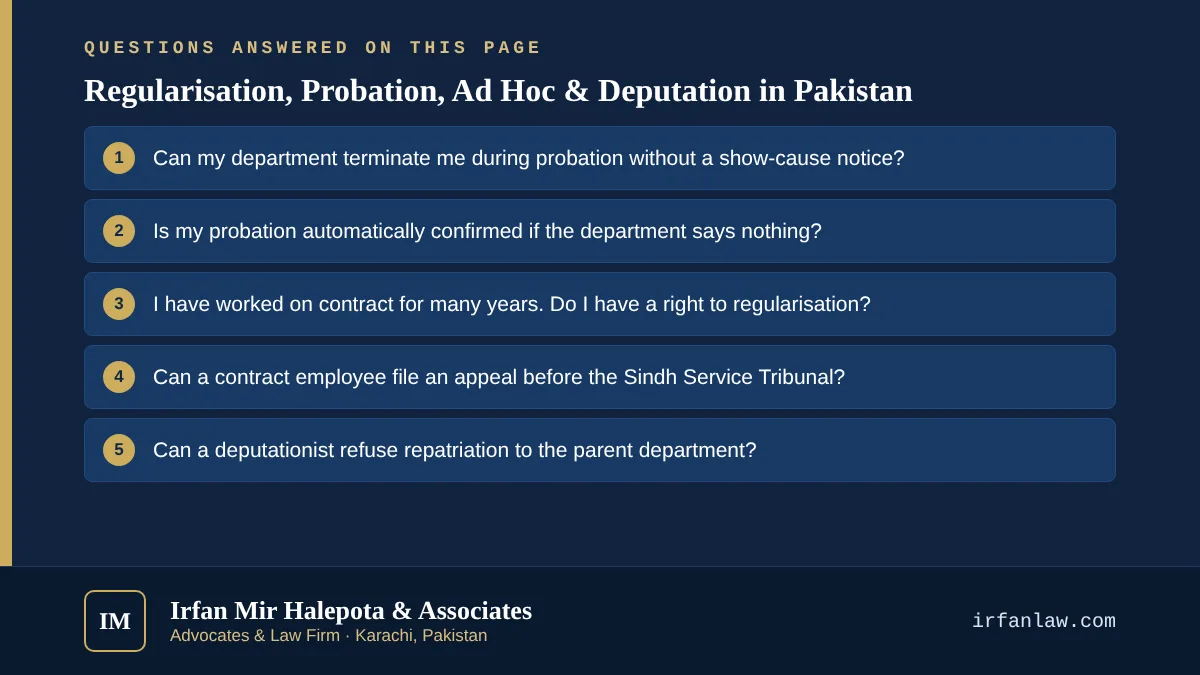
Can my department terminate me during probation without a show-cause notice?
Section 11(1)(i) of the federal and Sindh Civil Servants Acts allows termination without notice during the initial or extended probation period. If you were promoted or transferred and hold a lien on your earlier post, you revert to it instead. If the order accuses you of misconduct, take advice quickly, because whether it is a disguised penalty depends on its wording and the record.
Is my probation automatically confirmed if the department says nothing?
Not in Sindh. Rule 3 of the Sindh Civil Servants (Probation, Confirmation and Seniority) Rules, 1975 treats silence at the end of the initial period as an extension by one year, and silence after an extended period as continuation until further orders. Confirmation still needs an order against a permanent post.
I have worked on contract for many years. Do I have a right to regularisation?
Not by length of service alone. The Supreme Court has held that regularisation needs the backing of a law, rules or policy. In Sindh, the Regularization of Adhoc and Contract Employees Act, 2013 covered ad hoc and contract employees in BS-1 to BS-18 who were in service immediately before 25 March 2013 and otherwise eligible, but not daily-wage or work-charged staff.
Can a contract employee file an appeal before the Sindh Service Tribunal?
Generally no, because section 2(1)(b) of the Sindh Civil Servants Act, 1973 excludes persons employed on contract from the definition of civil servant, and the Tribunal hears civil servants. A contract employee who can point to a statutory right, such as regularisation under the 2013 Act, may consider a constitutional petition in the Sindh High Court.
Can a deputationist refuse repatriation to the parent department?
Usually not. The Supreme Court has held that a deputationist has no vested right to stay on the post and can be repatriated at any time. Federal practice under ESTACODE treats three years, extendable by two, as the limit, and the officer stands relieved when the approved period ends.
Can I be absorbed in the department where I am serving on deputation?
Only through a lawful route, such as absorption of a surplus civil servant under section 11A of the federal Act or rule 9-A of the Sindh appointment rules. The Supreme Court in 2013 SCMR 1752 and 2015 SCMR 456 struck down cross-cadre absorptions in Sindh made outside the rules, and such absorptions can be reversed later.
Does my ad hoc service count for seniority?
In Sindh, rule 10 of the 1975 Rules counts seniority from regular appointment and bars retrospective regularisation of ad hoc appointments. Where a statute deems employees regular from a fixed date, as the 2013 Sindh Act does, seniority has been held to run from that statutory date instead.
This article is general information about Pakistani law and procedure, not legal advice for any specific matter. If this touches on something you're currently facing, get in touch and we'll advise on your facts directly.