Seniority and Promotion Disputes: A Guide for Federal and Sindh Civil Servants
A civil servant can challenge a wrong seniority list or a denial of promotion based on eligibility before the Service Tribunal, after a departmental representation. But under section 4(1)(b) of the Service Tribunals Act, 1973 (and the same clause in the Sindh Act) no appeal lies against a decision on a person's fitness for promotion. Seniority itself runs from the date of regular appointment under section 8 of the Civil Servants Act, 1973 and its Sindh equivalent, not from acting charge or ad hoc service.
Seniority decides who is considered for promotion and when, so a single misplaced name on a seniority list can cost an officer years. Disputes in this area turn on a distinction that many officers miss: the law lets a civil servant contest where he stands and whether he was eligible, but largely shields the selection board's judgement of his fitness. Anyone looking for the best service lawyer in Karachi for a promotion case should first ask whether the complaint is about eligibility or about fitness, because that answer decides whether the Service Tribunal can hear it at all. This guide covers both federal civil servants and those serving the Government of Sindh.
How seniority is fixed: federal and Sindh rules
Both the federal Civil Servants Act, 1973 and the Sindh Civil Servants Act, 1973 require the appointing authority to maintain a seniority list for each service, cadre or post. Section 8(1) of each Act adds that the list confers no vested right to a particular seniority. Seniority is reckoned against others in the same service or cadre, whether or not they work in the same department.
The core rule is in section 8(4) of both Acts: seniority in a post to which a civil servant is promoted takes effect from the date of regular appointment to that post. Officers promoted in one batch keep their inter se seniority from the lower post.
The detail sits in subordinate rules, and here the two regimes differ:
| Question | Federal: Civil Servants (Seniority) Rules, 1993 | Sindh: Sindh Civil Servants (Probation, Confirmation and Seniority) Rules, 1975 |
|---|---|---|
| Initial recruitment | Rule 2: earlier open advertisement ranks senior; within one batch, merit order assigned by the selection authority | Rule 11(a): merit order of the selection authority; a person selected in an earlier selection ranks senior |
| Promotion | Rule 3: from the date of regular promotion; earlier selection ranks senior; one batch keeps lower-post order | Rule 11(b): inter se seniority in the lower post |
| Promotees and direct recruits on the same date | Rule 6: date of regular appointment | Rule 11(c): promotees rank senior to direct recruits |
| Officer not considered on his turn | Rule 3, proviso (c): on promotion, takes seniority with the original batch | Rule 13(1): deemed promoted in the same batch as his juniors, if the delay was not due to unfitness |
| Transfer on own request | Rule 4: from the date of regular appointment to the new cadre | Rule 12(b): placed junior to those already regularly appointed |
The Sindh rules also require the appointing authority to prepare or revise the seniority list in January every year (rule 9(2)), and they bar retrospective regularisation of ad hoc appointments (rule 10(2)). Never assume a federal rule applies to a Sindh cadre, or the reverse: the inter se rule for promotees and direct recruits is a good example of how they part ways.
Employees of statutory corporations and autonomous bodies are usually outside both sets of rules. Their seniority depends on the body's own service regulations, and the forum depends on whether they are civil servants at all, a question covered in our guide to Service Tribunal jurisdiction under Article 212.
Objections to a tentative seniority list
Most departments circulate a tentative seniority list and invite objections before it is finalised. This is the cheapest and fastest point at which to correct an error. An objection filed now is decided on the department's own record; a challenge mounted years later meets arguments about settled seniority and delay.
A useful objection does three things:
- Identifies the exact entry complained of and the officers placed above you, by name and serial number.
- States the rule that governs your placement, for example the date of regular appointment, the merit order in the selection list, or the batch in which you were promoted.
- Attaches the documents that prove the operative dates: appointment and promotion notifications, the selection authority's merit list, and joining reports.
Keep a diary number or acknowledgement. When the final list is issued and your objection has been rejected or ignored, that final list (or the order rejecting the objection) is usually the order you take forward by way of departmental representation.
Departments also have duties. A seniority position already granted is an important service right, and the Supreme Court in October 2026, in review proceedings concerning Sindh Police sub-inspectors, held that revising seniority without hearing the affected officers offended natural justice and Article 10-A of the Constitution. The judgment was reported by the national news agency; its formal citation should be checked before reliance. In practice, any department that intends to push officers down a list should issue notice, hear them and pass a reasoned order.
Antedated seniority, retrospective promotion and proforma promotion
Officers often ask for their seniority or promotion to be antedated, that is, given effect from an earlier date. The general rule is against it. Promotion runs from the date of regular promotion, and the High Court of Sindh has repeatedly said that promotion cannot be granted retrospectively and that acting charge service cannot later be regularised with backdated effect (for example, C.P. No. D-6666 of 2016, High Court of Sindh).
The recognised exception is where the officer was eligible and in line, but was not considered on his turn for a reason that was not his fault: undetermined seniority, missing performance reports, deputation, training, leave or pending proceedings that later ended in his favour. The federal rule 3 proviso (c) and Sindh rule 13(1) then restore seniority with the original batch.
Where the officer has since retired, or the benefit can only be given notionally, the remedy is proforma promotion: promotion on paper from the date his immediate junior was promoted, with consequential pay fixation and pensionary effect. In 2026 a Division Bench of the High Court of Sindh at Hyderabad (C.P. No. D-1371 of 2025) held that deferring an officer solely because his performance reports were missing, through no fault of his own, was arbitrary. It directed the selection board to decide whether he was fit when deferred and, if so, to grant proforma promotion from his junior's date. Any knock-on effect on retirement dues is dealt with in our guide to pension disputes in Sindh.
How promotion works: boards, deferment and supersession
Section 9 of both Acts makes a civil servant with the prescribed minimum qualifications eligible for promotion to a post reserved for departmental promotion. Eligibility is not entitlement. For a selection post promotion is by selection on merit; for a non-selection post it is on seniority-cum-fitness. The Supreme Court has long held that no one has a vested right to promotion or to the eligibility rules staying the same (Muhammad Umar Malik v. Federal Service Tribunal, PLD 1987 SC 172).
Who decides. In Sindh, under rule 7 of the Sindh Civil Servants (Appointment, Promotion and Transfer) Rules, 1974, a Departmental Promotion Committee recommends promotions to posts in BPS-3 to BPS-18 (other than those reserved for the board), and a Provincial Selection Board recommends promotions to BPS-18 posts carrying special pay and above. Rule 8 bars regular promotion to BPS-18 to BPS-21 until the officer completes the minimum length of service notified by Government. Federally, Departmental Promotion Committees deal with posts up to BPS-18, departmental selection boards with BPS-19, and the Central Selection Board considers promotions to BPS-20 and BPS-21.
Deferment and supersession are different outcomes. A deferred officer has not been rejected: under rule 10(1) of the federal Civil Servants Promotion (BPS-18 to BPS-21) Rules, 2019, he must be considered again once the reason for deferment ceases to exist. Supersession means he was considered and found not fit at that time. Under rule 10(5) of the same Rules a superseded officer becomes eligible for reconsideration only after earning one more full-year performance report. In 2022 the High Court of Sindh set aside second supersessions made within a year of the first, because the Central Selection Board had ignored that requirement (C.P. No. D-2946 of 2020 and connected petitions).
Common grounds for deferment include incomplete performance reports, pending disciplinary or criminal proceedings and missing training. Where serious allegations are pending, the courts will not force a promotion through (Mst. Iffat Nazir v. Government of Punjab, 2009 SCMR 703, applied by the High Court of Sindh), but a deferment that drags on after the reason has gone is open to challenge.
The fitness bar: what the Service Tribunal can and cannot hear
Section 4(1)(b) of the federal Service Tribunals Act, 1973, and the identical clause in section 4 of the Sindh Service Tribunals Act, 1973, provide that no appeal lies against a decision of a departmental authority determining a person's fitness to be appointed to or hold a post, or to be promoted to a higher post or grade.
The Supreme Court drew the line in Ali Azhar Khan Baloch v. Province of Sindh, 2015 SCMR 456: the terms and conditions of service, which belong to the Tribunal, include transfer, posting, absorption, seniority and eligibility for promotion; the board's assessment of fitness does not. In practice:
- Within the Tribunal's reach: a wrong seniority list; being left out of consideration though eligible; a board applying the wrong criteria or the wrong length-of-service rule; a junior promoted on a wrong seniority basis.
- Outside it: a complaint that the board should have rated you higher, or preferred you over a colleague on comparative merit.
Even fitness decisions are not wholly immune. The Supreme Court has recognised that patent illegality, mala fides or procedural impropriety in the process may still be examined (Secretary, Establishment Division v. Aftab Maneka, 2015 SCMR 1006, as applied by the High Court of Sindh). The relief is usually a direction to reconsider, not an order promoting the officer.
Article 212 of the Constitution bars other courts from matters within the Tribunal's jurisdiction, so a civil servant cannot normally take a seniority or eligibility dispute to the High Court. One narrow opening exists: where there is no final, appealable order (for example, an officer kept deferred indefinitely without any decision), the High Court of Sindh has held an Article 199 petition maintainable, since the Tribunal could not hear the matter. Such petitions now go before the High Court's Constitutional Benches. Federal and Sindh appeals from the Tribunals continue to lie to the Supreme Court under Article 212(3), on a substantial question of law of public importance.
Out-of-turn promotion, acting charge and current charge in Sindh
Out-of-turn promotion. Section 9-A of the Sindh Civil Servants Act, 1973, as substituted in 2012, allowed out-of-turn promotion for gallantry or exceptional performance. In Contempt Proceedings against Chief Secretary Sindh, 2013 SCMR 1752 (judgment of 12 June 2013), the Supreme Court declared that provision and the related validating sections unconstitutional, and the Sindh Government then reversed the out-of-turn promotions. In Ali Azhar Khan Baloch, 2015 SCMR 456, the Court reaffirmed that ruling and made clear that the ruling also reaches employees of statutory and other bodies controlled by the Province. The High Court of Sindh has since dismissed petitions seeking to revive such promotions; the route, if any, lay in review before the Supreme Court.
Acting charge. Under rule 8-A of the Sindh Appointment, Promotion and Transfer Rules, where the senior eligible officer lacks the required length of service, a post reserved for promotion may be filled on acting charge on the recommendation of the Departmental Promotion Committee or Selection Board. Rule 8-A(6) and (7) are explicit: acting charge is not regular promotion for any purpose, including seniority, and confers no vested right to regular promotion. For vacancies likely to last under six months, a current charge appointment may be made.
Own pay scale postings. Posting an officer against a higher post in his own pay scale (OPS) is a different practice. The Supreme Court has held it impermissible save in genuine exigency (Province of Sindh v. Ghulam Fareed, 2014 SCMR 1189), and the High Court of Sindh has set aside OPS postings on that basis. A senior officer bypassed by a junior on OPS has a real grievance; the junior acquires no seniority from it.
Building the case: documents, timing and common mistakes
Whether you are the officer or the department, the file that wins seniority and promotion disputes is documentary. Gather:
- Appointment, regularisation and promotion notifications for you and for the officers you are compared with.
- The selection authority's merit list or the board's recommendation, and the tentative and final seniority lists.
- Your objection and the reply, with proof of submission.
- Board minutes or the deferment or supersession order, obtained by application if not supplied.
- Performance reports for the relevant years and any record of pending proceedings.
Timing is as important as merit. A final order must first be taken to the departmental authority by representation, as explained in our page on the departmental appeal before the Service Tribunal. The appeal then lies within 30 days of communication of the decision on it, or after 90 days if the department sits on it; delay is the subject of our guide to limitation and condonation of delay.
The mistakes we see most often:
- Framing an eligibility case as a fitness case ("I deserved it more"), which invites dismissal under section 4(1)(b).
- Ignoring the tentative list and only objecting years later when a junior is promoted.
- Not joining the officers whose seniority would be affected as respondents.
- Counting acting charge, OPS or ad hoc service as if it were regular service.
- For departments: revising a settled list without notice, or relying on a federal rule for a Sindh cadre.
The wider sequence of civil service litigation, from show-cause notice to Supreme Court, is set out on our civil services law page.
Official sources
Common questions
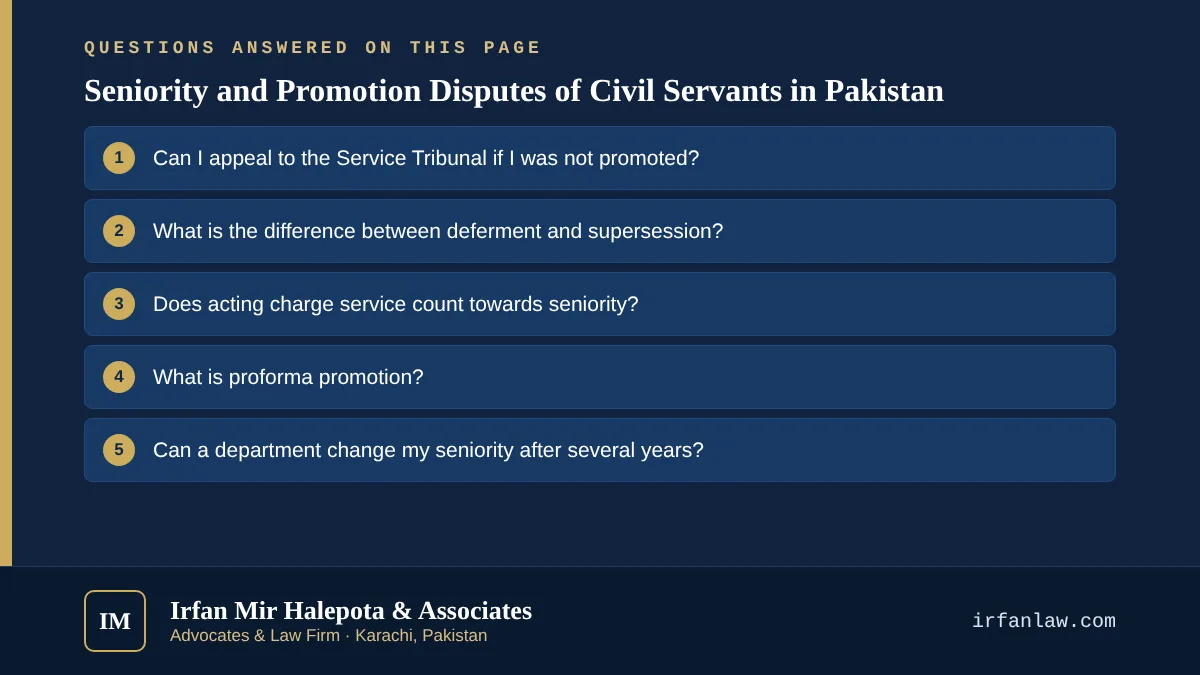
Can I appeal to the Service Tribunal if I was not promoted?
It depends on why. If you were ignored though eligible, judged under the wrong rules, or placed wrongly on the seniority list, that is an eligibility or seniority issue the Tribunal can hear after a departmental representation. If the board considered you and simply found you not fit, section 4(1)(b) of the Service Tribunals Acts bars an appeal, unless the process itself was illegal or mala fide.
What is the difference between deferment and supersession?
Deferment means your case was put off for a reason such as missing performance reports or pending proceedings; you must be reconsidered once that reason ends. Supersession means you were considered and not found fit at that time, so a junior moved ahead. Under the federal Promotion Rules, 2019, a superseded officer is reconsidered only after one more full-year performance report.
Does acting charge service count towards seniority?
Not in Sindh. Rule 8-A of the Sindh Appointment, Promotion and Transfer Rules states that acting charge is not regular promotion for any purpose, including seniority, and creates no vested right to regular promotion. Federally, seniority on promotion also runs only from the date of regular promotion.
What is proforma promotion?
It is promotion granted notionally from the date your immediate junior was promoted, where you were eligible and fit but were not considered on time through no fault of your own. It is often sought by officers who retired while their case was pending, because it corrects pay fixation and pension.
Can a department change my seniority after several years?
A department can correct a list that breaches the rules, but it must first give the affected officers notice and a hearing and pass a reasoned order. The Supreme Court has treated seniority as an important service right for this purpose. A revision made behind an officer's back can be challenged.
Are employees of Sindh statutory or autonomous bodies covered by these rules?
Usually not directly. Employees of statutory or autonomous bodies are governed by their own service regulations and are often not civil servants, which also affects whether the Sindh Service Tribunal or the High Court is the right forum. The Supreme Court did, however, apply its out-of-turn promotion ruling to employees of bodies controlled by the Province.
Do I need to object to the tentative seniority list?
You should. It is the stage at which errors are most easily corrected on the department's own record, and the rejection of your objection or the final list becomes the order you challenge by representation. Waiting until a junior is promoted makes the case harder and raises arguments of delay.
This article is general information about Pakistani law and procedure, not legal advice for any specific matter. If this touches on something you're currently facing, get in touch and we'll advise on your facts directly.