Geographical Indications in Pakistan: Registration, Authorised Users, Enforcement and the Basmati Dispute
A geographical indication (GI) identifies goods whose quality, reputation or other characteristic is essentially due to where they come from. In Pakistan GIs are registered at IPO-Pakistan under the Geographical Indications (Registration and Protection) Act, 2020, under which the Federal Government owns every Pakistani GI, a designated public body registers it, and individual producers use it only after registering as authorised users. Infringement suits go exclusively to the IP Tribunal.
Before 2020, Pakistan protected place names on goods mainly through the Trade Marks Ordinance, 2001 and the law of passing off. The Geographical Indications (Registration and Protection) Act, 2020 (Act No. XVIII of 2020) created a separate register, a separate set of rights and a model in which no private business owns a Pakistani GI outright. Exporters looking for the best IP lawyer in Karachi to protect a regional product name usually need to begin with a narrower question: is that name already registered as a GI, who is the registrant, and what does the book of specifications require before the name can lawfully go on a label?
What counts as a geographical indication
Section 2 of the Act defines a geographical indication as an indication that identifies goods as originating in a territory, region or locality where a given quality, reputation or other characteristic of the goods is essentially attributable to that geographical origin. For manufactured goods, at least one of the main stages of production, processing or preparation must take place in that area. The definition also allows certain non-geographical names, if they point to a specific area of Pakistan, to qualify.
“Goods” is drawn widely: agricultural, horticultural and natural goods, raw and manufactured goods, handicrafts, industrial goods and food and drink, whether finished or semi-processed. Rice, fruit, minerals, textiles and craft products can all be GIs.
A GI is not a trademark. A trademark tells the buyer which business made the goods; a GI tells the buyer where they came from and promises characteristics linked to that place. Several competing firms can lawfully use the same GI, provided each meets the specification.
Section 8 bars registration of an indication that does not meet the definition, is likely to deceive or confuse, is not protected or has fallen into disuse in its country of origin, has become a generic name, or is contrary to morality or public policy. Two transitional points also matter. Section 58 repealed the GI definition that used to sit in the Trade Marks Ordinance, and provided that GIs registered under that Ordinance lapse, so fresh registration under the 2020 Act is needed. Section 46 lets the Registrar of Trade Marks refuse or rectify a trademark containing a GI for goods that do not come from the indicated territory, where the public would be misled.
Who owns a GI: registrants and authorised users
The most unusual feature of the Act is section 11, which declares the Federal Government the holder and exclusive owner of all Pakistani GIs. The Government may authorise statutory bodies, public bodies, provincial or local administrations, government enterprises and similar juristic persons to register a GI as its registrant. Producers and traders do not apply for the GI itself; they apply to become authorised users of it.
| Registrant | Authorised user | |
|---|---|---|
| Who | A public or statutory body designated by the Federal Government (section 11) | A producer or operator, natural or juristic person or group, that complies with the book of specifications (sections 11(3) and 17) |
| Needs | An application with the area map, producer details, proof of quality or reputation and a book of specifications (section 12) | The registrant's formal assent and a statement of compliance with the specification (section 17) |
| Register | Part A (section 6) | Part B (section 6) |
| Duration | No expiry (section 25) | Ten years, renewable for ten years at a time (section 25) |
| Main right | Can sue for infringement (sections 26 and 32) | Exclusive right to use the GI on the registered goods, and to sue (sections 26 and 27) |
The book of specifications is the document that matters day to day: it defines the area, the production method and the testable qualities of the product. Under section 13 a certification body designated by the concerned Division inspects and monitors compliance. Non-compliance can lead to a warning, temporary disqualification or an application to the Registrar to suspend or cancel the user's rights, and the cost of compliance falls on authorised users. Registered products may carry the national GI logo established under section 28.
Registration procedure at IPO-Pakistan
Under sections 3 and 4, GIs are handled by a GI Registry under the Intellectual Property Organization of Pakistan. Until a separate registry is set up, the Trade Marks Registry and the Registrar of Trade Marks perform those functions. Rules under section 55 were notified in January 2021; registrant forms published by the Trade Development Authority of Pakistan refer to them as the GI Rules 2020. Procedure, forms and fees are governed by those rules and the official schedule.
- Application by the registrant (section 12): the GI, the class of goods, the geographical area with a map, details of producers, the quality, reputation or characteristic relied on, and the book of specifications. Reputation can be shown through consumer recognition, and the claimed quality must be capable of testing.
- Examination (section 15): the Registrar may call for explanations or evidence and may consult experts such as geologists or meteorologists (section 14).
- Acceptance and advertisement (sections 16 and 19): acceptance may be absolute or conditional, with written reasons for any conditions.
- Opposition (section 20): any interested person may oppose within three months of advertisement. The applicant must file a counter-statement within two months of receiving the notice, failing which the application is treated as abandoned. The Registrar then hears the parties.
- Authorised user applications (sections 17 and 23): once the GI is on the register, producers apply with the registrant's assent. If registration is not completed within twelve months because of the applicant's default, the Registrar may treat it as abandoned.
- Appeal (section 50): decisions of the Registrar go to the High Court, within the period prescribed by the rules.
Foreign GIs can also be protected. Under section 10 a foreign GI may be registered if it is protected in its country of origin, and the application must be filed through a legal representative in Pakistan.
Duration, renewal and how rights are lost
Section 25 draws a sharp line between the two tiers. The registrant's registration is perpetual. An authorised user's registration lasts ten years and is renewable for further ten-year periods. If renewal is missed, the user can still renew within six months after expiry on payment of a surcharge; between six months and one year after expiry, restoration is at the Registrar's discretion. After that, a fresh application is needed.
Authorised-user rights are personal. Section 43 prohibits an authorised user from assigning, licensing, pledging or mortgaging the GI; on the user's death the rights pass to the successor in title. A business that buys a rice mill or a salt processor therefore does not acquire GI rights by contract and should check whether a fresh authorised-user application is needed. This is a point to include in any acquisition review alongside the matters in our due diligence checklist.
Registrations can also be attacked. Section 45 allows the Registrar to vary or cancel an authorised-user registration on application by the registrant, the certification body or another authorised user, and the IP Tribunal may do so where the user has infringed. Section 53 allows an interested person to apply to the Registrar within twelve months of an authorised-user registration to revoke on the section 8 grounds, and the High Court may revoke at any time after registration.
Infringement, offences and the IP Tribunal
Section 30 treats as infringement the use of a registered GI by someone who is not an authorised user, including:
- using the GI on goods that do not originate in the indicated area, or in a way that misleads about origin;
- using the GI in translation or with words such as “kind”, “type”, “style” or “imitation”;
- using the GI on goods that genuinely come from the area but do not comply with the book of specifications recorded on the register;
- using a deceptively similar indication that is likely to cause confusion or an association with the GI.
The third point is easily overlooked: a Sindh or Punjab producer inside the right area can still infringe if its product falls short of the specification.
Section 31 sets out defences, such as good-faith use of a person's own name or place of business without confusion. Under sections 32 and 34, registrants, authorised users and interested persons, including groups of producers or consumers, may sue for injunctions, damages or an account of profits, seizure and destruction of infringing goods. Section 35 makes the IP Tribunal the only forum for infringement suits; our guide to IP Tribunal jurisdiction and procedure explains how these suits run in Karachi.
Two limits deserve emphasis. First, section 33 bars infringement proceedings for an unregistered GI, although passing off remains available. Second, section 51 imports several provisions of the Trade Marks Ordinance, 2001, including those on imported infringing goods, which means the border measures described in our counterfeit goods guide can in principle be used for GI-protected products.
Falsely applying a GI is also an offence. Section 41 provides for imprisonment of six months to three years, a fine, or both, and section 42 penalises falsely representing that an indication is registered. Under section 40(3), a seller accused of selling falsely marked goods bears the burden of showing consent or innocence.
Homonymous GIs and the Basmati dispute
Section 9 allows homonymous GIs, meaning identical or similar names for goods from different places, to be registered, but only after the Registrar considers how they will be distinguished, whether producers are treated fairly and whether consumers would be misled. That concept is at the centre of the most important GI dispute affecting Pakistan: whether “Basmati” belongs to India alone or to both countries.
| Date | Event |
|---|---|
| 2018 | India applied to the European Commission for protected geographical indication (PGI) status for Basmati, describing an area in the Indo-Gangetic plains. |
| September 2020 | India's application was published in the EU, prompting Pakistan to oppose it on the basis that Basmati is grown on both sides of the border. |
| January 2021 | Pakistan notified its GI rules and registered Basmati domestically under the 2020 Act, with the Trade Development Authority of Pakistan as registrant. |
| June 2021 | The Commission indicated that the two countries had until September 2021, after an extension, to try to reach an amicable settlement. |
| 24 August 2023 | Pakistan's own EU application for “Basmati” PGI (file PGI-PK-02990) is recorded. |
| 23 April 2024 | Commission Implementing Decision (EU) 2024/2995 ordered publication of Pakistan's application, opening it to opposition. |
| October 2025 | Press reports described both applications as still pending, with Basmati listed among issues in EU-India trade talks; Pakistan asked the EU for an impartial decision. |
| 27 January 2026 | The EU-India free trade agreement was concluded. Rice was excluded from tariff liberalisation, and a separate GI agreement was reported as still under negotiation. |
Current position (October 2026): we have found no published EU decision registering Basmati for either India or Pakistan, or registering a shared name. On the sources available to us, the EU dispute remains unresolved. Pakistan's domestic registration protects the name within Pakistan; it does not by itself determine what the EU will do. Exporters should keep labels truthful and consistent with the domestic book of specifications, and watch for an EU decision, because a joint, split or one-country outcome would change labelling rules for the EU market.
Pakistani GIs registered so far, and what producers should do
The domestic register is still small and IPO-Pakistan does not publish an easily searchable online GI database. We list only registrations we could confirm from dated public sources:
- Basmati: registered in January 2021, with the Trade Development Authority of Pakistan (TDAP) as registrant. TDAP publishes the book of specifications.
- Sindhri Mango: TDAP publishes an authorised-user application form for the “Sindhri Mango” GI, describing itself as registrant under the GI Act and Rules 2020.
- Khewra Pink Rock Salt: in November 2025 a producer publicly announced that IPO-Pakistan had certified it as a registered authorised user of this GI. Separately, the federal cabinet approved the Pakistan Mineral Development Corporation as registrant agency for rock salt in 2021.
Other products, including Chaunsa mango, Kinnow and several gemstones, were approved by the Ministry of Commerce in 2021 for GI registration. Approval is not registration, so the register itself should be checked before relying on any of them.
For a Karachi exporter or processor, the practical sequence is:
- Obtain the registrant's book of specifications and check that your sourcing area, variety and processing match it.
- Apply to the registrant for assent and file the authorised-user application with supporting documents showing your place in the supply chain.
- Diarise the ten-year renewal and keep compliance records for the certification body.
- Align any trademark on the same packaging with the GI. A private brand that includes a GI word can be refused or rectified under section 46 if the goods do not come from the area.
For broader brand strategy alongside a GI, see our intellectual property practice and the related guide on well-known trademarks in Pakistan.
Follow us on Google
If these guides are useful, add this site as a preferred source. Google will then show it more prominently to you in Search, Discover and AI results.
Official sources
- Geographical Indications (Registration and Protection) Act, 2020 (Act No. XVIII of 2020), FBR-hosted copy
- WIPO Lex: Geographical Indications (Registration and Protection) Act, 2020 (Pakistan)
- Dawn, 28 January 2021: Pakistan gets Geographical Indicator tag for basmati
- Commission Implementing Decision (EU) 2024/2995 of 23 April 2024 (Basmati PGI, Pakistan), text
- Euronews, 7 October 2025: status of competing Basmati applications in the EU
- TDAP: Authorised user application form, Sindhri Mango GI
Common questions
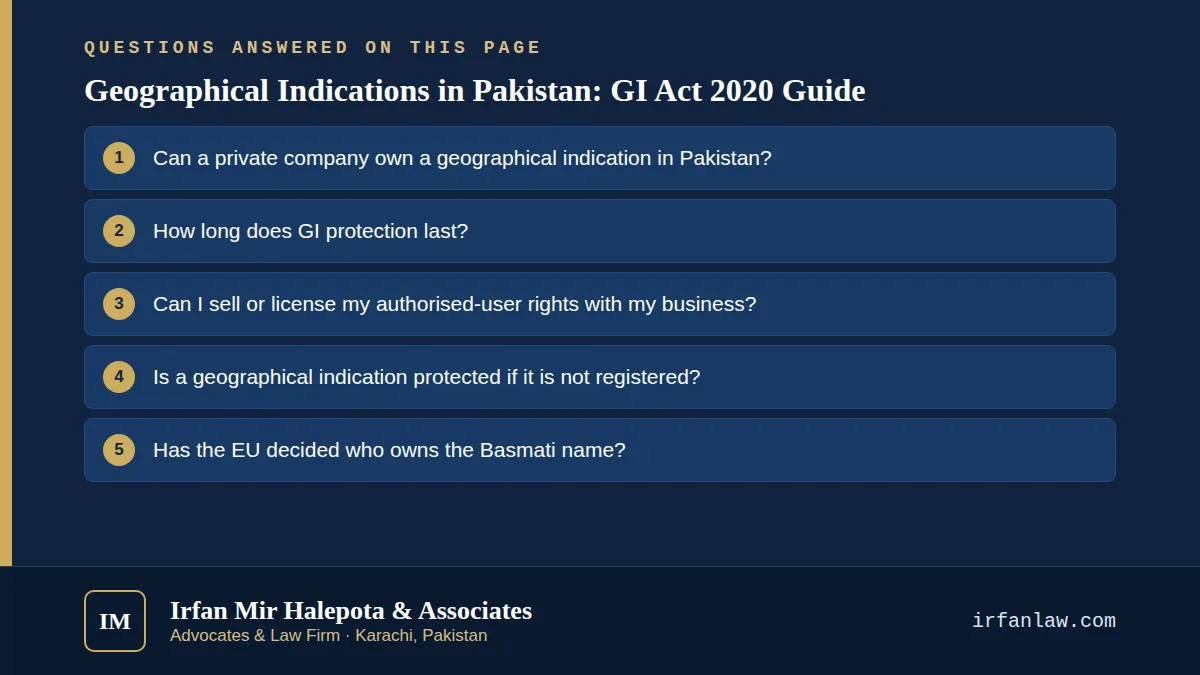
Can a private company own a geographical indication in Pakistan?
No. Section 11 of the Geographical Indications (Registration and Protection) Act, 2020 makes the Federal Government the holder and exclusive owner of all Pakistani GIs. A designated public body registers the GI as registrant, and private producers or traders can only become authorised users, with the registrant's assent and subject to the book of specifications.
How long does GI protection last?
The registrant's registration under section 25 has no expiry. An authorised user's registration lasts ten years and can be renewed for further ten-year periods. A missed renewal can still be made within six months of expiry with a surcharge, and restoration may be allowed at the Registrar's discretion up to one year after expiry.
Can I sell or license my authorised-user rights with my business?
No. Section 43 prohibits an authorised user from assigning, transmitting, licensing, pledging or mortgaging rights in a registered GI. Rights pass only to a successor in title on death. A purchaser of a business should therefore plan for its own authorised-user application.
Is a geographical indication protected if it is not registered?
Only through passing off. Section 33 of the Act says no infringement proceedings can be brought for an unregistered GI, but it preserves passing-off actions. Registration is therefore needed to use the statutory remedies before the IP Tribunal.
Has the EU decided who owns the Basmati name?
Not as far as published sources show as of October 2026. India applied in 2018 and Pakistan filed its own application in 2023, which the Commission ordered published in April 2024. When the EU-India trade agreement was concluded in January 2026, GI matters were reported as still under negotiation.
Can a foreign producer register its GI in Pakistan?
Yes. Section 10 permits registration of a foreign GI that is protected in its country of origin. The application must be filed through a legal representative in Pakistan, and the Registry may ask for details of the home-country protection.
Where do I sue someone misusing a GI in Karachi?
Infringement suits under the Act must be filed before the IP Tribunal, which section 35 makes the exclusive forum. Appeals against decisions of the Registrar, such as on oppositions, go to the High Court under section 50.
This article is general information about Pakistani law and procedure, not legal advice for any specific matter. If this touches on something you're currently facing, get in touch and we'll advise on your facts directly.