Where to File a Trademark Invalidity Application: What the Sindh High Court Decided in HCA No. 289 of 2024
A trademark invalidity application can still be filed directly in the Sindh High Court. In High Court Appeal No. 289 of 2024 (decided 10 February 2025), a Division Bench held that section 80(4) of the Trade Marks Ordinance, 2001 lets an interested party choose between the Registrar and the High Court where no proceedings on the mark are pending, and that section 18 of the IPOP Act, 2012 did not force the applicant into the IP Tribunal. Infringement and passing-off suits, by contrast, belong before the IP Tribunal.
Since IP Tribunals began functioning, Karachi practitioners have argued about which trademark disputes the Tribunal now owns and which can still begin in the Sindh High Court. In February 2025 a Division Bench headed by the Chief Justice answered that question for one important category: applications to have a registration declared invalid. Anyone searching for the best trademark lawyer in Karachi to cancel a rival's registration should start with this forum point, because a wrong filing can cost years before the merits are ever heard. This note explains the facts, the holding, the reasoning, and what the judgment leaves unresolved.
The dispute in brief
The case arose inside a family. Two brothers were in dispute over a registered word mark in Class 30, the class covering spices and similar foodstuffs. On 11 October 2022 one brother filed a Judicial Miscellaneous application (J.M. No. 34 of 2022) on the original side of the Sindh High Court at Karachi, asking for the other brother's registration to be declared invalid under section 80 of the Trade Marks Ordinance, 2001 (read with section 14).
In October 2023 the registered proprietor applied under Order VII Rule 10 of the Code of Civil Procedure, 1908 for the application to be returned. His position was that the Intellectual Property Organization of Pakistan Act, 2012 (the IPOP Act) had moved trademark litigation to the specialised IP Tribunal, so the High Court lacked jurisdiction. A single judge dismissed that objection on 3 June 2024. The proprietor died while the matter was pending, and his legal heirs pursued an intra-court appeal. The Registrar of Trade Marks was a respondent but did not appear.
The appeal decided forum only. The bench did not rule on whether the registration is valid, whether it was obtained in bad faith, or who owns the brand. Those questions remain for the invalidity proceedings themselves.
The question before the Division Bench
Can the High Court hear an application for a declaration of invalidity under section 80(4) of the Ordinance when no proceedings about that mark are pending in any court, or must such an application now go to the IP Tribunal?
The appellants relied on section 18(1) of the IPOP Act, which provides that "All suits and other civil proceedings regarding infringement of intellectual property laws shall be instituted and tried in the Tribunal." They also relied on section 39, the Act's overriding clause. Their argument was that every trademark proceeding, invalidity included, had been channelled to the Tribunal.
The question was sharpened by the Trade Marks (Amendment) Act, 2023, which received assent on 11 August 2023 and was gazetted on 16 August 2023. That amendment rewrote the forum references in several sections of the Ordinance, and both sides drew arguments from what it changed and what it left alone.
What the court decided
The Division Bench (Muhammad Shafi Siddiqui, CJ and Jawad Akbar Sarwana, J) dismissed the appeal on 10 February 2025, upheld the single judge's order of 3 June 2024, and left the parties to bear their own costs. The invalidity application was held maintainable in the High Court. The holding has three parts:
- Section 80(4) gives a choice of forum. An interested party may apply to the Registrar or to the High Court. In the bench's words, "It is entirely in the applicant's discretion to decide which forum to pursue."
- The choice is regulated, not unlimited. Where proceedings concerning the mark are already pending in court, the application must be made there; and the Registrar may refer an application to the court at any stage. Here nothing was pending, either in the High Court or before an IP Tribunal.
- Revocation and rectification are different. Applications under section 73(4) (revocation) and section 96(2) (rectification) generally go to the Registrar first unless court proceedings on the mark are already pending. Section 80(4) is the provision that offers a direct route.
The reasoning
The structure of section 80(4). The bench read the subsection as creating parallel tribunals for the applicant. It accepted that this permits a degree of forum choice, but observed that "this 'forum shopping', as it were, is not entirely unregulated": the pending-proceedings rule and the Registrar's power of reference keep it in check.
The 2023 amendment pointed the same way. The judgment sets out the old and new text side by side. The amendment removed District Court references from several provisions but kept "the High Court" in section 80(4) and in section 14(3)(a). Parliament revisited the forum provisions eleven years after the IPOP Act and chose to leave the High Court in place. The bench treated that as significant when reading section 18(1) of the IPOP Act.
Section 116. The bench described section 116 of the Ordinance as an enabling mechanism that sustains direct actions in the High Court, reinforcing the conclusion that the High Court route survives.
The contrary authority was distinguished. The appellants relied on an Islamabad High Court decision, Shaheen Chemist v. Zahid Mehmood Chaudhry, 2023 CLD 1. The bench distinguished it on three grounds: it concerned a combined application under sections 73(4) and 80(4); it was decided under the pre-amendment law; and it drew on a Sindh High Court single-bench order of 1 November 2021 in Suit No. 2058 of 2019 which a Division Bench had since set aside, on 17 January 2025, in HCA No. 264 of 2021.
No mechanical rule. The bench was careful to say that "No hard and fast rule can be laid down" and that "The principles laid down in trademark cases cannot be mechanically applied in rem." The forum depends on which provision is invoked and on what is already pending. That caution matters: the judgment is not a general licence to bring any trademark dispute to the High Court.
Read it alongside the infringement cases
Fifteen days later, on 25 February 2025, a single judge of the same court (Adnan Iqbal Chaudhry, J) returned a trademark infringement and passing-off suit, Suit No. 741 of 2019, for presentation before the IP Tribunal. Relying on the Supreme Court decision reported as 2022 SCMR 979, the order treated the Tribunal's jurisdiction over infringement suits as exclusive, even where passing off is pleaded as well.
The plaintiff there argued that because revocation and invalidity applications on the same mark were pending in the High Court, the infringement suit should stay with them. The court called the submission "misconceived": subsection (4) of sections 73 and 80 brings applications to a court where proceedings are already pending, and those provisions "do not cater vice versa for a suit for trademark infringement." Nor could the suit be transferred under section 17(6) of the IPOP Act, which applied only to suits pending when sections 17 and 18 took effect on 29 December 2015. The plaintiff was left to seek exclusion of the time spent in the High Court under section 14 of the Limitation Act, 1908.
Taken together, the two decisions draw a working line in Karachi: a challenge to the register itself by way of invalidity may begin in the High Court, while infringement and passing-off suits begin in the IP Tribunal. Our infringement guide covers the Tribunal side of that line.
What it changes in practice for Karachi businesses
- Pick the invalidity forum deliberately. The Registrar route keeps the matter within the Trade Marks Registry; the High Court route puts it before a judge on the original side, with appeal lying to a Division Bench, as this case shows. The right choice depends on the evidence the ground needs, for example proof of bad faith or of earlier use, and on how quickly the business needs certainty.
- Check what is already pending before filing. If the mark is already the subject of court proceedings, section 80(4) sends the application to that court. A search of cause lists and of the Registry record is a necessary first step.
- Plead each ground under its own section. Revocation, for example for non-use, sits under section 73 and normally starts with the Registrar. Bundling revocation and invalidity in one High Court application invites the kind of objection that succeeded in the Islamabad case.
- Send infringement to the IP Tribunal. If the real need is to stop a copycat, the suit and any interim injunction application belong in the Tribunal. See our note on interim injunctions.
- Budget time for forum fights. The invalidity application here was filed in October 2022 and the forum objection was finally resolved in February 2025. The infringement suit in Suit No. 741 of 2019 was returned roughly six years after filing. Getting the forum right at the outset is the cheapest protection available.
- Settle ownership of family brands early. Disputes between relatives over a shared trade name are common in Karachi's food and trading sectors. Recording who owns the mark, whether an individual or the company, and documenting licences and assignments with the Registry, reduces the chance of an invalidity fight later. Our trademark registration page explains the filing side.
What remains open
- Section 39 of the IPOP Act. The bench recorded that section 39 gives the IPOP Act overriding effect, which "arguably" favours the Tribunal, and said the interplay with the amended Ordinance remains subject to judicial determination. It also observed that the reading of section 18(1) in earlier case law "requires review" after the 2023 amendment. The point has been flagged rather than finally closed.
- Invalidity where an IP Tribunal case is already running. The bench noted that no Tribunal proceedings existed here. It did not decide where an invalidity application should go when an infringement suit on the same mark is already pending before the Tribunal.
- Wording in the later single-judge order. The 25 February 2025 order described subsection (4) of sections 73 and 80 as bringing applications to the High Court where proceedings are pending there. That was said in the context of an infringement suit, and the order does not refer to the Division Bench judgment. Where the two appear to pull apart on invalidity, the Division Bench reasoning is the more authoritative statement within the Sindh High Court.
- Other High Courts and the apex courts. The Islamabad High Court reached a different result under the old text. At the time of writing we have not found a Supreme Court or Federal Constitutional Court decision on the post-2023 wording, so practice outside Sindh may differ.
- The merits. Whether the disputed registration survives is still to be decided.
Citation
| Case | Legal heirs of the registered proprietor v. the invalidity applicant and the Registrar of Trade Marks, High Court Appeal No. 289 of 2024 |
|---|---|
| Court | High Court of Sindh at Karachi (Division Bench) |
| Bench | Muhammad Shafi Siddiqui, CJ and Jawad Akbar Sarwana, J |
| Heard / decided | 5 February 2025 / 10 February 2025 |
| Arising from | J.M. No. 34 of 2022 (order of 3 June 2024) |
| Reported citation | None located at the time of writing |
| Companion order | Suit No. 741 of 2019, Sindh High Court, Adnan Iqbal Chaudhry, J, 25 February 2025 |
For a wider view of the four IP statutes and Tribunal remedies, see our IP practice page.
Follow us on Google
If these guides are useful, add this site as a preferred source. Google will then show it more prominently to you in Search, Discover and AI results.
Official sources
Common questions
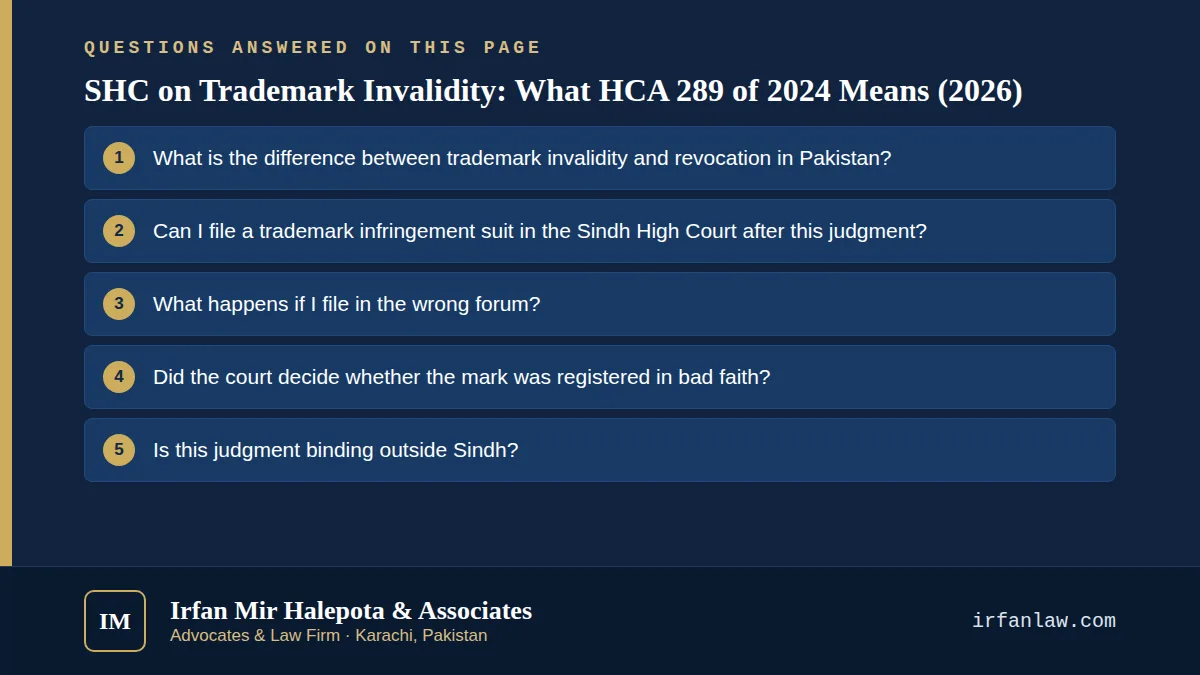
What is the difference between trademark invalidity and revocation in Pakistan?
Invalidity under section 80 of the Trade Marks Ordinance, 2001 attacks the registration as one that should never have been granted, for example because the application was made in bad faith. Revocation under section 73 ends a registration because of what happened afterwards, such as non-use. The forum rules also differ: the Sindh High Court held that invalidity offers a direct High Court route, while revocation generally starts with the Registrar.
Can I file a trademark infringement suit in the Sindh High Court after this judgment?
No. The judgment concerns invalidity applications only. Infringement and passing-off suits go to the IP Tribunal; a single judge of the Sindh High Court returned such a suit to the Tribunal on 25 February 2025, relying on 2022 SCMR 979.
What happens if I file in the wrong forum?
The court can return the plaint or application under Order VII Rule 10 of the Code of Civil Procedure for presentation in the right forum. You can ask for the time spent in the wrong court to be excluded under section 14 of the Limitation Act, 1908, but the months or years lost cannot be recovered, and the other side gains time to entrench its position.
Did the court decide whether the mark was registered in bad faith?
No. The appeal was about jurisdiction only. Whether the registration is valid remains to be decided in the invalidity proceedings.
Is this judgment binding outside Sindh?
It is a Division Bench decision of the Sindh High Court, which single judges of that court ordinarily follow. It does not bind other High Courts, and the Islamabad High Court reached a different result on the pre-2023 text in 2023 CLD 1.
Should I go to the Registrar or the High Court for an invalidity application?
Either is open where nothing is pending, so the choice is strategic. Consider the evidence your ground needs, whether there are related court proceedings, and how quickly you need a decision. If court proceedings on the mark are already pending, the application must go to that court.
This article is general information about Pakistani law and procedure, not legal advice for any specific matter. If this touches on something you're currently facing, get in touch and we'll advise on your facts directly.