Legal Rights and Challenges for Women Whose Husbands Live Abroad
Maintenance, custody and even basic communication become harder when a husband lives overseas. Here's what's actually available under Pakistani law.
A significant number of the family law matters we handle involve a husband who has moved abroad for work — sometimes staying genuinely involved with his family, and sometimes becoming difficult to reach, unresponsive on maintenance, or unwilling to cooperate on documentation his wife and children need. The legal tools available don't disappear because a husband is overseas, but using them does require some extra steps. Women searching for the best family lawyer in Pakistan when a husband is abroad need this authority in hand before the conversation about maintenance even starts.
Maintenance when the husband is abroad
A wife and children's right to maintenance doesn't depend on the husband's physical presence in Pakistan. A maintenance suit can still be filed in the Family Court, and orders can be enforced against income, property, or assets the husband holds or is entitled to in Pakistan — though enforcing an order against assets held entirely abroad is more complex and depends on the specific country involved.
Getting documents signed or processes moving without his physical presence
Many routine steps — consenting to a passport for a child, executing a power of attorney, or participating in a settlement — can be handled through a power of attorney executed and attested at a Pakistani embassy or consulate abroad, which avoids the common problem of a case stalling simply because one party isn't physically in the country.
If he becomes unresponsive or stops sending money
Silence isn't a legal defence. Where a husband abroad stops supporting his family, that's grounds for a maintenance suit like any other, and the Family Court can proceed even if he doesn't formally respond, provided he's been properly served — including through the mechanisms available for serving process on someone outside Pakistan.
Custody and travel concerns
Where a husband abroad seeks to take a child out of Pakistan, or where a wife is concerned about a child being relocated without her consent, custody and guardianship proceedings — including protective orders restricting a child's travel — remain available through the Guardian Court regardless of where the father is currently based.
Divorce and khulla proceedings
A husband's absence from Pakistan doesn't prevent a wife from pursuing divorce or khulla — proper service of the suit on him abroad is the procedural step that needs careful handling, since a defective attempt at service can delay a case considerably.
Our advice
These cases move faster and with fewer surprises when the paperwork — Nikah Nama terms, any prior agreements, and a clear record of communication — is organised early, rather than assembled after a dispute has already escalated.
Your rights as a married woman, whether he is here or abroad
A husband working in the Gulf, the UK or elsewhere still owes everything the marriage created. Knowing these rights precisely matters because they are often the first thing negotiated away under pressure.
- Dower (haq mehr). Under section 10 of the Muslim Family Laws Ordinance, 1961, if the Nikahnama does not say how dower is payable, the whole amount is payable on demand. In September 2026 a five-member bench of the Supreme Court, as reported, called dower the wife's exclusive property and said its payment cannot be made conditional on her conduct or on whether she seeks divorce. The Lahore High Court has recently restated that a wife may live apart until her prompt dower is paid. That ruling is persuasive, not binding, in Sindh.
- Maintenance through the Union Council. Besides a Family Court suit, section 9 of the Ordinance lets a wife apply to the Chairman of the Union Council, who constitutes an Arbitration Council. It can issue a certificate fixing maintenance, recoverable as arrears of land revenue. Support for the children is a separate duty, explained in our guide to a father's duty of child maintenance.
- A home of your own. Many wives of overseas husbands are left in the in-laws' house. Where there is real cause, such as threats or ill-treatment, courts accept a demand for separate accommodation. In C.P. No. S-448 of 2020 (decided 11 November 2022), the High Court of Sindh restored a maintenance decree for a wife who had demanded separate residence after threats from her in-laws.
- Your Nikahnama. Columns 13 to 16 record dower, column 17 special conditions, column 18 whether the right of divorce was delegated to you, column 19 any limits on his right of divorce, and column 20 documents about dower and maintenance. If column 18 gives you the delegated right, you can divorce without a court case: section 8 applies the section 7 notice procedure to you. Get a certified copy from the Union Council and read it before anything else.
- A second marriage. The Ordinance applies to "all Muslim citizens of Pakistan, wherever they may be". Under section 6, a husband needs the Arbitration Council's prior written permission, and his application must say whether you consented. If he marries without permission, he must pay your entire dower, prompt and deferred, at once. He is also liable on conviction upon complaint, and you gain a ground for dissolution.
If he disappears or stops supporting you: dissolution without khula
Khula is not the only way out of a marriage to an absent husband. Section 2 of the Dissolution of Muslim Marriages Act, 1939 gives a wife grounds for a decree that do not depend on the husband's agreement. Several of them fit the overseas husband who has gone silent:
- Whereabouts unknown for four years (ground (i)). The decree does not take effect for six months. If he appears in that time, in person or through an agent, and satisfies the court he is prepared to perform his conjugal duties, the decree is set aside. Under section 3, the plaint must name the people who would be his heirs if he had died on the date of filing, they must be served, and his paternal uncle and brother must be made parties.
- Failure to maintain for two years (ground (ii)). Remittances that stopped, or never started, are the usual evidence. Keep bank statements and messages asking for money.
- Failure to perform marital obligations for three years without reasonable cause (ground (iv)).
- A second marriage in breach of the 1961 Ordinance (ground (ii-a)), and cruelty (ground (viii)).
- Any other ground recognised by Muslim law (ground (ix)). In October 2026 a five-member Supreme Court bench, as reported, upheld dissolution for shiqaq, a lasting breakdown of the marriage, even where cruelty was not proved. It also held that family courts were wrong to convert cruelty petitions into khula without the wives' clear consent, and set aside directions making them give up their dower.
The choice of route has money consequences. Section 5 of the 1939 Act preserves a wife's dower on dissolution, whereas in Sindh a khula decree generally requires restoring dower received, under the proviso to section 10(4) of the Family Courts Act. A suit for dissolution or dower may be filed where you ordinarily live (proviso to rule 6 of the West Pakistan Family Court Rules, 1965), so you need not travel to his family's city.
Serving him abroad, and the children's passports
The fastest decree is worthless if it is later set aside for defective service. In Nofil Nawaz Mulkana v. Sana Maqbool (C.P. No. S-849 of 2017, decided 13 June 2018), the High Court of Sindh set aside an ex parte decree. The Nikahnama showed the husband's address in Copenhagen, but the Family Court had relied on a Karachi address and an alleged attorney. The Court said a summary trial does not make service a formality, and that what counts is where the defendant actually lives at the time of service. Its list of substituted modes includes electronic communication, courier and publication in the press.
So, before filing, collect everything that shows where he really is: his foreign address, employer, visa or residence card copies, email address and the WhatsApp number he uses. Give them all to the court, and ask for service by every mode the court will allow, not just the old Pakistani address. If he begins pressuring you or your family to stop the case, see our guide to blackmail and threats by an ex-husband or in-laws.
Passports and travel. Where the children live with you, disputes over their passports belong before the Guardian Court, and the High Court has supervised these arrangements closely. In C.P. No. S-341 of 2024 (order of 15 March 2024), a mother with custody faced an appellate order withholding her child's passport. The High Court directed that the passport be prepared in accordance with law, leaving the appellate court free to hold it until anyone sought permission to travel. In the other direction, C.P. No. S-310 of 2023 holds that orders stopping a parent or child from leaving Pakistan need sound reasons. If you fear he will take the children abroad on a visit, apply to the Guardian Court early, with evidence of the risk, for an order that the passports be deposited or that travel requires the court's permission. Passport office requirements for minors change, so check the current requirements before applying.
Follow us on Google
If these guides are useful, add this site as a preferred source. Google will then show it more prominently to you in Search, Discover and AI results.
Official sources
Common questions
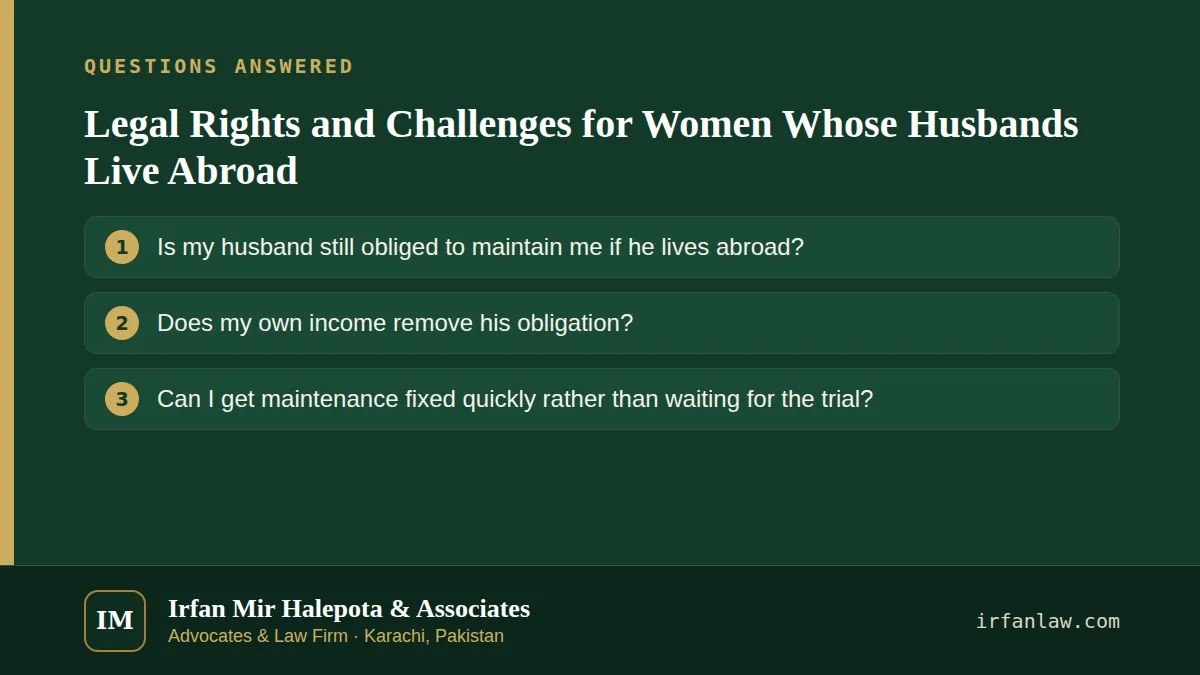
Is my husband still obliged to maintain me if he lives abroad?
Yes. In Haseen Ullah v. Naheed Begum (Supreme Court, 23 November 2021) the Court confirmed that a husband is obligated to provide maintenance (nafaqah) to his wife under Islamic law so long as she is faithful and fulfils, or is willing to fulfil, her matrimonial obligations. Residence abroad does not discharge the obligation, and in that case the husband had contracted a second marriage and was living with his second wife.
Does my own income remove his obligation?
No. The obligation is not conditional on the wife's own financial position. Similarly, in the custody context, the Supreme Court held long ago that a mother cannot be deprived of custody merely because her income is small (Muhammad Ramzan v. Mst. Fazal Nishan).
Can I get maintenance fixed quickly rather than waiting for the trial?
Yes. Section 17-A of the West Pakistan Family Courts Act, 1964 obliges the Family Court to fix interim monthly maintenance, and reported authority holds it bound to do so on the first date of appearance of the defendant (2019 CLC 1261, Lahore). Non-payment by the fourteenth day of each month exposes the defendant to having his defence struck off.
My husband married again abroad without my consent. What can I do?
Section 6 of the Muslim Family Laws Ordinance requires prior written permission from the Arbitration Council, and the Ordinance applies to Pakistani Muslim citizens wherever they live. A husband who marries without permission must pay the entire dower, prompt and deferred, immediately, and is liable to punishment on conviction upon complaint. The second marriage is also a ground for dissolution under section 2(ii-a) of the 1939 Act.
My husband has not contacted me or sent money for years. Do I have to file khula?
No. Failure to maintain for two years and unknown whereabouts for four years are both grounds for dissolution under section 2 of the Dissolution of Muslim Marriages Act, 1939, and section 5 of that Act preserves your dower. Khula remains available if you prefer it, but the Supreme Court has said in 2026 that family courts should not convert a petition into khula without the wife's clear consent.
Can my husband abroad stop our children's passports or take them out of Pakistan?
Disputes over a child's passport and travel are decided by the Guardian Court on the child's welfare, and the High Court of Sindh has directed that a passport be prepared while leaving the court free to hold it until travel is authorised. If you fear removal, apply to the Guardian Court with evidence of the risk; travel restrictions must rest on sound reasons.
This article is general information about Pakistani law and procedure, not legal advice for any specific matter. If this touches on something you're currently facing, get in touch and we'll advise on your facts directly.