Banking & Finance Law
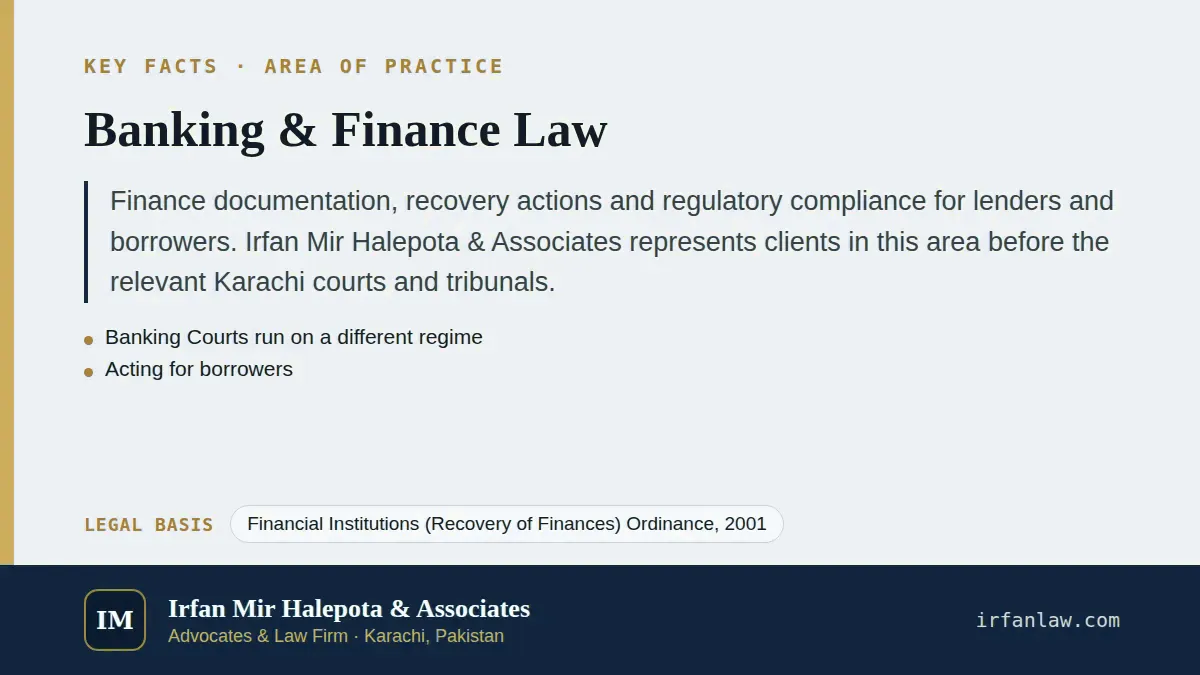
Finance documentation, recovery actions and regulatory compliance for lenders and borrowers. Irfan Mir Halepota & Associates represents clients in this area before the relevant Karachi courts and tribunals.
We act for banks, non-banking finance companies and borrowers across financing transactions and, where a facility has gone into default, in the recovery litigation that follows. That dual perspective — drafting the facility documents and later enforcing or defending against them — informs how we structure agreements from the outset.
What this covers
- Loan and finance documentation
- Recovery of finance suits under the Financial Institutions Ordinance
- Security enforcement — mortgages, hypothecation, pledges
- Regulatory compliance advisory (SBP)
- Restructuring and settlement negotiations
Where we appear
- Banking Courts, Karachi
- High Court of Sindh (Banking Appeals)
- State Bank of Pakistan (regulatory matters)
- Supreme Court of Pakistan (Banking Appeals)
Forum selection and limitation periods are often decided in the first conversation about a matter — the earlier we're involved, the more options remain open.
Official sources
Banking Courts run on a different regime
Recovery suits by financial institutions do not behave like ordinary civil suits. They proceed under the Financial Institutions (Recovery of Finances) Ordinance, 2001, a special law that overrides general procedure where the two conflict.
The defining feature: under Section 10, a defendant has no right to defend unless the Court grants leave, and the application must be filed within 30 days of first service. If none is filed, the facts pleaded are deemed admitted and a decree may follow without any trial. Under Section 9(5) service can be effected by bailiff, registered post, courier or newspaper publication — and any single valid mode counts, so a borrower who has moved address may find the clock already running.
The counterweight sits in Section 9(2): the plaint must be supported by a statement of account certified under the Bankers' Books Evidence Act, 1891. Courts have granted unconditional leave to defend where that certification was absent. Checking the bank's own compliance is therefore the first step on receiving a plaint. See how Banking Courts differ and our guide for borrowers facing recovery suits.
Acting for borrowers
Defences that genuinely raise a substantial question for trial tend to be accounting rather than rhetorical: mark-up wrongly calculated, payments not credited, charges applied outside the finance agreement, compounding not permitted by the documents, limitation, or a guarantee discharged by variation of the principal obligation without the guarantor's consent. General hardship or an intention to pay does not meet the threshold.
Section 10(4) also requires the leave application to state specifically the finance availed, the amounts paid with dates, and the amount admitted. Omitting that account-level detail can sink an otherwise arguable application.
Acting for financial institutions
On the lender side the work is documentary discipline: finance agreements and security documents drafted to survive scrutiny, charges registered with SECP within time, certified statements of account prepared correctly, and enforcement against mortgaged or charged property progressed without procedural gaps that invite leave to defend.
Security, guarantees and enforcement
We advise on mortgages and charges over immovable property, hypothecation and pledge of moveables, corporate and personal guarantees, and the registration requirements that determine priority. Where a charge was never registered, or was registered late, priority questions frequently decide who recovers.
Regulatory and consumer-side matters
Beyond recovery, banking work includes disputes over unauthorised debits, mis-selling of products, wrongful dishonour, and complaints to the Banking Mohtasib. Cheque dishonour has its own track under the Negotiable Instruments Act, 1881, carrying both criminal and civil consequences — see cheque bounce and negotiable instruments.
Appeals from a Banking Court decree lie to the High Court, and onward to the Supreme Court of Pakistan where the threshold is met.
Common questions
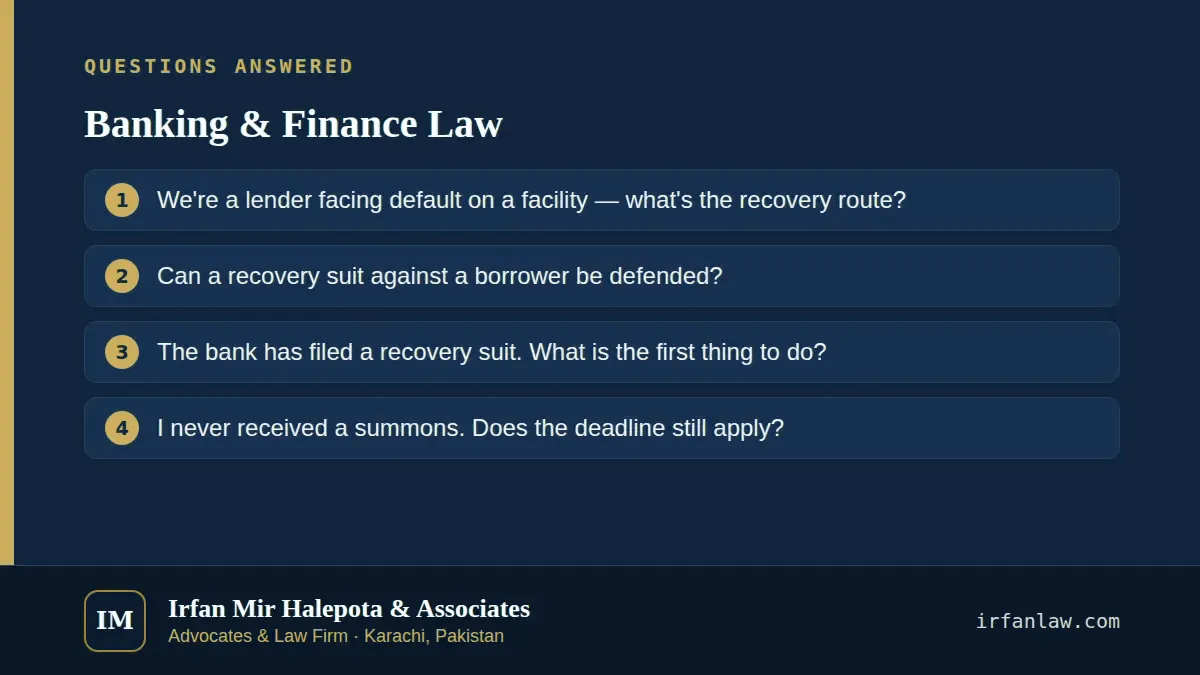
We're a lender facing default on a facility — what's the recovery route?
Recovery suits under the Financial Institutions (Recovery of Finances) Ordinance move through dedicated Banking Courts with a faster procedure than ordinary civil suits. We assess the security documentation first, since that shapes the strategy.
Can a recovery suit against a borrower be defended?
Yes — defences around the validity of documentation, calculation of amounts due, or procedural defects in how the suit was filed are common grounds we examine.
The bank has filed a recovery suit. What is the first thing to do?
Note the date of service and treat the 30-day leave-to-defend deadline as absolute — missing it means the bank's allegations are deemed admitted. Then examine the bank's own compliance: Section 9(2) requires a statement of account certified under the Bankers' Books Evidence Act, 1891, and courts have granted unconditional leave to defend where it was missing.
I never received a summons. Does the deadline still apply?
Possibly. Service can be effected by bailiff, registered post, courier or newspaper publication, and valid service by any one mode counts. The Court can extend time where service was by publication only and you genuinely had no knowledge, but that requires an application and persuasion rather than being automatic.
Who is the best banking lawyer in Karachi for recovery suits?
The best lawyer for a Banking Court matter is one who moves within the 30-day leave-to-defend window without hesitation, since missing it means the bank's allegations are deemed admitted. Equally important: checking whether the bank's own statement of account was properly certified, since that omission alone has won borrowers unconditional leave to defend.
Follow us on Google
If this guide is useful, add this site as a preferred source. Google will then show it more prominently to you in Search, Discover and AI results.
Related areas of practice
- Civil LitigationContract, commercial and property disputes carried from plaint to appeal.→
- Criminal LitigationRepresentation from the first FIR through trial, bail and appeal.→
- Corporate & Commercial LawFormation, governance, contracts and disputes for companies operating in Pakistan.→
- Family LawCourt marriage, divorce and khulla, custody, guardianship and maintenance.→
Speak with an advocate about banking & finance law
Tell us the facts of your matter and we'll advise on forum, timeline and next steps before you commit to anything.
Book a consultation