Dishonour of Cheque & Negotiable Instruments Law
Criminal and civil action for dishonoured cheques under the Negotiable Instruments Act. Irfan Mir Halepota & Associates represents clients in this area before the relevant Karachi courts and tribunals.
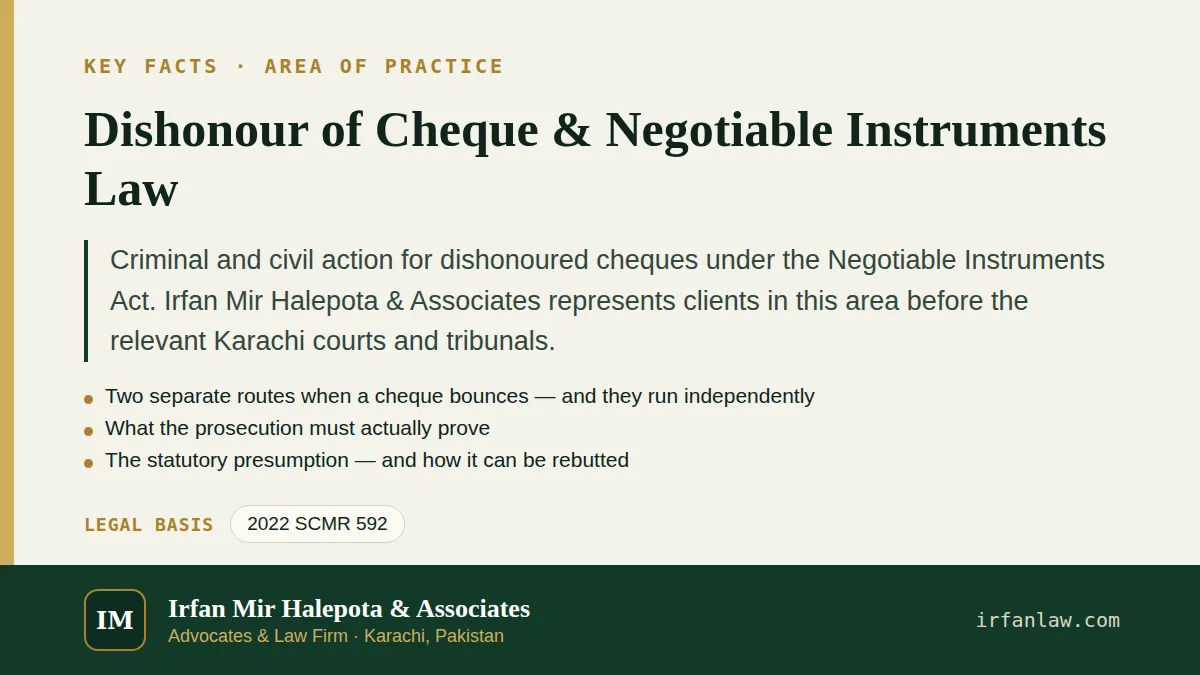
A dishonoured cheque in Pakistan isn't just a banking inconvenience — it's a criminal offence under Section 489-F of the Pakistan Penal Code, alongside civil recovery options under the Negotiable Instruments Act, 1881. We act for payees pursuing both the criminal complaint and civil recovery of the amount owed, and for account holders defending against complaints where the dishonour doesn't actually meet the legal threshold for a criminal offence.
What this covers
- Criminal complaints under Section 489-F PPC for dishonoured cheques
- Civil recovery suits on the underlying debt
- Defending account holders against cheque dishonour complaints
- Notice drafting and pre-litigation demand procedure
- Cheque-related disputes arising from commercial and loan transactions
Where we appear
- Sessions & Magistrate Courts (criminal complaint)
- Banking Courts / Civil Courts (recovery)
- High Court of Sindh (appeals)
- Supreme Court of Pakistan (further appeal)
Forum selection and limitation periods are often decided in the first conversation about a matter — the earlier we're involved, the more options remain open.
Two separate routes when a cheque bounces — and they run independently
A dishonoured cheque in Pakistan gives rise to two distinct remedies that can be pursued together, not as alternatives:
- Criminal complaint under Section 489-F, Pakistan Penal Code — aimed at punishing dishonest issuance of a cheque, not primarily at recovering the money. Conviction can carry imprisonment up to three years, a fine, or both.
- Civil suit for recovery — filed under summary procedure in Order XXXVII of the Code of Civil Procedure, which bypasses much of the normal procedural delay specifically because negotiable instruments carry a statutory presumption in the holder's favour.
Courts have confirmed these run on separate tracks: acquittal or conviction under Section 489-F does not determine the civil recovery claim, and the civil claim can proceed to judgment independently of how the criminal complaint concludes.
What the prosecution must actually prove
The Sindh High Court has set out four ingredients of Section 489-F: dishonest issuance of the cheque, that it was issued for repayment of a loan or discharge of a liability, that it was dishonoured, and that the dishonour was the fault of the accused rather than the bank. Reported authority is consistent that mere dishonour does not automatically create criminal liability — dishonest intention at the time of issuance is the element that must be established, not merely the fact that the cheque bounced.
The statutory presumption — and how it can be rebutted
Section 118 of the Negotiable Instruments Act, 1881 creates a presumption that a cheque was issued for consideration and in discharge of a valid debt. This presumption favours the holder from the outset, but it is rebuttable — the accused can displace it with cogent evidence, such as showing the cheque was given as security rather than payment, or that no debt or liability actually existed.
The six-month "stale cheque" rule
A cheque presented more than six months after its date is generally treated as stale or out of date, and a bank is not obliged to honour it. Reported Sindh High Court authority has gone further: where a complainant knowingly presented a stale cheque merely to found a Section 489-F complaint, this weighed in favour of the case being treated as one of further inquiry and pre-arrest bail being confirmed — timing the presentation carefully matters on both sides of these disputes.
Notice and timeline before filing
Before a complaint or suit is filed, a legal notice is ordinarily issued to the drawer following the bank's dishonour intimation, demanding payment within a stated period. Only once that period lapses without payment does the cause of action for prosecution or suit properly mature — filing prematurely, before this notice period has run, is a common defect that can undermine an otherwise strong case.
Bail in Section 489-F matters
The Supreme Court has addressed the parameters for bail in Section 489-F cases (Abdul Saboor v. State, 2022 SCMR 592), and reported authority has confirmed that where dishonest intention is genuinely disputed — for example, on evidence the cheque was security rather than payment, or was presented stale — the matter is treated as one requiring further inquiry, which is generally favourable to a bail application.
Common questions
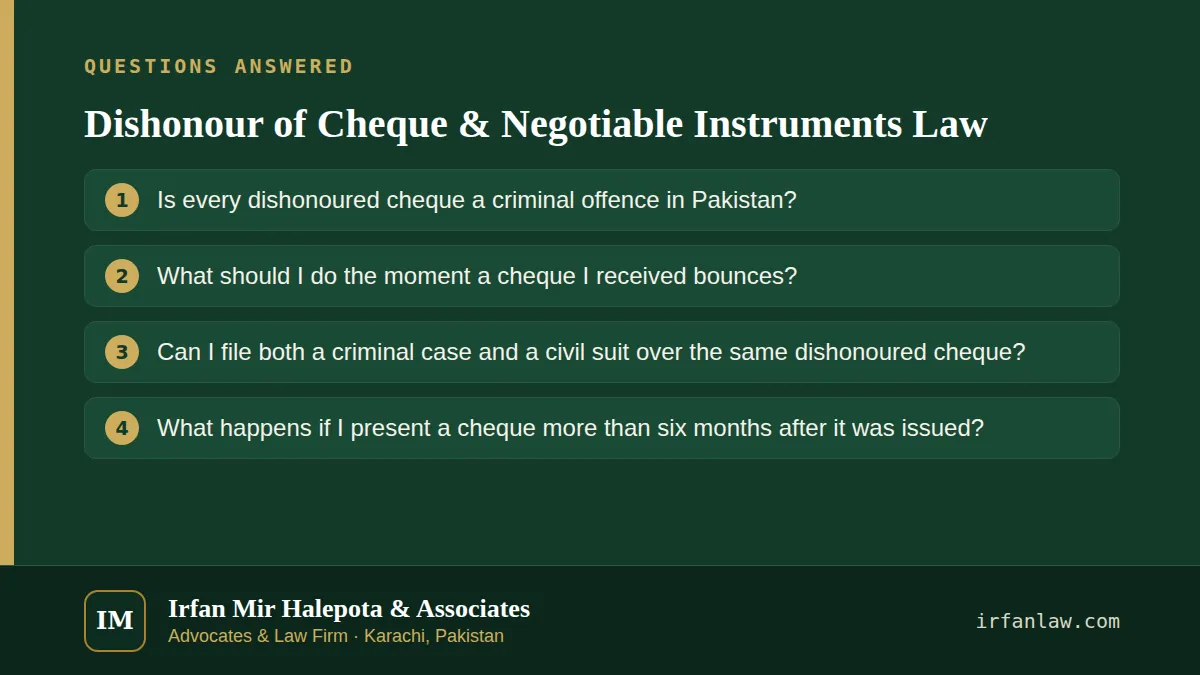
Is every dishonoured cheque a criminal offence in Pakistan?
No. Section 489-F of the Pakistan Penal Code applies where a cheque is issued dishonestly towards repayment of a loan or fulfilment of an obligation and is then dishonoured. Mere dishonour is not enough: a cheque bounced by a genuine account problem, or given as security rather than payment, does not automatically support a conviction. We check these elements before advising whether a criminal complaint is actually available.
What should I do the moment a cheque I received bounces?
Keep the cheque and the bank's dishonour memo, then decide the route. Section 489-F of the Pakistan Penal Code does not require a legal notice before a criminal complaint, but a written demand for payment is still useful evidence of the debt and of the drawer's intention. Recovering the money is a separate civil claim, usually a summary suit under Order XXXVII of the Code of Civil Procedure. We advise which route, or both, fits before anything is filed.
Can I file both a criminal case and a civil suit over the same dishonoured cheque?
Yes. The Section 489-F PPC criminal complaint and a civil recovery suit under Order XXXVII CPC proceed independently — the outcome of one does not determine the other, and pursuing both is common practice rather than an either/or choice.
What happens if I present a cheque more than six months after it was issued?
It is generally treated as stale or out of date, and the bank is not obliged to honour it. Courts have gone further and treated deliberate presentation of a known stale cheque, purely to found a criminal complaint, as a factor favouring the accused at the bail stage.
Who is the best lawyer in Karachi for cheque dishonour cases?
The best lawyer for a Section 489-F matter understands that mere dishonour is not automatically criminal — dishonest intention at issuance must be proven — and can pursue the criminal complaint and the civil recovery suit as the two independent tracks they actually are.
Follow us on Google
If this guide is useful, add this site as a preferred source. Google will then show it more prominently to you in Search, Discover and AI results.
Related areas of practice
- Civil LitigationContract, commercial and property disputes carried from plaint to appeal.→
- Criminal LitigationRepresentation from the first FIR through trial, bail and appeal.→
- Corporate & Commercial LawFormation, governance, contracts and disputes for companies operating in Pakistan.→
- Family LawCourt marriage, divorce and khulla, custody, guardianship and maintenance.→
Speak with an advocate about dishonour of cheque & negotiable instruments law
Tell us the facts of your matter and we'll advise on forum, timeline and next steps before you commit to anything.
Book a consultationOfficial sources