Property Sale Agreement: What It Must Contain
Most property litigation traces back to what the agreement to sell left out. Getting the description, payment schedule, possession terms and default consequences right at the drafting stage costs a fraction of litigating them later.
An agreement to sell (bay’ana) is where most property disputes are either prevented or created. By the time parties are in court over specific performance or forfeited earnest money, the answer usually turns on wording that took ten minutes to get wrong.
What the agreement must actually contain
- Precise description of the property — plot number, block, scheme, measurement, boundaries. A vague description is a defence to specific performance.
- Full consideration and the payment schedule — each instalment, each date, and what constitutes payment (cheque clearance, not delivery).
- Earnest money — the amount, and expressly what happens to it on default by either side.
- Time for performance, and whether time is of the essence. This single phrase changes the legal consequences of delay materially.
- Possession — when it passes, and whether the buyer takes possession before or only on completion.
- Who bears what — stamp duty, registration charges, society transfer fees, outstanding utilities and taxes.
- Seller’s warranties — clear title, no encumbrance, no pending litigation, no prior agreement to sell.
- Default consequences for both parties, not just the buyer.
Earnest money and forfeiture — how courts actually treat it
Reported Sindh High Court authority (2020 CLC 300) confirms that advance or earnest money can be forfeited where a purchaser fails to fulfil contractual commitments — but the court retains discretion to interpret and implement forfeiture clauses. Forfeiture is therefore not automatic simply because a clause says so; how the clause is drafted, and the proportionality of the amount, both matter.
On damages more generally, Section 74 of the Contract Act, 1872 provides for liquidated damages, but reported authority is clear that these are granted only where the claimant proves default or breach. Under Section 73, a claimant must lead positive evidence of loss; a damages figure written into the agreement does not by itself establish entitlement.
The clause buyers most often omit
A restraint on the seller creating third-party interests — further agreements to sell, mortgages, or transfers — during the currency of the agreement. Without it, a buyer who has paid substantial earnest money discovers the property has been sold onward, and is left chasing a remedy rather than the property.
Registration and stamp duty
An agreement to sell is not itself a conveyance; title passes on the registered sale deed. But the agreement’s treatment under the Registration Act, 1908 and applicable stamp requirements should be settled at the outset rather than assumed, particularly where possession is being delivered at the agreement stage.
Before signing — verify, don’t assume
- Chain of title against revenue or society records, not just the documents presented
- Whether any litigation is pending on the property
- Seller’s identity and authority — particularly where a power of attorney is being used
- Outstanding dues, and whether the property is mortgaged
If the agreement is already signed and the seller is refusing to complete, see our guide to specific performance. If a transfer is threatened, a stay order may need to come first.
Common questions
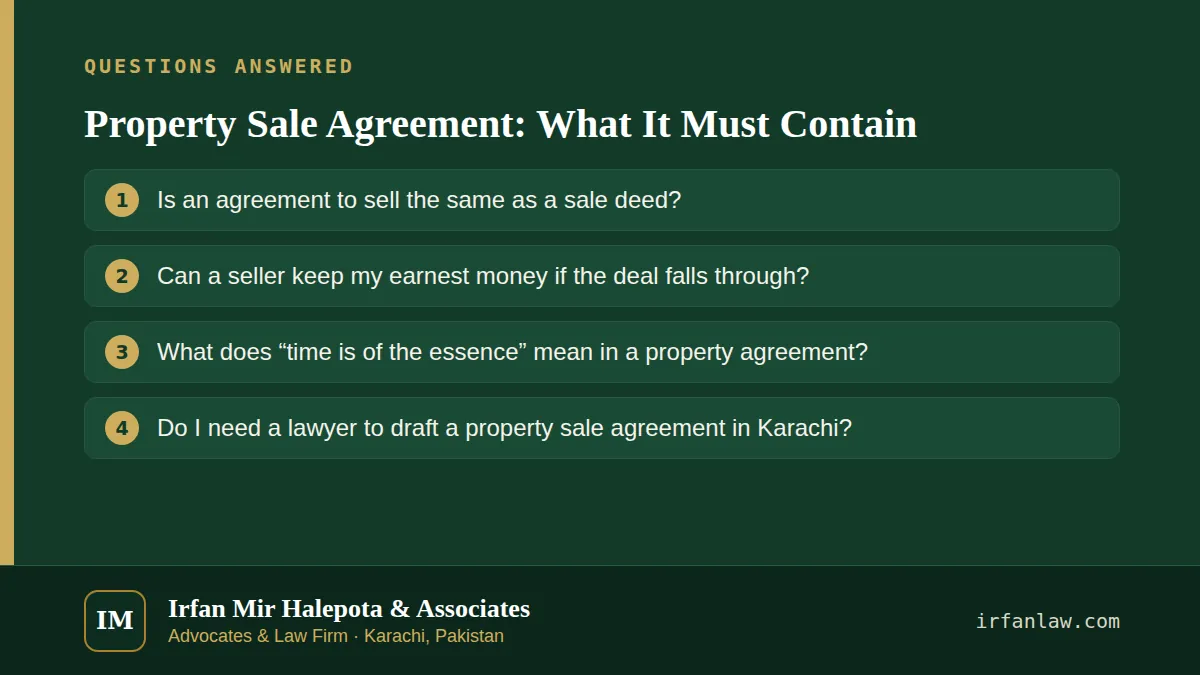
Is an agreement to sell the same as a sale deed?
No. An agreement to sell records the parties’ commitment to complete a sale on agreed terms; title passes only on the registered sale deed. An agreement to sell does not by itself transfer ownership.
Can a seller keep my earnest money if the deal falls through?
It depends on why it fell through and how the clause is drafted. Sindh High Court authority confirms earnest money can be forfeited where the purchaser fails to fulfil contractual commitments, but the court retains discretion to interpret and implement forfeiture clauses — so forfeiture is not automatic merely because the agreement says so.
What does “time is of the essence” mean in a property agreement?
It makes the completion date a fundamental term rather than an indicative one, so that failure to perform by that date is itself a breach entitling the other side to treat the agreement as at an end. Whether the phrase appears materially changes the consequences of delay, which is why it should be a deliberate choice rather than boilerplate.
Do I need a lawyer to draft a property sale agreement in Karachi?
It is worth it even where both parties are agreed and cooperative. The clauses that decide later disputes — property description, forfeiture terms, restraint on onward sale, who bears which charges — are cheap to get right at drafting and expensive to litigate afterwards.
Can I claim damages written into the agreement automatically?
No. Under Section 74 of the Contract Act, 1872 liquidated damages are granted only where default or breach is proved, and under Section 73 a claimant must lead positive evidence of loss. A figure in the agreement does not by itself establish entitlement to it.