Breach of Contract in Pakistan: Your Remedies
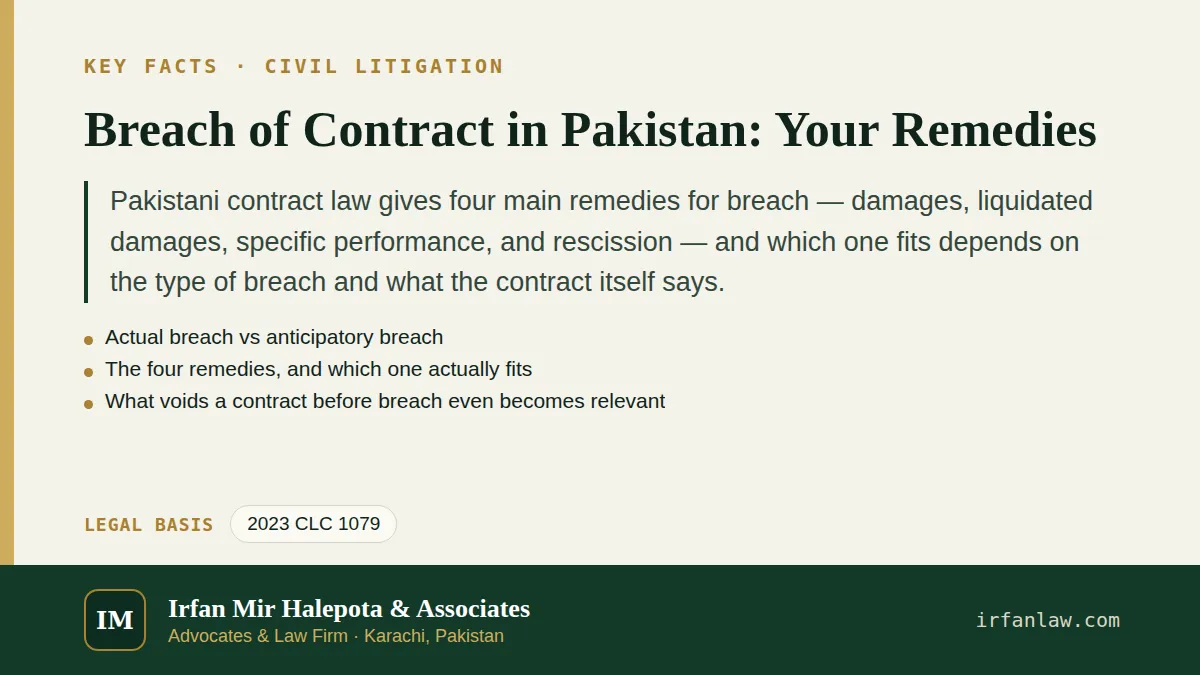
Pakistani contract law gives four main remedies for breach — damages, liquidated damages, specific performance, and rescission — and which one fits depends on the type of breach and what the contract itself says.
A breach of contract in Pakistan is governed by the Contract Act, 1872, and the remedy that fits depends heavily on which kind of breach you're dealing with and what the contract itself says about consequences. Getting this choice right at the outset matters — suing for the wrong remedy wastes the time a genuine claim needed.
Actual breach vs anticipatory breach
- Actual breach — a party simply fails to perform by the agreed date. A seller doesn't deliver, a contractor abandons the project midway.
- Anticipatory breach — a party indicates, before the performance date arrives, that they will not perform. This lets the innocent party act immediately rather than waiting for the deadline to pass.
The four remedies, and which one actually fits
1. Unliquidated damages — Section 73
Section 73 entitles the injured party to compensation for loss that arose naturally from the breach, or that both parties knew was likely at the time of contracting. This is the default remedy where the contract says nothing about what happens on breach. The claimant must provide positive evidence of actual loss — courts do not award damages on the strength of the breach alone.
2. Liquidated damages — Section 74
Where the contract itself specifies a sum payable on breach, Section 74 applies instead. Pakistani courts award reasonable compensation not exceeding the stated amount, whichever way the clause was drafted. Critically, a clause that operates as a penalty rather than a genuine pre-estimate of loss is void — in Habib Construction (2024 PLD 552), the court upheld a liquidated damages clause specifically because the agreed amount reasonably compensated the breach, while making clear that penalty clauses do not survive scrutiny.
3. Specific performance
Available where monetary compensation would be inadequate — most commonly in property transactions, since land is treated as unique. The claimant must show readiness and willingness to perform their own obligations throughout. See our detailed guide to specific performance where a seller won't complete a sale for the property-specific procedure.
4. Rescission and injunction
Rescission cancels the contract and restores both parties to their pre-contract position, appropriate where continuing the contract makes no sense. An injunction restrains a party from a specific act — useful where the harm from a threatened breach is more urgent than damages could address after the fact.
What voids a contract before breach even becomes relevant
Not every agreement is enforceable to begin with. Under Sections 23 and 26, an agreement involving illegal or immoral consideration is void from the outset. In Abdul Sattar v. Abdullah (2023 CLC 1079), an oral property agreement structured around an exchange involving a bride was held void as against public policy — a reminder that legality of consideration is checked before any breach analysis is even relevant.
Earnest money and forfeiture in property contracts
A recurring dispute: can a seller keep the buyer's advance payment when the buyer defaults? Reported authority confirms earnest money can be forfeited where a purchaser fails to fulfil their contractual commitments, but courts retain discretion in interpreting and applying forfeiture clauses — a forfeiture clause is not automatically enforced exactly as written regardless of the circumstances.
Whether time is "of the essence"
Section 55 determines whether a missed deadline itself constitutes breach, or merely entitles the other party to compensation for delay. Whether time was intended to be essential is assessed from the parties' actual intention at the time of contracting, not asserted after the fact — which is why the wording of the contract's time provisions matters more than most parties realise when drafting.
Building the claim
- Identify the specific obligation breached and the relevant clause
- Check for a liquidated damages or dispute-resolution clause before assuming Section 73 applies
- Gather contract copies, communications, payment proof and delivery records
- Send a notice to perform or compensate before filing, where the situation allows time for it
- Choose the remedy that fits the breach — damages, specific performance, rescission or injunction — rather than defaulting to whichever is most familiar
Common questions
What's the difference between Section 73 and Section 74 damages?
Section 73 covers ordinary compensation for actual loss, which the claimant must prove with positive evidence. Section 74 applies where the contract itself specifies a sum payable on breach — courts award reasonable compensation up to that stated amount, but a clause structured as a penalty rather than a genuine pre-estimate of loss is void.
Can I sue for breach of contract without proving actual loss?
Under Section 73, no — you must provide positive evidence of the loss you actually suffered. Where the contract specifies liquidated damages under Section 74, courts have historically taken different approaches to whether actual loss must still be shown, so the position depends on how your specific clause is drafted.
Can a seller keep my advance payment if I can't complete the purchase?
Potentially yes. Reported authority confirms earnest money can be forfeited where a purchaser fails to fulfil their contractual commitments, though courts retain discretion in interpreting forfeiture clauses rather than enforcing them automatically as written.
What is anticipatory breach and why does it matter?
It's where a party indicates before the performance date that they won't perform. It matters because it lets you act immediately — seeking a remedy or making alternative arrangements — rather than waiting for the deadline to formally pass before treating the contract as breached.
Is an oral contract enforceable in Pakistan?
Generally yes, subject to the same requirements as any contract under the Contract Act, 1872 — but proving its terms becomes considerably harder without documentation, and some categories of agreement have specific consideration and legality requirements that oral arrangements can fall foul of, as reported case law involving void oral property agreements illustrates.
More insights
- Specific Performance: Seller Won't Complete SaleCivil Litigation · The property-specific remedy in detail.→
- Due Diligence Checklist: Buying a BusinessCorporate & Commercial · Catching contract risk before you sign.→
- Shareholder Agreement EssentialsCorporate & Commercial · Drafting to prevent disputes.→
- Recovery Suit Timeline in PakistanCivil Litigation · How long a money recovery suit actually takes.→