Arbitration & Alternative Dispute Resolution
Domestic and international arbitration, and negotiated settlement of commercial disputes. Irfan Mir Halepota & Associates represents clients in this area before the relevant Karachi courts and tribunals.
Arbitration clauses are common in Pakistani commercial contracts, but the process only works in a client's favour when it's handled with the same rigour as litigation — proper notice, careful selection of arbitrators, and disciplined evidence. We represent clients in arbitral proceedings and in the enforcement or challenge of resulting awards, and we act as mediators and negotiators where a settled outcome serves the client better than a prolonged dispute.
What this covers
- Domestic arbitration under the Arbitration Act, 1940
- International arbitration and enforcement of foreign awards
- Drafting and reviewing arbitration clauses
- Mediation and negotiated settlement
- Challenge and enforcement proceedings before the High Court
Where we appear
- Arbitral tribunals (ad hoc and institutional)
- High Court of Sindh (Arbitration matters)
- International arbitration centres
- Supreme Court of Pakistan (further appeal in arbitration matters)
Forum selection and limitation periods are often decided in the first conversation about a matter — the earlier we're involved, the more options remain open.
Official sources
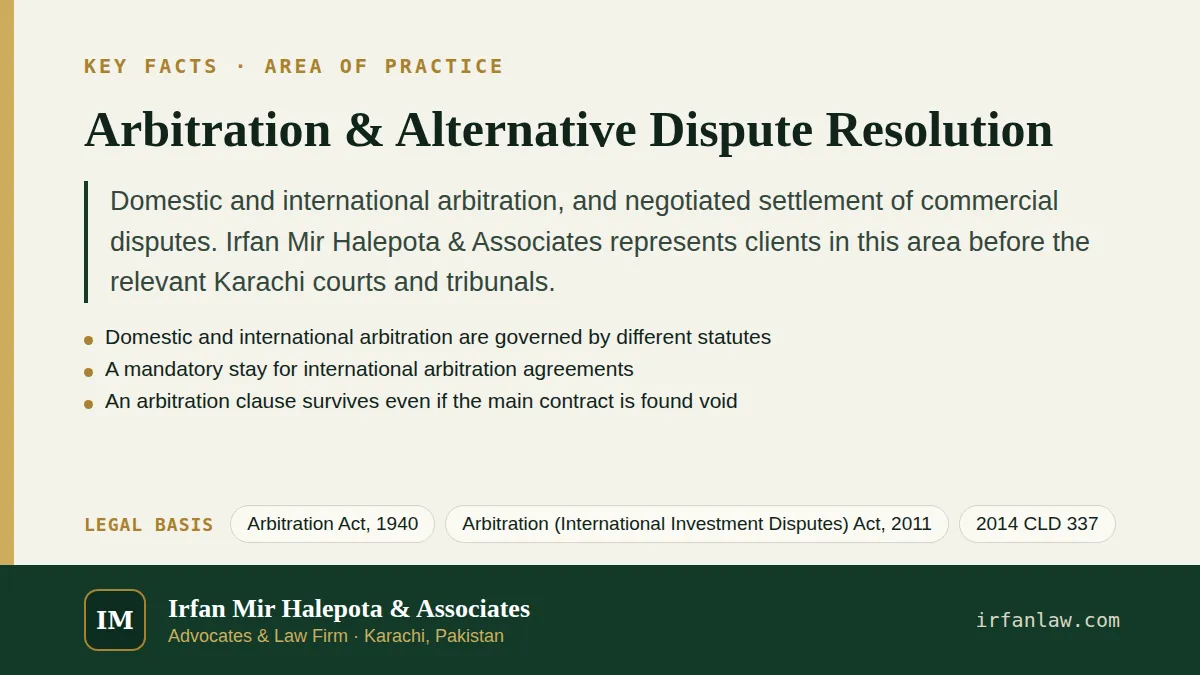
Domestic and international arbitration are governed by different statutes
This is the first thing to establish in any arbitration matter, because it changes which court has jurisdiction and what grounds are available to challenge an award.
- Domestic arbitration — governed by the Arbitration Act, 1940, colonial-era legislation that remains the operative framework for domestic agreements, procedure and awards. See our dedicated page on challenging an arbitral award for the Section 30 grounds.
- Foreign arbitral awards — governed by the Recognition and Enforcement (Arbitration Agreements and Foreign Arbitral Awards) Act, 2011, which gives effect to the New York Convention. The 1940 Act does not apply to a foreign arbitration agreement.
- Investment disputes — the Arbitration (International Investment Disputes) Act, 2011 implements Pakistan's ICSID obligations separately again.
A mandatory stay for international arbitration agreements
Where parties have agreed to international arbitration, the 2011 Act provides for a mandatory stay of any civil suit brought in breach of that agreement. In Metropolitan Steel Corporation Ltd v Macsteel International Ltd (PLD 2006 Karachi 664), the Sindh High Court held it could not refuse to stay proceedings on public policy or forum non conveniens grounds where the 2011 Act applied — the pro-arbitration policy is treated as close to absolute.
An arbitration clause survives even if the main contract is found void
Pakistani courts recognise the doctrine of separability: an arbitration clause is treated as a separate agreement from the contract it sits inside, and survives termination or invalidity of the main contract. This was established in Sezai Turkes Feyzi Akkaya Construction Company v Messrs Crescent Services (1997 SCMR 1928), and applied by the Sindh High Court in Lakhra Power Generation Company Ltd v Karadeniz Powership Kaya Bey (2014 CLD 337) — where the arbitration agreement was upheld as valid even though the Supreme Court had, in related proceedings, found the main contract void for having been awarded unlawfully. A party cannot escape an arbitration clause simply by attacking the validity of the contract around it.
Once a foreign award is made, challenging it in Pakistan is very narrow
In Cynergyico Pk Limited v Trafigura PTE Limited (2023 SHC KHI 374), the Sindh High Court refused to entertain a suit seeking to set aside a foreign arbitral award, citing its earlier decision in Abdullah (PLD 2014 Sindh 349, sometimes referenced as the CNAN case) for the proposition that an award-debtor has no route to a declaratory suit challenging a foreign award's validity — objections must be raised within the narrow framework of the 2011 Act and the New York Convention itself, at the enforcement stage.
Enforcement of foreign awards in Pakistan is, in practice, readily granted. In Ovex Technologies (Private) Ltd v National Highway Authority ([2023] CLD 1365), the Islamabad High Court enforced an interim award issued by a Paris-seated tribunal, dismissing NHA's resistance to recognition.
Interim relief pending arbitration
A party can seek interim relief from the civil court while arbitration is pending, but the Sindh High Court has held (Pakistan Airline Pilots' Association v Federation of Pakistan, 2021 PLC(CS) 860) that this jurisdiction is available to a party who has conceded to and expressed willingness to proceed to arbitration — typically through an application under Section 20 of the 1940 Act for reference of the dispute. Interim relief is not a route for a party who is simultaneously resisting arbitration.
Common questions
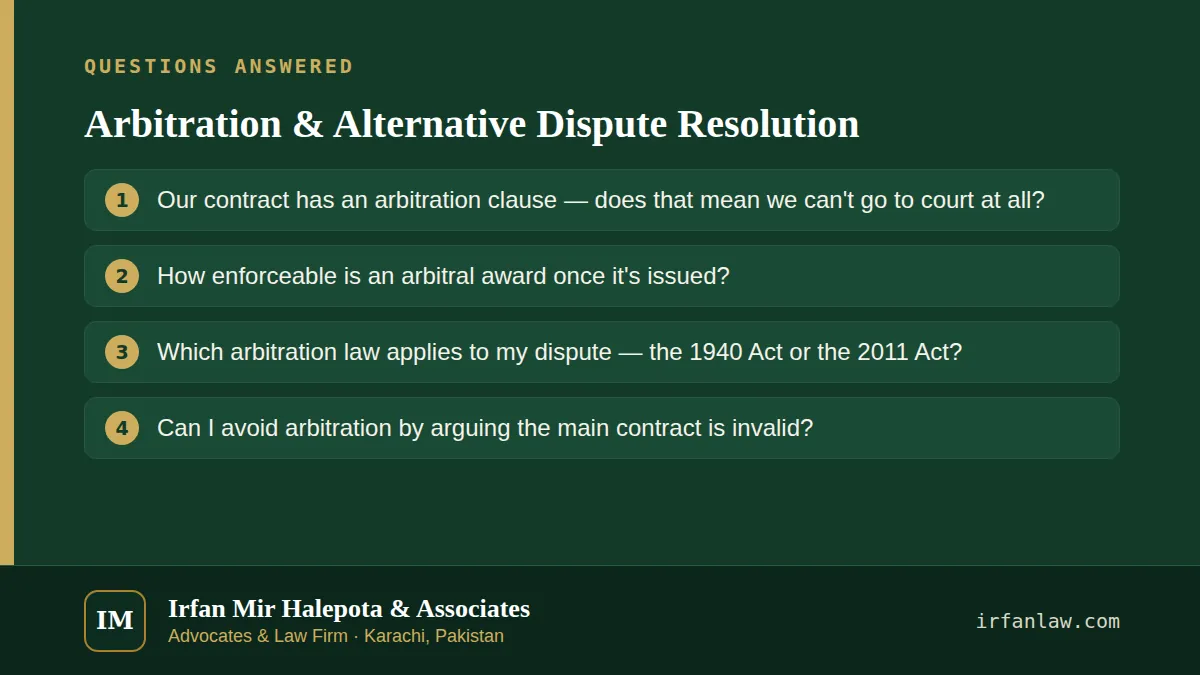
Our contract has an arbitration clause — does that mean we can't go to court at all?
Generally yes for the dispute covered by the clause; courts will typically refer the parties to arbitration if one side tries to litigate instead. Certain interim relief may still be available from the courts pending the arbitration.
How enforceable is an arbitral award once it's issued?
A domestic award is enforceable much like a court decree once it's made a rule of court; foreign awards are enforced under the New York Convention, subject to narrow statutory challenges we'd assess against your specific award.
Which arbitration law applies to my dispute — the 1940 Act or the 2011 Act?
It depends on whether the arbitration agreement is domestic or international. Purely domestic agreements, procedure and awards fall under the Arbitration Act, 1940. Foreign arbitration agreements, and recognition and enforcement of foreign awards, fall under the Recognition and Enforcement (Arbitration Agreements and Foreign Arbitral Awards) Act, 2011, which implements the New York Convention — the 1940 Act does not apply to a foreign arbitration agreement at all.
Can I avoid arbitration by arguing the main contract is invalid?
Generally no. Pakistani courts apply the doctrine of separability — an arbitration clause is treated as a distinct agreement from the contract it sits within, and survives even where the main contract is later found void. The Sindh High Court applied this in Lakhra Power Generation Company Ltd v Karadeniz Powership Kaya Bey (2014 CLD 337).
Can I challenge a foreign arbitral award in a Pakistani court?
The route is very narrow. In Cynergyico Pk Limited v Trafigura PTE Limited (2023 SHC KHI 374), the Sindh High Court held there is no route to a declaratory suit challenging a foreign award's validity — objections must be raised within the framework of the 2011 Act itself, typically when enforcement is sought, not through separate civil proceedings.
Who is the best arbitration lawyer in Karachi?
The best arbitration counsel knows whether your agreement is domestic (governed by the 1940 Act) or international (governed by the 2011 Act implementing the New York Convention) before advising on strategy, since the grounds for challenging an award differ sharply between the two regimes.
Follow us on Google
If this guide is useful, add this site as a preferred source. Google will then show it more prominently to you in Search, Discover and AI results.
Related areas of practice
- Civil LitigationContract, commercial and property disputes carried from plaint to appeal.→
- Criminal LitigationRepresentation from the first FIR through trial, bail and appeal.→
- Corporate & Commercial LawFormation, governance, contracts and disputes for companies operating in Pakistan.→
- Family LawCourt marriage, divorce and khulla, custody, guardianship and maintenance.→
Speak with an advocate about arbitration & alternative dispute resolution
Tell us the facts of your matter and we'll advise on forum, timeline and next steps before you commit to anything.
Book a consultation