How to Become an Advocate in Pakistan: Pupillage & Bar Council Enrolment
Enrolment as an advocate in Pakistan requires five things in sequence: an LL.B, six months of pupillage under a senior advocate of at least ten years’ standing, the LAW-GAT exam, a viva voce, and formal enrolment with the Bar Council.
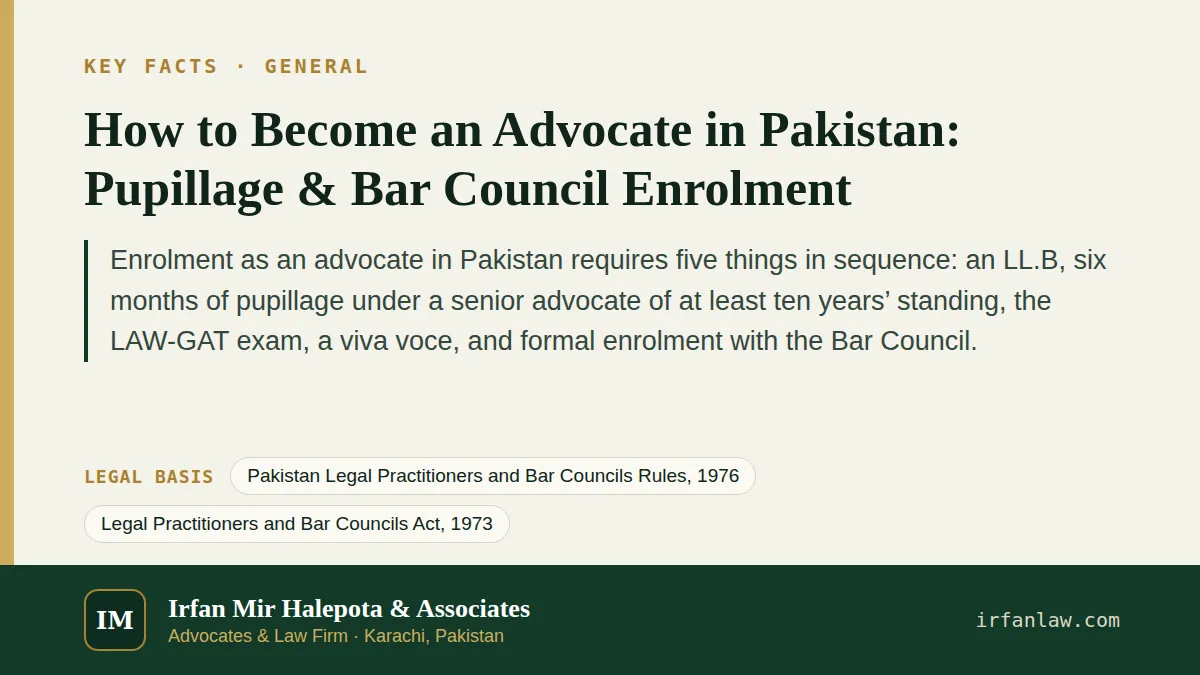
Becoming a practising advocate in Pakistan is not a single exam — it is a sequence of distinct requirements under the Legal Practitioners and Bar Councils Act, 1973 and the Pakistan Legal Practitioners and Bar Councils Rules, 1976, and missing the order of them is the most common way graduates lose months.
The five requirements, in the order they actually need to happen
- 1. An LL.B from a recognised university. The degree must be from an institution accredited by the Pakistan Bar Council, and your academic record needs to be verifiable through the Higher Education Commission before a Bar Council will process your application.
- 2. Six months of pupillage. Under Rule 108C of the 1976 Rules, every applicant (with narrow exceptions) must complete a continuous six-month period of training in the chambers of an advocate who has himself practised for not less than ten years. During this period you must assist on a minimum of ten cases. At the end, your senior signs a Form B certificate of training, without which the Bar Council will not proceed.
- 3. The Law Graduate Assessment Test (LAW-GAT). A written qualifying examination requiring a minimum 50% score, which must be cleared within two and a half years and four attempts of becoming eligible. This runs independently of pupillage — many graduates complete both in parallel.
- 4. The viva voce. An oral examination before the Provincial Bar Council, held after LAW-GAT is cleared and the pupillage certificate is filed.
- 5. Enrolment and the identity card. Once all of the above are satisfied, the Bar Council places your name on the roll and issues a certificate of enrolment and an identity card carrying your roll number — only at this point are you entitled to use the title "Advocate."
Choosing a senior for pupillage
Not every practising lawyer can take a pupil. The Rules require the senior to have been entitled to practise for at least ten years, and most Bar Councils cap how many pupils a single advocate can train at once — commonly no more than three. Before approaching a chamber, confirm the senior meets this threshold, since a certificate signed by someone who does not qualify will simply be rejected at enrolment.
What matters during the six months is less about the paperwork and more about what you are exposed to: drafting under supervision, court attendance, genuine involvement in case preparation rather than administrative work. A pupillage that produces ten cases' worth of real drafting and court experience puts you in a materially stronger position afterward than one that produces ten cases' worth of file-carrying.
The paperwork the Bar Council will ask for
- Verified academic transcripts, matriculation through LL.B, via HEC
- The Form B certificate of training from your pupillage senior
- Two character certificates from advocates of at least ten years' standing
- An affidavit addressing any gap between your academic examinations and your enrolment application
- A character and conduct certificate from any prior employer
- An affidavit disclosing any criminal or professional-misconduct proceedings, in any country
- An undertaking to join a Bar Association within six months of enrolment
- Prescribed enrolment fees to both the Pakistan Bar Council and the relevant Provincial Bar Council
Provincial rules add some local variation — the Islamabad Bar Council and Punjab Bar Council, for instance, use their own versions of the intimation and training-certificate forms — so the exact document set should be confirmed against the specific Bar Council you are enrolling with.
After enrolment: the classes of advocate
Enrolment as an Advocate is the first tier, entitling you to practise before the District and Sessions Courts. Practising before a High Court and, later, the Supreme Court requires separate applications and additional standing, each with its own eligibility period. The Supreme Court Bar Association additionally requires membership within six months of admission as an Advocate of the Supreme Court.
How this differs from a law firm internship
Pupillage is a legal requirement tied to enrolment; a firm internship is not. Students and recent graduates who intern before completing their LL.B, or before starting pupillage, are gaining general exposure — drafting, research, court attendance — without it counting toward the six-month pupillage requirement, which specifically requires you to already hold your degree. See our internship programme for that separate opportunity.
Common questions
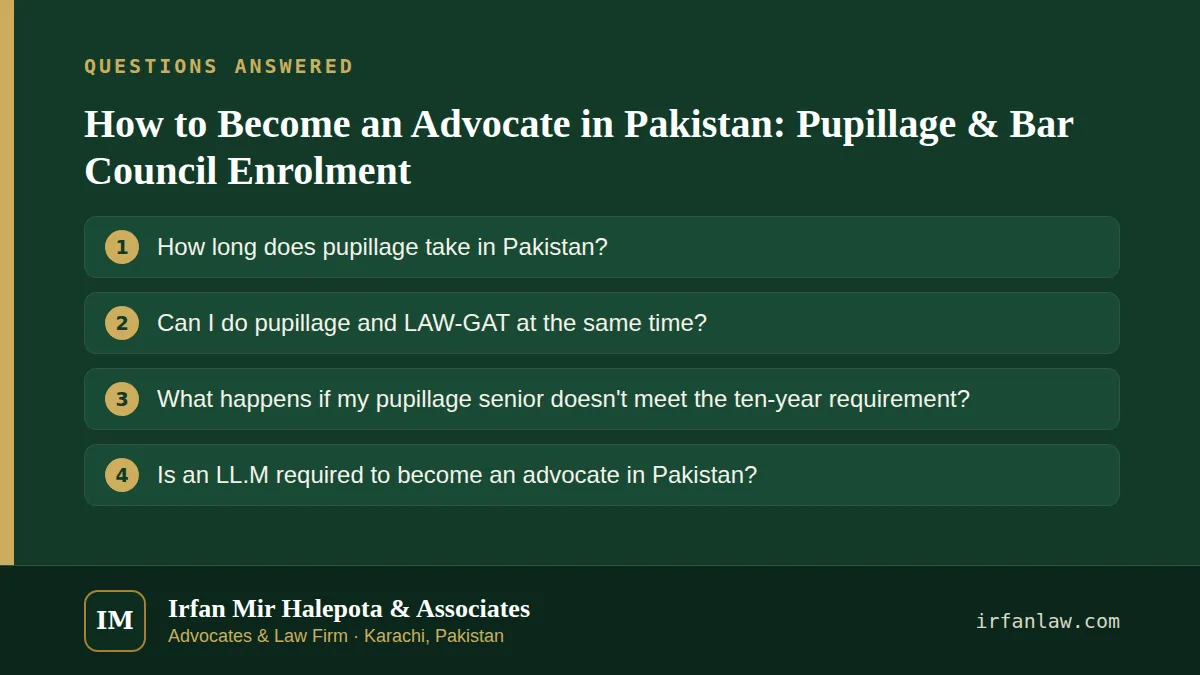
How long does pupillage take in Pakistan?
Six months, continuous, under Rule 108C of the Pakistan Legal Practitioners and Bar Councils Rules, 1976. It must be undertaken with an advocate who has practised for at least ten years, and you must assist on a minimum of ten cases during that period.
Can I do pupillage and LAW-GAT at the same time?
Yes, and most candidates do. Pupillage and the Law Graduate Assessment Test are separate requirements that run on independent tracks — LAW-GAT must be cleared within two and a half years and four attempts of becoming eligible, which often overlaps with the pupillage period rather than following it.
What happens if my pupillage senior doesn't meet the ten-year requirement?
The Bar Council will not accept the Form B training certificate, and your enrolment application will be rejected on that basis alone regardless of the training you actually received. Confirm your senior's standing before beginning pupillage, not after completing it.
Is an LL.M required to become an advocate in Pakistan?
No. An LL.B is the standard route, followed by pupillage, LAW-GAT and the viva voce. Holders of an LL.M from a recognised Pakistani institution have historically had a different pathway available under the Rules, but this should be confirmed against the current Rules for the relevant Bar Council rather than assumed.
What's the difference between an Advocate and an Advocate of the High Court?
Advocate is the first tier of enrolment, entitling practice before the District and Sessions Courts. Advocate of the High Court is a separate, later application requiring additional standing as an Advocate first — it does not happen automatically at the same time as initial enrolment.
More insights
- How to Choose a Lawyer in KarachiGeneral · What to check before hiring, and warning signs.→
- Departmental Appeals in KarachiCivil Service · Exhausting the departmental remedy before the Service Tribunal.→
- Service Tribunal Wrongful Termination AppealsCivil Service · How Service Tribunals handle these cases.→